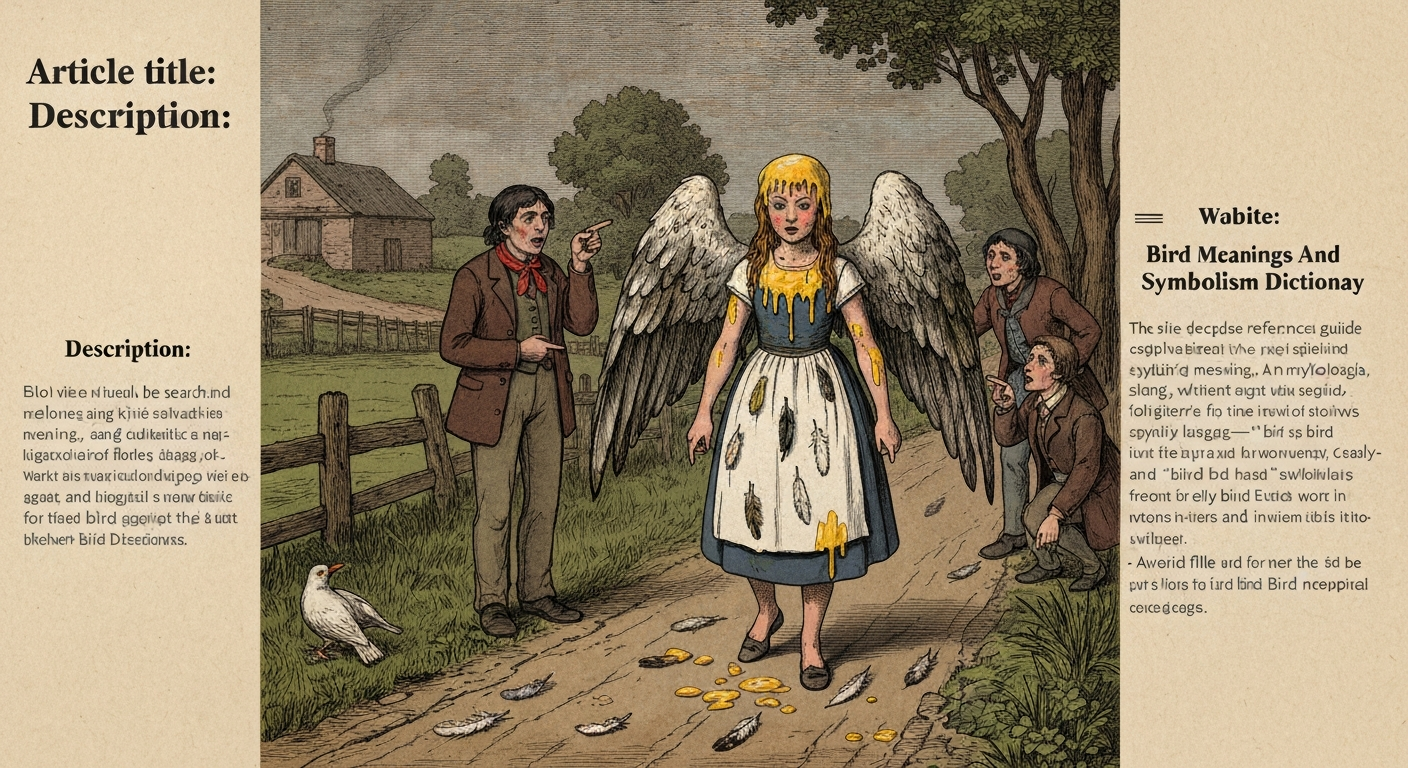
"Fitcher's Bird" is a folkloric motif and fairy tale collected by the Brothers Grimm (KHM 46, first published 1812 under the German title "Fitchers Vogel") in which a young woman disguises herself with honey and feathers to escape a sorcerer, and is addressed on the road as "Fitcher's Bird." The name almost certainly refers to a disguised human in bird-form rather than any single identifiable species, though the Grimms' own annotations link the word "Fitcher" to the Icelandic fitfuglar, meaning a web-footed water bird. Symbolically, the motif stands for transformation, feminine agency, and survival through cunning, sitting within tale-type ATU 311 ("The heroine rescues herself and her sisters").
Fitcher's Bird Meaning: Symbolism, Origins, and Practical Guide

Marcus Blackwell
11 Aug 2026
What the Grimms' Tale Actually Says
The plot of "Fitcher's Bird" is compact and unsettling. A sorcerer travels from house to house as a beggar, and when women touch his basket they are magically compelled to follow him home. He captures three sisters in succession. Each time, he hands the captive woman an egg and a key, tells her she may explore the entire house except for one forbidden chamber, and then leaves. The first two sisters break the prohibition, discover a chamber full of dismembered bodies, drop and stain the egg (which cannot be cleaned), and are killed and dismembered in turn when the sorcerer returns. The youngest sister sets the egg safely aside before she enters the chamber, cleans up and reassembles her sisters' bodies (which miraculously revive), hides the sisters in a basket covered with gold, and commands the sorcerer himself to carry it home without resting. She then covers herself from head to toe with honey and feathers, walks out of his house looking like an extraordinary bird, and is greeted along the road by the remark that she must be "Fitcher's bird." Her family, forewarned by a coded message she has sent home, burns the sorcerer's house with him inside while she escapes.
Three things are worth noting about where the bird actually appears in the narrative. First, the bird-form is purely a disguise, not a magical transformation in the classic sense. Second, it is the heroine alone who engineers both her rescue and her sisters' rescue; the sorcerer never suspects her because she has passed his egg test. Third, the disguise is improvised from household materials rather than granted by any external power, which gives the motif a distinctly practical edge compared to other fairy-tale transformations.
Origins, Variants, and How the Name Developed
The tale was first printed in Volume 1 of Kinder- und Hausmärchen in 1812, and folklorists classify it under Aarne-Thompson-Uther (ATU) type 311. Uther’s The Types of International Folktales, Hans-Jörg Uther (publisher page) provides the current standard summary and bibliography for ATU 311 The Types of International Folktales — Hans-Jörg Uther (publisher page). The ATU type is broadly summarized as "The heroine rescues herself and her sisters," placing it alongside dozens of cognate tales from across Europe and the Mediterranean catalogued in Johannes Bolte and Jiří Polívka's Anmerkungen zu den Kinder- und Hausmärchen der Brüder Grimm (1913), which remains the principal comparative bibliography for KHM 46.
Close analogues appear in two particularly well-known collections. Peter Christen Asbjørnsen and Jørgen Moe's Norwegian "The Old Dame and Her Hen" shares the forbidden-room structure, and the Italian tale "How the Devil Married Three Sisters" preserves the rescue-by-chest device and a "false lookout" motif. Crucially, Bolte and Polívka note that the bird-disguise element is not universal across ATU 311 variants. In many Italian and Southern European versions it is absent or replaced by an alternative escape device, suggesting that the honey-and-feathers detail is a feature of certain German and Northern European branches of the tale rather than the archetype's defining mark.
As for the name itself: the blank" rel="noopener noreferrer">Grimms' own 1856 annotations explicitly cite the Icelandic term fitfuglar (fit-fuglar) as relevant to explaining "Fitcher." The Cleasby-Vigfusson Old Icelandic dictionary glosses fitfugl as a web-footed or water bird, which later commentators have summarized as something resembling a swan in whiteness. Alternative derivations connect the name to the Old High German fittich (wing) or the German Feder (feather), both of which tie the name more directly to the feathered disguise than to any specific species. Jack Zipes, in his standard contemporary translation The Complete Fairy Tales of the Brothers Grimm, and Maria Tatar in The Annotated Brothers Grimm both acknowledge that the word "Fitcher" is essentially untranslatable without some etymological guesswork, which is why English translators have largely left it alone rather than substituting a species name.
Which Real Bird Might "Fitcher" Describe?
Because the name resists clean translation, readers and scholars have proposed several candidate species. None is definitively correct, but each proposal has something to recommend it.
- Finch (family Fringillidae): Finches are the most commonly suggested small-bird identification, partly because the German word Fink (finch) sounds plausibly close to "Fitch" and partly because finches carry consistent folk symbolism around freedom, resourcefulness, and cheerful persistence that maps neatly onto the youngest sister's character. The symbolic meaning of the finch as a bird of resilience and clever adaptation makes it a tempting fit.
- Linnet or Green Finch: Both are small streaky European finches associated in folk tradition with song, domestic familiarity, and modest but persistent courage. If the honey-and-feathers disguise is meant to produce a mottled or streaky appearance, a linnet or greenfinch coloration is plausible. The green finch and linnet share overlapping symbolic weight around perseverance in constrained circumstances.
- Goldfinch: In medieval and early modern European iconography the goldfinch is heavily associated with souls, resurrection, and surviving mortal danger (it appears prominently in religious painting as a symbol of the Passion and resurrection). Given that the tale ends with the sisters literally returning from death, a goldfinch identification is symbolically compelling, even if phonetically it is a stretch.
- House Finch: Less likely as a Germanic folk identification (the house finch is primarily a North American species), but in modern symbolic interpretation it is often read as a bird of resourceful home-making and domestic courage, which aligns with the heroine's ingenuity inside the sorcerer's house.
- Canary: The canary's association with danger-detection (miners' canaries signaling deadly air) and captivity make it an interesting symbolic parallel to the imprisoned sisters, but its Mediterranean and Atlantic Island origins make it an unlikely folk-name source for a 19th-century German tale.
- Bunting (family Emberizidae): Buntings are small, often colorfully marked birds sometimes confused with finches in folk naming. Their symbolic associations with transformation and seasonal change (many are migratory) overlap with the tale's themes, though no specific scholarly identification of "Fitcher" with a bunting species has been made.
- Web-footed water bird (Grimms' own suggestion): The etymology the Grimms themselves favored points not to any finch at all but toward a pale, web-footed water bird (fitfugl), something swan-like or goose-like in appearance. This reading emphasizes the whiteness and strangeness of the disguise rather than the specific species.
The honest answer is that the tale probably never had a single real bird in mind. The heroine looks like "a strange bird" because she is covered in honey and feathers, and the name "Fitcher's Bird" is applied as a reaction of astonishment by passers-by, not as a careful ornithological label. The ambiguity is the point: she is unrecognizable, other, and free.
The Core Symbolic Themes
Transformation and Disguise
The honey-and-feathers costume is one of folklore's most striking improvised transformations. Unlike shape-shifting by spell or enchantment, the youngest sister changes herself through deliberate action. She does not become a bird; she makes herself look like one. That distinction matters symbolically. Her transformation is a performance of freedom rather than a magical gift, which is why this motif resonates so differently from, say, a swan maiden story where a woman is involuntarily given or stripped of a bird form. Thompson's Motif-Index records related motifs around birds carrying persons between worlds (F62) and egg-based test motifs (analogous to F403.2.1.1), but the honey-and-feathers disguise is comparatively rare in its deliberate, self-authored quality.
Deception as Moral Competence
In "Fitcher's Bird," deception is unambiguously heroic. The youngest sister lies by disguise, sends a secret coded message home through her sisters' basket, and tricks the sorcerer into carrying his own victims back to their family. The tale does not moralize against her cleverness; it rewards it. This is notably different from the Bluebeard tradition (ATU 312), where curiosity and deception are punished. In ATU 311, the heroine's cunning is the exact quality that saves her, which makes the tale unusually direct in validating women's strategic intelligence against male supernatural power.
Witchcraft and the Forbidden Chamber
The forbidden room is one of folklore's most durable motifs. Thompson's Motif-Index clusters related variants around V360-V364, and the room appears across ATU 311 and ATU 312 tales as a site of prohibited knowledge, death, and revelation. In "Fitcher's Bird" specifically, the room is less a test of obedience than a test of emotional self-control: the first two sisters fail not merely because they opened the door but because they could not control their reaction (dropping the stained egg is the tell). The youngest sister passes because she is methodical enough to set the egg aside before she enters. The sorcerer functions as a witch-figure: he has power over life and death (he reassembles bodies), he uses a magical compulsion to capture women, and he is ultimately destroyed by fire.
Rescue, Rebirth, and Female Agency
The sisters' restoration from dismembered parts to living bodies is one of the tale's most visceral images of rebirth. The youngest sister performs what is functionally a resurrection, reassembling and restoring her siblings before she even attempts to escape herself. Maria Tatar's annotations in The Annotated Brothers Grimm note that this inversion of typical rescue dynamics (the active female rescuing passive victims rather than waiting for a male hero) is central to the tale's modern critical reception. The bird-form she adopts to escape is then the outward sign of that completed work: she has done everything she needed to do, and now she flies.
How Fitcher's Bird Compares to Related Bird Meanings
The symbolic vocabulary of "Fitcher's Bird" overlaps in interesting ways with several small songbirds that carry their own folk meanings. Understanding where the similarities end is as useful as knowing where they begin.
The finch, as a symbolic bird, is broadly associated with resourcefulness, cheerful endurance, and freedom, all of which echo the youngest sister's character. The goldfinch specifically carries resurrection imagery in European religious art that maps almost perfectly onto the tale's rebirth scene. See also interpretations of the house finch bird meaning for another small-songbird symbolic tradition. For more on the goldfinch's resurrection symbolism, see a discussion of goldfinch bird meaning. The canary's associations with captivity and danger-detection reflect the sisters' imprisoned state, though the canary's symbolism tends toward vulnerability rather than the active agency that defines "Fitcher's Bird." The house finch, with its domestic-resilience symbolism, parallels the heroine's triumph within a domestic space (the sorcerer's house), while the green finch and linnet share a folk tradition of paired constancy and survival in difficult conditions. The bunting, with its migratory symbolism of seasonal transformation, rhymes loosely with the tale's themes of change and escape. For more on migratory symbolism and seasonal change associated with this species, see bunting bird meaning.
The sharpest difference between "Fitcher's Bird" and these small songbird meanings is one of register. Finches, canaries, goldfinches, buntings, and their kin carry mostly gentle, pastoral, or devotional symbolism. "Fitcher's Bird" is something rawer: the honey-and-feathers disguise is sticky, improvised, and achieved under mortal pressure. It is a survival costume, not a spiritual emblem. The bird-form in this tale carries the energy of escape rather than the serenity most small songbirds symbolize.
The Bowerbird Motif: Where It Overlaps and Where It Doesn't
The bowerbird is a genuinely different kind of symbolic bird and usually enters conversations about "Fitcher's Bird" because both involve elaborate construction and performance. For a fuller account of the bowerbird's symbolic associations, see the bower bird meaning. Male bowerbirds (family Ptilonorhynchidae) build ornate structures decorated with collected objects specifically to attract mates, and the bowerbird has become a recurring symbol in discussions of ornamentation, courtship display, art-making, and the relationship between beauty and manipulation.
The overlap with "Fitcher's Bird" is real but should not be overstated. The sorcerer in the Grimm tale does share a quality with the bowerbird: he constructs an elaborate domestic trap, uses the allure of his house to capture women, and exercises a kind of controlling aesthetic power. Some literary and feminist readings of ATU 311 use bowerbird imagery to describe exactly this predatory hospitality. However, the bowerbird motif in folklore and contemporary symbolism is almost always about the displaying male rather than about escape or rescue, and its tone is more ambivalent (is the builder an artist or a manipulator?) than the Grimm tale's clear moral geometry. The bowerbird's symbolic territory is courtship, ornamentation, and the performance of desirability; "Fitcher's Bird" is ultimately about dismantling that performance and walking away from it covered in feathers of your own choosing.
Species and Motif Comparison at a Glance
| Bird / Motif | Core Symbolic Meanings | Key ATU / Folkloric Link | Overlap with Fitcher's Bird | Main Difference |
|---|---|---|---|---|
| Fitcher's Bird (disguised human) | Transformation, escape, female agency, cunning, rebirth | ATU 311 (heroine rescues herself and sisters) | Is the primary subject | Not a real bird; a deliberate self-disguise |
| Finch | Resourcefulness, freedom, cheerful endurance, resilience | Pastoral and literary tradition; no specific ATU type | Shares resourcefulness and freedom themes | Gentle, positive; lacks the survival-under-threat urgency |
| Canary | Captivity, danger-detection, delicate beauty, vulnerability | Mediterranean and Atlantic Island origin; literary | Reflects sisters' captive state | Passive/vulnerable; Fitcher's Bird is active and triumphant |
| Goldfinch | Resurrection, the soul, surviving mortal danger, religious devotion | Christian iconography; European painting tradition | Strong overlap with rebirth and resurrection scene | Spiritual and devotional; Fitcher's Bird is earthly and improvised |
| House Finch | Domestic resilience, resourceful home-making, modest courage | North American folk symbolism | Parallels heroine's triumph within a domestic space | Domestic rather than transformative; lower dramatic intensity |
| Green Finch & Linnet | Paired constancy, survival in constraint, folk song tradition | British and European pastoral/folk song | Shares constancy and survival themes | Gentle and paired; Fitcher's Bird is solitary and dramatic |
| Bunting | Seasonal transformation, migration, change, modest endurance | European folk and natural history | Migration/transformation overlap | Lacks the rescue and cunning dimensions; more passive change |
| Bowerbird | Courtship display, ornamentation, manipulation through beauty, art-making | Natural history symbolism; contemporary literary use | Sorcerer's elaborate house as predatory display overlaps with bowerbird imagery | Symbolizes the male builder/predator, not the escaping heroine |
Modern Uses: Literature, Tattoos, Dreams, and Spiritual Readings
"Fitcher's Bird" has enjoyed a sustained life outside the Grimm collection. Angela Carter drew on the ATU 311 tradition in her dark fairy-tale fiction. Academic feminist critics, especially following Tatar's annotated editions, cite the tale as a model of active female heroism within the fairy-tale canon. In contemporary tattoo culture, honey-and-feathers imagery and "strange bird" motifs are used to signal transformation, survival of trauma, and reclaimed selfhood; the image of a figure covered in mismatched feathers reads immediately to tattoo clients familiar with the tale as an emblem of improvised freedom.
In dream interpretation, encountering a feathered or honey-covered figure is sometimes read through the lens of disguise and self-concealment: are you hiding something about yourself, or are you using a disguise to move safely through a dangerous environment? The tale's imagery also appears in spiritual and Jungian readings as a symbol of the shadow self rendered visible (the feathered creature who is also a human), or as an archetype of the trickster-heroine who uses the enemy's tools against him.
As a literary motif, "Fitcher's Bird" is sometimes invoked in discussions of witchcraft narratives, captivity narratives, and stories about women navigating institutions controlled by powerful men. The sorcerer's egg test has been read as a metaphor for emotional self-regulation under surveillance, and the forbidden room as a figure for institutional secrets that insiders know but are not supposed to acknowledge. These readings are consistent with the tale's structure even when they move well beyond the Grimms' context.
A Practical Guide to Interpreting the Motif
If you encounter "Fitcher's Bird" in a text, artwork, dream, tattoo, or cultural reference, here is a reliable interpretive framework to apply.
- Identify the context of the bird-form: is it a voluntary disguise, an involuntary transformation, or a metaphor for being unrecognizable to others? In the original tale it is deliberate and self-authored, which matters enormously for the meaning.
- Ask who holds the power: the tale's central tension is between the sorcerer's supernatural control and the heroine's practical intelligence. When the motif appears, it usually signals that the seemingly powerless party has the actual agency.
- Look for the egg: the egg in the story is a test of emotional control and self-mastery. In symbolic or literary references that invoke this tale, an unbroken egg (or equivalent undamaged object) signals that the protagonist has passed through danger without losing composure.
- Consider the fire ending: the tale ends in destruction of the predator's house. References to Fitcher's Bird imagery that do not include some form of destruction or escape may be adapting only part of the motif.
- Distinguish the bird-form from species symbolism: unless a specific species name is attached, "Fitcher's Bird" does not carry finch, canary, goldfinch, or bunting symbolism. It carries disguise, transformation, and escape symbolism. Do not conflate it with the gentler pastoral meanings those songbirds hold.
- For tattoos or visual art: if honey and feathers or a figure coated in mixed feathers appears, the standard reference-field meaning is survival through cunning, transformation by one's own hands, and emergence from a dangerous situation. That reading is consistent with both the Grimm text and contemporary tattoo convention.
- For spiritual or dream contexts: read the motif as addressing questions of self-disguise, protective camouflage, and the moment of escape from a controlling or threatening environment. The heroine's bird-form is not her true self; it is armor she chose to wear and can remove.
Why This Motif Still Matters
What makes "Fitcher's Bird" genuinely worth understanding is how stubbornly it resists the more passive dynamics of the fairy-tale tradition it inhabits. The youngest sister does not wait for rescue. She reassembles the dead, codes a message, builds a disguise out of kitchen pantry and barnyard materials, and walks out of the house in broad daylight while everyone around her sees only a strange bird. The name that strangers give her on the road is not her name; it is their failure to recognize her. That is the precise and rather satisfying symbolism at the heart of the motif: you can be in plain sight and completely free at the same time, if you have done the necessary work.
FAQ
What is a concise definition of 'Fitcher's Bird' as a motif and name?
'Fitcher's Bird' (German: Fitchers Vogel, KHM 46) is a motif derived from the Brothers Grimm fairy tale in which a heroine disguises herself with honey and feathers, appearing 'like a strange bird' and is called 'Fitcher’s Bird' in the narrative. The name has both a tale‑specific origin (the disguise in the Grimms' text) and contested etymological echoes—Grimm annotations link 'Fitcher' to Old Norse/Icelandic fitfugl (fit‑bird), often glossed as a web‑footed or water bird; other proposals connect it to German words for wing or feather. (See Grimm, Kinder‑ und Hausmärchen KHM 46 and Grimm Anmerkungen.)
What is the basic plot of the Grimm tale 'Fitcher's Bird' and how does the bird element arise?
In the Grimms' tale (KHM 46, first published 1812) an evil sorcerer (or villain) abducts sisters; the youngest outwits him by hiding her sisters in a chest and later disguising herself with honey and feathers to escape. Walking home she looks like a strange bird and is called 'Fitcher’s Bird' along the road—the feathered disguise is the explicit textual origin of the epithet. Primary English texts: Margaret Hunt and Jack Zipes translations provide accessible versions and notes.
How do folklorists classify 'Fitcher's Bird' among tale‑types and motifs?
Folklorists place the story in the Aarne–Thompson–Uther (ATU) catalogue as type ATU 311, commonly summarized as 'The heroine rescues herself and her sisters.' Motif indices relevant here include Thompson's 'forbidden room' motifs (V360–V364) and various bird/otherworld motifs (e.g., F62 in some motif lists). Bolte & Polívka and Uther give extensive variant bibliographies.
What are the origins and geographic variants of the tale and the 'bird' element?
'Fitcher's Bird' is part of a wide ATU 311 family with European and Mediterranean analogues. The Grimm version preserves the bird‑disguise element; some close analogues (Norwegian, Italian, etc.) keep similar rescue and deception structures, while other variants replace the bird disguise with different escape devices. Bolte & Polívka list many comparative variants; Uther’s catalogue summarizes international distributions.
What core symbolic themes does 'Fitcher's Bird' represent?
Common symbolic themes across versions and scholarship include: transformation (human ↔ avian imagery via disguise), deception and trickery (use of disguise and false appearances), witchcraft or sorcery (the villain’s supernatural role), rescue and female agency (the heroine’s cunning and action), rebirth or renewal (escape, return, freeing of sisters). These themes are supported by textual detail in the Grimm tale and by motif analysis in folktale scholarship (ATU and Thompson indices).
How should readers distinguish 'Fitcher's Bird' meaning from meanings of small songbirds (finch, canary, goldfinch, house finch, green finch, linnet, bunting)?
Distinguish by origin and emphasis: 'Fitcher’s Bird' specifically refers to a tale‑derived disguise and its narrative meanings (escape, trickery, agency). Small songbird meanings (finch, canary, goldfinch, house finch, green finch, linnet, bunting) derive from natural history, cultural symbolism (song, cheer, captivity, freedom), and species traits (color, song, habitat). When interpreting imagery, prefer the tale meaning if the context references Grimm, disguise, forbidden rooms, or sister‑rescue themes; prefer species symbolism if the image emphasizes natural traits (song, color, specific species markers). See linked sibling pages: finch, canary, goldfinch, house finch, green finch & linnet, bunting, and bowerbird for contrasts.
Next Article
Canary Bird the Figs Meaning: Symbolism Decoded for Dreams & Folklore
Decode canary + figs symbolism: literal, cultural, dream meanings, examples, comparisons, and practical takeaways.