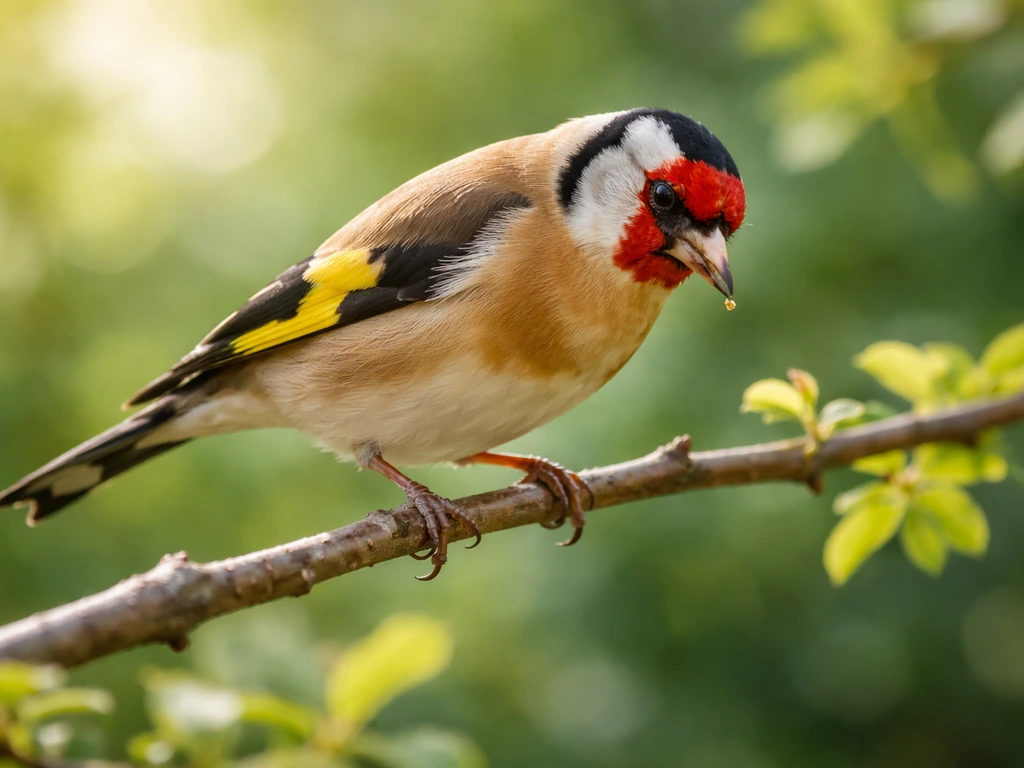
A house finch in your yard is carrying a few different kinds of meaning at once. On the literal side, it's a small, sociable songbird that has made a remarkable journey from the dry scrublands of the American West into almost every suburban backyard and city park in North America. On the symbolic side, people across spiritual and folk traditions read house finches as messengers of joy, adaptability, good news, and domestic warmth. Neither meaning cancels the other out, and honestly, knowing the real bird makes the symbolic layer far more interesting.
House Finch Bird Meaning: Symbolism, Signs, and Identification

Marcus Blackwell
22 May 2026
Quick ID: Making Sure You Actually Have a House Finch
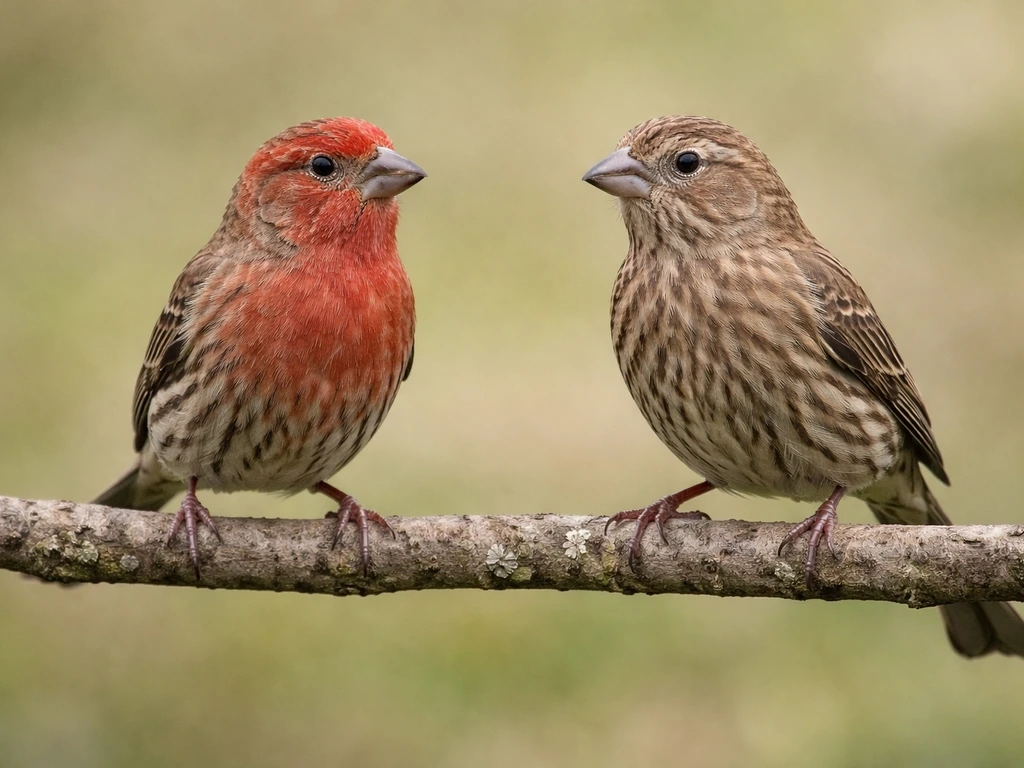
Before you do anything with the symbolism, it's worth confirming what you're looking at. A house finch is roughly sparrow-sized, about 6 inches long, with a relatively small and distinctly curved bill. The male is the easy one to spot: he has red on the head, breast, and rump, though that red can shade into orange or even yellowish depending on the individual bird's diet. blank" rel="noopener noreferrer">His belly is whitish with dark brown streaks, and his wings show two pale, somewhat indistinct wing bars. blank" rel="noopener noreferrer">His tail has only a shallow notch, which is a useful detail if you're trying to nail down the ID.
Females are considerably plainer: brownish overall, heavily streaked, with no bold eyebrow stripe. If you see a streaky brown bird hanging around your feeder and occasionally a reddish bird joins it, that's almost certainly a house finch pair.
The bird most likely to confuse you is the purple finch, which also has reddish coloring on males. The key differences: the house finch has a smaller, more curved bill, lacks a distinct pale eyebrow stripe, has a brown cap and cheek patch, and is more heavily streaked on the belly than a purple finch. House finches also tend to form larger, noisier flocks and are far more likely to be right at your feeder in a suburban setting.
Where House Finches Actually Come From (and Why That Shapes Their Meaning)
The house finch's original home was the American West and Mexico, where it lived in dry scrublands, chaparral, and streamside brush. That changed dramatically in 1940 when a small number of birds were accidentally introduced to New York City. By the early 1940s wild nests were appearing on Long Island, and within the next fifty years the species spread across almost all of the eastern United States and southern Canada. Today, virtually every house finch in eastern North America is descended from that same tiny founding group.
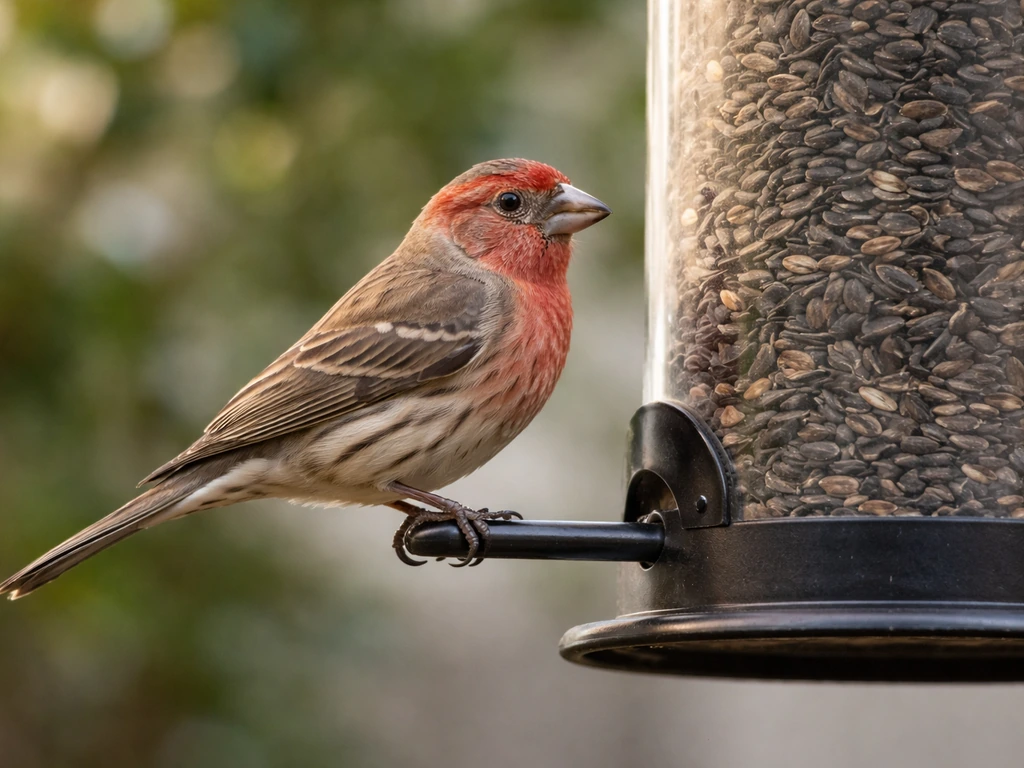
What makes this relevant for meaning is the "how" of that expansion. House finches didn't push into wilderness. They followed people: cities, suburbs, farms, front lawns, and especially backyard feeders. National Geographic points out that the proliferation of seed feeders throughout the East greatly benefits house finch populations. These birds are genuinely, not just poetically, a species defined by its relationship with human domestic spaces. That's not a symbol someone invented. It's just how they live.
Core Symbolic Meanings of the House Finch
Most of the symbolic meaning people assign to house finches clusters around a handful of themes, and when you look at the bird's actual behavior, the connections feel earned rather than arbitrary.
- Cheerfulness and joy: The male's song is a long, rambling, cheerful warble. He sings constantly, including a distinctive courtship flight-song where he flutters upward slowly and then glides back down. That persistent, upbeat presence is where the association with everyday optimism and good news comes from.
- Domesticity and home: No other wild bird in North America is more literally a "house" bird. House finches nest in backyards, on window ledges, in hanging baskets. Their name says it plainly. In symbolic traditions, they're often read as signs connected to home, family, and the warmth of a settled life.
- Adaptability and resilience: A bird that expanded its range by thousands of miles in fifty years, thriving specifically in human-modified environments, is a reasonable symbol for flexibility and the ability to make the best of changed circumstances.
- Communication and self-expression: The house finch is almost never quiet. Even outside breeding season, flocks keep up a constant chatter. The connection to communication, sharing, and expressing yourself openly is built right into how this bird actually moves through the world.
- Love and connection: Some spiritual interpreters link the male's red coloring to the heart chakra, connecting the bird to themes of compassion, love, and emotional openness. The birds' pair-bonding behavior, including the charming courtship display where the male feeds the female, reinforces this reading.
It's worth noting that finch symbolism more broadly, including the goldfinch and the greenfinch, tends to share some of these themes, particularly joy and communication. The house finch's specific angle is that domesticity layer: this is the finch that chose to live next to you.
Spiritual and Omen Interpretations (and How to Read Them Without Overreaching)
Spiritual interpretations of house finch sightings are genuinely popular right now, and there's nothing wrong with engaging with them as long as you hold them lightly. Here's the honest version: these meanings come from folk traditions, intuitive associations, and personal reflection. They're not predictive. A house finch at your window is not a guaranteed message that you're about to win a lottery or that a relationship will mend. What they can be is a prompt, a moment to pause and consider something.
Some of the most common spiritual readings you'll encounter: seeing a house finch is interpreted as an invitation to "open the door" to something good, meaning it's a nudge to be receptive to change or opportunity rather than a promise that the change is coming. Others frame it as a sign of good fortune or protection, particularly around the home. In traditions drawing on Chinese mythology, finches broadly carry associations with eternal love and fidelity. The red coloring on the male connects, in chakra-based interpretations, to the heart center and themes of love and compassion.
The most useful way to approach any omen reading is to ask what the symbol means in the context of your current life, not what it "predicts. If you're wondering about the bower bird meaning, it's a different kind of symbolism tied to its courtship behavior what the symbol means. " If a house finch keeps appearing and you've been avoiding a conversation, the "communication" symbolism might be worth sitting with. If you're at a crossroads about where to settle or how to build a home life, the domesticity connection feels apt. You're using the bird as a mirror, not a fortune teller, and that's a much more honest and ultimately more useful application.
Reading Behavior: What the Bird Is Actually Doing Matters
One of the things that separates a thoughtful symbolic reading from a generic one is paying attention to what the bird is actually doing. House finch behavior shifts meaningfully across the year, and those shifts give you richer material to work with.
Song and courtship (late winter through spring)
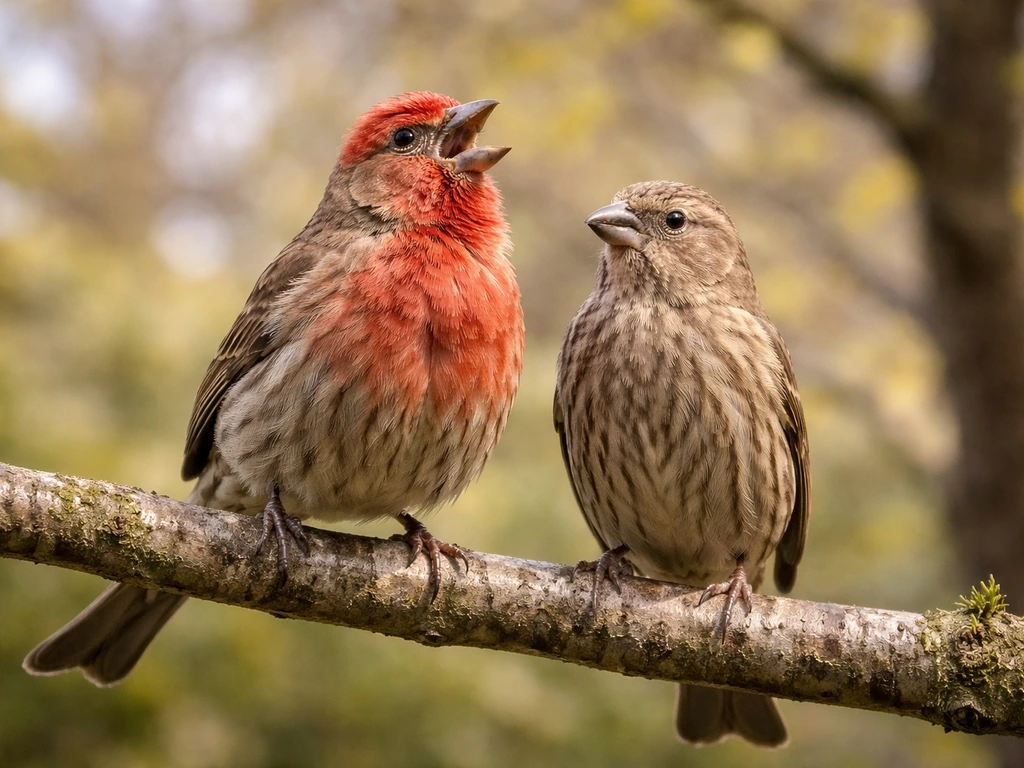
The male's song ramps up noticeably as breeding season approaches. If you're hearing a lot of cheerful, rambling warbling and seeing that flight-song display, the birds are in full courtship mode. The male's feeding of the female during this period is one of the more touching behaviors in backyard ornithology: he simulates regurgitation and then actually passes food to her, a behavior that, symbolically, connects beautifully to themes of nurturing, partnership, and care.
Nesting and broods (spring through summer)
House finches are productive nesters. A pair can raise up to three broods per year, sometimes more, with each clutch typically containing four or five eggs. Incubation takes about 13 to 14 days, and the young leave the nest around 12 to 15 days after hatching. If you see a lot of activity around a particular shrub, window box, or hanging basket, you may well have an active nest. In symbolic terms, a nesting pair near your home is one of the strongest possible expressions of the house finch's "home and family" associations.
Flocking (fall and winter)
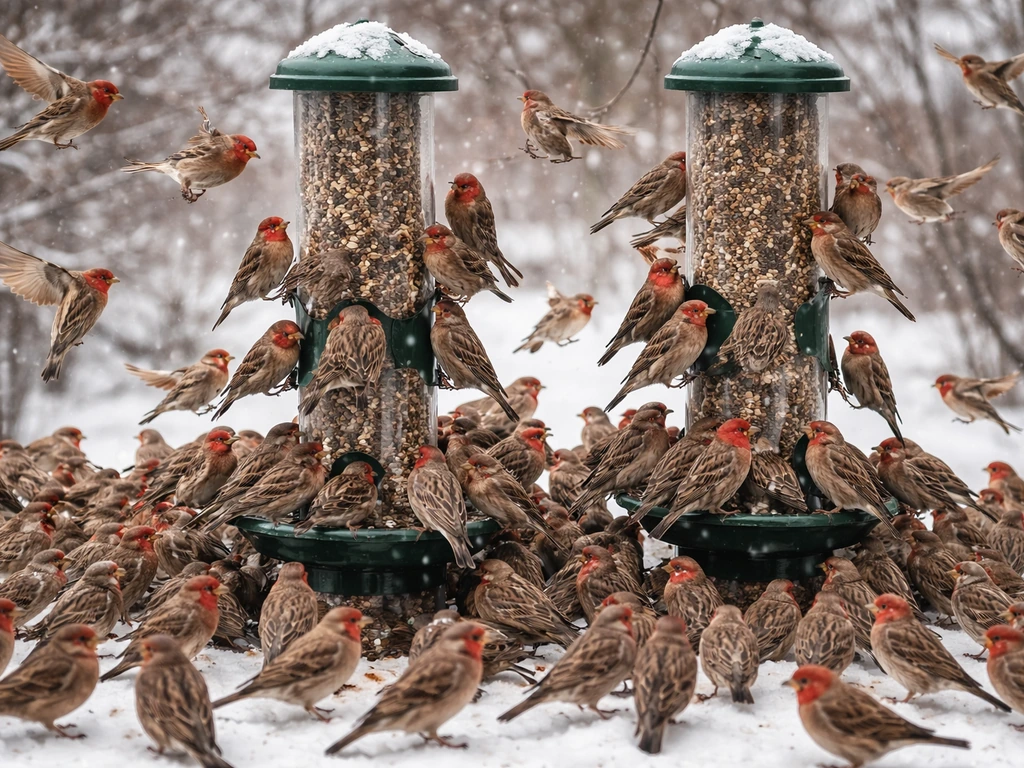
Outside the breeding season, house finches are highly social and rarely seen alone. Flocks can reach several hundred birds, and they're noisy and active at feeders. If you're suddenly seeing large numbers rather than just a pair or a small group, you're observing the birds' natural social nature rather than any unusual event. In symbolic terms, a large flock arriving tends to amplify the community and communication themes: this is a species that finds safety, sustenance, and joy in collective life.
Diet and season
Almost all of a house finch's diet is plant matter: seeds, berries, flower buds. They're not hunting. They're harvesting. This connects, for those drawn to elemental or earth-based symbolism, to themes of patience, gathering, and working with what's available rather than chasing something distant.
Practical Next Steps: Welcoming House Finches to Your Yard
If you want to observe house finches more closely, whether for the sheer pleasure of it or to deepen your symbolic engagement, the good news is that these birds are extraordinarily easy to attract. They're already predisposed to human spaces. You're mostly just making the visit more comfortable.
- Put out black oil sunflower seeds. This is the single most effective thing you can do. House finches are strongly drawn to them, and the seeds work in virtually any standard feeder.
- Use a feeder that's easy to disassemble and clean. Dirty feeders are a genuine health risk for the birds: moldy seed hulls and accumulated droppings can spread disease through a flock quickly. Clean your feeder about every two weeks, or more often in warm or damp weather. A nine-parts-water to one-part-bleach solution is the recommended approach for thorough disinfection.
- Place the feeder thoughtfully near a window. If you mount it very close to the glass (within a foot or two), birds that startle and fly toward the window don't build up enough speed to injure themselves. This is genuinely useful safety guidance that many people don't know.
- Wash your hands after handling feeders, bird food, or birdbaths. The CDC is straightforward about this: basic hygiene after contact with wild bird feeding equipment is important for your own health.
- Note what you observe. Keep a simple record of when house finches appear, how many, what they're doing (singing, feeding, displaying, flocking), and what the season is. Over time those patterns become the raw material for meaningful reflection, whether your interest is purely naturalist or also symbolic.
If you also see hummingbirds, it's worth knowing that house finches will sometimes visit hummingbird feeders for sugar water, so don't be surprised if you find them at those too.
How the House Finch Compares to Its Symbolic Relatives
The house finch sits within a broader family of small songbirds that carry overlapping symbolic weight. The canary, for example, is also associated with joy and song but carries stronger connotations of warning and vigilance rooted in its historical use in coal mines. The goldfinch is a well-documented symbol of happiness and, in Christian iconography, of the soul. The greenfinch and linnet, familiar to British folk tradition, carry their own pastoral and romantic associations. What makes the house finch distinct within this group is precisely that domesticity angle: it's the one that chose the suburb, the front porch, the window box. If the goldfinch belongs to meadows and the canary to cages, the house finch belongs to the neighborhood. That's its particular symbolic territory, and it's a genuinely useful one.
So when someone asks about house finch bird meaning, the fullest answer is: a bird that adapted brilliantly to human spaces, sings constantly, nests prolifically, travels in community, and shows up at your door whether you invited it or not. The symbolic readings people attach to it, joy, good news, domesticity, resilience, openness to change, are all rooted in something the bird actually does. If you’re curious about the bunting bird meaning idea, house finch symbolism offers a helpful way to start interpreting what you’re noticing. That grounding in real behavior is what keeps the symbolism honest.
FAQ
Is a house finch the same thing as a purple finch, and can the meaning change if I misidentify it?
They are different species, and misidentification can shift the practical “meaning” you assign because each bird responds differently to feeders. If it has a small, strongly curved bill, lacks a clear pale eyebrow, and shows heavier belly streaking, it’s usually a house finch. Treat symbolism as context-based rather than species-absolute if you are uncertain, and use behavior (bill shape, flock size at feeders, feeder habits) to confirm first.
What should I do if I see only one house finch and not a pair or flock?
House finches are often social, but singles do happen, especially during territorial movements or when a bird has just arrived at a new feeder. For symbolism, a solitary visit is still meaningful, but it may point more toward “attention” or “a prompt to pause,” rather than the amplified “community” theme you get from larger groups.
Does a house finch showing up at my window carry a different meaning than one at my feeder?
Window visits often feel more emotionally direct, but biologically it usually means the bird is attracted to reflections or to nearby insects and plants, or it’s negotiating space around feeders. If you want the symbolism to be grounded, compare placement: feeder activity fits “sustenance and availability,” while window behavior fits “communication and noticing,” and you can decide which life area matches your current situation.
If I find an active nest, should I stop thinking of it as a “sign” and focus only on safety?
You can still reflect, but prioritize practical responsibility. Avoid prolonged observation from close range, don’t disturb the shrub or planter, and pause any feeder behavior that could draw predators. Symbolically, an active nest tends to point to “home and partnership,” so it pairs naturally with protecting and supporting the vulnerable stage rather than taking action that disrupts it.
How can I tell whether the bird is actually a house finch or a similar feeder visitor from a distance?
Use three quick checks: size (about sparrow-sized), bill shape (small and curved), and patterning (males show red but females are plain and streaky). If you can’t see the bill clearly, count behavior cues: house finches frequently cluster at suburban feeders and are often noisier and more numerous than some look-alikes.
Do house finches have different “meaning” depending on the season?
Yes, and the most useful way is to match the bird’s current behavior. More song and courtship feeding aligns with themes of love, partnership, and new beginnings. Nest-building and heavy shrub activity aligns with family and commitment. Large feeder flocks outside breeding season align more with community, shared resilience, and communication.
Can house finches visit hummingbird feeders, and does that affect interpretation?
They can, sometimes by taking sugar water alongside nectar feeders. If you see them at a hummingbird station, the practical takeaway is that “food availability” is the driver, and symbolism can shift from “seed gathering” to “sweet opportunity” or “easy nourishment,” depending on how you frame it.
If my bird is a male versus a female, should I assign different symbolism?
Often people do, but the more consistent approach is behavior rather than gender coloring alone. Male red indicates breeding intensity and song, so it can emphasize communication and courtship themes. Female presence often means nesting or brooding activity, so it can emphasize care, steadiness, and protection. Use what they are doing right now to choose the theme.
What’s a common mistake people make when reading “omens” from house finch sightings?
Treating the sighting like a prediction with certainty. A more reliable method is to use the bird as a prompt: identify the life topic you are already dealing with (a decision, a conversation, a home situation), then ask how “openness to change,” “good news,” or “domestic warmth” could apply in that specific context.
How can I make my observation more reliable before interpreting house finch bird meaning?
Keep a quick log for a week: date, location (feeder, window, shrub), number of birds, and what you observed (singing, feeding, nest activity, flocking). This reduces guesswork, and it lets your symbolism follow actual patterns, not one-off excitement.
Next Article
Goldfinch Bird Meaning: Symbolism, Signs, and What It Means
Goldfinch bird meaning explained: symbolism, folklore, and practical tips to interpret sightings, feathers, and nests.