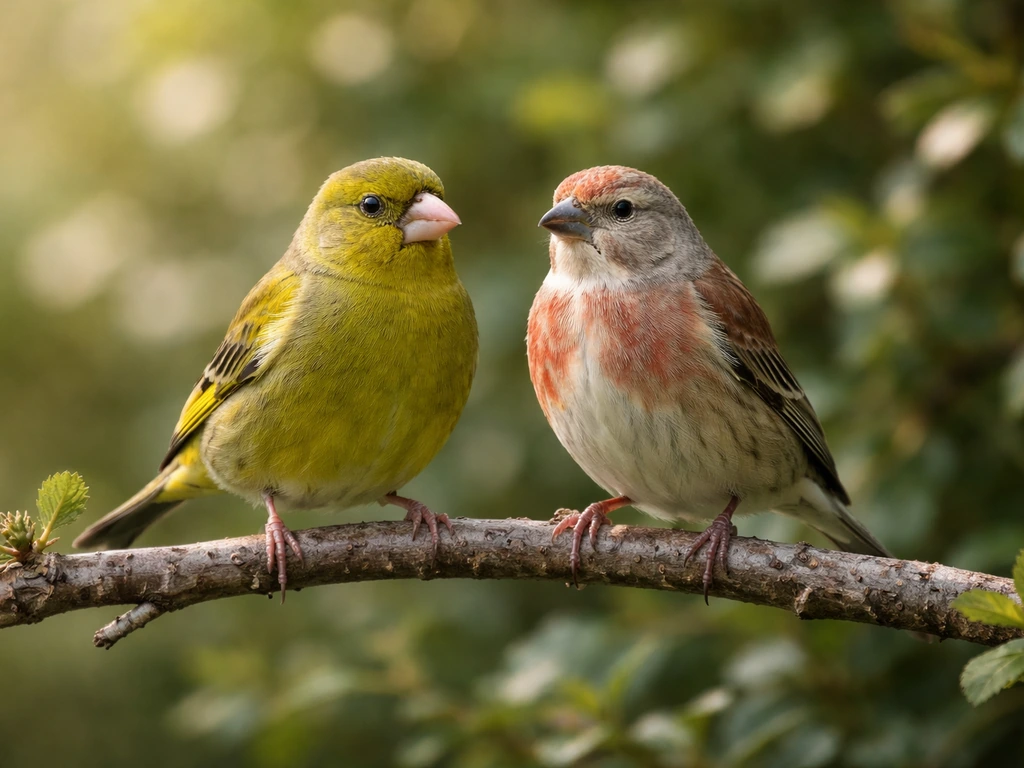
If you searched 'bunting bird meaning,' you're almost certainly asking about a real group of birds, not decorative flags. If you're also looking into the meaning of finch bird, the key is similar: confirm which species you mean before applying symbolism. Buntings are small, stocky songbirds with short, wide beaks, found across Europe, Asia, Africa, and North America. blank" rel="noopener noreferrer">The Old World species sit in the genus Emberiza (family Emberizidae), and they range from the streaky brown Corn Bunting to the brilliant yellow-headed Yellowhammer. Symbolically, buntings are most commonly associated with cheerfulness, seasonal renewal, simple abundance, and the music of open landscapes. But because the word 'bunting' carries at least two completely different meanings in everyday English, it's worth sorting out exactly which bunting you mean before diving into the symbolism.
Bunting Bird Meaning: Species vs Decorative Bunting

What 'bunting bird' actually means (and why the confusion happens)
The word 'bunting' genuinely has two distinct lives in English, and dictionaries acknowledge both under the same entry. The Cambridge Dictionary, for instance, lists 'bunting' as either a small singing bird with a short, wide beak found in Europe, Asia, and Africa, or as the decorative strips of cloth and flags used for holidays and celebrations. Collins similarly defines the decoration sense in American English, describing it as flag-like fabric hung for festive displays. So if someone grew up knowing 'bunting' as the red, white, and blue garlands draped over a porch railing on the Fourth of July, landing on a bird-symbolism article can feel disorienting. Reddit threads show this confusion playing out in real time: users note that they forgot the bird entirely and assumed bunting was purely a decorative term.
The word's etymology helps explain the split. The 'lark-like bird' use and the 'light woolen cloth used for flag material' use developed separately, and the two meanings have coexisted in English for centuries without much cross-pollination. When you're searching for 'bunting bird meaning,' you're squarely in bird territory, and the decorative sense is just noise. If you still feel unsure after checking the bird sense of bunting, you might also compare it with a related phrase like canary bird meaning to sharpen how people use bird-name symbolism in searches. One more source of search-result noise worth flagging: the 20th-century British poet Basil Bunting carries the surname, so searches for 'bunting meaning' sometimes pull up literary criticism. That's a different rabbit hole entirely.
Within the bird meaning itself, there's a second layer of confusion: not every bird called a 'bunting' belongs to the Emberiza genus. The Lark Bunting, for example, is technically Calamospiza melanocorys, a North American species placed in a completely different family. The Blue Bunting sits in the Cardinalidae family (genus Cyanocompsa). Even LeConte's Sparrow is sometimes called LeConte's Bunting in casual use. So 'bunting' is partly a true taxonomic grouping and partly a common-name convention applied loosely across species that share a similar look or niche. For symbolism purposes, this matters less than it does for birding, but it's useful to know which specific bunting you're looking at.
How to identify the bunting you're seeing right now
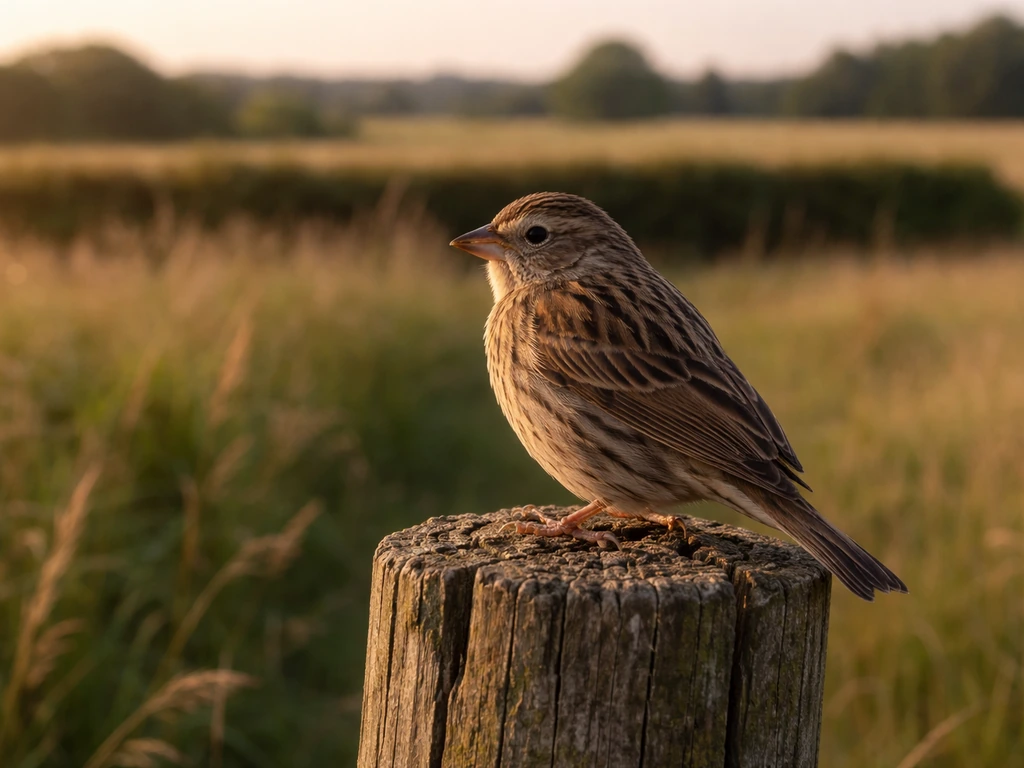
The quickest way to confirm you're looking at a bunting is the combination of a compact, seed-cracking bill and a preference for open, often agricultural landscapes. Buntings are not forest birds. They like field edges, hedgerows, grasslands, and scrubby open ground. If you're in the UK or Europe, here are the three most likely candidates you'll encounter:
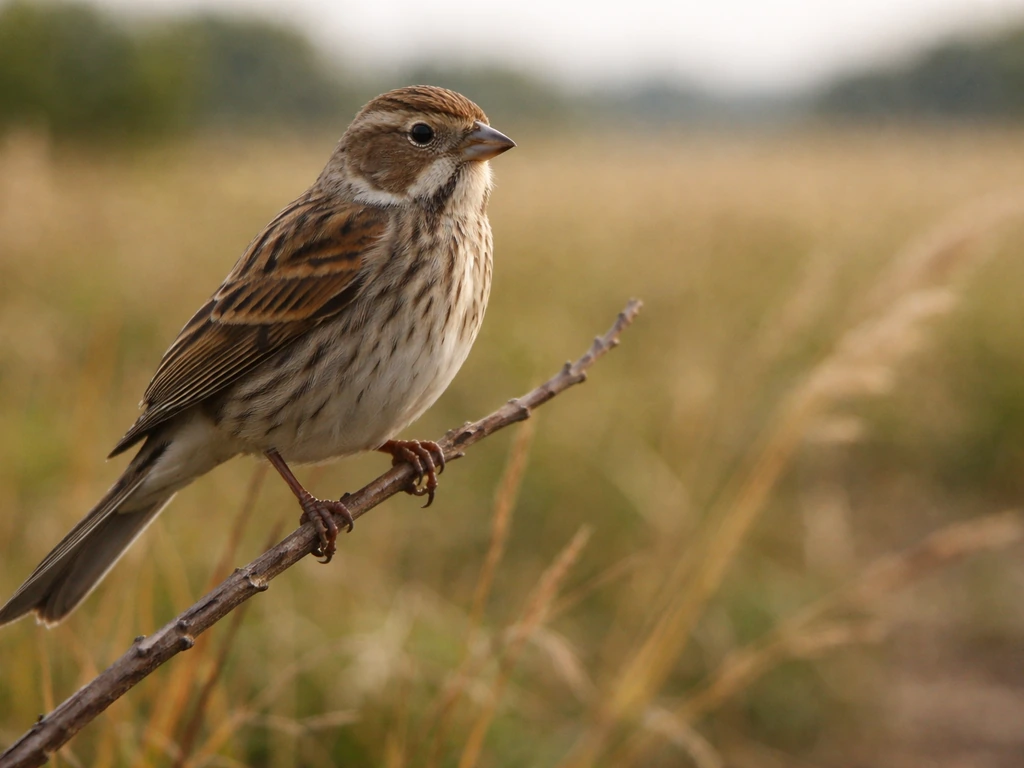
- Corn Bunting: sparrow-sized, streaky brown all over with no standout markings, a large pale bill, and a jangling song often compared to rattling keys. It favors arable farmland and cereal fields, and its UK distribution is patchy, concentrated in areas like the chalk downlands of southern England, northeast Scotland, and the machair of the Outer Hebrides.
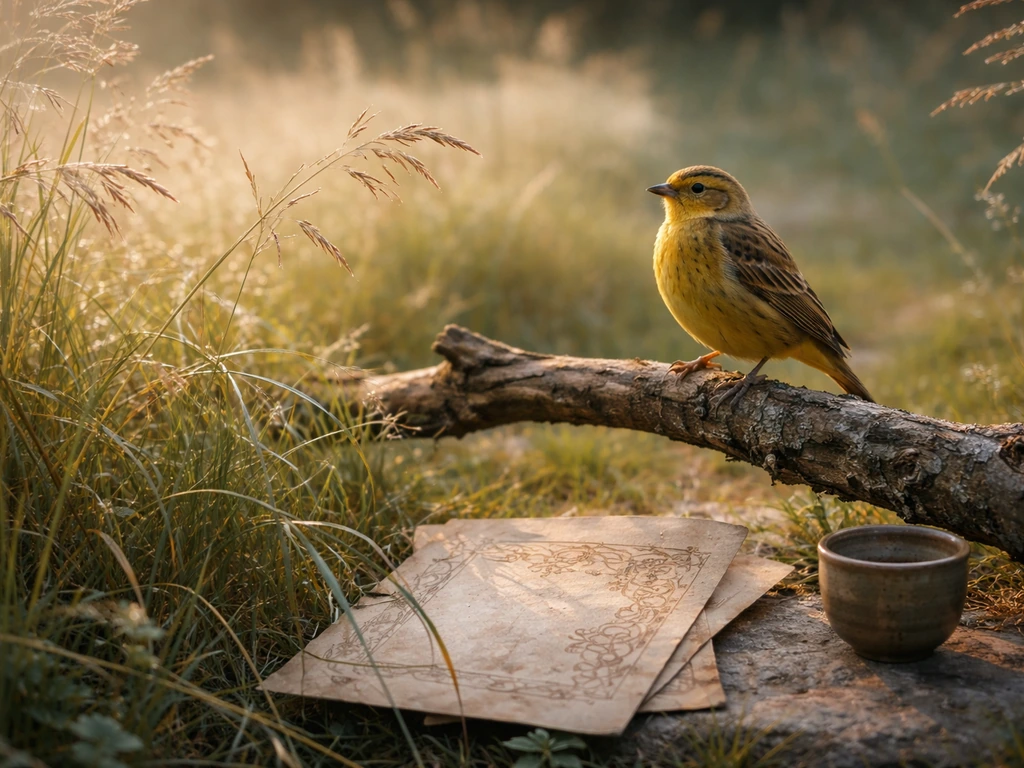
- Yellowhammer: the male has a bright yellow head and underparts, a streaked brown back with black, and a distinctive chestnut rump. This is the 'brightly colored' bunting that stands out in hedgerow views from spring through summer. Females are duller and more streaked, closer to the Corn Bunting in overall impression.
- Reed Bunting: a wetland and reedbed specialist. The male has a black head and white collar; the female is streaky brown with a pale eyebrow stripe. If you're near a marsh or river edge, this is the most likely bunting.
If you're in North America and you think you've seen a bunting, your most likely candidates are the Indigo Bunting (brilliant blue male, sparrow-sized, loves woodland edges and brushy fields), the Painted Bunting (arguably the most colorful bird in North America, with a red belly, blue head, and green back on the male), or the Lark Bunting in the Great Plains (breeding male is black with a large white wing patch and a notably thick, bluish-gray bill). Location alone narrows this down considerably.
Use photo ID tools to confirm your bird fast
If you have a photo, upload it to the Merlin Bird ID app from Cornell Lab. Merlin's Photo ID uses machine-learning models trained on the Macaulay Library's image database and runs directly on your phone. For the best result, make sure your device location is set correctly before you open the app, especially if you're offline. After Merlin gives you a suggestion, cross-check it against the species' range map and habitat description within the app before treating it as definitive. Merlin is a starting point, not a final verdict. Alternatively, post your photo as an observation on iNaturalist. The platform allows other users and automated suggestions to add identifications to your sighting, and including the date and location (which iNaturalist often logs automatically) significantly improves accuracy.
What buntings symbolize in folklore, literature, and culture
Buntings are not the birds that dominate the heavy mythology of ravens, owls, or doves. They occupy a quieter symbolic register, one tied to the land, the seasons, and the everyday fabric of rural life rather than to omens or divine messengers. In European folk traditions, the arrival of buntings on farmland in spring has long been read as a signal of seasonal turning: these are birds of fields coming alive again after winter, and their presence alongside newly planted crops gave them an association with agricultural hope and the promise of a good year ahead.
The Yellowhammer carries the most specific folk symbolism. In British and Scottish rural tradition, the Yellowhammer's song, often rendered as 'a little bit of bread and no cheeeeese,' embedded the bird in the rhythms of country life so firmly that it appeared in dialect poetry and regional song for centuries. Beethoven reportedly drew inspiration from a rhythmic motif matching the Yellowhammer's call for the opening of his Fifth Symphony, though musicologists debate the direct connection. More clearly, the bird features in John Clare's poetry as a marker of English pastoral beauty, specifically as an image of the undisturbed countryside he mourned losing. In that literary tradition, the bunting signals simplicity, authenticity, and the value of what is ordinary but alive.
In a broader symbolic sense, buntings are connected to song as a form of joy rather than warning. Unlike the crow or raven, whose calls often function as omens in folklore, the bunting's persistent, often repetitive singing was read as contentment, a bird singing for the sake of singing rather than to announce anything. This maps onto wider symbolic associations: cheerfulness in humble circumstances, the ability to find beauty in open, unremarkable landscapes, and resilience through seasonal change. The bower bird meaning often gets confused with other bird-related search terms, but it is usually used as a shortcut to discuss bower birds' elaborate courtship behavior. The Indigo Bunting in North American culture, particularly in the rural South, has been linked to summer abundance and the height of the warm season, given its arrival during peak growing months.
It's worth noting that the kind of rich, single-species Christian symbolism you find attached to some other small birds, like the European Goldfinch with its connection to the Passion of Christ and the crown of thorns, doesn't appear in the bunting's cultural record with the same clarity. If you're specifically looking for the goldfinch bird meaning, its symbolism is often tied to themes like renewal, perseverance, and, in Christian art, the Passion. Buntings were more vernacular birds: present in folk song, pastoral poetry, and agricultural lore rather than in cathedral iconography. Their meaning is horizontal, grounded in everyday human life, rather than vertical, pointing toward the divine.
Idioms, slang, and phrase mix-ups involving 'bunting'
The most common idiom you'll encounter that uses 'bunting' has nothing to do with birds at all. 'Bunting' in the sense of decorative fabric appears in political and national contexts, where 'hanging out the bunting' or 'bringing out the bunting' means celebrating something enthusiastically, often something that deserves more skepticism than fanfare. You might see a newspaper headline like 'Don't break out the bunting just yet' as a warning against premature celebration. This idiom flows entirely from the flag-and-garland sense of the word.
In baseball, 'bunting' refers to a batting technique (a bunt), which is etymologically unrelated to either the bird or the decoration. If your search for 'bunting meaning' pulled up baseball content, that's another dead end for bird symbolism purposes.
There are also nursery rhyme associations worth mentioning. The old English nursery rhyme 'Bye Baby Bunting' uses 'bunting' as a term of endearment for a baby, probably derived from a dialectal use of 'bunting' meaning 'plump' or 'short and thick. If what you meant was “canary bird the figs meaning,” note that this is another example of how a single phrase can be misread against unrelated word or folk-tradition uses Bye Baby Bunting. ' The rhyme goes 'Bye baby bunting, daddy's gone a-hunting, gone to fetch a rabbit skin to wrap the baby bunting in.' Here 'bunting' is not the bird at all, but the usage means that anyone who grew up with that rhyme may have a subconscious association between the word and small, round, cherished things.
Common misconceptions worth clearing up
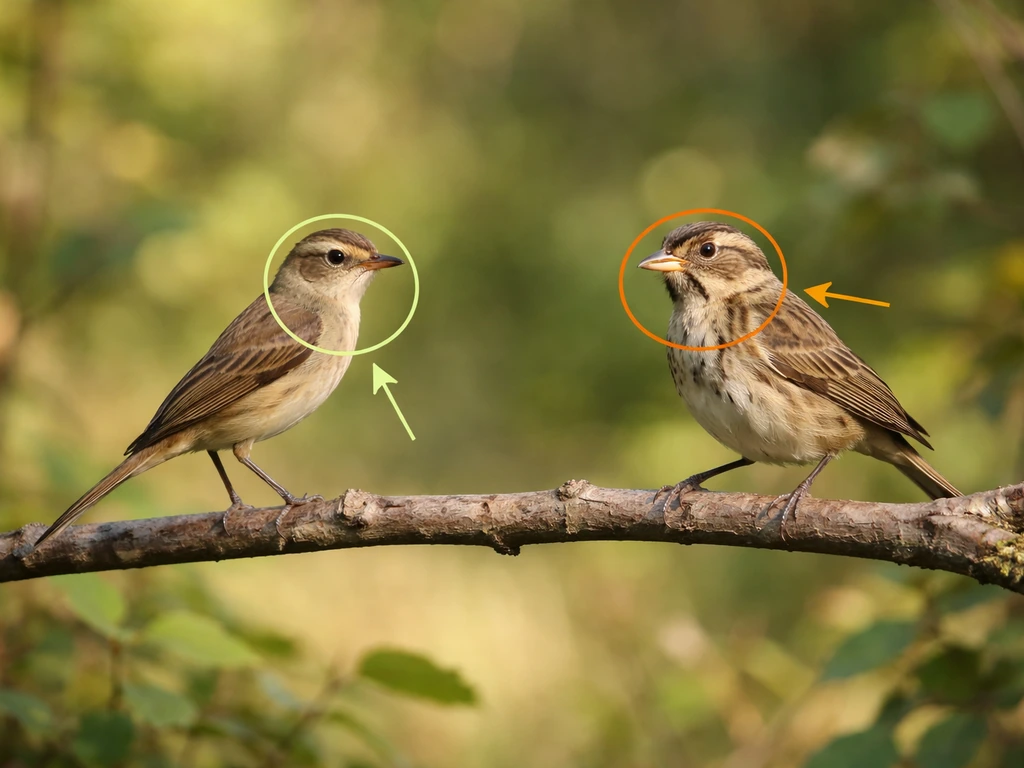
The biggest misconception in 'bunting bird' searches is treating buntings as interchangeable with any small brown songbird. Buntings are specifically finch-like birds with stocky, seed-cracking bills and open-country habits. In other words, the house finch bird meaning centers on how this finch-like songbird is interpreted symbolically in different contexts finch-like birds. They're not sparrows, though they look similar. They're not warblers, which tend to be slimmer and insect-eating. And they're not the same as finches, though the two groups share some superficial traits, which is part of why sibling topics like the meaning of the Goldfinch or the symbolism of the Canary attract readers who initially thought they were looking for a bunting.
The second major misconception is that all birds called 'buntings' belong to the same family. As mentioned earlier, common-name conventions have spread the 'bunting' label across multiple genera and families. The Indigo Bunting and Painted Bunting are in the family Cardinalidae, not Emberizidae. This doesn't change their cultural symbolism, but it does mean you can't assume the field marks or habitats of a European Corn Bunting apply to a North American Lazuli Bunting.
Finally, some readers arrive at 'bunting bird meaning' after encountering the word in poetry or literature and assuming it must carry dense symbolic weight the way a raven or dove does. “Fitcher’s bird” is an old term tied to a specific folk belief, and its meaning is different from the everyday “bunting” bird symbolism discussed here bunting bird meaning. In most literary contexts, a bunting is deliberately chosen as an ordinary bird: its symbolic value is precisely its commonness. Mistaking it for a coded symbol with a specific meaning (the way a swallow signals a sailor's homecoming, for instance) usually leads to over-reading. When a poet mentions a bunting, they're almost always reaching for the texture of everyday rural life, not a mythological cipher.
How to match your bunting to its meaning today
Once you've confirmed which bunting you're dealing with, using the ID steps above, the practical question is which symbolic layer applies. Here's a straightforward way to think about it:
| Species | Region | Core symbolic associations |
|---|---|---|
| Corn Bunting | UK and Europe (farmland) | Agricultural hope, seasonal persistence, humble beauty, the value of the ordinary |
| Yellowhammer | UK and Europe (hedgerows, farm edges) | Pastoral joy, the music of open land, rural continuity, summer vitality |
| Reed Bunting | UK and Europe (wetlands, reedbeds) | Adaptability, quiet persistence, the margin between elements (water and land) |
| Indigo Bunting | North America (woodland edges, brushy fields) | Summer abundance, vibrant but fleeting beauty, seasonal peak and the height of warmth |
| Painted Bunting | North America (southern US, Central America) | Extraordinary beauty in small things, the unexpected vividness of nature |
| Lark Bunting | North American Great Plains | Prairie freedom, open-sky symbolism, the scale of wild landscape |
If you encountered a bunting in a dream, piece of literature, or a personal experience and want to apply its meaning, the most reliable approach is to anchor the symbolism in what the bird was actually doing and where it appeared, rather than reaching for a fixed dictionary definition of 'bunting symbolism.' A Corn Bunting singing on a fence post in early spring reads differently from a Reed Bunting flushed from a marsh in autumn. Context, as with most bird symbolism, carries as much weight as the species name itself.
For next steps: if you're trying to trace bunting symbolism in a specific literary or cultural context, narrow your search to the species, not just the common name. If you came here because you're trying to understand a small songbird's symbolic meaning more broadly, the symbolic traditions around the Goldfinch and the Canary offer some of the richest parallels in the same family of small, musical birds. The green finch and linnet bird meaning is often interpreted in a similarly seasonal, everyday-symbolic way, depending on where and when the sighting appears Goldfinch and the Canary. The Goldfinch in particular carries a documented symbolic tradition in European art and literature that shares the same pastoral and melodic qualities you find in bunting symbolism, but with considerably more historical depth.
If you're simply trying to identify the bird you saw and figure out what it might mean for you personally, trust your location and the season. Buntings are, at their core, birds that tell you something about the place and time you're in. That's not a vague claim: it's the reason rural communities across Europe used their arrival and song as seasonal markers for centuries. Whatever bunting you encountered, it belongs to that tradition.
FAQ
Is the symbolic meaning of a bunting the same for every species called “bunting”?
Not necessarily. In folklore and everyday symbolism, buntings tend to mean “cheerful seasonal renewal,” but the interpretation shifts with context, like a singing fence-post bird in early spring versus a flushed bird in late autumn. If you want personal meaning, describe what you remember (time of year, location type, and the bird’s behavior) before applying symbolism.
How should I interpret bunting when it shows up in poetry or a novel?
Usually you should avoid treating a poetic mention as a coded omen. The article’s key principle is “ordinary chosen on purpose,” so unless the text gives extra specifics (scene, season, surrounding imagery), it is safer to read bunting as texture of rural life rather than a fixed message.
What’s the most reliable way to avoid wrong symbolism after I identify a bunting?
Use two checks before you trust symbolism you find online. First, confirm you have a real bunting species (not a sparrow, warbler, finch, or unrelated “bunting” name). Second, match the season and habitat to the bird’s typical preferences, since open-country, field-edge species behave differently in meaning than marsh or woodland birds.
If my bird looks like a small brown songbird, how do I know it is really a bunting?
Yes, a common mistake is to assume any small brown songbird equals “bunting.” Buntings are typically stocky and seed-cracking with a relatively short, wide bill, and they favor open agricultural or scrubby edges rather than deep forest. If your bird looks slender, insect-focused, or strongly forest-associated, re-check the ID.
Why can the same “bunting” label mean different birds in different places?
Don’t rely on common-name labels alone if you are trying to connect “meaning” across regions. For example, Indigo Bunting and Painted Bunting are in Cardinalidae, not Emberizidae, so their look, habitat, and cultural associations in North America may not map cleanly onto European Emberiza species like Corn Bunting or Yellowhammer.
What should I focus on in a dream to interpret bunting meaning accurately?
If you are using a dream for interpretation, treat the dream’s actions as the primary data. A bunting that is singing and staying in view usually supports themes of contentment and seasonal optimism, while a bunting that is hidden, fleeing, or silent may point more toward change and transition. Capture those details before you generalize.
How can I connect bunting meaning to a specific region’s symbolism?
If you want to connect bunting symbolism to a specific culture, narrow your research by country and time period, not just the bird name. Yellowhammer symbolism has very specific British and Scottish folk and literary echoes, while North American buntings often get summer-and-abundance readings, so “bunting cheerfulness” can feel too generic without that context.
What should I do when search results for “bunting bird meaning” keep showing unrelated stuff?
If your search results keep mixing in decorative flags, idioms, baseball, or the surname Basil Bunting, adjust your query with constraints like “bird species,” “Emberiza,” or the region you saw the bird (Europe versus North America). This usually pulls you back from the non-bird senses that share the same word.
Should I compare bunting meaning to canary or goldfinch meaning, or treat them separately?
If your main goal is personal insight, compare bunting symbolism with other small songbird traditions to see what resonates, but keep it grounded. The article suggests parallels with canary and goldfinch-style “seasonal everyday joy,” but don’t merge meanings that depend on different habitats or behaviors unless your context truly matches.
Green Finch and Linnet Bird Meaning: Symbolism Guide
Meaning of green finch vs linnet: symbolism, folklore, and how to interpret sightings, dreams, and signs accurately.