
The goldfinch is most consistently associated with joy, hope, renewal, and resilience across the traditions that reference it. In Christian iconography, it carries a direct link to the Passion of Christ. In modern spiritual and folk traditions, it reads as a messenger of happiness and good fortune. And in everyday life, spotting one is often just a delightful encounter with a small, brilliantly colored bird whose behavior has a perfectly rational explanation. Which meaning applies to you depends on context, and this guide will help you figure that out. If you're comparing similar omen-style meanings, you may also want to look up the green finch and linnet bird meaning alongside goldfinch symbolism.
Goldfinch Bird Meaning: Symbolism, Signs, and What It Means

Marcus Blackwell
16 May 2026
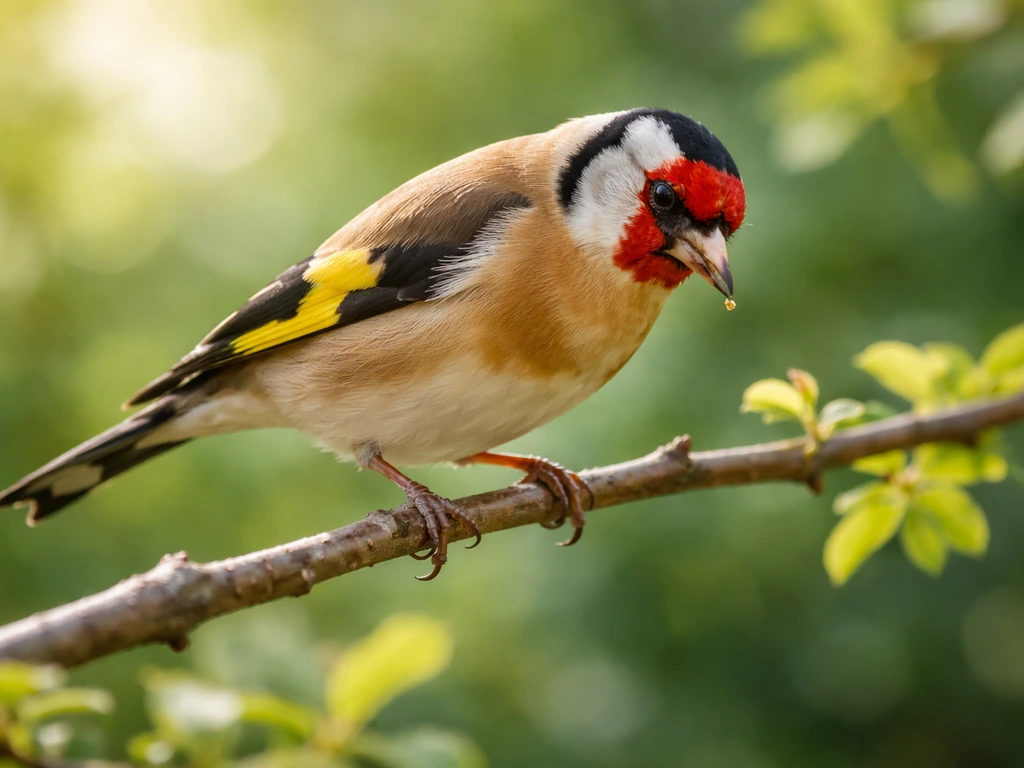
First: which goldfinch are you actually talking about?
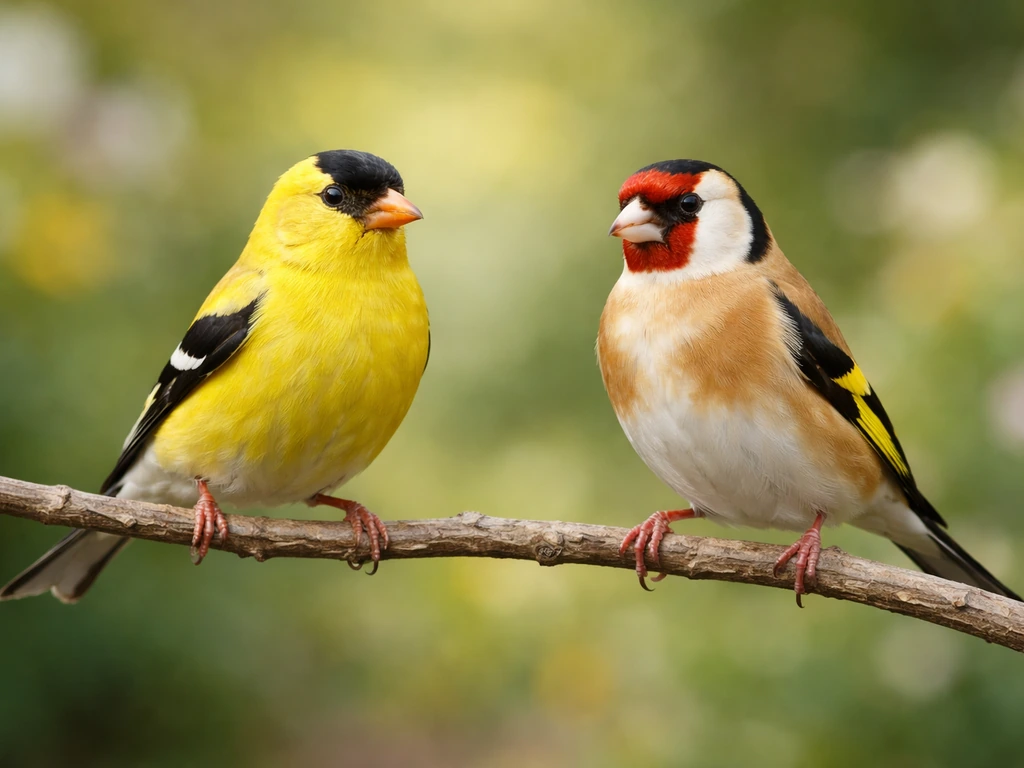
Before diving into symbolism, it helps to know there are two distinct birds people call a "goldfinch," and they carry slightly different cultural weight. The American goldfinch (Spinus tristis) is the one most North Americans encounter: a small, compact bird with a conical pink bill, vivid lemon-yellow body, and sharply contrasting black wings marked by two bold wingbars (buffy and quite wide on the lower bar). Males in summer are unmistakable. In winter, though, both sexes turn a drab yellowish-brown or gray, keeping those distinctive wingbars on blackish wings as the main ID clue. If you're not sure what you saw, check for those wingbars and the white tail spots.
blank" rel="noopener noreferrer">The European goldfinch (Carduelis carduelis) is a different species entirely, native to Europe, northern Africa, and western Asia. It has a red face, black-and-white head, and golden-yellow wing patches. It's the bird that dominates medieval Christian art and most Old World folklore. If you're reading European poetry, Renaissance paintings, or older religious texts, that's the goldfinch being referenced, not the American species.
There's also a Lesser goldfinch in the American West that can cause confusion. When you're checking symbolic meaning guides, most of them are drawing from a blended cultural pool, but the underlying visual inspiration is almost always one of these two main species. Getting the ID right matters if you're trying to connect a real sighting to a meaning, because the American goldfinch in winter plumage looks nothing like a bright-yellow bird, and people sometimes misidentify it entirely.
What the goldfinch actually symbolizes
Across the traditions that have engaged with the goldfinch, a few core themes come up repeatedly. They're worth laying out clearly before getting into specific situations.
- Joy and happiness: The goldfinch's bright color and cheerful, bouncing song have made it a near-universal symbol of delight and high spirits across folk traditions. Its presence is read as an uplifting sign.
- Hope and renewal: Because American goldfinches molt into their brilliant plumage in spring and time their nesting to midsummer (waiting until milkweed and thistle produce fibrous seeds in June or July), they're associated with seasonal renewal and patient optimism.
- Resilience and endurance: The goldfinch winters over in cold climates, surviving on dried seed heads while many birds have migrated south. That toughness maps onto themes of persistence through hardship.
- Spiritual protection and redemption: In Christian tradition, the goldfinch is explicitly tied to the Passion of Christ. A medieval legend holds that a small bird (often depicted as a goldfinch) flew down as Christ carried the cross, plucked a thorn from the crown, and was splashed with blood, leaving a red mark. The European goldfinch's red face is read as a permanent trace of that act. This makes the bird a symbol of sacrifice, compassion, and redemption.
- Good fortune: In folk belief and modern spiritual writing, a goldfinch sighting is widely interpreted as a positive omen, a signal that lighter, better times are approaching.
What it might mean when you see one (common situations)
People usually arrive at this question because something specific happened: a goldfinch showed up somewhere unexpected, behaved in an unusual way, or appeared at a meaningful moment. Here's how to think through the most common scenarios.
A goldfinch in your garden or yard
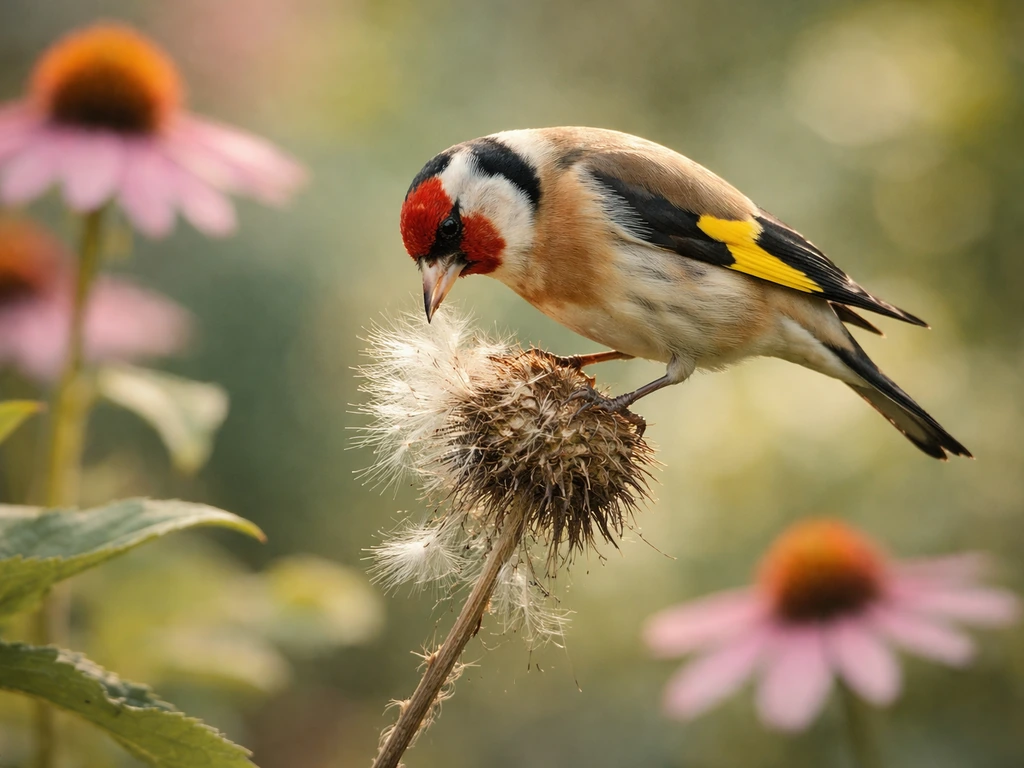
Goldfinches actively forage in weeds, shrubs, and thistles, climbing around on seed heads to extract seeds. If one showed up in your garden, especially near a thistle, coneflower, or sunflower, the most immediate explanation is habitat: your yard has what it needs. Symbolically, having a goldfinch settle in your space is widely read as a sign of abundance and joy coming to your home environment. If it kept returning, folk tradition tends to read that as ongoing good fortune rather than a one-off message.
A goldfinch at your window
Window encounters are common and have two overlapping explanations. Behaviorally, birds hit or approach windows because they see a reflection and interpret it as open sky or another bird invading their territory, especially during spring and fall. The Tufts Wildlife Clinic and Cornell both note this is a territorial or navigational error, not a directed communication.
Symbolically, though, a bird appearing at a window has long been read as a messenger bringing news from the spirit world or the universe, and the goldfinch specifically carries that message as one of joy or encouragement. If you are looking up the bunting bird meaning, this kind of spiritual read is the same style of interpretation people often connect to birds appearing at personal moments.
If you have come across fitcher’s bird meaning, this is the kind of folk symbolism people often connect to a goldfinch appearing at a window long been read as a messenger bringing news. You can hold both interpretations: check whether the bird seemed confused or disoriented (behavioral explanation), and also notice whether the timing felt meaningful to you personally.
Hearing a goldfinch singing
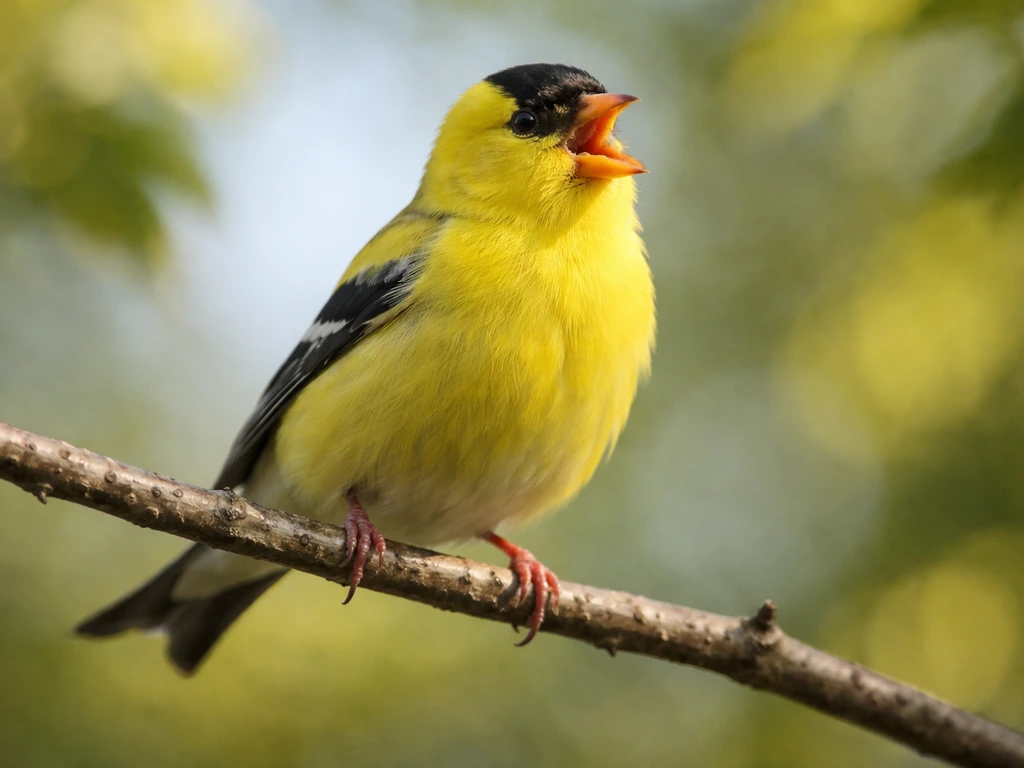
The American goldfinch has a distinctive, bouncy, warbling call, and males sing actively during courtship and territorial display, often during a fluttering flight display. Cornell research has connected early-morning singing to territorial behavior and diet rather than any mystical motive. Symbolically, hearing a goldfinch song is read as a sign of incoming happiness or as an invitation to embrace lightness. If you heard it at a moment of personal significance, many folk traditions would say the bird was confirming something positive.
Finding a goldfinch feather or nest
A goldfinch feather, especially one of those bright yellow ones, is read in folk belief as a small token of luck and joy. Finding a nest (often built from plant down and spider silk, compact and cup-shaped) is associated with themes of home, new beginnings, and careful nurturing. blank" rel="noopener noreferrer">Goldfinches wait until late June or July to nest when thistle seeds are available, so a summer nest find aligns with themes of patient preparation paying off.
The goldfinch in folklore, spirituality, and cultural tradition
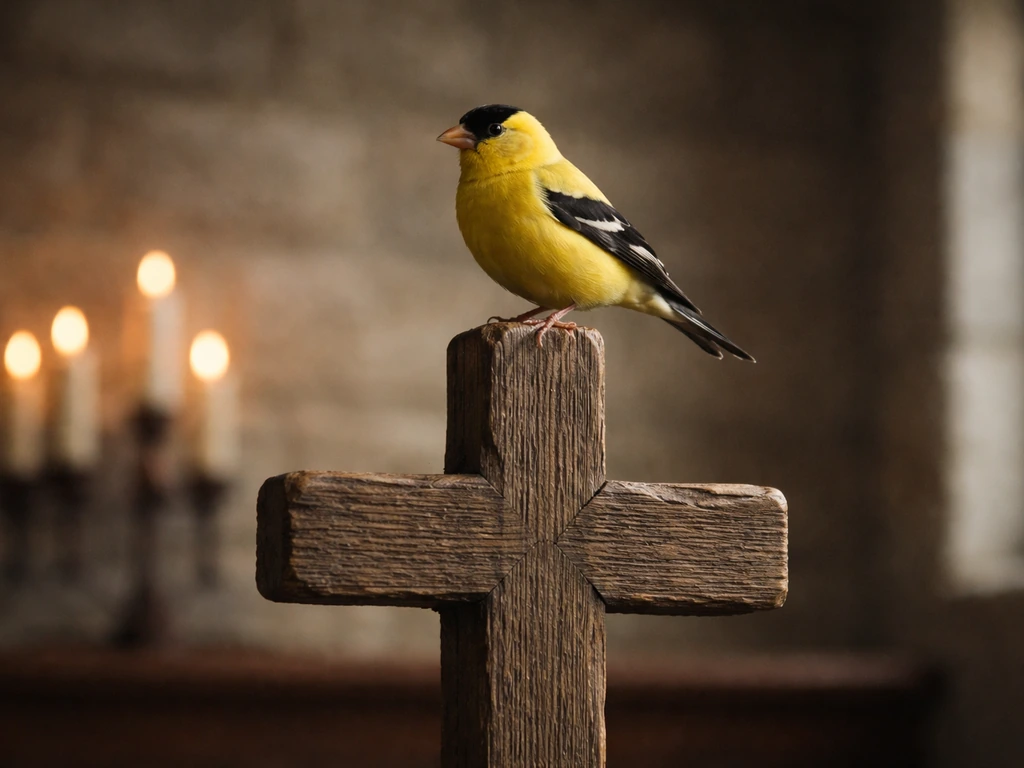
The Christian devotional tradition is where the goldfinch's symbolic weight is heaviest and most historically documented. Herbert Friedmann's scholarly work, catalogued by the Smithsonian, specifically traced the goldfinch's significance through European devotional art across centuries. The bird appears in Renaissance Madonna-and-Child paintings held by the National Gallery in London and elsewhere, almost always perched near the infant Christ or held in his hand, a quiet visual shorthand for his coming Passion. The goldfinch essentially functioned as a theological symbol you could decode if you knew the legend.
Outside Christianity, European folk traditions associated the goldfinch with healing and protection, partly because of the thorn-pulling legend and partly because the bird's bright colors were seen as inherently vital and health-conferring. In some traditions, a caged goldfinch was kept in a home as a good-luck charm.
In modern spiritual and New Age frameworks, the goldfinch functions as a spirit animal or totem associated with joy, positivity, and the ability to find lightness even in difficult circumstances. It's positioned as a reminder not to let hardship extinguish your sense of wonder or happiness. This interpretation draws on the bird's real behavior (staying bright and active through winter) and maps it onto personal resilience.
The goldfinch shares symbolic DNA with related birds. If you're exploring adjacent meanings, finch symbolism broadly covers themes of resourcefulness and adaptability, and the canary (a close relative) carries its own associations with joy and warning. The goldfinch sits in that family but occupies a more spiritually elevated position due to its Christian iconographic history.
How the goldfinch shows up in literature and metaphor
The most prominent literary goldfinch in contemporary culture is the painting at the center of Donna Tartt's Pulitzer Prize-winning novel "The Goldfinch" (2013). The painting, based on a real 17th-century Dutch work by Carel Fabritius, functions in the novel as a symbol of salvation, beauty's persistence through destruction, and redemption. SparkNotes and LitCharts both frame it as the book's central symbol, and it's one of the clearest examples of how the goldfinch's longstanding redemptive symbolism gets translated into contemporary fiction.
In poetry, the goldfinch appears as a thematic image of fleeting beauty and vibrant life. The Poetry Foundation hosts work like "Parable of the Goldfinch," which uses the bird not as a literal subject but as a vehicle for larger reflections on joy, transience, and meaning, exactly what centuries of symbolic use have primed it to carry.
Metaphorically, calling someone or something a "goldfinch" tends to evoke brightness, rare beauty, and a certain delicate resilience. It doesn't appear in fixed English idioms the way some birds do (think "early bird" or "bird in hand"), but it functions as a potent image in literature and art when a writer wants to signal joy, hope, or something precious and slightly vulnerable.
How to figure out what it means for your specific situation
The most useful thing you can do is treat the interpretation as a combination of context, timing, and personal resonance. Here's a practical process for working out what a goldfinch encounter means to you.
- Confirm what you actually saw. Use the wingbar pattern (bold, buffy, on black or dark wings), the small pink bill, and the yellow coloring (remembering that winter birds are much duller) to verify it was actually a goldfinch. A wrong ID makes the symbolism moot.
- Note the context: where it appeared, what it was doing, and whether there was a plausible behavioral explanation (foraging near thistles, reacting to a window reflection, singing in spring courtship mode). This doesn't cancel symbolic meaning, but it gives you the full picture.
- Identify the timing. Was it during a moment of personal significance, a decision point, a period of grief or celebration? Most symbolic frameworks weight context heavily, and a goldfinch appearing the day you made a big decision reads differently than one that shows up every morning because you have a thistle feeder.
- Choose a symbolic framework that matches your own beliefs. If you're drawn to Christian tradition, the redemption and compassion angle is historically deep and well-documented. If you're working from a general spiritual or folk lens, joy, hope, and good fortune are the core messages. If you're more secular, the bird's real resilience (wintering in place, molting into brilliant color each spring) is itself a meaningful natural metaphor.
- Journal what you noticed: the exact behavior, the time of day, your own emotional state, and what the encounter brought up. Even if you're skeptical of omens, writing it down crystallizes why the moment felt significant, and that clarity is useful regardless of which interpretation you choose.
- If the encounter felt like a message, ask what kind of encouragement you actually need right now. Goldfinch symbolism clusters around joy, hope, resilience, and redemption. If one of those themes is live in your life, the bird's appearance can function as a useful prompt to reflect on it more intentionally.
Where to be careful: folk belief vs. what we actually know
It's worth being honest about where the line sits between documented cultural symbolism and personal folk belief. The Christian iconographic meaning of the goldfinch is historically grounded and well-documented through centuries of European devotional art, scholarly analysis (including Friedmann's work at the Smithsonian), and museum records at institutions like the National Gallery. That's a real cultural tradition with traceable roots.
Modern spiritual interpretations, the spirit animal framing, the idea that a goldfinch at your window is a personal message from the universe, are folk belief. Some people also look up the bower bird meaning, but that refers to a different species with its own symbolic associations. They're meaningful to many people and draw on genuine cultural patterns, but they aren't universal facts. National Geographic has noted explicitly that attributing human meaning to animal behavior requires care, because animals don't communicate through symbolic omens in the way folklore suggests. A goldfinch hitting your window is almost certainly reacting to a reflection, not delivering a telegram.
That doesn't mean the symbolic interpretation is worthless. Symbols work because we invest meaning in them, and the goldfinch has accumulated enough consistent symbolic weight across enough traditions that engaging with it as a meaningful image is culturally legitimate. Just be clear in your own mind about whether you're working with a documented historical tradition, a modern spiritual framework you find personally meaningful, or a coincidence you're choosing to interpret. All three are valid starting points, but they're different things.
| Type of meaning | Basis | Reliability as universal fact |
|---|---|---|
| Christian Passion symbolism (redemption, compassion) | Centuries of European devotional art, documented by scholars and major museums | High as a cultural/historical tradition; not a universal natural fact |
| Joy, hope, good fortune (folk and spiritual) | Widespread folk belief and modern spiritual writing; consistent across many traditions | Meaningful as shared cultural belief; not empirically verifiable |
| Resilience and renewal | Rooted in real goldfinch behavior (winter survival, spring molt, late nesting) | Strong as a natural metaphor; the behavior is factual, the symbolic meaning is applied |
| Window/garden visit as personal omen | Behavioral ecology (reflections, food sources) plus folk belief overlay | The behavior has a scientific explanation; omen interpretation is personal belief |
The goldfinch is one of the more symbolically rich small birds in Western tradition, sitting in the same family as finches, house finches, and canaries, all of which carry their own distinct symbolic profiles. house finches also have their own symbolism and “house finch bird meaning” is worth comparing when you are deciding what your sighting might suggest. This includes the commonly asked question, canary bird the figs meaning, and how people apply it to life situations canaries.
But the goldfinch's direct tie to Christian iconography gives it a depth that most of its relatives don't share. If you're trying to understand what a goldfinch meant when it crossed your path, you're working with genuinely rich material. Use the framework that fits your context, stay honest about the difference between belief and fact, and let the bird's real qualities, bright, resilient, and joyfully persistent, do some of the interpretive work for you.
FAQ
If I saw a goldfinch in winter, does the “goldfinch bird meaning” change because it is less colorful then?
The symbolic themes people associate with goldfinches, joy and resilience, do not disappear in winter. The difference is practical: winter plumage is drabber, so first confirm it is a true goldfinch (look for the distinctive wingbars and white tail spots on American goldfinch). Once the ID is solid, winter sightings often feel more meaningful in modern spiritual readings because the bird stays active and bright-toned even when conditions are harsher.
How can I tell whether I’m looking at an American goldfinch versus a European goldfinch for meaning accuracy?
Use visible face and wing cues. American goldfinches typically show black wings with two bold wingbars and often a conical pinkish bill, males turning vivid yellow in summer. European goldfinches have a red face and a black-and-white head with golden-yellow wing patches, features that dominate older Old World religious and poetic references. If your sighting does not match those European traits, it is safer to rely on the more general joy and hope themes rather than medieval Christian iconography.
What should I do if I found a goldfinch feather or nest, can I interpret that and also handle it responsibly?
Yes, you can treat it symbolically, but handle it carefully. Do not disturb an active nest, remove nest material, or relocate feathers if a live bird is nearby. If you must move something for safety (for example, preventing injury to people or pets), do it minimally and consider contacting a local wildlife or conservation group for nest timing guidance. Symbolic value can remain even if you avoid interfering with the bird’s actual breeding cycle.
Does a goldfinch flying into my window always mean something spiritual?
No. Start with behavior. If the bird looked dazed, flew repeatedly, or appeared to startle at reflections, the likely cause is a territorial or navigational error. After that, if the timing felt personally significant, you can add the spiritual overlay as an interpretation you are choosing, not something you can treat as a definitive message. A good rule is to separate what the bird is doing physically from what you are emotionally making of it.
If I hear a goldfinch call but I cannot see the bird, how should I interpret “goldfinch bird meaning”?
Sound alone supports the “encounter” theme people attach to goldfinches, but it reduces certainty about the specific context. For American goldfinches, early-morning singing often relates to territorial and diet-related behavior. In interpretation, this usually maps to anticipation or upcoming good news rather than a concrete event. If you are trying to connect it to a particular situation, look for what was happening in your life around that time, not just the sound itself.
Are there common misidentifications that mess up goldfinch symbolism?
Yes, especially confusing goldfinches with other finch species or with winter-duller plumage. American goldfinch winter looks less bright and can be mistaken for other small yellowish birds. The practical check is wingbars plus tail spots on American birds. Also, avoid mixing up with species referenced in other “meaning” guides, like bunting birds or bower birds, since their symbolic interpretations often get blended incorrectly.
If I keep seeing goldfinches repeatedly, how do I decide whether it is “ongoing good fortune” or just good habitat?
Use a simple timeline check. If the sightings cluster around food sources (thistle, coneflower, sunflower, weeds and shrub cover), habitat-driven explanations become more likely. If you are still seeing the bird in the same way after removing obvious attractants, or it appears during unusually personal moments, then repeating encounters can carry a stronger personal-meaning read. Either way, note your observations rather than forcing one explanation before you gather context.
Is it okay to connect goldfinch meaning to Christianity if I am not Christian?
You can, but consider it as cultural symbolism rather than a religious claim. The Christian iconographic link is historically documented in European devotional art, so it can be meaningful as an image of hope and renewal even if you do not share the faith. If you are using the symbol personally, focus on the themes (joy, endurance, renewal) and treat the theological specifics as optional context.
Can “goldfinch bird meaning” apply to dreams, not just real-world sightings?
Often people apply the same themes to dreams, but dreams are symbolic in a different way than wildlife behavior. If you dreamed of a goldfinch, a practical approach is to ask what kind of feeling the dream carried (lightness, comfort, urgency). Then check whether the dream context resembles real-world cues from the article, such as window-like boundaries (reflecting or feeling “on the other side”), song-like invitations (anticipation), or nest-like beginnings (preparation and nurturing).
What is a safe, realistic way to use goldfinch meaning without getting stuck in superstition?
Treat it as a reflective tool, not a prediction tool. Set a concrete next step you can control, like taking a hopeful action you have been postponing, adding bird-friendly plants, or improving your morning routine if hearing the call is a recurring trigger. This keeps the meaning grounded in behavior you choose, while still letting the symbol inspire you.
Next Articles
Canary Bird Meaning: Symbolism, Song, and Sounds Explained
Canary bird meaning, including symbolism plus what canary song and other sounds typically represent in culture and metap
Meaning of Finch Bird: Literal Definition and Symbolism
Meaning of finch bird: literal definition plus symbolism of joy, song, communication, resilience, and new beginnings.

Munster Bird Meaning: Folklore, Symbolism, and How to Verify
Meaning of Munster bird searches: folklore, symbolism, idioms, spelling variants, and quick ways to verify the reference