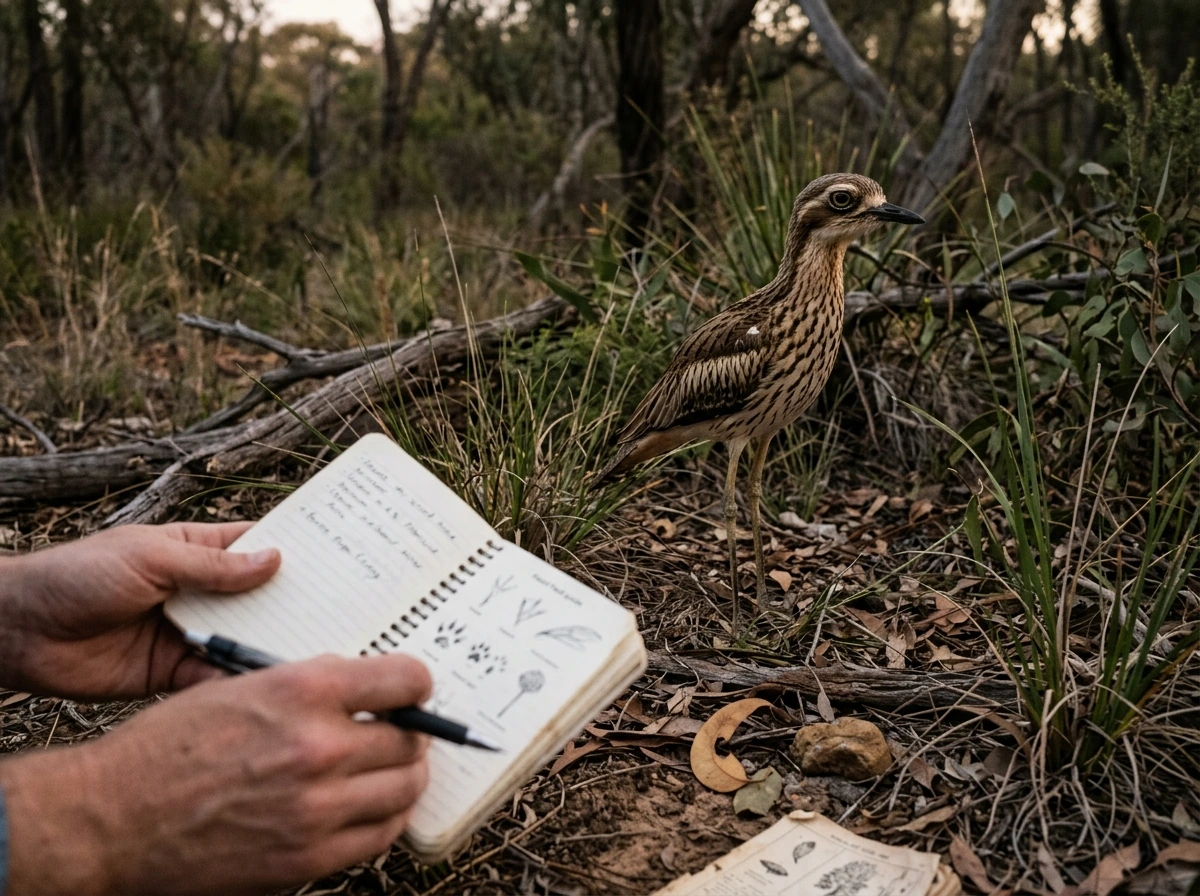
When most people search 'curlew bird meaning,' they're after one of two things: a quick symbolic read ('what does this bird represent?') or a way to interpret something they actually saw or heard. The short answer is this: the curlew most commonly symbolizes longing, melancholy, transition, and the wildness of liminal places, especially in British and Irish cultural tradition. Its haunting, bubbling call is the engine behind almost all of that symbolism. Everything else, from omen readings to tattoo designs to spiritual interpretations, flows from there.
Curlew Bird Meaning: Myth, Spiritual Signs, and Real Sighting Tips

Marcus Blackwell
23 Mar 2026

What a curlew usually symbolizes

In the broadest symbolic terms, the curlew stands for longing, nostalgia, and emotional depth. Britannica notes that curlews are shorebirds in the genus Numenius, characterized by a bill that curves downward (sickle-shaped) curlews are shorebirds in the genus Numenius with a downward-curving, sickle-shaped bill.
That framing is consistent across modern spiritual-interpretation writing, nature essays, and the older British and Irish folklore it draws from. The second major theme is transition: the curlew occupies the edges, moors turning into coast, land giving way to mudflat, summer tipping into autumn. That in-between quality makes it a recurring figure in writing and art about change, seasons shifting, and the bittersweet feeling of something passing.
A third, lighter reading that appears in contemporary symbolic contexts is freedom, often tied to the image of a bird whose call carries across open moorland or estuary with no obstruction.
If you heard a curlew rather than saw one, that's actually the more culturally significant encounter. The call is the whole story with this bird. Almost no other British or Irish wader has generated as much literary and spiritual weight purely from its voice.
Cultural and folklore associations
In UK and Irish folklore, the curlew carries a complicated reputation. The call heard at dusk or in the night was widely interpreted as a bad omen, a signal of approaching storms, or even a portent of death, depending on the region.
In UK and Irish folklore, The Curlew Sounds Project reports that the curlew's nighttime call has often been interpreted as a bad omen, including portents of death or calamity bad omen, a signal of approaching storms, or even a portent of death. These aren't obscure fringe beliefs; they're documented in folklore collections and appear repeatedly in nature writing that draws on oral tradition.
The curlew's cry at night, lonely and falling in pitch, fits the emotional grammar of a warning in a way that's easy to understand even without any supernatural commitment.
At the same time, there's an almost opposite tradition. For generations in some parts of Britain, hearing the curlew's call for the first time in a given year meant spring was coming. That dual role, both ominous and hopeful, is actually typical of birds that occupy liminal spaces in folklore. The curlew isn't comfortably settled on one side of the symbolic ledger. It announces things, but what it announces depends on context.
In older poetry and literature, 'the voice of the curlew' became a shorthand for desolation, distance, and a kind of eerie atmospheric weight. If a poem wanted to place you on an empty moor or a windswept coast and make you feel the loneliness of that landscape, a curlew call in the text did that work efficiently. That literary use has fed directly into how people now interpret curlew encounters as symbols.
For Indigenous Australian traditions, particularly around the Eastern Curlew, there are accounts describing the bird as a curlew bird meaning. This is referenced in broader bird-symbolism discussions, but it's worth being careful here: the 'messenger' framing appears in secondary sources rather than in directly Indigenous-authored material, so treat it as a pointer toward further research rather than a settled cultural fact. If this connection matters to you, looking for Indigenous-authored sources specific to your region is the right next step. For Indigenous Australian traditions and the Eastern Curlew, you can explore how curlew bird meaning is described in community accounts and related scholarship.
Spiritual and nature-meaning interpretations
Modern spiritual writing around the curlew clusters around a few consistent ideas. Longing and emotional release come up constantly, usually tied directly to the bird's call, which practitioners describe as 'emotionally expressive' in a way that mirrors grief, nostalgia, or catharsis. The practical suggestion in these frameworks is that encountering a curlew (especially by hearing it) is an invitation to sit with unprocessed emotion rather than push through it.
The transition theme gets a more specific treatment in shamanic and nature-based spiritual writing: the curlew's migration patterns and its habit of moving between moorland and coast are read as symbolic guidance during periods of personal change. If you're mid-transition, the curlew as a spirit animal or totem is framed as a guide that knows how to move between worlds without losing itself. That's a coherent interpretation when you know the bird's actual ecology.
One detail worth knowing: the curlew's scientific genus name, Numenius, is sometimes linked by spiritual readers to the Latin for 'new moon,' and the species name arquata to the arc of a bow, both of which get incorporated into moon-cycle symbolism and ideas about precision or focus. This is a biological naming convention, not mystical designation, but it does add texture if you're working within a symbolic framework that finds meaning in names.
A grounding note here, and one worth keeping: the RSPB and mainstream naturalists are consistent in pointing out that the curlew's behaviors (calling at dusk, moving between habitats, appearing seasonally) have entirely ordinary biological explanations. Symbolic meaning, if you're going to use it, works best as a personal reflection tool rather than a literal predictive system. The curlew calling at night means a storm might be coming because the bird is sensitive to atmospheric pressure changes, not because the universe is sending you a message. Both readings can coexist, but knowing the difference keeps your interpretations honest.
Curlew in language: idioms and expressions
Unlike the crow or the raven, the curlew hasn't generated a stable body of idioms or fixed phrases in everyday English. You won't find 'curlew' sitting inside common expressions the way 'bird in hand' or 'early bird' does. Most 'curlew meaning' in language is symbolic and atmospheric rather than idiomatic. What the bird has contributed to language is more like a tone than a phrase: its name itself is imitative of its call (an older form of sound-symbolism that entered English partly because the 'cur-lee' cry is so distinctive), and that connection between sound and meaning has made it a reliable atmospheric word in poetry and nature writing. cat bird meaning. claw bird meaning
The practical upshot: if someone uses 'curlew' figuratively in conversation, literature, or art, they're almost certainly reaching for atmosphere, specifically the feeling of wild, empty, emotionally charged landscapes, rather than invoking a fixed cultural shorthand. Context will tell you whether the mood is one of nostalgia, warning, longing, or freedom.
Modern contexts: art, tattoos, and omen readings
In contemporary art and tattoo design, the curlew is almost always rendered through two visual anchors: the long, dramatically curved bill and the suggestion of its open habitat (moor, estuary, shoreline). Sometimes the call is implied through design elements like sound waves or open sky. These choices aren't random; they're pulling directly from the same symbolic vocabulary the folklore established. A curlew tattoo is usually a statement about connection to wild places, emotional depth, or a specific landscape that matters personally to the wearer. It's also increasingly tied to conservation awareness, since the curlew is a declining species in the UK and Ireland, which adds a layer of urgency or mourning to the image.
For omen or sign readings, context does most of the interpretive work. Here's how to read it practically:
- Curlew seen or heard at dusk or night: traditional omen of approaching weather change or storm; in a personal reading, often interpreted as a prompt to pay attention to what's ending or shifting in your life.
- Curlew call heard in spring for the first time: seasonal return, renewal, a signal that something dormant is waking up.
- Curlew seen at a transition zone (estuary edge, where moor meets farmland): reinforces themes of being between two states, useful if you're navigating a life decision or change.
- Single curlew vs. a group: solitary curlews tend to carry stronger associations with loneliness, reflection, or a personal message; groups are more about seasonal movement and return.
- Repeated encounters: if you keep hearing or seeing curlews over a short period, most symbolic frameworks treat that as an amplified signal worth sitting with rather than dismissing.
How to confirm you actually saw a curlew
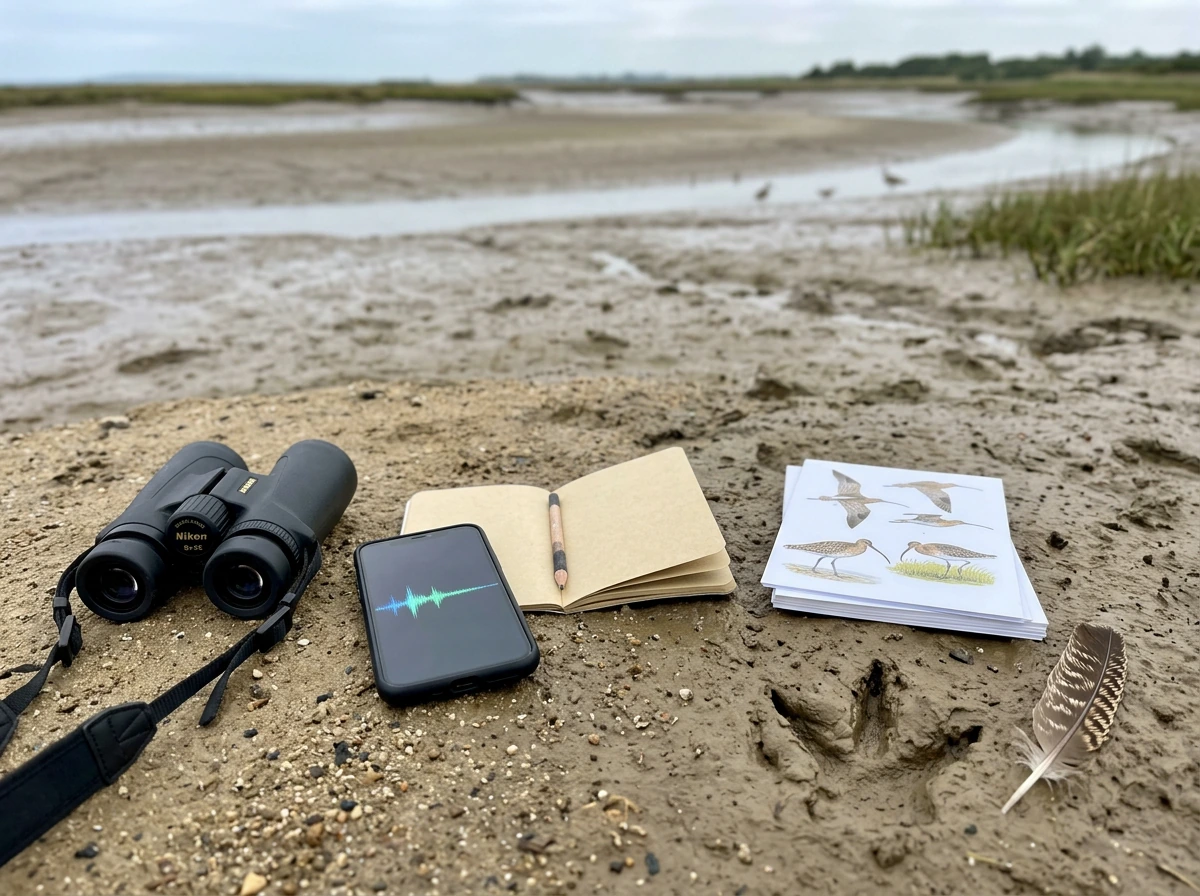
This matters more than it might seem: interpreting the symbolism of the wrong bird is a problem with a simple fix. The curlew is distinctive, but it does get confused with other large waders, especially in poor light or at a distance. If you want a broader directional read, you can also check crawl bird meaning as a related option for how people interpret different bird behaviors and clues.
This matters more than it might seem: interpreting the symbolism of the wrong bird is a problem with a simple fix. The curlew is distinctive, but it does get confused with other large waders, especially in poor light or at a distance. interrogate the symbolism of the wrong bird crawl bird meaning
Key field marks
- Bill: long, strongly downcurved, and quite obvious even at a distance. This is the single most reliable feature.
- Size: the Eurasian curlew is the UK's largest wader, noticeably bigger than a redshank or godwit.
- Plumage: mottled brown and grey on top, streaked below. Not flashy, built for camouflage on moorland or estuary mud.
- Legs: long, bluish-grey.
- Behavior: probes deep into mud with that long bill when feeding, especially on mudflats or estuary edges.
The call is your best confirmation
If you heard the bird but didn't see it clearly, the call is probably enough on its own. The curlew produces a slow, rising 'cur-lee' whistle (the name really does describe it) that can also develop into a fast, bubbling trill during display or excitement. No other common UK wader sounds quite like it. Deep, wild, unmistakable once you've heard it. If you're unsure, search for 'curlew call' in any birding app or audio database and compare.
Common lookalikes
| Bird | Key difference from curlew | Habitat overlap |
|---|---|---|
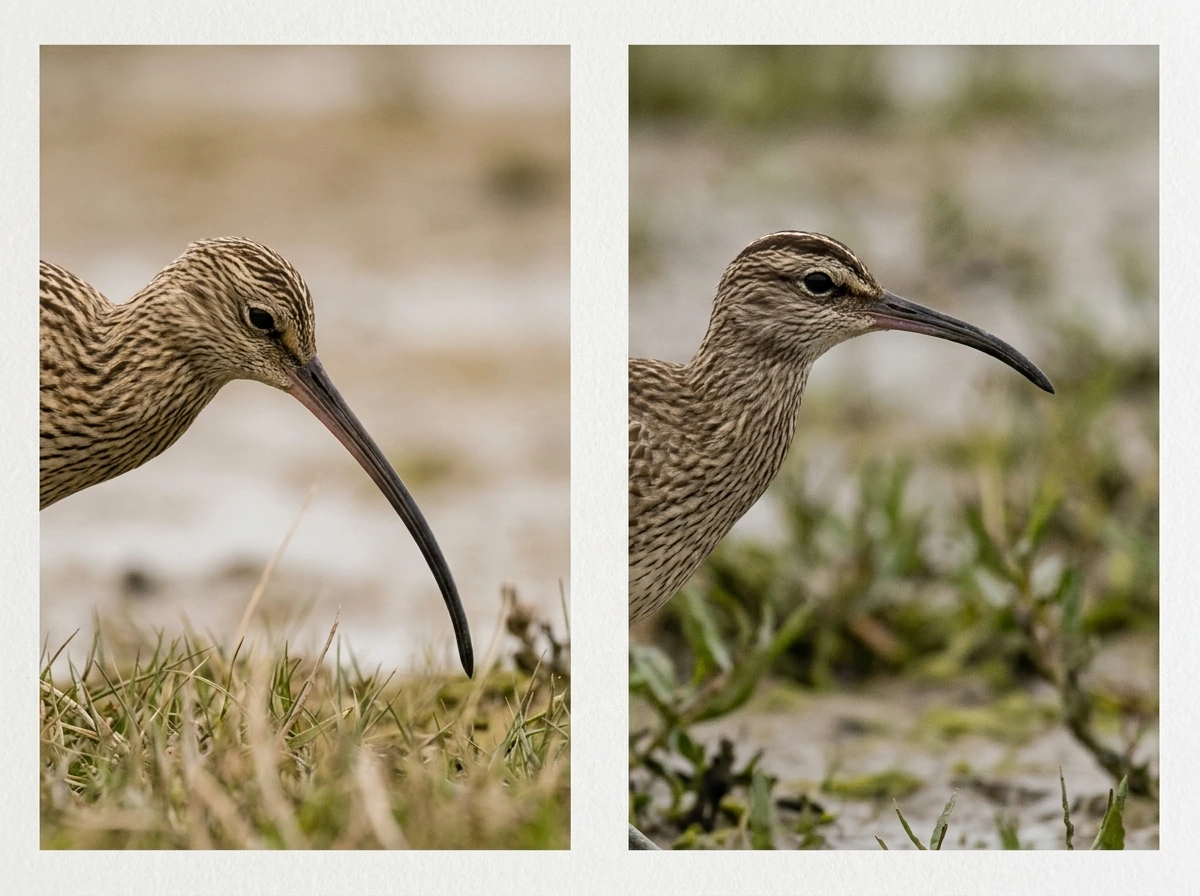
| Whimbrel | Smaller, shorter and less curved bill, striped crown, faster 'tittering' call | Coastal and moorland during migration |
| Bar-tailed godwit | Bill is slightly upturned, not downcurved; bold rusty breeding plumage | Estuaries and mudflats |
| Black-tailed godwit | Straight bill, bold black and white wing pattern in flight | Estuaries, wet meadows |
| Eurasian curlew juvenile | Very similar to adult but bill shorter and less curved in first year | Same as adult |
The whimbrel is the most common source of confusion, especially in spring and autumn when it migrates through the same habitats. The size difference and the bill shape (shorter, kinked rather than smoothly curved) are the fastest way to separate them. The calls are completely different, so if you heard it, that's your clearest path to certainty.
Putting it all together: your practical interpretation
Here's the working framework for anyone who wants a grounded, honest read on a curlew encounter or a general symbolic question:
- Confirm the identification using bill shape, size, habitat, and especially the call. Don't build a symbolic reading on an uncertain ID.
- Note the context: time of day (dusk and night carry different weight than midday), habitat (moor, estuary, farmland edge all shift the reading), and whether the bird was calling.
- Match context to the core symbolic themes: longing and nostalgia, transition between states, seasonal return, or a prompt to pay attention to approaching change.
- Hold the 'omen' framing loosely. The curlew's behaviors have biological explanations. Any symbolic meaning you draw from an encounter is a personal reflection, not a factual prediction.
- If you're exploring further, the curlew's closest symbolic relatives are other birds associated with haunting calls and liminal habitats. Birds like the crow carry some related 'messenger' themes, though the emotional register is quite different.
The curlew is one of those birds where the symbolic and the real are genuinely hard to separate, not because the symbolism is literally true, but because the actual experience of hearing that call across an empty estuary at dusk is exactly as eerie and moving as the folklore suggests. You don't have to commit to a mystical framework to find it meaningful. The bird earns its symbolism honestly.
FAQ
How should I interpret a curlew as a sign without it turning into a fear-prediction?
If you are doing a “sign” reading, the safest rule is to treat a curlew encounter as an emotional prompt, not a prediction. For example, if you heard it at night and felt anxious, the more grounded interpretation is “check what you have been avoiding” rather than “a specific event will happen.”
If multiple curlew meanings fit, how do I choose the right one for what I experienced?
Use timing plus your level of certainty. First, verify whether it was a curlew call (“cur-lee” whistle, then sometimes a bubbling trill) rather than a general wader sound. Second, match the context you were in (dusk, stormy weather, or migration season) to decide whether the dominant theme in your reflection is transition, longing, or warning.
Does the setting (moorland vs estuary) change the meaning I should take from it?
Yes, you can get more accurate by switching from symbolism-only to observation-first. Note whether the bird was on mudflats, moorland, or coastal edge, and whether it was calling from display behavior. Location and behavior often determine whether your reflection should focus on “between worlds” (transition) or “release” (emotional expression).
What if I only saw a bird and didn’t get a clear call, can I still read meaning?
If you only saw the bird briefly, don’t over-interpret the symbolism until you are confident it was a curlew. In poor light, large waders can look similar, so confirmation usually comes from the bill shape (long, strongly down-curved) plus calling. When in doubt, wait to reflect until you can corroborate with a call or clearer sighting.
Is hearing a curlew at night always an omen of something bad?
The most common mistake is assuming “curlew at night” equals “bad omen” every time. Birds may call at night for ordinary reasons like atmospheric conditions or breeding and display cycles, so keep the omen idea as one possible story your mind can tell, not the default conclusion.
Why do some traditions say curlews mean spring is coming, while others say death or storms?
In most folklore use, “hopeful” and “ominous” readings both appear across time and region. A practical way to handle this is to decide what your life theme needs more of right now, then let that be the takeaway, instead of trying to force the bird into a single moral category.
How can I tell whether I heard the curlew or the whimbrel, especially for meaning-based interpretations?
Avoid mixing up curlew meaning with another species. The whimbrel is a frequent confusion source in the same habitats, so if you are relying on sound, compare the call closely. If you are relying on sight, compare bill form and overall size, and use a birding app audio match if possible before you assign symbolism.
Can the genus or species name (Numenius, arquata) be relied on for symbolism?
Don’t treat the Latin name “Numenius” and “new moon” as a guaranteed link. In symbolic practice it can be used as a reflection tool, but keep it framed as wordplay inspired by naming conventions, not as evidence of a specific mystical message.
How do I use a curlew as a totem or spirit animal in a practical way?
If you want a “spirit animal” style reading, a helpful edge case is using it for process rather than identity. For example, think of the curlew as “guidance for moving between habitats” during a specific transition you are experiencing, then set a concrete next step like planning a small change or having an honest conversation.
What makes a curlew tattoo meaning more personal and less generic?
For tattoos, the meaning can become overly generic if you copy a common design without personal context. Add a personal anchor, like the landscape you associate with the call (estuary, moor) or the emotional phase you are working through (grief, release, change), because the bird’s symbolism is strongest when tied to your own experience and location.
Next Article
Curlew Bird Aboriginal Meaning: Stories, Symbolism, and Respectful Next Steps
Curlew bird Aboriginal meaning: symbolism, stories and respectful ways to ask without misusing sacred or restricted know