If you've searched 'African ceiling bird,' you've almost certainly encountered a chirping smoke detector in the middle of the night and turned to the internet for answers. The phrase is overwhelmingly a modern internet meme: online dictionaries, soundboard pages, and meme generators use 'African ceiling bird' as humorous slang for a smoke alarm whose low-battery chirp is mistaken for a bird. That said, there are real birds roosting on ceilings and rafters across Africa, real African folklore about birds in domestic spaces, and legitimate symbolic layers worth knowing. This article covers all three angles so you leave with a complete answer.
African Ceiling Bird Meaning: Definitions, Species & Culture

Marcus Blackwell
17 Jul 2026
Three senses to check before going further
The phrase sits at the intersection of three very different meanings, and which one applies depends entirely on where you encountered it.
- Meme and internet slang: The dominant modern use. Wiktionary records 'ceiling bird' as humorous internet slang for a smoke detector, and Urban Dictionary entries link 'African ceiling bird' specifically to the chirping sound a low-battery smoke alarm makes at 3 a.m. Soundboard sites like MyInstants host an 'African ceiling bird' sound effect button, and Imgflip lists it as a meme template. This is the primary sense you'll find online today.
- Literal roof and ceiling roosters: A genuine natural-history reading. Several African bird species—swifts, swallows, pigeons, weavers, starlings—routinely nest and roost inside buildings, under eaves, or on rafters. If someone in a birding or pest-control context uses the phrase, they probably mean one of these real species.
- Cultural, spiritual, or idiomatic use: The most culturally layered sense. In many African traditions, birds entering or nesting in a home carry symbolic weight as messengers, omens, or ancestral visitors. No single pan-African phrase 'African ceiling bird' has been documented in pre-internet literary or folkloric records, but the symbolic framework around roof-birds is well-attested in regional oral traditions.
The internet meme: why your smoke alarm is a 'bird'
The 'African ceiling bird' meme almost certainly began with the common experience of a smoke detector chirping at irregular intervals due to a dying battery. The sound is genuinely birdlike: a short, high-pitched peep, often coming from a direction that's hard to pinpoint in a dark room. Someone, somewhere, described their frantic 3 a.m. search for the source as hunting an 'African ceiling bird,' and the phrase spread because it was funny and immediately relatable. Meme generators and soundboard sites picked it up, and now it dominates the search results for the phrase. If your search for 'African ceiling bird' started with a mysterious chirp in the night, this is your answer. Check the smoke detectors first.
Literal ceiling birds: real species roosting in African buildings
Across sub-Saharan Africa, several bird groups have adapted so thoroughly to human structures that 'ceiling bird' is a perfectly reasonable description. These birds don't just pass through; they nest, roost, and sometimes raise multiple clutches per year in the same rafter or eave. Here is what the science actually documents.
Swifts and swallows
The Little Swift (Apus affinis) is probably the most iconic building-nester in Africa. eBird/Macaulay species pages for the Little Swift (blank" rel="noopener noreferrer">Little Swift - eBird / Macaulay media) note it is a small swift with a white rump that nests on buildings and under eaves. Field accounts confirm it roosts in its own nest or under eaves and places its nest 'under an overhang or the eaves of buildings, bridges, or a natural rock face.' Colonies can be conspicuous, with dozens of nests packed under a single roof. The African Palm Swift (Cypsiurus parvus) uses palm crowns and eaves, and BirdLife's DataZone specifically notes its use of man-made structures for nesting. The Barn Swallow (Hirundo rustica), which winters across much of Africa, is documented worldwide for nesting 'on beams, rafters, under eaves or in barns and other buildings. Barn Swallow Overview, All About Birds, Cornell Lab of Ornithology documents Barn Swallow (Hirundo rustica) nesting 'on beams, rafters, under eaves or in barns and other buildings' and notes the species winters across much of Africa. ' In Africa, you see Barn Swallows particularly in farm buildings and open-sided structures during the austral summer. Both swifts and swallows are fast, small, and tend to cluster near the ceiling line when inside a building, which makes the 'ceiling bird' label especially apt.
Pigeons and doves
The Rock Pigeon or Feral Pigeon (Columba livia) is the quintessential urban building-nester worldwide, and African cities are no exception. BirdLife's species factsheet describes permanent roosts on buildings and bridges, with rafters, ledges, and broken tiles all serving as nest sites. In many African markets, warehouses, and railway stations, feral pigeons occupy the ceiling structure year-round. Several dove species also use eaves and low overhangs, though they are generally less committed to interior spaces than pigeons.
Starlings, mynas, and sparrows
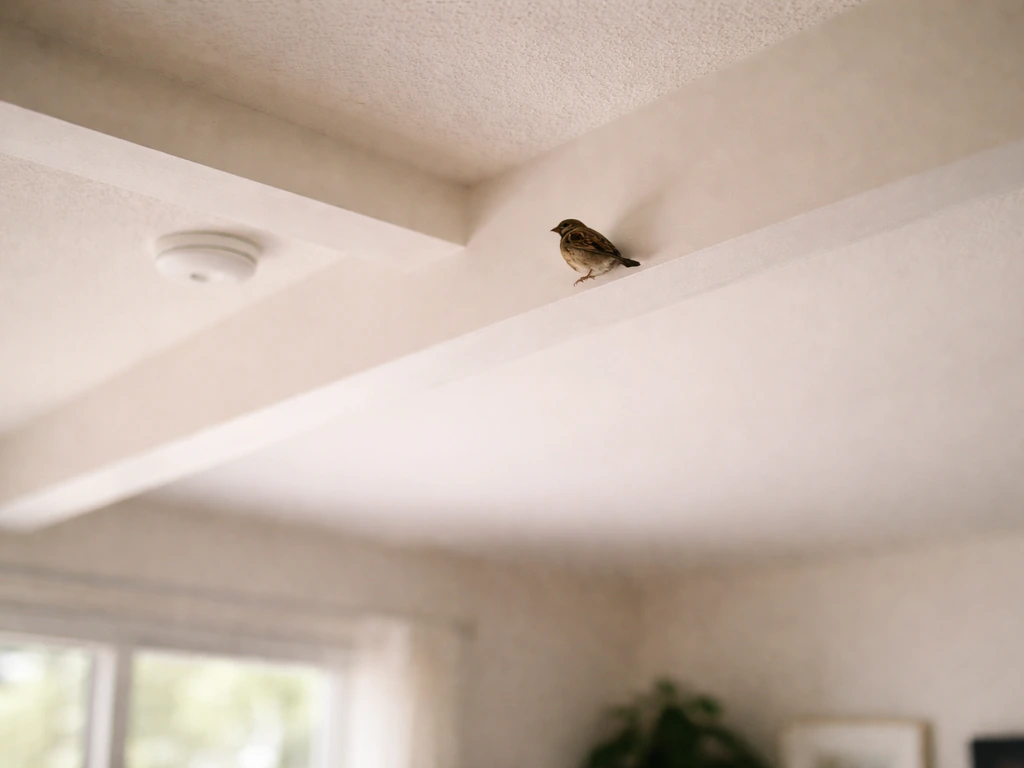
Common Mynas (Acridotheres tristis), introduced across eastern and southern Africa, aggressively occupy building cavities, roof spaces, and eaves. Several native starling species also use holes in walls and eaves. The House Sparrow (Passer domesticus), documented by BirdLife as a confirmed building-cavity nester, forms communal roosts in eaves and roof spaces and is now found in most African urban and suburban environments. These species are often heard before they are seen: rustling, chattering, and scratching in ceiling voids are all characteristic.
Owls and nocturnal visitors
Barn Owls (Tyto alba) are well-named. They roost and breed in roof spaces, church towers, barns, and similar structures across virtually the entire African continent. A Barn Owl in a ceiling void will produce hissing, snoring, and screeching sounds that are decidedly un-birdlike to an uninitiated ear. African Scops Owls and Pearl-spotted Owlets also occasionally use building cavities, though they prefer tree holes. If the mysterious ceiling bird is nocturnal and sounds alarming, a Barn Owl is the first suspect.
Weavers and other nest-builders
Southern Masked Weavers and Village Weavers sometimes attach their pendant nests to overhangs, gutters, or structures immediately adjacent to buildings. Less commonly, they work their way under wide eaves. More relevant to the 'ceiling' label are species like the Red-rumped Swallow and various martin species that construct mud-cup nests directly onto interior rafters or external walls, leaving a recognizable half-cup of dried mud stuck to the surface.
How to identify your ceiling bird: a practical checklist
If you genuinely have a bird in your building and want to identify it, a few targeted observations narrow things down quickly. Work through these in order.
- Size and silhouette: Is it sparrow-sized, pigeon-sized, or owl-sized? A bird that looks like a small crescent or boomerang in flight is almost certainly a swift. A chunky, rounded bird is likely a pigeon or dove.
- Feet and clinging behaviour: Swifts cannot perch conventionally; they cling vertically to walls or hang from nest entrances. Swallows perch on wires and beams but not on walls. Pigeons and sparrows walk and perch normally.
- Droppings and nesting signs: Swift nests are compact, cup-shaped, and glued to a surface with saliva. Pigeon nests are flat, loose platforms of sticks. Mud cups stuck to rafters or walls indicate swallows or martins. White-wash droppings below a beam suggest a regular roost.
- Calls and timing: Heard only at night? Think owl or nightjar. A regular, high, screaming call during daylight flight suggests swifts. Chattering and chirping from a ceiling void suggests sparrows, mynas, or starlings. A single short chirp at irregular intervals, especially at night? Check the smoke detector.
- Timing of activity: Migratory swallows and some swifts are seasonal. Pigeons, sparrows, mynas, and Barn Owls are year-round residents in most African cities.
- Best photos to take: Photograph the nest structure (shape and material), any droppings below the roost, and the bird itself if you can, focusing on tail shape (forked vs. rounded), back colour, and any distinctive rump patch. Post to eBird or iNaturalist for expert community ID, or contact the African Bird Club ([email protected]) for regional advice.
Quick-reference: species, signs, and symbolic associations
| Species | Key ID feature | Roosting/nesting sign | Symbolic notes (African contexts) |
|---|---|---|---|
| Little Swift (Apus affinis) | White rump, tiny, screaming call | Mud-and-saliva nest glued under eave | Speed, agility; in some traditions, swifts are considered untouchable, never landing on earth |
| African Palm Swift (Cypsiurus parvus) | Very slender, pale underparts, palm association | Tiny felt-like pad nest on palm frond or eave | Associated with palm trees, which carry their own spiritual significance across West Africa |
| Barn Swallow (Hirundo rustica) | Long forked tail, rufous throat | Mud-cup nest on rafter or beam | Pan-cultural good luck symbol; arrival signals seasonal change |
| Rock/Feral Pigeon (Columba livia) | Chunky, variable colour, red feet | Stick platform on ledge or rafter, heavy white droppings | Doves and pigeons broadly symbolize peace, ancestral messages in many African traditions |
| Barn Owl (Tyto alba) | Heart-shaped face, white underparts, nocturnal | Pellets, white droppings, eerie screeching | Often an omen of death or misfortune in sub-Saharan folklore; also a protective spirit in some communities |
| House Sparrow (Passer domesticus) | Small, streaked brown, chirping | Loose nest of grass in eave cavity | Commensal with humans; associated with domesticity and community |
| Common Myna (Acridotheres tristis) | Yellow eye patch, white wing flash, loud | Cavity nest stuffed with grass and debris | Invasive; considered a pest bird in many African urban areas; no strong traditional symbolism |
| Smoke Detector (meme sense) | None — not a bird | Low-battery chirp, usually 2–4 a.m. | 'African ceiling bird' in internet slang; the dominant online meaning of the phrase |
Cultural, mythological, and spiritual meanings across African regions
It's important to state upfront: no single documented pre-internet tradition uses the exact phrase 'African ceiling bird' as a fixed cultural term. What does exist, and is well-documented, is a rich and varied body of bird symbolism in African oral traditions where birds in domestic spaces carry layered meaning. The following examples are drawn from documented sources, with uncertainties flagged. See the related piece on majestic bird meaning for how grandeur-associated bird symbolism compares across cultures.
Birds as messengers and omens in East African traditions
A 2026 study published in the East African Journal of Traditions, Culture and Religion, titled 'Voices of the Sky: Birds in Lango Myths and Traditions,' documents birds as messengers and omens in Lango oral culture in northern Uganda. The analysis shows that birds entering homes or behaving unusually near human habitation are interpreted as communications from ancestors or as warnings. This is a pattern that appears across many East and Central African communities, not unique to Lango culture. The Barn Owl is particularly freighted in this context: in many sub-Saharan traditions, a Barn Owl roosting in or near a home is interpreted as a death omen or a sign of witchcraft, though in a smaller number of traditions it serves as a protective spirit. The key caution here is that bird symbolism varies dramatically by ethnic community, region, and even family tradition. A bird that is a good omen in one community may be deeply feared in a neighboring one. If you are researching a specific tradition, a local-language consultation is essential.
Swallows, swifts, and the domestic sphere
The Barn Swallow enjoys broadly positive symbolism across much of Africa, as it does globally. Its arrival signals seasonal change, and in farming communities its return to a familiar rafter is often read as a sign of continuity and good fortune. Swifts occupy a more ambiguous symbolic space. Their habit of never landing on the ground, their screaming calls, and their aerial mastery have generated beliefs in several traditions that they are untouchable or semi-spiritual creatures. Whether this translates to a specific 'ceiling bird' meaning depends on the community and context.
Pigeons, doves, and ancestral communication
Across West, Central, and Southern Africa, pigeons and doves appear in oral tradition and ritual practice as vehicles for ancestral messages or spiritual communication. A dove that enters a house unexpectedly is often read as a sign from a deceased relative. This is broadly documented in Zulu, Shona, Igbo, and Akan traditions, among others, though the specific interpretation varies. The connection between doves and peace is also present but is often overlaid with older, more complex meanings that predate Christian or Islamic symbolism in the region.
A note on uncertainty
Much African bird symbolism is transmitted orally, varies by community and generation, and has not been systematically collected in accessible English-language sources. Claims found on general symbolism websites should be treated with caution. For serious research, the African Bird Club, university ethnobiology departments, and regional oral-history archives are the most reliable starting points.
Figurative, idiomatic, and modern slang uses
Outside the meme context, 'ceiling bird' and variations of the phrase appear in a few distinct figurative registers, each worth understanding separately.
Internet slang: the smoke detector bird
As already established, this is the dominant modern use. 'African ceiling bird' functions as a euphemism or comedic label for a chirping smoke detector. The humor relies on the confusion of a manufactured sound for a living creature, and the 'African' modifier amplifies the absurdity by suggesting the chirp is exotic and unidentifiable. The phrase circulates on social media, in forum posts, and as a soundboard button. It has no fixed metaphorical extension beyond the literal joke.
Figurative uses in creative writing and music
In African creative writing and oral poetry, a bird under the roof or in the rafters frequently serves as a metaphor for something that cannot be named directly: a secret, a premonition, a presence from the spirit world. The 'ceiling bird' as a figurative device appears in this tradition without being a fixed idiom. A character might describe hearing 'a bird in the ceiling' to indicate an uneasy awareness of something approaching, drawing on the same cultural reservoir as the omen-bird traditions described above. This usage is contextual and literary rather than idiomatic in the strict sense.
How context shifts the meaning
If someone uses 'African ceiling bird' in a late-night social media post about sleep deprivation, the meme reading is almost certain. If it appears in a short story set in rural East Africa, the omen-bird reading is more plausible. If it turns up in a pest-control forum, someone genuinely has a bird in their roof. Context is everything, and the phrase is too new and too loosely defined to have a single stable meaning outside the meme sense.
How 'African ceiling bird' compares with related bird symbols
It helps to place this phrase alongside the broader family of bird-symbol keywords it sits near. Each comparison reveals something about what 'African ceiling bird' is and is not.
| Term | Primary symbolic register | Visual character | How it differs from 'African ceiling bird' |
|---|---|---|---|
| Ceiling bird (generic) | Internet meme: smoke detector | No fixed visual; the joke is that there's no bird | The generic form; 'African' is added for comic exaggeration |
| Magpie | Folklore omen (good/bad luck by count), intelligence, theft symbolism | Black-and-white, long tail, bold and conspicuous | Established pre-internet folklore tradition across Eurasia; complex, documented symbolism vs. a modern meme phrase |
| Grackle | Urban trickster, iridescent, loud and bold | Iridescent black, yellow eye, strutting | North American cultural register; similar to 'African ceiling bird' in urban-commensal context but with more folkloric depth |
| Crested bird | Authority, royalty, spiritual elevation | Prominent head crest as the defining visual feature | Describes a visual and symbolic type; 'African ceiling bird' is behaviorally defined, not visually |
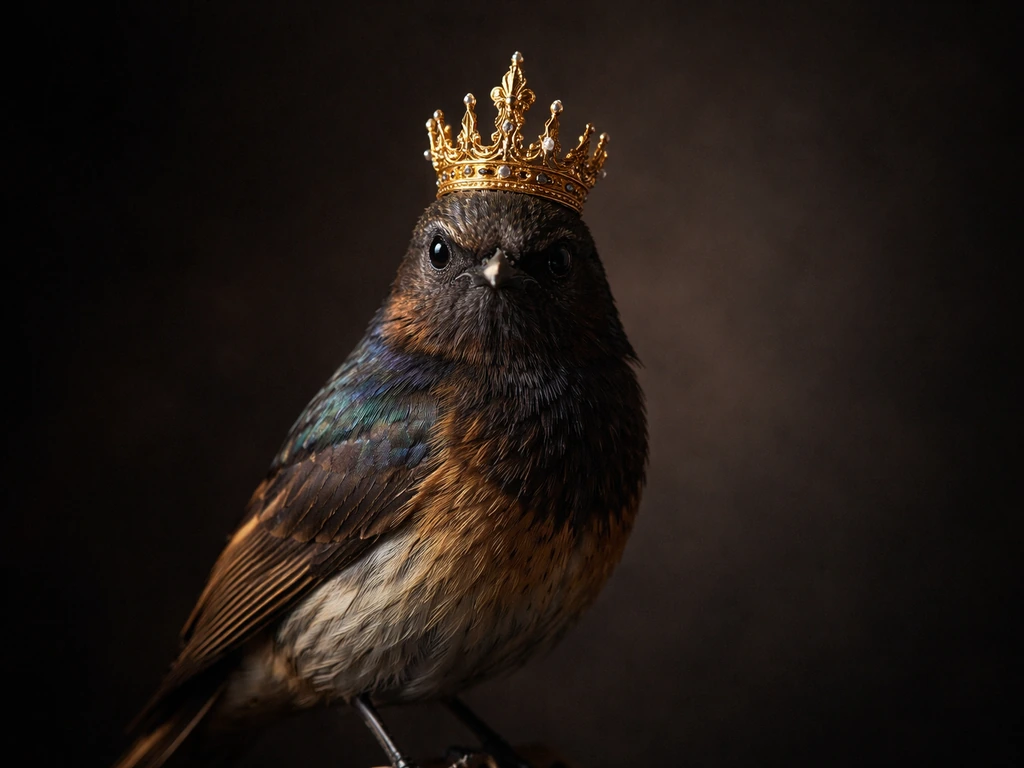
| Bird with crown | Kingship, divine sanction, regal power | Literal crown-like crest or adornment | Highly positive, regal symbolism; contrasts sharply with the comic or ominous ceiling-bird register |
| Majestic bird | Awe, power, freedom, the sublime | Large wingspan, soaring, commanding presence | The opposite of a ceiling bird: seen at height in open sky, not tucked into a rafter |
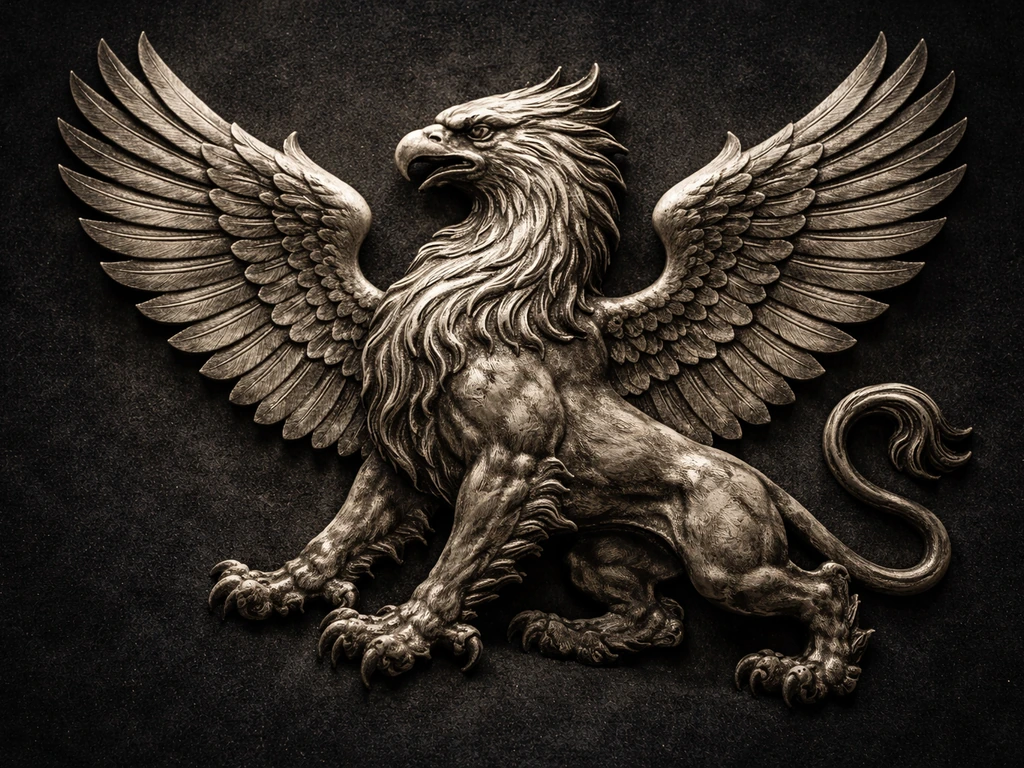
| Griffin | Mythic hybrid power, guardian, heraldic strength | Lion body, eagle head and wings; purely imagined | A mythic construct with no behavioral reality; shares visual grandeur with majestic birds but is entirely symbolic |
The contrast with the magpie is especially instructive. The magpie carries centuries of documented folklore, regional variation, and literary use. The 'African ceiling bird' phrase, by contrast, appears to have emerged from digital culture within the last decade or so, with almost no pre-internet paper trail. That doesn't make it meaningless, but it does mean the meaning is unstable and still forming. The crested bird and bird-with-crown traditions represent the aspirational, elevated end of bird symbolism, where birds signal divine authority or royal status. For more on bird-with-crown traditions and the bird with crown meaning across cultures, see the related guide on bird-with-crown symbolism. See also griffin bird meaning for how legendary hybrid birds convey authority and royal symbolism. The ceiling bird, in all its senses, operates at the opposite end: domestic, unglamorous, and grounded in everyday confusion rather than mythic grandeur.
Where to go for more reliable answers
If you need a confirmed identification of a real bird in your building, the best tools are eBird (which links to the Macaulay Library's photo and audio archive with photographer credits and license data), iNaturalist for community-assisted ID, and the Southern African Bird Atlas Project (SABAP2) hosted by the FitzPatrick Institute at UCT for southern African range data. For related information on urban, roosting birds and their cultural symbolism, see grackle bird meaning. For cultural or spiritual meanings tied to a specific African tradition, the African Bird Club ([email protected]) can point you toward regional experts, and university ethnobiology or oral-history departments in the relevant country are often the most reliable sources. General symbolism websites frequently over-generalize across an enormously diverse continent; when in doubt, go local.
FAQ
What does the phrase “African ceiling bird” most likely mean?
There are two primary, evidence-backed senses: (1) Literal—an actual bird species in Africa that nests, roosts or is commonly seen on building ceilings, eaves, rafters or other overhead domestic structures (candidates: swifts, swallows, pigeons, sparrows, starlings/mynas). (2) Modern internet/meme slang—a humorous or ironic label (often applied to an alarm/chirping smoke detector or a mysterious overhead chirp) documented on meme/soundboard sites (e.g., MyInstants) and in crowd-sourced dictionaries. Where context is unclear, treat the term as ambiguous and check whether the user means a real bird observation or an online meme.
What literal bird species in Africa are good candidates for being called a “ceiling bird”?
Key candidates with documented habits of roosting/nesting on eaves, rafters or building ceilings: Little Swift (Apus affinis), African Palm Swift (Cypsiurus parvus), Barn Swallow (Hirundo rustica), Rock/Feral Pigeon (Columba livia), House Sparrow (Passer domesticus), and various starlings or mynas. Field guides and species accounts (BirdLife, eBird/Macaulay Library, Cornell Lab) list nesting/roosting behavior on buildings for these species.
How can I visually identify likely “ceiling bird” species from photos or a quick look?
Identification tips: Little Swift—small, cigar-shaped, fast flier with a white rump patch; nests under eaves. African Palm Swift—very long wings and long forked tail resembling a flying crescent; often around palms and eaves. Barn Swallow—blue iridescent back, reddish throat, deeply forked tail, nests on rafters/under eaves. Rock Pigeon—chunky dove with variable grey plumage, often on ledges. House Sparrow—small, stocky, brown-streaked with stout bill. Use behavior (clinging to rafters, nesting in cavities, flocking in roosts) plus tail/wing/size cues to separate species; consult Macaulay Library/Wikimedia Commons photos for comparison.
Where can I find reliable photos to illustrate each candidate species and ensure proper licensing?
Use the Macaulay Library (eBird) for high-quality photos with photographer credits and provenance, and Wikimedia Commons for CC‑licensed images (many with Flickr-to‑Commons transfer and clear attribution). Always check the asset’s license/credit on the media page before reuse; examples: Macaulay ML637927154 (Barn Swallow) and Commons image of African Palm Swift (CC BY‑SA).
Does the phrase have documented cultural, mythological, or spiritual meanings in African contexts?
Birds as overhead messengers or omens appear in many African oral traditions and ethnographies (e.g., regional studies such as 'Voices of the Sky' on Lango myths). However, there is little or no authoritative pre‑internet evidence that the exact phrase “African ceiling bird” is an indigenous idiom. The plausible cultural reading—an overhead bird as messenger, omen, or spirit—exists in many local traditions, but any claim linking the precise phrase to specific cultural beliefs should be treated as uncertain and verified locally.
Are there known idiomatic, literary, or slang uses of “ceiling bird” or “African ceiling bird”?
Yes—modern internet slang and memes: Wiktionary lists 'ceiling bird' as humorous slang (sometimes for a smoke detector), Urban Dictionary has related crowd-sourced senses, and soundboard/meme pages (MyInstants) host an 'African ceiling bird' button/sound effect. These uses are recent and primarily digital; they appear to be meme-based rather than longstanding idioms or literary tropes.