Most of the time, 'ceiling bird' is internet slang for a smoke detector, specifically one that chirps repeatedly when its battery is dying. That's the definition you'll find on Wiktionary and Urban Dictionary, and it's probably the most common reason someone ends up searching the phrase. But 'ceiling bird meaning' can also point to three other very real situations: a live bird that's gotten inside your home and is flying around near the ceiling, a piece of ceiling art or decor featuring a bird motif that you're trying to decode symbolically, or a phrase or superstition someone mentioned to you that you're now trying to track down. Each of those leads somewhere completely different, so the first job is figuring out which one applies to you.
Ceiling Bird Meaning: Real Birds, Decor, and Symbolism Explained

Marcus Blackwell
17 May 2026
What 'Ceiling Bird' Actually Refers To
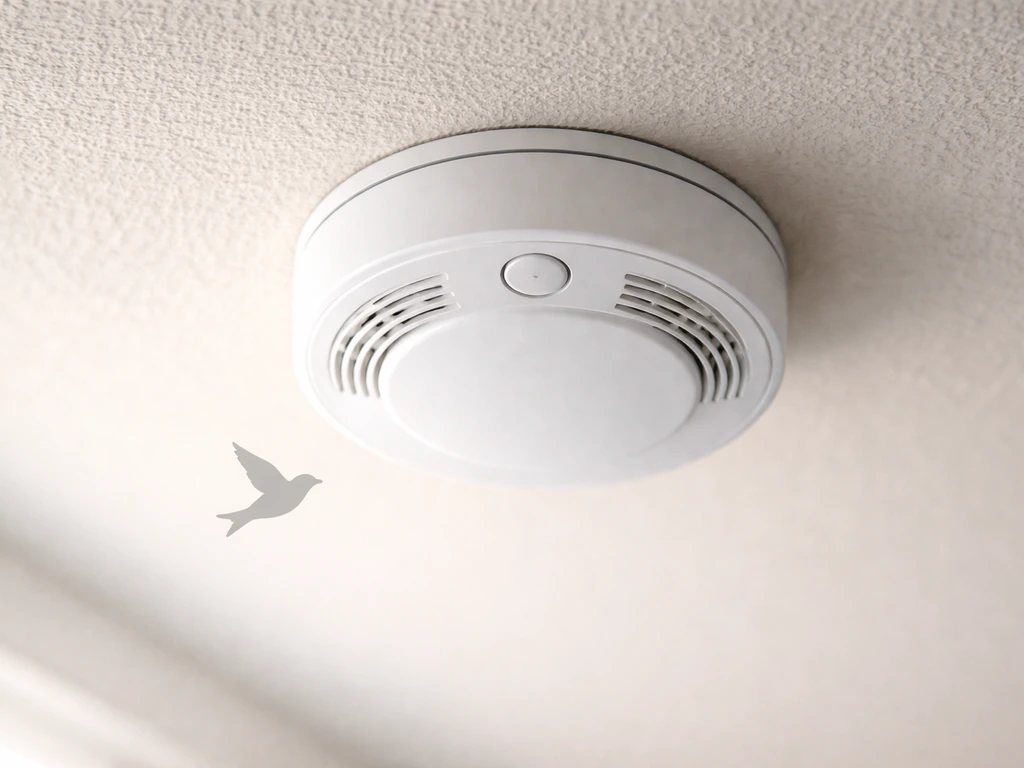
The slang usage is the most documented one. Wiktionary lists 'ceiling bird' as an internet slang synonym for smoke detector, and Urban Dictionary describes it specifically as 'a constantly chirping smoke detector which is usually mounted on the ceiling, typically needing a new battery.' There's even a meme built around the concept. A Memedroid page for the “Ceiling bird” meme uses an image labeled “Smoke Detector,” matching the everyday meaning of the term “Smoke Detector” meme labeling. So if you woke up at 3 a.m. to a chirping sound coming from above you and started googling, that's your answer: replace the battery.
Beyond the slang, 'ceiling bird' appears in a few niche contexts. In philately, it shows up as a catalog label in collections of bird-themed stamps. In art history, birds painted on ceilings have a long tradition, from the trompe l'oeil sky-filled-with-birds studies held at The Met to the bird motifs designed for the ceiling of the Louvre. There's also 'African ceiling bird,' which circulates as the name of a meme coin on the Solana blockchain, complete with a fictional 'discovery' story and a disclaimer that it has no intrinsic value. It is not a real bird species. Knowing these possibilities helps you figure out which path you're on.
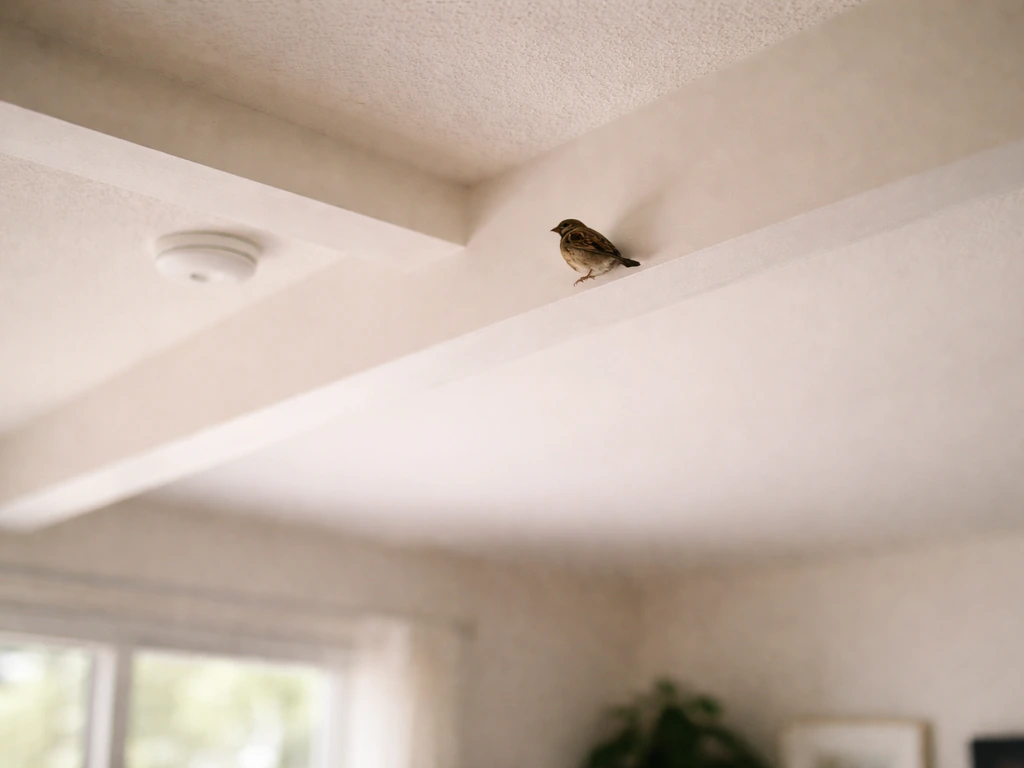
If There's a Real Bird Flying Around Inside
A bird trapped indoors is disoriented and stressed, and it almost always ends up near the ceiling because birds instinctively fly upward toward light. Your goal is to give it a clear exit without chasing it into further confusion. Here's what actually works:
- Close off as many rooms as possible so the bird is contained in one space. The fewer options it has, the easier this gets.
- Turn off or dim interior lights. Bright light indoors competes with the natural light from the exit you're about to create, which confuses the bird.
- Open a window or door to the outside, ideally the largest one available and the one that lets in the most daylight.
- Leave the room. Give the bird 15 to 20 minutes without human pressure. Birds often find their own way out once the path is obvious and the room is quiet.
- If it's nighttime, place a light source outside the window to draw the bird toward it, then turn off all interior lights.
- If the bird has hit something and is sitting still on the floor or furniture, resist the urge to pick it up immediately. Give it time to recover. If it's clearly injured, contact a licensed local wildlife rehabilitator rather than attempting to handle it yourself.
One specific hazard worth highlighting: ceiling fans. Veterinary sources are emphatic on this point. Ceiling fans are one of the most common causes of serious bird injury, whether it's a pet bird or a wild one that's gotten inside. Turn off any ceiling fan the moment you realize a bird is in the room. A bird flying near the ceiling has no reliable way to perceive a slowly spinning fan blade until it's too late.
If the bird won't leave on its own after a reasonable amount of time, or if you're not comfortable trying to guide it out, professional wildlife removal services can handle it without risk of injury to you or the bird. Birds that become trapped and can't escape may eventually die inside a wall or attic space, which creates its own problems, so don't wait indefinitely if the situation isn't resolving.
If It's Ceiling Art or Decor with a Bird Motif
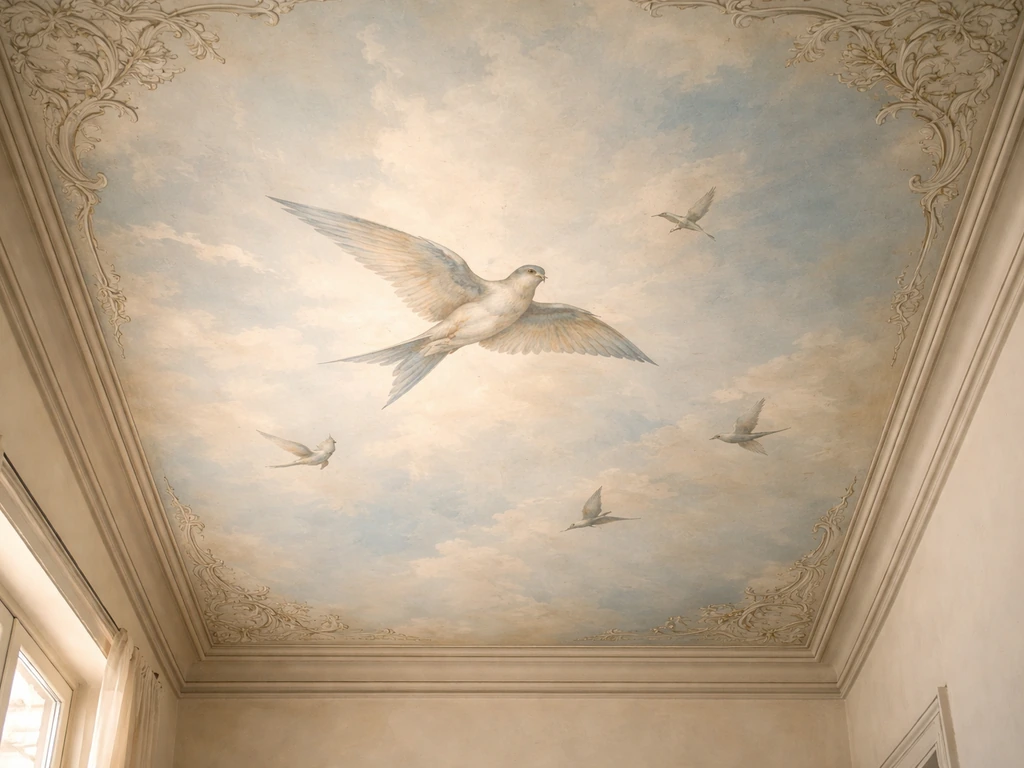
Birds painted or carved on ceilings carry some of the richest symbolic weight in world art. The placement matters: a ceiling positions the bird in the sky, the realm of gods, spirits, and the divine. That's not an accident. In East Asian art, the Inmyeonjo, a human-faced bird, appears in Goguryeo tomb murals specifically on the ceiling of burial chambers, including the northeast ceiling of the burial chamber at Muyongchong. Its placement overhead was deliberate, connecting the deceased to a higher spiritual realm. In Western decorative tradition, ceiling birds like the trompe l'oeil skies painted by 18th-century European artists carried ideas about heaven, freedom, and the boundlessness of the natural world brought indoors.
To interpret a specific bird on a ceiling, you need to identify the bird first, then consider the cultural tradition the artwork comes from. A bald eagle on the ceiling of an American government building (and one does appear in the art of the U.S. Senate Reception Room) signals national authority and power. A dove in a Christian chapel ceiling suggests peace and the Holy Spirit. A phoenix in East Asian ceiling art means renewal and transformation. The bird species plus the cultural context almost always gives you the meaning.
What Different Birds Commonly Symbolize
Bird symbolism varies by culture, but certain themes repeat across traditions, especially when birds are shown in elevated positions like ceilings or high places. Here's a practical breakdown of the most commonly encountered meanings:
| Bird or Trait | Common Symbolic Meaning | Cultural Context |
|---|---|---|
| Eagle (especially bald eagle) | Power, freedom, divine authority, national identity | Native American, American civic, ancient Roman |
| Dove | Peace, purity, the Holy Spirit, new beginnings | Christian, Mediterranean, broadly Western |
| Crane | Longevity, wisdom, good fortune, loyalty | East Asian (Chinese, Japanese, Korean) |
| Raven / Crow | Prophecy, intelligence, death omens, transformation | Norse, Celtic, Indigenous North American |
| Owl | Wisdom, death, hidden knowledge, the underworld | Greek, Roman, many Indigenous traditions |
| Phoenix | Rebirth, renewal, immortality, rising from destruction | Chinese, Egyptian, Greek mythology |
| Swallow | Home, loyalty, safe return, spring/hope | European maritime folklore, general Western |
| Peacock | Immortality, beauty, royalty, spiritual vision | Hindu, Persian, early Christian |
| Human-faced bird (Inmyeonjo) | Soul of the deceased, spiritual messenger, liminal being | Korean/East Asian tomb art and mythology |
| White bird (general) | Purity, spirit, divine messenger, peace | Widespread across many traditions |
| Crested bird | Leadership, heightened perception, spiritual authority | Various, especially Egyptian and African traditions |
If you're decoding a ceiling mural or decorative piece and the bird is unfamiliar, look at secondary details: what is the bird carrying (a scroll, a branch, a flame)? What surrounds it (clouds, stars, geometric patterns)? These elements usually confirm the intended meaning. The crested bird meaning and the bird with crown motif are related categories worth exploring if you're seeing a bird with a distinctive head feature, since those carry their own layered symbolism across African, Egyptian, and European traditions. If you're trying to interpret a bird with a crest or crown, the crested bird meaning can help narrow down the symbolism. If you’re specifically looking at a headpiece or crest-like feature, a bird with crown meaning can add another layer to the symbolism. The griffin bird meaning is commonly tied to strength, protection, and powerful spiritual symbolism across different traditions.
If You Heard 'Ceiling Bird' Used as a Phrase or Superstition
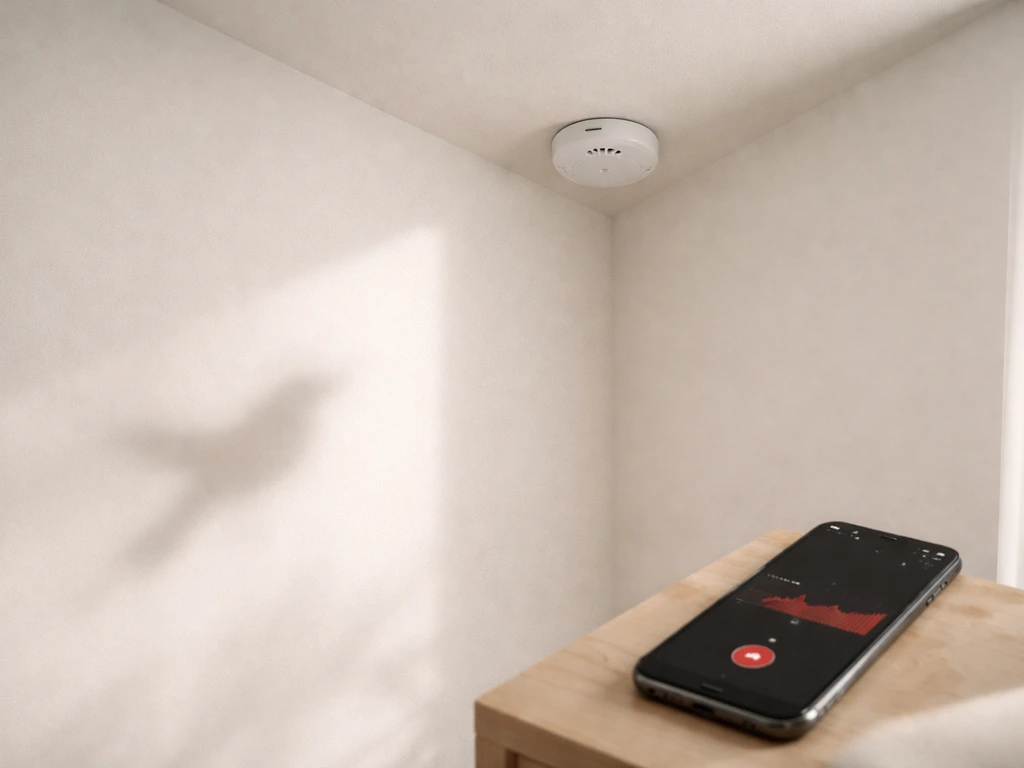
'Ceiling bird' does not appear in documented folklore as a traditional omen or proverb. Unlike phrases such as 'a bird in the hand' or the longstanding superstition that a bird flying into a house signals a death in the family, 'ceiling bird' as a phrase has no verified pre-internet history. Wiktionary explicitly classifies it as internet slang rather than a standard English expression with folk roots. So if someone told you that 'ceiling bird' is an old superstition or a sign of something, it's worth a healthy skepticism.
To verify any phrase someone presents as a superstition or traditional saying, run it through a few checks. First, can you find it in a documented folklore archive, a historical dictionary, or a reputable mythology source? Second, does the person who told you it give a specific cultural origin (a particular country, ethnic tradition, or historical period)? Vague claims like 'it's an old saying' without a verifiable source are a red flag. Third, does the meaning they describe match what birds symbolize in the culture they're citing? The symbolism should be internally consistent with that tradition. If 'ceiling bird' as a phrase was presented to you with a specific cultural claim you want to verify, start with that culture's documented bird symbolism and work outward.
The 'African ceiling bird' variant is a clear example of internet fiction: the website around it explicitly carries a meme coin disclaimer stating it has no intrinsic value and is not connected to any real wildlife or cultural tradition. If you encountered this version of 'ceiling bird,' you can safely treat it as a creative internet concept rather than documented symbolism.
How Ceiling Placement Changes Bird Symbolism
Even setting aside specific species, the fact that a bird appears overhead carries meaning on its own. Across many traditions, height equals access to the divine. Gods live above. Spirits ascend. Guidance comes down from above. When birds are placed on ceilings in sacred or ceremonial spaces, the position amplifies whatever the bird itself already represents. A crane on a wall is auspicious. A crane on the ceiling of a tomb is explicitly guiding the soul upward. A dove in a painting is peaceful. A dove painted above an altar is a direct invocation of the Holy Spirit descending. The overhead position is almost never neutral in religious or spiritual art.
This is also why birds overhead have such persistent omen associations in folklore. A bird entering your home and flying near the ceiling is, symbolically speaking, a visitor from a higher realm entering your personal space. Whether you read that as threatening or protective depends entirely on the cultural tradition you're working within. In some European folklore, it's a death omen. In others, it's a messenger from an ancestor. In still others, it's purely neutral and the practical concern is just getting the bird back outside safely.
Quick Decision Checklist: Figure Out Your Situation
Use this to settle on which interpretation applies to you, then take the matching action.
| Your Situation | What It Most Likely Is | What to Do Next |
|---|---|---|
| Heard chirping from the ceiling, especially at night or in a regular pattern | Smoke detector with a low battery (internet slang: 'ceiling bird') | Replace the 9V or AA battery in your smoke detector |
| A live bird is inside your home and flying near the ceiling | Wild or escaped pet bird trapped indoors | Close off rooms, dim lights, open a window/door, step back, wait 15-20 min; call wildlife rehab if injured |
| A bird is near or hit your ceiling fan | Collision hazard, possible injury | Turn off the fan immediately; assess the bird; contact a vet or wildlife rehab if injured |
| You see a bird painted or carved on a ceiling in a home, gallery, or sacred space | Decorative or spiritual ceiling bird motif | Identify the species, look up the cultural tradition of the artwork, check the symbolism table above |
| Someone used 'ceiling bird' as a phrase, omen, or saying | Likely internet slang or informal usage, not a documented proverb | Check Wiktionary, a folklore archive, or the specific cultural tradition cited; treat unsourced claims with skepticism |
| You saw 'African ceiling bird' online | Solana meme coin, internet fiction, not a real species or cultural symbol | Disregard as a wildlife or symbolism source; it's a fictional concept created for a cryptocurrency project |
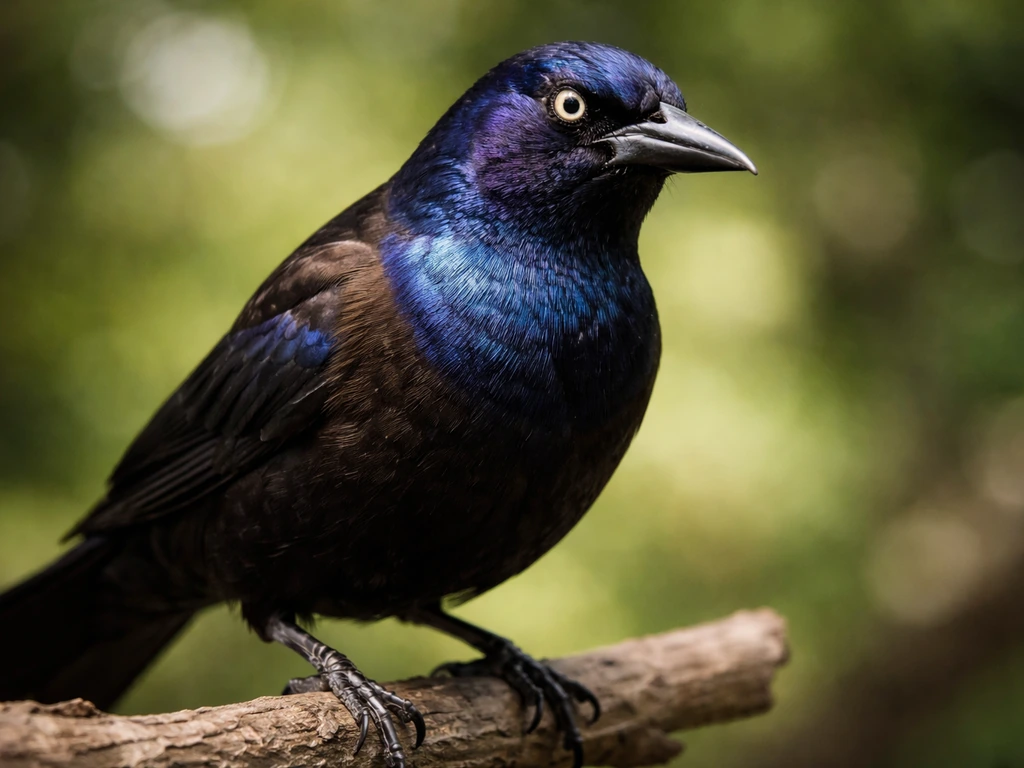
If you're here for the symbolism and want to go deeper, the most rewarding directions are the specific bird species involved (magpies, grackles, and crested birds each carry very distinct meanings across cultures) or the artistic tradition the ceiling image comes from. In many cultures, the grackle bird meaning is tied to themes like intelligence, resourcefulness, and adaptation. If the bird in question is a magpie, its magpie bird meaning can add extra layers to the overall interpretation. Bird symbolism in art and mythology rewards specificity: the more precisely you can identify the bird and its cultural home, the richer and more accurate the meaning you'll uncover.
FAQ
If my “ceiling bird” is chirping, how do I confirm it is a smoke detector battery low and not something else?
Check the label or test button on the device on the ceiling. A low-battery smoke alarm usually chirps in a repeating pattern (often once every 30 to 60 seconds) and may stop after a fresh battery. If the chirp continues after replacing the battery, verify the alarm model (smoke vs. CO) and consider checking other ceiling alarms, since interconnected systems can chirp across multiple units.
What should I do right away if I have a live bird flying near the ceiling?
First, turn off ceiling fans and keep doors to other rooms closed if possible, then open one exterior door or window and block other escape routes so the bird funnels toward the exit. Avoid loud chasing or turning on bright lights that create glare, since sudden changes can increase panic and keep the bird circling the ceiling.
How long is “reasonable time” to wait before calling wildlife removal, and what signs mean I should not wait?
If the bird has not found the exit after roughly 15 to 30 minutes of clear access, or it is repeatedly hitting walls, getting tangled, or unable to perch and calm down, call a local wildlife service. Also call sooner if the bird appears injured, is trapped in an attic or between floors, or you suspect hazardous conditions like a damaged power fixture or attic insulation access point.
Is it ever safe to catch a ceiling bird directly with my hands or a towel?
Only as a last resort and with care, because stressed birds can bite or scratch and can also break feathers or wings. If you must intervene, use a towel to gently guide the bird into a box or carrier, and wear thick gloves if available. Otherwise, prioritize making a single clear exit and letting the bird leave on its own.
Can a bird motif on a ceiling mean something different depending on whether it is a painted sky or a realistic animal?
Yes. A trompe l’oeil “sky” effect often emphasizes heaven, openness, and spiritual ascent, while a more literal, grounded bird study can focus on the bird as an emblem (for example, dove as peace). Look for framing elements such as halos, crowns, clouds, or insignia, since those usually indicate whether the intention is symbolic elevation or a specific character trait.
How do I interpret a ceiling bird if I cannot confidently identify the species?
Use identifying cues beyond color, especially beak shape, crest or crown, tail length, and any objects the bird carries. Then match those cues to the likely cultural style of the space, since the same species feature can be drawn differently across traditions. If you still cannot narrow it down, interpret at a higher level (for example, “messenger,” “protection,” or “renewal”) rather than forcing a specific species meaning.
Do ceiling birds always have spiritual or omen meaning, or can it be purely decorative?
It can be purely decorative, especially in residential or modern interior design, where birds are used as aesthetic motifs. The strongest indicators of intentional spiritual symbolism are sacred context markers (chapel, tomb, temple), iconographic repetition (stars, divine rays, altar placement), or known artists and periods associated with religious iconography.
What does it mean if a bird appears on a ceiling above a doorway or altar area, versus just anywhere on the ceiling?
Placement changes emphasis. Birds positioned above a focal point like an altar, throne, or ceremonial entrance are more likely to function as an invocation, blessing, or spiritual “authority mark.” If the bird is placed randomly for balance in a living room ceiling, the meaning is more likely decorative or thematic rather than a message aimed at a ritual focal point.
I heard “ceiling bird” is an old superstition, is that reliable?
Be cautious. The term is best treated as internet slang rather than a documented, folk-rooted proverb. If someone claims it is traditional, ask for the specific region and historical source, then compare the described meaning against what birds symbolize in that culture, because mismatches are common when the story is invented.
What’s the best way to interpret a specific named motif like “crested bird,” “bird with crown,” or “griffin” on a ceiling?
Start with the motif’s defining feature (crest/crown/hybrid form), then consider whether the artwork is aiming for status and authority (crown or imperial cues), spiritual defense (griffin-like protective symbolism), or a particular cultural lineage. If the motif appears alongside specific objects such as scrolls, flames, or religious emblems, that usually resolves the ambiguity more effectively than bird name alone.
Next Article
Grackle Bird Meaning: What It Really Symbolizes and Means
Grackle bird meaning decoded: symbolism, folklore, and what a grackle sighting can signal from behavior and season cues.