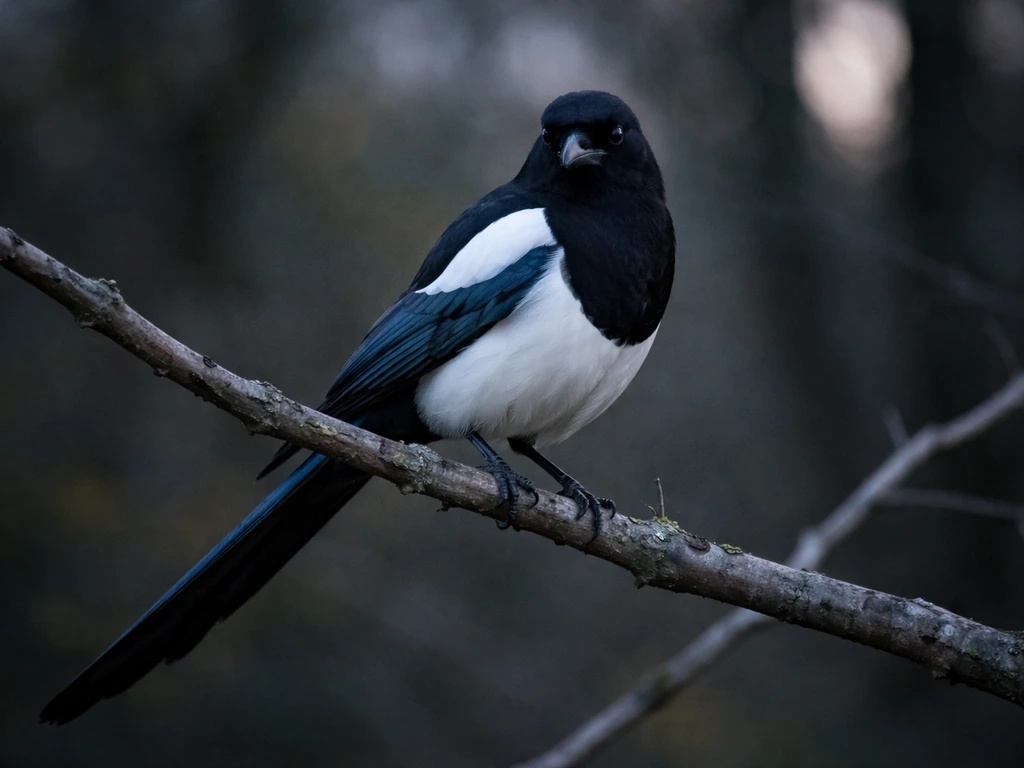
Spiritually, the magpie is most commonly interpreted as a symbol of duality, intelligence, balance, and the need to pay attention to what is happening around you right now. If you are here because you just saw one and want to know what it means, the short version is this: it almost certainly means something to you personally, and that matters more than any rhyme or superstition.
Core symbolism across folklore and culture
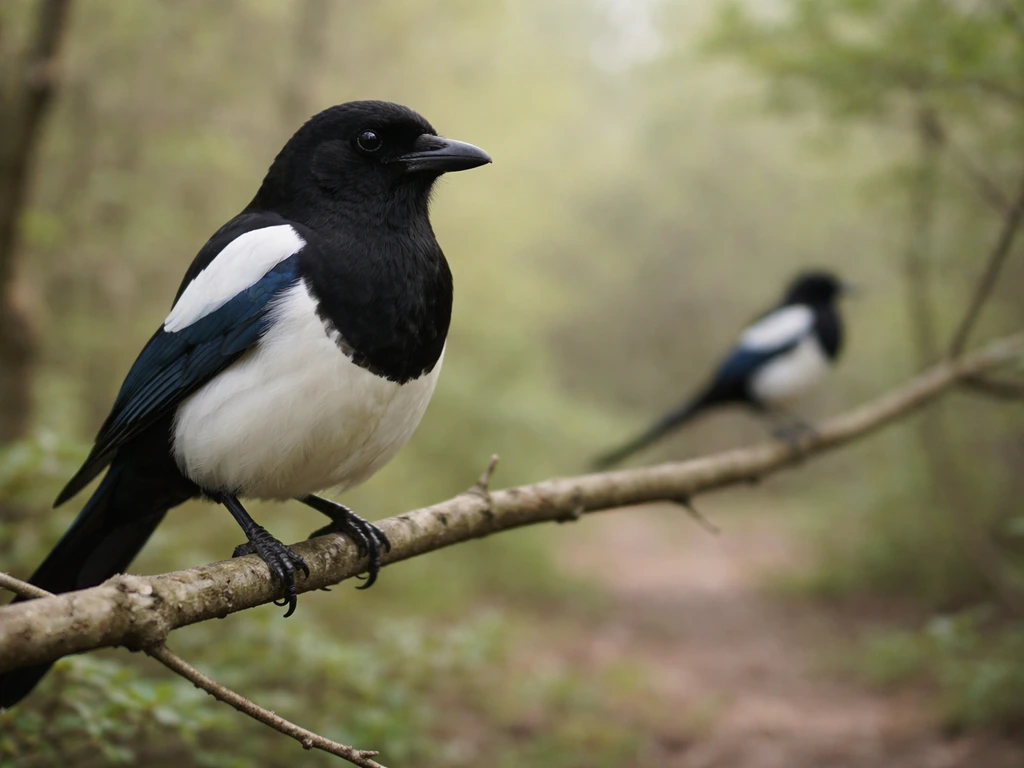
Magpie symbolism did not arrive fully formed. It grew over centuries from a mix of practical observation, fear of the unknown, and the bird's genuinely striking appearance. The Eurasian magpie's bold black-and-white plumage made it impossible to ignore, and different cultures read different things into those two contrasting colors. The folklore scholar Steve Roud noted that in British tradition, large black birds like crows and ravens were coded as evil, while white birds carried positive associations. The magpie, being both at once, ended up straddling both sides of the symbolic fence, which is probably why its meaning was never settled.
Across several European countries including Bulgaria, the Czech Republic, Germany, Hungary, Poland, Russia, Slovakia, and Sweden, the magpie carries a persistent reputation as a thief. This is partly behavioral (magpies are opportunistic foragers and genuinely curious birds) and partly a projection of human anxieties onto a conspicuous, intelligent animal. Medieval-era bestiaries and symbolic encyclopedias sometimes tied the black-and-white plumage to moral dualism, associating the bird with vanity or disruptive chatter. That framing stuck around in various forms for centuries.
The tradition of reading fortune from bird behavior, known as ornithomancy, has roots going back at least to the early 1500s in Britain. The counting rhyme, "One for sorrow, two for joy, three for a girl, four for a boy, five for silver, six for gold, seven for a secret, never to be told," is one of the most durable examples of that practice. Even Sir Humphry Davy offered a quasi-scientific explanation for it in 1828, suggesting that lone magpies venture out in harsher weather while pairs appear when conditions are mild, linking their number to the kind of day (and by extension, the kind of luck) you might expect. It is a charming attempt to rationalize superstition, but the rhyme had already taken on a life of its own long before Davy weighed in.
In East Asia, the magpie's story is almost entirely positive. In China, the bird is a popular emblem of joy, good luck, and enduring fortune, appearing in art, poetry, and wedding iconography. The contrast with European tradition is stark, and it is a useful reminder that bird symbolism is always culturally constructed rather than universally fixed. Much like the grackle bird meaning, which shifts between nuisance and omen depending on who you ask, the magpie means something quite different depending on which tradition you are drawing from.
Magpie symbolism at a glance
| Tradition / Region | Primary Symbolic Meaning | Tone |
|---|
| Britain and Ireland | Omen of luck (good or bad depending on number seen) | Mixed / cautious |
| Broader Europe | Trickery, theft, cunning | Negative |
| East Asia (esp. China) | Happiness, good luck, joy, fortune | Positive |
| Medieval Christian symbolism | Moral duality, vanity, chatter | Negative |
| Contemporary spiritual traditions | Duality, intelligence, balance, adaptability | Neutral / positive |
The spiritual meaning of magpies
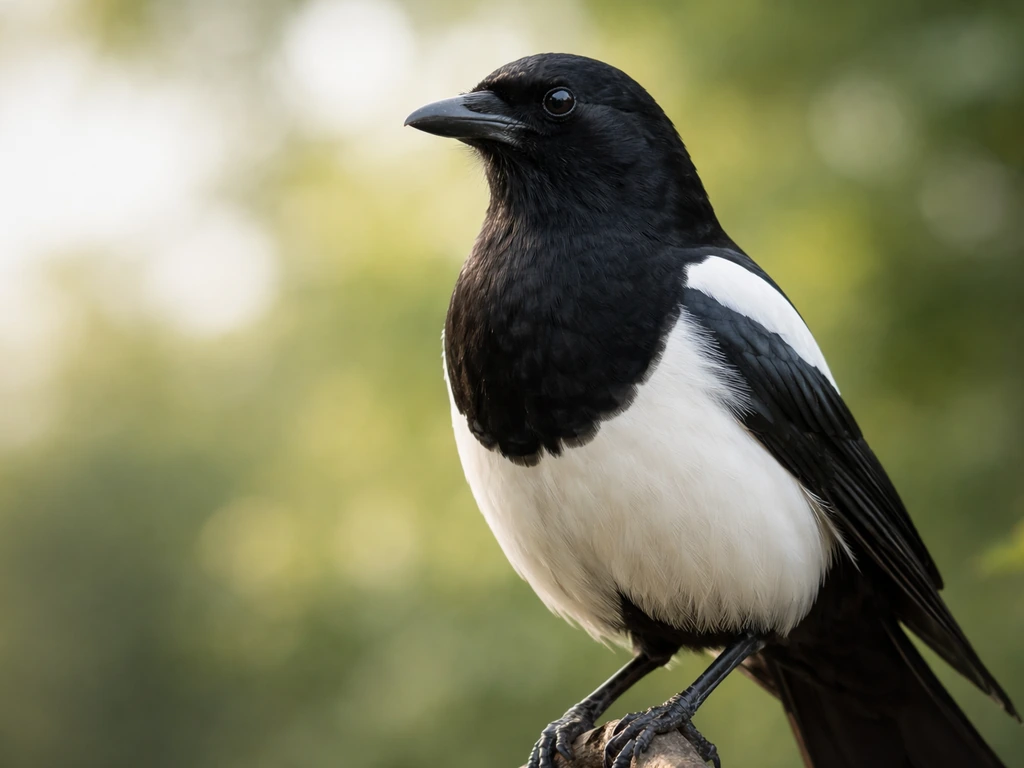
In contemporary spiritual circles, the magpie is most often interpreted as a messenger of duality and balance. Its two-tone plumage alone invites this reading: black and white, shadow and light, the seen and unseen. People who engage with spirit-animal traditions tend to associate the magpie with intelligence, adaptability, and the kind of sharp observation that helps you navigate complex situations. The magpie does not miss much, and that alertness is read spiritually as a prompt to pay closer attention yourself.
Another common spiritual interpretation ties the magpie to communication and expression. Magpies are notably vocal birds with individually distinct calls, and they respond in sophisticated ways to environmental threats and social cues. Spiritually, this gets translated into a message about speaking your truth, listening carefully to those around you, or noticing what you have been avoiding saying. If you have been sitting with an unspoken thought and a magpie shows up, that kind of symbolism can feel pointed.
The magpie's association with both good and bad luck in Western tradition also feeds into a spiritual reading about embracing uncertainty. Some spiritual teachers frame the magpie as a symbol that resists easy categorization, much like a majestic bird meaning that commands attention without offering simple comfort. The idea is that the magpie teaches you to hold ambiguity without rushing to resolve it into a verdict of "good" or "bad."
In some animist and shamanic traditions, the magpie is considered a guide between worlds, partly because of its bold confidence and partly because of its relationship with both light and darkness. This overlaps loosely with how mythological hybrid creatures are interpreted: the griffin bird meaning in heraldic and mythological traditions similarly draws on a combination of opposing qualities to represent a being that bridges different realms. The magpie occupies a comparable symbolic space in folk spirituality, never fully belonging to the world of good omens or bad ones.
What to do with a magpie sighting
If you have just seen a magpie and you are wondering whether it means something, here is the practical guidance: start with honest observation before you reach for an interpretation. Note the context. Were you in a difficult moment? Starting something new? Feeling uncertain about a decision? The mind tends to notice things that resonate with what it is already processing, and a magpie sighting can act as a useful anchor for reflection rather than a verdict handed down by the universe.
The old British and Irish custom of saluting a lone magpie to ward off bad luck is genuinely interesting, not because it works, but because it reveals how people historically managed anxiety around omens. Asking after the magpie's "wife and children" as a ritual greeting is essentially a way of converting a moment of unease into a social gesture, which redirects your attention and gives you something to do. If you find yourself anxious after seeing a lone magpie, doing something small and deliberate (a mental greeting, a breath, a moment of noticing) serves the same psychological function without requiring you to believe in the superstition literally.
If you see multiple magpies, the counting rhyme gives you a loose framework, but treat it as a conversation starter with yourself rather than a prediction. "Two for joy" is not a promise; it is a prompt to consider where joy might already be present or accessible in your life right now. Some people find it useful to track magpie sightings the same way they might track any ceiling bird meaning or recurring symbol: logging what was happening emotionally when the encounter occurred and looking for patterns over time.
Common misconceptions worth clearing up
The biggest misconception about magpie symbolism is that it is uniform. It is not. A single magpie does not universally mean bad luck; that is a specifically British and Irish framing rooted in a particular regional counting tradition. Importing that reading wholesale into a different cultural context (or a personal spiritual practice that does not draw from that tradition) does not serve you well. Similarly, the "thief" association is a European folkloric projection, not a cross-cultural truth about what magpies represent.
Another common error is treating the counting rhyme as ancient wisdom when it is actually a relatively recent formalization of a folk practice. The ballad and folk-song tradition around “Crow and Pie” also reflects older naming for the magpie, where “pie” was an older name for the magpie. The rhyme has been around for several centuries, but its meaning has shifted over time and varies by region. There are multiple versions of it, and different communities assigned different meanings to the same numbers. Treating any one version as the definitive key to magpie meaning is a bit like treating a regional dialect as the only correct form of a language.
It is also worth noting that a magpie's striking appearance, which can feel extraordinary or arresting when you encounter it, is not itself evidence that the encounter is a supernatural sign. Magpies are intelligent, conspicuous birds that often appear near human habitation. If you live somewhere they are common, you will see them regularly. The crested bird meaning tradition, for instance, shows how the physical distinctiveness of a bird can generate symbolic associations that outlast any rational basis for them. Noticing a magpie and feeling something is perfectly valid; concluding that it was a supernatural message requires a bit more epistemic humility.
A mindfulness-based approach to "signs" is useful here. When a sighting triggers a strong emotional response, try observing the emotion itself rather than immediately hunting for meaning. Notice what the feeling is, where it sits in your body, and let it be present without immediately converting it into a narrative about what the magpie was trying to tell you. That kind of grounded attention, borrowed from contemplative practice, gives you more genuine insight than the superstition alone ever could.
How to use magpie symbolism practically today
The most useful thing you can do with magpie symbolism is treat it as a lens for reflection rather than a prediction machine. Here are some concrete ways to apply it.
Journaling prompts after a magpie sighting
- What was I thinking or feeling in the moments before I noticed the magpie? Was I anxious, excited, uncertain, or distracted?
- Which aspect of the magpie's symbolism (duality, adaptability, communication, luck) feels most relevant to what I am navigating right now?
- If I take the magpie as a prompt rather than a prediction, what question does it ask me to sit with?
- Have I seen magpies repeatedly lately? If so, what has been consistent in my emotional state or life circumstances during those sightings?
- Where in my life am I resisting ambiguity or rushing to label something as good or bad, when it might simply be both?
Practical next steps
If you want to work with magpie symbolism in a sustained way, consider keeping a nature-observation log where you record sightings alongside your emotional and situational context. This is not about proving that magpies are sending you messages; it is about noticing what you notice and why. Over time, patterns may emerge that say more about you than about the bird. Some people find it helpful to pair this with a broader reading of bird symbolism, since the magpie is most meaningful when understood alongside other birds you encounter. For example, understanding the distinction between a bird with crown meaning and a magpie helps clarify what makes magpie symbolism specifically about duality rather than authority or divine favor.
If you are drawn to the spiritual angle, the most grounded approach is to use the magpie's core themes (duality, intelligence, balance, the tension between light and shadow) as prompts for honest self-assessment rather than fortune-telling. Ask yourself which side of a duality you have been ignoring, where you need to be more observant, or where your communication has been muddled. Those questions have real traction regardless of what any bird is doing outside your window.
Finally, keep some cultural perspective handy. The African ceiling bird meaning tradition, for example, shows how differently birds can be interpreted across geographic and cultural contexts, which is a useful corrective whenever one tradition's reading starts to feel like universal truth. The magpie is a rich symbol precisely because it has meant so many things to so many people. You are allowed to choose which thread of meaning resonates with you, as long as you hold it with enough looseness to let reality in.