The linnet is a small seed-eating finch (Linaria cannabina) native to Europe, western Asia, and North Africa, carrying symbolic weight around song, freedom, love, and innocence that stretches from Victorian cages to Romantic poetry. Whether you spotted one in a hedgerow, encountered it in a poem, or dreamed of a small red-fronted bird, the linnet consistently points toward themes of voice, constraint, and the longing for open air.
Meaning of Linnet Bird: Symbolism, ID & Cultural Uses

Marcus Blackwell
23 Jul 2026
What 'linnet' means in one line
A linnet is a small, melodious finch whose name and symbolism are both rooted in the flax plant, and whose song made it one of the most beloved and most imprisoned cage birds in British history.
Literal definition and taxonomy
The Common Linnet's accepted scientific name is Linaria cannabina, first formally described by Linnaeus in 1758. It belongs to the family Fringillidae (the true finches). For most of the twentieth century it was classified in the large catch-all genus Carduelis, but molecular phylogenetic work by Zuccon and colleagues (2012) demonstrated that linnets and their close relatives form a distinct lineage, prompting major global checklists, including the IOC World Bird List and the Clements/Cornell checklist (updated August 2017), to move the species into the reinstated genus Linaria. So if you see Carduelis cannabina in an older field guide, it is the same bird under a former name.
- Scientific name: Linaria cannabina (Linnaeus, 1758)
- Family: Fringillidae (true finches)
- Order: Passeriformes
- Common names: Common Linnet, Eurasian Linnet
- Former genus: Carduelis (reassigned to Linaria after 2012 molecular review)
What a linnet looks like in the field
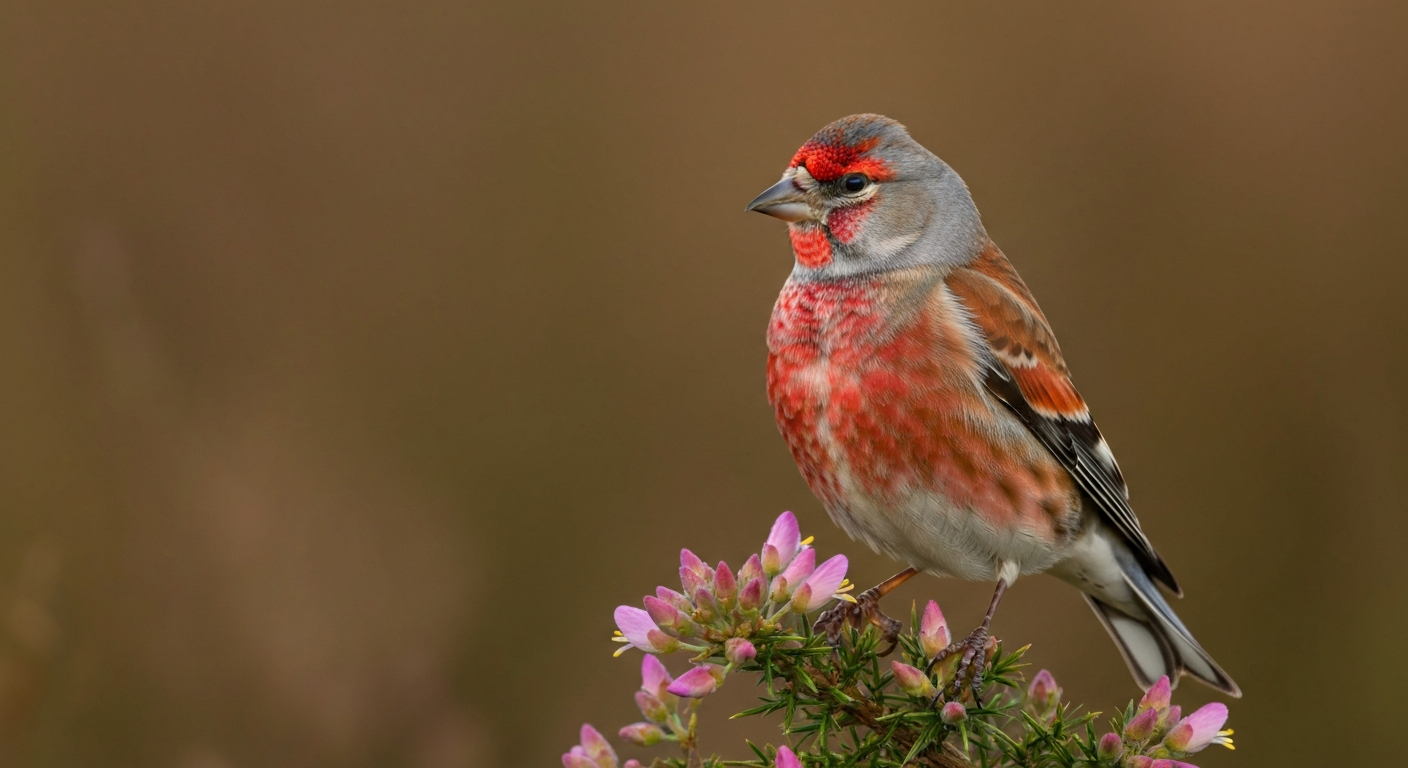
Linnets are compact, neat birds, measuring roughly 13 to 14 cm in length, a little smaller than a house sparrow. The male in breeding plumage is unmistakable once you know what to look for: a crimson-red patch on the forehead and a rosy-red flush across the breast, set against a chestnut-brown back and grey head. Outside the breeding season, that red fades considerably and the male looks much plainer. The female and juvenile lack red entirely, wearing streaky brown-buff tones throughout the year, which makes them harder to pick out but still identifiable by the white wing-flash visible in flight. Both sexes have a short, slightly notched tail and a small, conical finch bill.
- Length: 13–14 cm
- Male breeding: red forehead and breast, chestnut back, grey head
- Male non-breeding: muted, brownish — red almost absent
- Female and juvenile: streaky brown-buff, no red, white wing-flash in flight
- Bill: short and conical, classic finch shape
- Tail: slightly forked or notched
The linnet's song, what to listen for
The linnet's voice is the reason it ended up in so many Victorian parlours. The territorial and advertising song is a rambling, thin, musical stream: squeaky and slightly reedy notes tumbling together in short trills and whistles, often delivered from the top of a gorse bush or hedgerow. It is not the powerful fluting of a blackbird or the cascading invention of a skylark, it is more intimate, like a very enthusiastic conversation held at low volume. Males frequently sing in loose colonies, and the overlapping voices create a characteristic background murmur on heathland and scrub. If you hear a bird delivering a rapid, twittering mix of buzzy and clear notes with no obvious long pauses, you may well have a linnet. Thousands of recordings with visual spectrograms are freely available on xeno-canto under the name Linaria cannabina, which is the quickest way to learn the song before heading out.
Where linnets live, range and habitat
The Common Linnet breeds across a wide band from western Europe (including the British Isles, Iberian Peninsula, and Scandinavia) through central Asia to western China, and across North Africa. BirdLife International and eBird Status and Trends range maps confirm it is a widespread resident and short-to-medium-distance migrant: British and northern European populations often move south and west in autumn, sometimes gathering in large flocks on coastal stubble fields or saltmarshes before returning north to breed.
In terms of habitat, linnets are birds of open and semi-open country. They favour gorse and bramble scrub, hedgerows, heathland, farmland with weedy margins, and coastal dunes. They are notably associated with agricultural landscapes, and their decline as a breeding bird in the UK (well-documented by the BTO) tracks closely with the loss of weedy arable fields and rough grassland through agricultural intensification. They nest in low, dense scrub, often gorse, and are rarely found in closed woodland or urban environments.
Diet and feeding, a seed-eater, not a predator
This is worth stating clearly: linnets are granivorous finches. They eat seeds. Their short, strong bill is perfectly adapted for cracking open small seeds of weeds and agricultural plants, and they forage mainly on the ground or in low vegetation. Authoritative species accounts (e.g., blank" rel="noopener noreferrer">LINNET (Linaria cannabina) - songbird factfile | SongBird Survival) describe linnets as seed‑eating finches that forage on the ground and in low vegetation. Common food plants include fat hen, sorrel, charlock, and, as the scientific name hints, flax (Cannabis and related species). Adults feed almost exclusively on seeds year-round, and even nestlings are provisioned with partly-digested seed crop material rather than insects or invertebrates, which makes them unusual among small songbirds and distinguishes them clearly from predatory species. If you have come here wondering whether a linnet might eat 'limbless prey' such as worms or snails, the answer is no: that is simply not how finches feed. See the note on limbless prey for a bird meaning for more on why linnets do not eat worms or snails.
Where the name 'linnet' comes from
The etymology is elegant and surprisingly direct. The word 'linnet' traces back through Middle English and Old French to the Latin word linum, meaning flax. The bird was named for its love of flax seeds, which formed a significant part of its diet in the agricultural landscapes where people first observed and named it. The same Latin root gives us 'linen' (cloth made from flax) and the scientific name Linaria, so the bird's common name and its genus name are essentially saying the same thing in different languages. The suffix '-et' is a diminutive, so a linnet is literally 'a little flax-bird.' That naming logic tells you something useful: this was a bird people watched closely enough to notice exactly what it was eating.
What the linnet symbolises
Linnet symbolism clusters around a handful of interlocking themes, most of them flowing directly from the bird's real behaviour and its long history with humans. Song is the central one. Because the linnet sings so freely and musically, and because it kept singing even when caged, it became an emblem of voice as an essential, inextinguishable quality. You can imprison a linnet, but you cannot make it mute. That tension between constraint and expression feeds directly into the second major theme: freedom and its loss.
The image of the caged linnet runs through English literature as a shorthand for unjust confinement and the longing for liberty. Richard Lovelace used it precisely this way in 'To Althea, from Prison' (1642), writing of 'committed linnets' whose singing transcends their captivity, the linnet's song becomes proof that the spirit cannot be fully caged even when the body is. Wordsworth took a gentler angle in 'The Green Linnet,' presenting the bird as a creature of pure, unself-conscious delight in a natural setting, associating it with innocence and the spontaneous joy of the natural world. Tennyson's 'In Memoriam' invokes linnet imagery in passages about lost love and grief, linking the bird's voice to the bittersweet persistence of memory.
Beyond literature, linnets carry associations with love and affection in folk tradition, partly because pairs bond closely and partly because the male's singing was understood as courtship display. In Victorian popular culture, gifting a singing linnet was an act of romantic sentiment, which adds a slightly bittersweet layer given what cage-keeping meant for the bird. Innocence and youth are also recurring themes, probably because the bird's song sounds light and unguarded rather than imposing.
- Song and voice: the linnet as emblem of communication, expression, and inextinguishable inner life
- Freedom and captivity: the caged linnet as a symbol of unjust constraint and the spirit's persistence
- Love and affection: associated with courtship, romantic sentiment, and close pairing
- Innocence: the linnet's light, unguarded song connects it to youth and unspoiled nature
- Joy in the natural world: Wordsworth's angle — the bird as a symbol of spontaneous, uncomplicated delight
Cultural and historical significance
The linnet's cultural footprint in Britain and Ireland is larger than its modest size suggests. By the 18th and 19th centuries, the trade in wild-caught cage birds was enormous, and the linnet was one of the most sought-after species, prized above all for its song. Working-class households in Victorian Britain kept linnets in small wooden cages, and street vendors sold them at markets across the country. Social history records of the period document bird-catchers who trapped linnets in large numbers on farmland, sometimes using call-birds (decoy linnets) to draw wild birds into clap-nets. This is not a pleasant history, but it matters for understanding the symbolism: the linnet became a cultural reference point precisely because so many ordinary people had direct, daily experience of hearing one sing in their kitchen or parlour.
In folk belief, a linnet's song near the house was sometimes taken as a good omen, an indicator of coming good news or happiness, consistent with the broader association between songbirds and positive fortune found across British and Irish tradition. The bird also appears in the visual arts and decorative traditions of the period, featured on Victorian ceramic tiles and embroidery patterns alongside other familiar garden and farmland birds.
Linnet in idiom and figurative language
The linnet does not generate a long list of standalone idioms the way ravens or owls do, but it appears reliably as a figurative touchstone in poetic and literary English. 'Singing like a linnet' was a common compliment for a pleasant singing voice in 18th- and 19th-century usage. 'A linnet in a cage' or 'like a caged linnet' functions as a compressed metaphor for someone gifted with expression but held in unjust circumstances, a phrase that retains its force today because the image is so specific. Writers reaching for a bird that represents pure, natural song without the grandeur of the lark or the darkness of the raven reliably land on the linnet.
How the linnet compares to the lark, meadowlark, and skylark
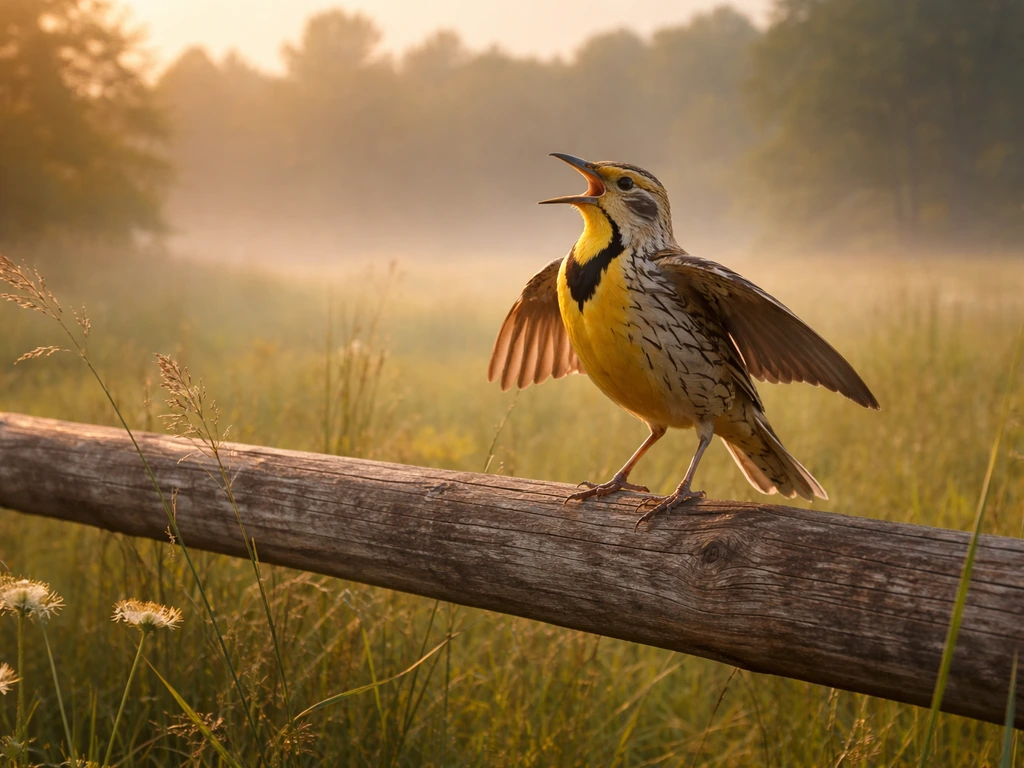
If you are working with bird symbolism and trying to choose between these species, or if you have encountered them in literature and want to understand the distinctions, the differences are meaningful. Larks and skylarks share the 'song' theme with linnets, but their symbolic registers diverge sharply. The skylark sings in flight, high above the ground, and its symbolism tends toward transcendence, aspiration, and the soul reaching upward (Shelley's 'Blithe Spirit' is the canonical example). The linnet sings from a bush, lower, closer, more intimate. The meadowlark carries a strongly North American flavour, associated with wide prairies and open optimism rather than the English hedgerow tradition. And the lark more broadly has connotations of dawn and new beginnings ('the lark at break of day arising') that the linnet does not carry. For more on the lark's connotations of dawn and new beginnings, see lark bird meaning (resource id ae4eba0b-96e2-42e5-af1b-e6807942e455).
| Bird | Scientific name | Size | Symbolic focus | Key cultural association | Song register |
|---|---|---|---|---|---|
| Common Linnet | Linaria cannabina | 13–14 cm | Song, freedom, love, innocence | Victorian cage bird; Lovelace, Wordsworth, Tennyson | Ground-level, intimate, rambling |
| Skylark | Alauda arvensis | 18–19 cm | Transcendence, aspiration, joy | Shelley's 'To a Skylark'; flight-song tradition | Aerial, sustained, soaring |
| Eurasian Lark (general) | Various Alauda spp. | Variable | Dawn, new beginnings, hope | 'The lark at break of day'; morning idioms | Dawn song, rising |
| Meadowlark | Sturnella spp. | 21–24 cm | Open space, optimism, the American frontier | North American folklore and prairie symbolism | Rich, fluting, carrying |
The practical distinction for writers and symbolism researchers: reach for the linnet when you want a songbird that represents expression under constraint, intimate love, or the beauty of the common and overlooked. Reach for the skylark when you need elevation and transcendence. For dawn and renewal, the lark is your bird. For wide-open American optimism, the meadowlark.
Interpreting a linnet sighting, dream, or tattoo
Symbolic interpretation of a bird sighting is inherently personal and culturally variable, so treat the following as a framework rather than a fixed meaning. That said, consistent themes do emerge across traditions.
Sightings
Encountering a linnet, especially a singing male, is most commonly associated in British and Irish folk tradition with good news or a positive turn in communication. Because linnets favour farmland margins, scrub, and hedgerows rather than gardens, seeing one is slightly unusual in many urban contexts, which may make the sighting feel more significant. If you hear one singing nearby without seeing it, the traditional reading would lean toward a message that has not yet arrived or a voice not yet heard clearly.
Dreams
A linnet in a dream is most often read as relating to self-expression, voice, or freedom. A linnet singing freely in open country typically suggests that communication is flowing well or that some creative or emotional expression is being released. A caged linnet in a dream may reflect feelings of constraint, a sense that something important in you is not being allowed to be heard. As always with dream symbolism, context matters far more than the bird alone.
Tattoos
Linnet tattoos are less common than robin, swallow, or raven designs, but they appear among people with connections to British folk tradition, poetry, or music. The most common personal meanings attached to them are freedom, the value of one's own voice, love, and sometimes a tribute to a lost relationship or person, drawing on the linnet's literary associations with song, longing, and constrained beauty. The male's red breast gives the design a natural focal point of colour.
Suggested images for this article
- Field identification photo: breeding male Common Linnet on a gorse perch showing red forehead and breast (available via Macaulay Library / eBird media catalog under Linaria cannabina)
- Song spectrogram: a visual waveform of Linnet song showing the characteristic rambling trill structure (available from xeno-canto recordings of Linaria cannabina)
- Habitat shot: open farmland or gorse heathland in early summer, showing typical linnet breeding habitat
- Literary/illustrative image: a Victorian cage-bird illustration or a reproduction of a period print depicting caged songbirds, contextualising the cultural symbolism
FAQ
What primary biological facts must I verify for the "meaning of linnet bird" article?
Confirm accepted scientific name(s) and taxonomy (e.g., Linaria cannabina), family (Fringillidae), key ID metrics (size 13–14 cm), male/female and seasonal plumage differences, typical song description, global range and regional status, habitat preferences, diet (granivorous—seed‑eating) and typical behaviours (ground foraging, flocking, breeding). Use recent taxonomic checklists, field guides and species accounts to verify.
Which source types are best for the literal identification and natural‑history section?
Tier‑1 sources: peer‑reviewed phylogenetic papers (e.g., Zuccon et al. 2012), major checklists (IOC, Clements), national bird atlases and organisations (BTO, RSPB), BirdLife International factsheet, and eBird/EBird Status & Trends. Use these for taxonomy, range maps, behaviour and conservation status.
What sources should I use for song, audio and sonogram material?
Use large audio repositories with metadata and spectrograms: xeno‑canto (many Linaria cannabina recordings) and the Macaulay Library/Cornell Lab. These let you embed audio, create/verify spectrograms and cite recording metadata (recorder, location, date).
What research questions should I ask about name origin and etymology?
Verify the linguistic origin of 'linnet' (and historic variants), earliest usages in English, and the Latin/binomial derivation (Linaria cannabina). Consult historical dictionaries (Oxford English Dictionary), etymological references and original taxonomic descriptions (Linnaeus 1758) for authoritative citations.
How should I research symbolic meanings (song, love, freedom, innocence, communication)?
Look for documented historical uses and interpretations in folklore studies, cultural history books, art history sources and literary criticism. Prefer scholarly or reputable secondary sources that discuss bird symbolism; where only anecdotal or literary evidence exists, use cautious language (e.g., 'often associated with' or 'commonly used as a symbol') and cite primary literary examples.
Which primary cultural and literary sources are useful to demonstrate linnet symbolism?
Cite primary texts that use linnet imagery (e.g., Richard Lovelace's 'To Althea, from Prison', Wordsworth's 'The Green Linnet', Tennyson's relevant passages). Use reliable text archives (Wikisource, Gutenberg) or scholarly editions for quotations and attribution. For historical practice (cage‑bird trade), cite social‑history works and period sources documenting 18th–19th‑century bird‑keeping.