
If you searched 'irn bird meaning,' the most likely answer is that 'IRN' is a well-established hobbyist abbreviation for the Indian Ringneck parakeet (Psittacula krameri), one of the most popular pet parrots in the world. That said, 'irn' can also be a garbled rendering of Hawaiian bird names like ʻiwa (the great frigatebird) or ʻiʻiwi (the scarlet honeycreeper), and some readers arrive here after mistyping 'ibis' or encountering a regional vernacular term like 'wawa.' The right answer depends almost entirely on context, so this article works through each candidate, pins down the correct species, gives you pronunciation guidance, and explains the symbolism attached to each bird.
Irn Bird Meaning: Disambiguation, Symbols & Cultural Uses

Marcus Blackwell
5 Aug 2026
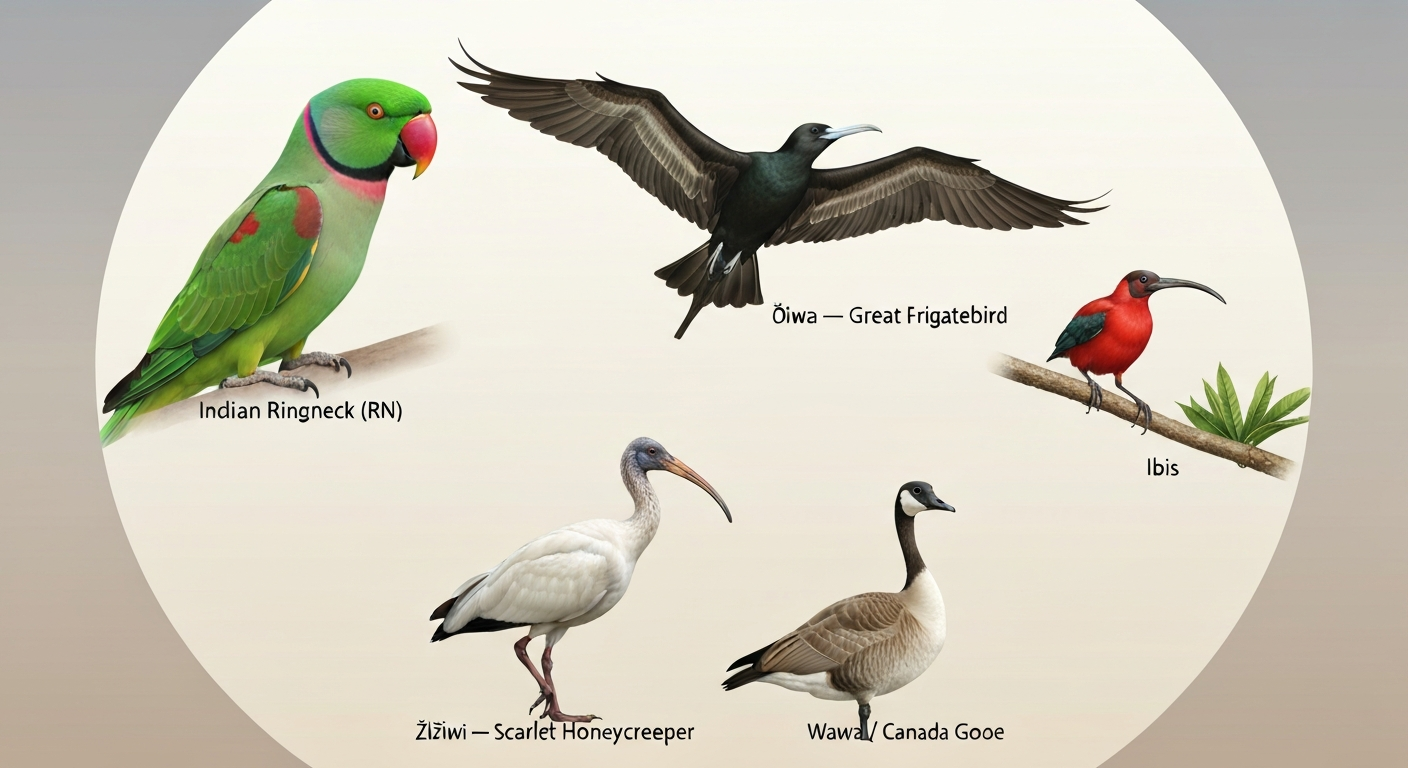
Why People Search 'Irn Bird' and What to Expect Here
The search string 'irn bird' lands in a genuinely interesting gray zone. Online parrot communities use IRN constantly, shorthand that is so embedded in forums and social media that newcomers simply absorb it without knowing what the letters mean. At the same time, Hawaiian and Polynesian bird names use letters that English keyboards drop or mangle, so a person who saw ʻiwa written somewhere and typed it without the glottal-stop character ends up with a string that looks a lot like 'irn' after autocorrect or a careless keystroke. Add tattoo culture (where Hawaiian motifs are common) and you get a genuinely mixed audience: pet owners, tattoo researchers, mythology enthusiasts, and students of Pacific cultures all showing up at the same search result. This article covers all five realistic candidates, ranked by how frequently each one drives the search, and gives you enough information to be confident about which bird you actually mean.
Quick Disambiguation: Which Bird Are You Actually Looking For?
Before diving into species profiles, here is a short decision guide. Run down this list and pick the description that matches where you first saw 'irn bird.' That will tell you which section to read first.
| If you saw 'irn' in… | You probably mean… | Go to section |
|---|---|---|
| A parrot forum, Reddit r/parrots, a pet-care site, or a bird-owner social post | IRN = Indian Ringneck parakeet | Indian Ringneck Profile |
| A Hawaiian context, tattoo flash, or Pacific Islander content | ʻiwa = great frigatebird | Iwa / Great Frigatebird Profile |
| A Hawaii nature or conservation article mentioning red feathers | ʻiʻiwi = scarlet honeycreeper | Iwi and Spelling Variants |
| Ancient Egypt, mythology, or a cultural-symbolism article | Ibis (sacred or white ibis) | Ibis Profile |
| Great Lakes, Ojibwe, or West African regional text | 'Wawa' vernacular for goose or waterfowl | Wawa Regional Notes |
If none of those contexts fit, the safest default is the Indian Ringneck, because that is by far the most common driver of the exact lowercase string 'irn bird' in English-language web searches.
The Indian Ringneck (IRN): Species Profile and Identification
The Indian Ringneck parakeet, Psittacula krameri manillensis, is a medium-sized parrot native to the Indian subcontinent and parts of sub-Saharan Africa. Adults reach about 40 cm (16 inches) from bill tip to tail, with a long, graduated tail making up roughly half that length. Wild-type birds are lime green with a rose-and-black neck ring in adult males; domesticated breeding has produced a striking palette of mutations including lutino (yellow), albino, blue, violet, and cinnamon. The bill is red and strongly hooked. They are highly intelligent, capable talkers, and notoriously independent in temperament.
In hobbyist communities, the uppercase initialism IRN is so standard that forum threads titled simply 'My IRN' or 'IRN care tips' appear on Reddit's r/parrots, parrot breeder boards, and dedicated sites like IndianRingNeck.com. It functions as a proper noun shorthand: if someone posts a photo of a green parakeet and types 'my IRN is finally talking,' they are not being cryptic. Capitalisation matters here: 'IRN' (caps) points almost exclusively to this parrot; lowercase 'irn' is where the ambiguity enters.
Quick ID Tips for the Indian Ringneck
- Body length around 40 cm; long tapering tail is a key field mark
- Adult male has a rose-pink and black ring around the neck; females and juveniles lack the full ring
- Bright red hooked bill, yellow under-tail coverts
- Wild type is grass-green; captive mutations include lutino (yellow), blue, violet, and albino
- Loud, clear call; capable of mimicking speech and household sounds
- In the wild, found in open woodland, farmland, and urban parks across South Asia; feral populations established in the UK, Europe, and parts of the Middle East
ʻIwa (Great Frigatebird): Species Profile and Identification
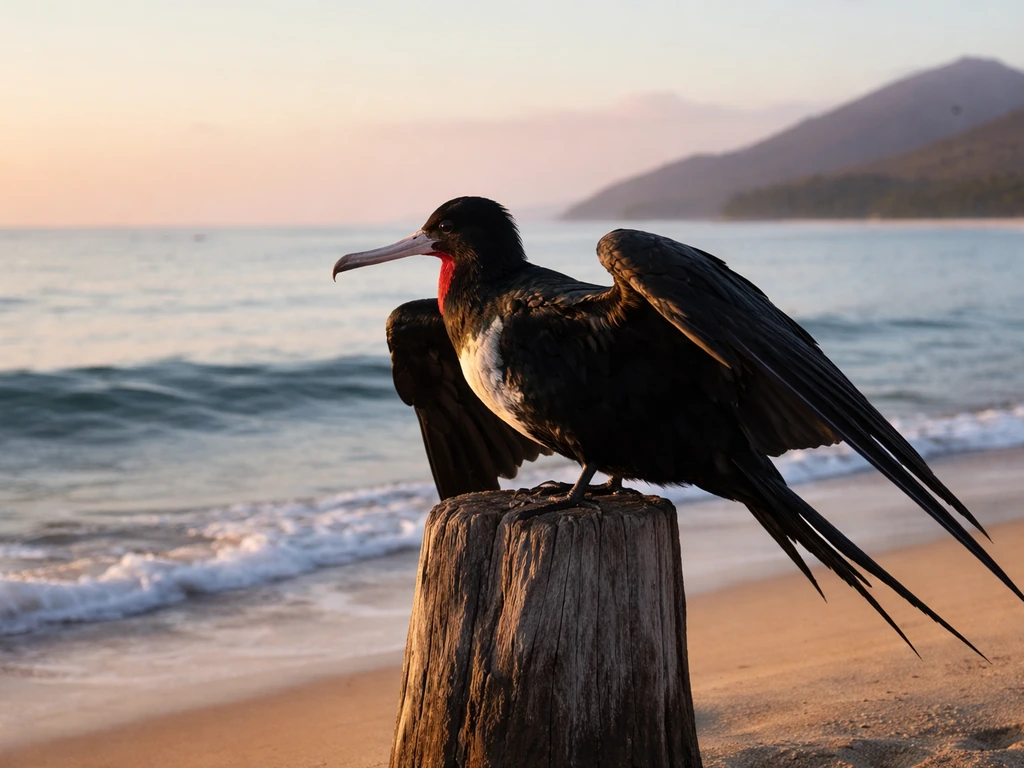
The ʻiwa (pronounced approximately 'EE-vah' in Hawaiian) is the great frigatebird, Fregata minor, one of the most visually dramatic seabirds in the Pacific. Hawaiʻi's Division of Land and Natural Resources (DLNR) lists it as the authoritative Hawaiian name. See Hawaiʻi DLNR, ʻIwa (great frigatebird) species page for the official state listing, scientific name, and natural‑history summary Hawaiʻi DLNR — ʻIwa (great frigatebird) species page. The bird is large, a wingspan of up to 2.3 metres (about 7.5 feet), and almost entirely jet black in the male, with a brilliant scarlet throat pouch inflated during courtship displays. Females are white-breasted. Frigatebirds are aerial kleptomaniacs by nature: they cannot land on water because their feathers lack waterproofing, so they harass other seabirds into dropping their catch and then snatch it mid-air.
In Hawaiian, the word ʻiwa carries a figurative layer that maps directly onto that behavior. Pukui and Elbert's Hawaiian dictionaries (accessible via the University of Hawaiʻi's Wehewehe portal) record ʻiwa meaning not only 'frigate bird' but also 'thief' and 'handsome person' in figurative usage. That dual meaning, beauty and theft coexisting in a single word, is unusually compact symbolism, and it tells you a lot about how Hawaiian speakers observed this bird. For readers interested in exploring the broader Hawaiian seabird tradition, the iwa bird meaning entry on this site goes into that cultural layer in full detail.
Quick ID Tips for the ʻIwa / Great Frigatebird
- Wingspan up to 2.3 m; deeply forked tail is the most distinctive field mark in flight
- Male is entirely glossy black with an inflatable red gular (throat) pouch
- Female has a white breast and brownish wing-bars
- Never lands on water; soars on thermals for hours
- Found across tropical Pacific and Indian Oceans; regularly observed around the Hawaiian islands
- Correct spelling uses the ʻokina (glottal stop) before the 'i': ʻiwa, not 'iwa' or 'irn'
Ibis: Species Profile and Identification
If someone typed 'irn' while thinking of 'ibis,' they are likely interested in either the African sacred ibis (Threskiornis aethiopicus) or the American white ibis (Eudocimus albus), the two candidates that most commonly come up in cultural and symbolic discussions. The sacred ibis is a large wading bird native to sub-Saharan Africa (and historically Egypt), standing about 75 cm tall, with a white body, black bare head and neck, and glossy black wing-tips. The white ibis of the Americas is slightly smaller, also white-bodied, with a long curved pink-red bill, pink facial skin, and black wing-tips visible in flight. Both species are unmistakable in their respective regions. For readers wanting deeper ibis coverage, the ibis bird meaning page on this site focuses specifically on its symbolic lineage.
Quick ID Tips for the Ibis
- Long, curved (decurved) bill is the universal field mark across all ibis species
- Sacred ibis: white body, black bare head, black tail plumes; adult stands about 75 cm
- White ibis: white body, pink-red decurved bill, pink facial skin, black wingtips; found in wetlands from the southeastern US through Central America
- Both species wade in shallow water probing for invertebrates
- The sacred ibis is the species with direct Egyptian religious association; look for images of the Thoth deity (ibis-headed figure) as a cultural signal
Wawa: Regional and Vernacular Uses (and How to Verify This Reading)
The word 'wawa' as a bird name is genuinely regional and does not carry a single universal meaning, which is worth stating plainly before anyone commits it to a tattoo or a cultural essay. In Ojibwe and Great Lakes contexts, 'wawa' (or 'wawashkeshi' in extended forms) has been used as a vernacular term for Canada goose or wild goose, and it survives in Canadian placenames like Wawa, Ontario. blank" rel="noopener noreferrer">Wisdom Library's 'Wawa' lexical notes document vernacular meanings, including 'wild goose' in Ojibwe and related regional listings. Some West African and Central African ethnoscience lexicons also include 'wawa' as a local name for various waterfowl, but these are regionally bounded. The bottom line: if you encountered 'wawa bird' in a specifically Ojibwe, Great Lakes, or West African context, it is plausible. If you found it without any regional marker, it is more likely a misspelling of ʻiwa or a variant of one of the other candidates discussed here. The wawa bird meaning entry on this site is the right place to trace those regional usages further.
To verify which reading is intended, look for geographic cues in the original text: Is there a mention of the Pacific, Hawaii, or Polynesia? Lean toward ʻiwa. Is there a mention of Canada, the Great Lakes, or Indigenous North American traditions? Lean toward the Ojibwe goose reading. Without any regional anchor, return to the Indian Ringneck as the default.
ʻIʻiwi, Spelling Variants, and an Important Māori Language Note
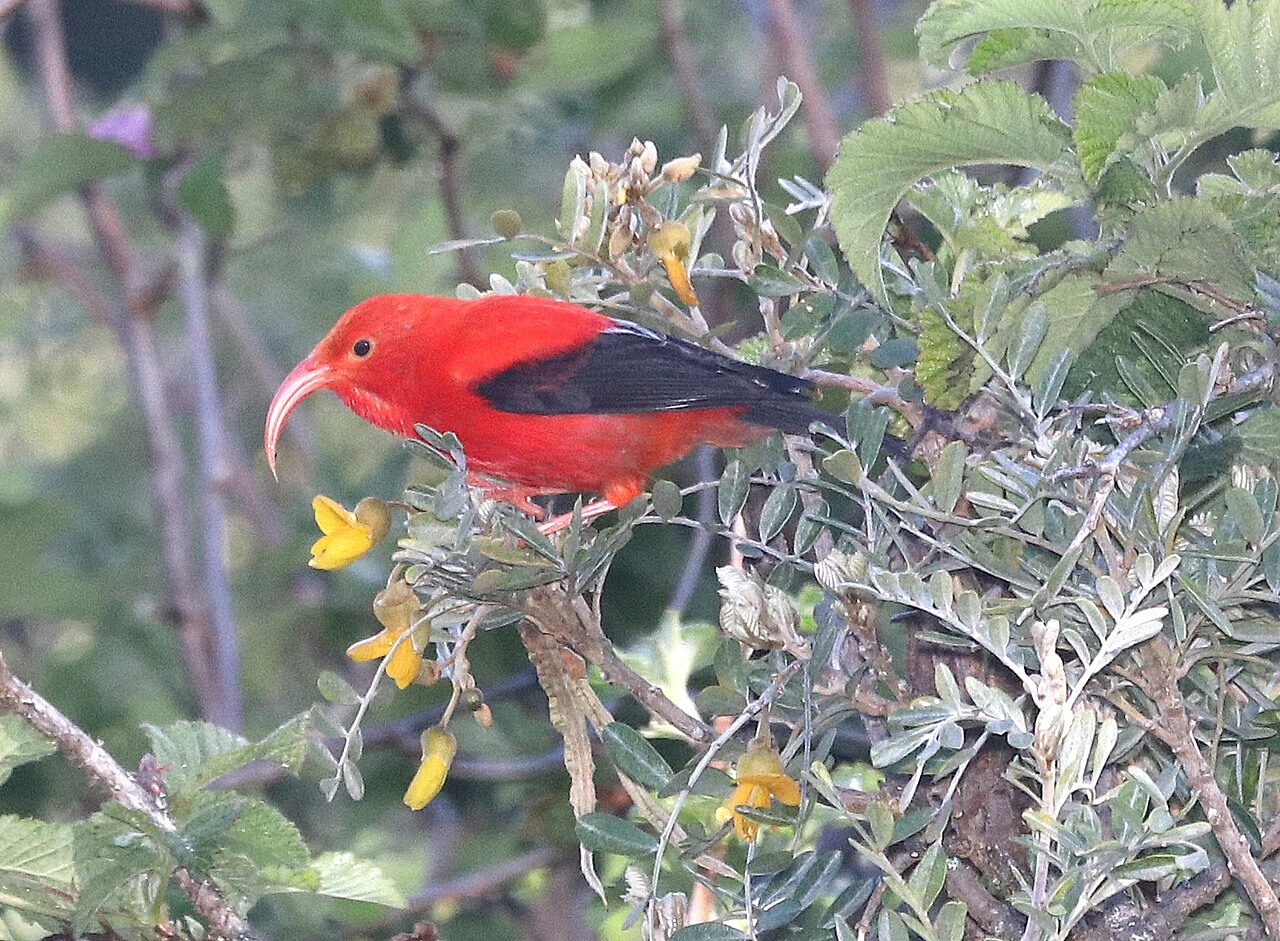
The ʻiʻiwi (Drepanis coccinea, formerly Vestiaria coccinea) is a native Hawaiian honeycreeper: a brilliant scarlet bird about 15 cm long with a long, strongly curved salmon-pink bill adapted to sip nectar from ʻōhiʻa lehua flowers. Its IUCN status is Vulnerable, and populations have declined severely due to introduced avian malaria spread by mosquitoes at lower elevations. Hawaiʻi's DLNR documents its importance to Hawaiian culture through the use of its vivid red feathers in aliʻi (chiefly) feather cloaks and helmets, some of which required hundreds of thousands of feathers and generations of accumulation. The ʻiʻiwi's full symbolic and conservation story is covered in the iwi bird meaning section of this site.
The spelling variants matter for anyone searching online. You will see ʻiʻiwi (fully correct Hawaiian orthography with two ʻokina), iiwi (most common anglicised form in English-language nature writing), i'iwi (informal rendering with an apostrophe substituting for ʻokina), and occasionally iwi (dropping one syllable). That last form, 'iwi,' is also an important Māori word meaning 'tribe' or 'bone' in te reo Māori, with deep cultural significance in New Zealand. These two words are unrelated beyond a surface similarity in spelling. If your source is in a New Zealand or Māori cultural context, 'iwi' almost certainly refers to kinship and tribe, not to a Hawaiian bird. Using them interchangeably would be a significant error, and it is the kind of conflation that Māori communities have rightly pushed back against in online discussions.
Cultural and Spiritual Symbolism: Each Candidate at a Glance
Indian Ringneck (IRN)
The Indian Ringneck has a long cultural history that predates its role as a pet. In South Asian tradition, parakeets with rose rings appear in Sanskrit literature and Mughal miniature painting as symbols of eloquence, beauty, and the power of speech. Their ability to mimic human language gave them a reputation for carrying messages and secrets, and they appear in Persian poetry as the 'parrot' figure (tuti) who narrates stories, a role familiar to anyone who has read Attar's Conference of the Birds or the Tuti-Nameh (Tales of a Parrot). In modern Western pet culture, IRN owners frequently describe their birds in terms of wit and personality, which is a secular echo of those older associations with speech and intelligence.
ʻIwa (Great Frigatebird)
In Hawaiian culture, the ʻiwa occupies an interesting symbolic position because it is simultaneously beautiful and predatory. The same Pukui and Elbert entry that gives 'thief' also records a figurative use for a strikingly attractive person, implying that the Hawaiians saw this bird's audacious elegance and its piracy as two aspects of the same quality. In navigation, the ʻiwa was a practical waymarker: Polynesian voyagers used frigatebird flight patterns to identify land because the birds, unable to sleep on water, always return to land each evening. That navigational role lends the bird symbolic weight as a guide and a sign of home. Hawaiian and Polynesian tattoo traditions have drawn on this imagery extensively, making the ʻiwa a popular design choice for people with Pacific heritage or an interest in wayfinding as a life metaphor.
Ibis
The ibis carries some of the oldest documented bird symbolism on the planet. In ancient Egypt, the sacred ibis was the living embodiment of Thoth, god of writing, wisdom, and the moon. Peer-reviewed archaeogenomic research published in PLOS and PMC has confirmed the staggering scale of this cult: millions of sacred ibises were mummified as votive offerings, particularly during the Late Period and Greco-Roman era, at sites like Hermopolis and Saqqara. Thoth-as-ibis appears in the judgment scene of the Book of the Dead, recording the weighing of the heart. This association with record-keeping, divine knowledge, and cosmic order is the core symbolic thread of the ibis, and it runs through Greek interpretations of Thoth as Hermes Trismegistus and into Renaissance hermeticism. In the Americas, the white ibis held different meanings among various Indigenous peoples and later became the mascot of the University of Miami, a much more recent and secular kind of cultural embedding, but a demonstration of how durable ibis symbolism is across time.
Wawa / ʻIʻiwi Variants
The Ojibwe goose 'wawa' does not carry a single unified symbolic tradition in the way the ibis or frigatebird does, but geese across many North American Indigenous traditions represent seasonal return, communal loyalty, and the connection between sky and earth. The ʻiʻiwi, by contrast, carries very specific cultural weight in Hawaii: red feathers (ʻula) were among the most precious materials in the Hawaiian chiefly gift economy, and the ʻiʻiwi was one of the primary sources. Wearing or giving red feathers signalled divine lineage, power, and rank. That connection to chiefly authority and sacred power is the dominant symbolic frame for the ʻiʻiwi.
Folklore, Religion, Literature, and Idioms
The ibis-Thoth connection is the most thoroughly documented thread in this group. The Book of the Dead scenes featuring Thoth recording the outcome of heart-weighing ceremonies place the ibis at the intersection of justice, language, and the afterlife, a combination that makes it one of the richest symbolic birds in any tradition. Greek scholars who encountered Egyptian religion mapped Thoth onto Hermes, and that equivalence (Hermes Trismegistus) carried ibis imagery into alchemy, hermeticism, and early European esoteric literature.
The frigatebird ʻiwa appears in Hawaiian moʻolelo (oral traditions) as a figure of cunning and speed. Some traditional Hawaiian sayings use ʻiwa as a shorthand for a quick-witted or elusive person, the same way English speakers might say someone 'flies under the radar.' In Pacific navigation traditions, the appearance of frigatebirds in flight was read as directional information, a practical use that elevated the bird to the status of a sign-giver in Polynesian cosmology.
The Indian Ringneck's literary life is richest in South Asian traditions. In the Tuti-Nameh, a 14th-century Persian adaptation of Sanskrit originals, a caged parrot tells stories each night to prevent its mistress from being unfaithful, a framing device that kept a woman occupied for fifty-two nights. The parrot here is a symbol of wit, narrative power, and the capacity to use language strategically. Persian and Mughal poets used the ringneck parrot (often called tuti or tota) as a figure for the soul's capacity for divine speech, a symbolism that sits alongside but distinct from the Western European magpie or crow as 'talking bird.'
Etymology and Pronunciation
For Hawaiian names, the single most important thing to know is that the ʻokina (written ʻ, the reversed apostrophe-like character) represents a genuine consonant in Hawaiian: a glottal stop. Dropping it changes meaning and disrespects the language. ʻIwa is correctly rendered 'EE-vah' in English approximation, two syllables, stress on the first. ʻIʻiwi is 'ee-EE-vee,' three syllables. Neither should be pronounced like the English word 'irn' or 'iron.' The University of Hawaiʻi's Wehewehe dictionary portal and the DLNR's species pages both use the ʻokina forms as the authoritative standard, and that is what you should use in any writing or design work involving these birds. See the iwa bird Hawaii meaning page on this site for expanded etymology and cultural context.
The word 'ibis' comes from the ancient Greek ibis, borrowed from Egyptian hb (hieroglyphic), making it one of the oldest bird names in continuous use in Western languages. It has been standard in English since at least the 16th century. Pronounce it 'EYE-bis.' The Indian Ringneck abbreviation IRN is an initialism, pronounced as individual letters (I-R-N) in pet communities, never as a word.
The Ojibwe 'wawa' is onomatopoeic, echoing the honking call of the Canada goose, which is a naming strategy that appears independently across many languages and cultures. The Hawaiian iwa bird Hawaii meaning page on this site expands considerably on the etymological and cultural context of the ʻiwa name within the broader Hawaiian language framework.
How to Read 'Irn Bird' in Context: Social Media, Tattoos, and Text References
Context is everything here, and a few quick signals will almost always resolve the ambiguity. If the post includes a photo of a green or colourful parrot, a cage setup, or parrot-care hashtags like #parrotlife or #IRNlove, you are dealing with an Indian Ringneck. If the image is ocean-themed, features a dark silhouette with a forked tail, or mentions Hawaii, surfing, or Pacific wayfinding, you are looking at ʻiwa. If the tattoo design has Egyptian iconography, an ibis-headed human figure, hieroglyphic borders, a scales-of-justice motif, the ibis is the intended bird. If the design includes red feathers worked into a cloak or featherwork pattern, think ʻiʻiwi.
In text messages and casual typing, people frequently drop diacritics entirely. Someone who means ʻiwa might type 'iwa,' 'iwa bird,' or even 'irn bird' if autocorrect has interfered. If you are the writer, do not rely on the reader to decode your shorthand: spell out the full name (great frigatebird, Indian Ringneck, sacred ibis) at least once before using any abbreviation or vernacular form. This is especially important in tattoo briefs and cultural writing, where ambiguity about which bird is meant can produce results that are difficult to correct.
Writing and Design Tips: Choosing a Bird Symbol Thoughtfully
If you are using one of these birds in a tattoo, a creative piece, or a social media post, a few practical principles will save you from common mistakes. First, verify the specific species before commissioning art: a frigatebird silhouette and an ibis silhouette look nothing alike, and the symbolism attached to each is specific. An artist who draws a generic 'tropical bird' when you asked for ʻiwa is not giving you what you mean.
Second, if you are drawing on Hawaiian or Māori cultural traditions, it is worth being explicit in your brief about which culture and which bird you mean, and to consult resources from within those communities rather than relying on general-purpose folklore blogs. The Pukui and Elbert dictionary, the DLNR's species pages, and museum resources on Hawaiian featherwork are all publicly accessible and give you a cultural grounding that informal websites cannot. Using the ʻiwa or ʻiʻiwi as a design element without understanding their specific cultural weight, particularly the ʻiʻiwi's connection to aliʻi rank and sacredness, risks producing something that looks like Hawaiian design without being rooted in it.
Third, if you are writing about the Indian Ringneck in a pet context, use the full name at least once and then IRN is perfectly fine shorthand. Avoid writing 'irn bird' in lowercase in any published or formal context, it reads as a typo to most audiences and muddies search results for everyone. The ingrid bird meaning page on this site is an example of how another unusual or ambiguous bird-name search can be cleanly disambiguated when the full name is established early.
Compact Reference: All Five Candidates at a Glance
| Bird / Name | Correct Spelling | Pronunciation | Region | Core Symbolism | Best Search Term |
|---|---|---|---|---|---|
| Indian Ringneck parakeet | IRN (abbreviation) / Indian Ringneck | I-R-N (letters) | South Asia; global pet trade | Speech, wit, eloquence; soul as divine speaker (Persian/Mughal poetry) | IRN parrot meaning / Indian Ringneck symbolism |
| Great frigatebird | ʻiwa | EE-vah | Hawaiian Islands; tropical Pacific | Thievery and beauty; navigational guide; cunning; wayfinding | iwa bird meaning / Hawaiian frigatebird symbolism |
| Sacred / white ibis | ibis | EYE-bis | Egypt / sub-Saharan Africa; Americas | Wisdom, writing, divine record-keeping (Thoth); justice and the afterlife | ibis bird meaning / ibis Thoth symbolism |
| Scarlet honeycreeper | ʻiʻiwi | ee-EE-vee | Hawaiian Islands | Chiefly rank, sacred power, red feathers; aliʻi authority | iiwi bird meaning / Hawaiian honeycreeper symbolism |
| Wawa (goose / waterfowl) | wawa | WAH-wah | Great Lakes (Ojibwe); some West African regions | Seasonal return, communal loyalty; regionally variable | wawa bird meaning / Ojibwe goose symbol |
Finding More: Where to Go Next
Once you have identified which bird you actually mean, the Bird Meanings And Symbolism Dictionary has dedicated entries for several of these candidates that go considerably deeper than what a disambiguation article can cover. For the Hawaiian frigatebird, the iwa bird meaning and iwa bird Hawaii meaning pages are the most comprehensive starting points on the site, covering the moʻolelo, navigational symbolism, and tattoo context in full. For the honeycreeper, the iwi bird meaning page addresses the featherwork tradition and conservation narrative. The ibis bird meaning page focuses on the Thoth connection and its downstream influence on Western esoteric traditions. And if 'wawa' is your primary interest, the wawa bird meaning page traces those regional vernacular uses in detail.
For authoritative external sources, the University of Hawaiʻi's Wehewehe dictionary portal is the best free resource for Hawaiian bird names and their figurative meanings. Hawaiʻi DLNR species pages give you natural history grounded in state management data. For ibis symbolism, peer-reviewed archaeological literature on Egyptian votive ibis mummies (available via PLOS and PMC) gives you the primary evidence behind the Thoth association rather than secondhand folklore claims. And for IRN care and community usage, the subreddit r/parrots and IndianRingNeck.com are where the living language of that community actually evolves.
FAQ
What does the search phrase “irn bird meaning” usually refer to?
There are several likely intentions behind “irn bird meaning.” Rank and quick clues: (1) IRN (uppercase) — almost always shorthand for the pet Indian Ringneck / Rose‑ringed Parakeet (Psittacula krameri) in aviculture and social‑media pet posts. (2) ʻIwa (typed as iwa/irn by mistake) — the Hawaiian name for the great frigatebird (Fregata minor), common in Hawaiian cultural contexts and tattoos. (3) ʻIʻiwi / iiwi (misspellings like i'iwi, iiwi, or 'irn') — the Hawaiian scarlet honeycreeper (Drepanis/Vestiaria coccinea). (4) Ibis — sometimes intended when people mean an ibis (sacred ibis or white ibis) and mistype. (5) Regional vernaculars such as “wawa” (local names for geese or waterfowl) — less likely but possible. Use context: pet forums → IRN; Hawaiian cultural/tattoo posts → ʻiwa or ʻiʻiwi; ancient‑Egypt/wisdom imagery → ibis.
How should I pick which meaning applies to a specific use (disambiguation tips)?
Check three quick signals: (1) Capitalization: IRN (all caps) almost always = Indian Ringneck. (2) Context words: ‘parrot’, ‘pet’, ‘cage’, ‘hand‑tamed’ → Indian Ringneck; ‘Hawaii’, ‘ʻokina’, ‘tattoo’, ‘frigate’, ‘ocean’ → ʻiwa; ‘red feathers’, ‘honeycreeper’, ‘aloha’, ‘feather cloak’ → ʻiʻiwi; ‘Thoth’, ‘mummy’, ‘ancient Egypt’, ‘wisdom’ → sacred ibis. (3) Image or region: island/ocean silhouette → frigatebird; bright red small bird → iʻiwi; long slender curved bill/wading bird → ibis. When unsure, expand the query (e.g., “IRN parrot” or “ʻiwa frigatebird meaning”).
Concise species profile: Indian Ringneck (IRN) — ID, pronunciation, basic facts
Name/pronunciation: Indian Ringneck or Rose‑ringed Parakeet (Psittacula krameri); abbreviation IRN is pronounced as letters: “I‑R‑N.” ID: medium parakeet, green plumage (wild), males develop a narrow dark + rose ring on the neck; captive color mutations include blue, lutino, cinnamon. Range/setting: South Asia, introduced worldwide; very common in pet and hobbyist communities. Typical symbolic notes: intelligence, mimicry/voice, companionship, stubbornness or independent spirit in pet contexts.
Concise species profile: ʻIwa (great frigatebird) — ID, pronunciation, basic facts
Name/pronunciation: ʻIwa (Hawaiian, with ʻokina) pronounced roughly “EE‑vah.” Scientific: great frigatebird (Fregata minor). ID: very large seabird with long wings, forked tail; males have a red gular pouch (inflated) and distinct silhouette. Range: tropical oceans, nests on islands (including Hawaiian isles). Cultural notes: in Hawaiian tradition the ʻiwa appears in place names and proverbs; figuratively linked to daring, kleptoparasitism (stealing food), and skillful flight. Use ʻokina and correct spelling (ʻiwa) in cultural contexts.
Concise species profile: ʻIʻiwi (iiwi) — ID, pronunciation, basic facts
Name/pronunciation: ʻIʻiwi (Hawaiian) pronounced approximately “ee‑EE‑vee” (the ʻokina breaks sound); anglicized as iiwi or i'iwi. Scientific: Drepanis coccinea (scarlet honeycreeper). ID: small, bright scarlet bird with a decurved bill adapted to nectar feeding. Cultural notes: highly valued historically for red feathers used in aliʻi regalia; associated with beauty, mana (spiritual power), and the islands’ endemic biodiversity. Correct orthography with ʻokina is important in Hawaiian contexts.
Concise species profile: Ibis (sacred/white) — ID, pronunciation, basic facts
Name/pronunciation: ibis (IB‑iss). Common species that might be intended: African sacred ibis (Threskiornis aethiopicus) and American white ibis (Eudocimus albus). ID: long legs, long downcurved bill, wading birds often found in wetlands. Cultural notes: sacred ibis is widely associated with Thoth in ancient Egyptian religion (writing, wisdom); in other cultures ibises can symbolize resourcefulness, purity (white ibis), or connection to marshlands.
Next Articles
Iwi Bird Meaning: What It Refers to and Symbolism
Learn what iwi bird meaning means, how to identify the exact bird, and the common symbolism and misconceptions behind it
Iwa Bird Hawaii Meaning: i‘wa Spelling, Species, and Culture
Meaning of i‘wa bird in Hawaii: correct spelling, which species it is, and cultural symbolism and verification tips.

Wawa Bird Meaning: Symbolic Traits, Contexts, and What to Do
Meaning of the wawa bird phrase, symbolic traits, context clues, and what to do if you saw or heard it