"Wacko bird" is an American political slang compound meaning an eccentric, erratic, or extreme person, typically applied as a dismissive insult to someone whose views or behavior are considered wildly out of step with mainstream norms. The phrase carries the sting of wacko (informal for a crazy or eccentric person) paired with bird, a longstanding slang word for a person, producing a double layer of contempt. It sits firmly in the informal, mildly derogatory register and gained its widest public exposure in March 2013 when U.S. Senator John McCain used it on the Senate floor to describe colleagues he viewed as grandstanding obstructionists.
Wacko Bird Definition: Meaning, Origin, Usage & Alternatives

Marcus Blackwell
21 Jul 2026
Quick Facts
| Feature | Detail |
|---|---|
| Core definition | An eccentric, erratic, or extreme person; a political or social outlier viewed as irrational |
| Part of speech | Noun (compound); occasionally used attributively as an adjective ("wacko-bird politics") |
| Register | Informal, colloquial, political slang |
| Tone | Dismissive, mocking, mildly to strongly derogatory depending on context |
| Primary language | American English |
| Notable public attestation | Senator John McCain, U.S. Senate / ABC News interview, March 2013 |
| Literal bird connection? | None — "bird" here is slang for "person," not a reference to an actual species |
Dictionary-Style Definition: Literal vs. Figurative
Literally, the two words describe separate things: wacko means a person who behaves in a crazy or highly eccentric way (Merriam-Webster records it as an informal noun and adjective; Cambridge Dictionary similarly glosses it as "a person whose behaviour is strange or different from most people"). Bird in British and some American slang simply means a person, roughly equivalent to "guy" or "character" (as in the British "odd bird" or "strange bird"). Put them together and you get a compound that doubles down on strangeness.
Figuratively, "wacko bird" functions as a targeted political epithet, a compound insult aimed at individuals perceived as recklessly extreme, attention-seeking, or ideologically untethered from their own party's mainstream. It is not used to describe actual birds. When McCain applied it in 2013, he was clearly using it as a rhetorical weapon to marginalize political rivals, not as a neutral descriptor. The figurative weight of the phrase is the whole point: it frames the target as unserious, unstable, and outside the bounds of reasonable debate.
Tone, Register, and Connotations
"Wacko bird" is unambiguously informal and operates in the slang register. Merriam-Webster labels wacko itself as informal; the Oxford Advanced Learner's Dictionary also notes the informal register and provides both British and American usage markers. When you attach bird as an amplifying slang term for a person, the resulting compound reads as folksy and cutting at the same time, which is probably why a senior senator chose it over a more clinical dismissal.
The phrase carries real derogatory potential. Calling someone a "wacko bird" questions their mental stability and rational judgment in one breath. In political contexts it is meant to delegitimize, not just describe. Outside politics, using it casually about a colleague, neighbor, or public figure can land as an ableist-adjacent slur, since it metaphorically equates unconventional thinking with mental illness. The AP Stylebook advises caution when quoting or repeating insulting or stigmatizing labels; when you need to report that someone used the phrase, quoting it directly with clear attribution is the responsible editorial approach rather than adopting it as neutral vocabulary.
Where the Phrase Came From: Etymology and First Attestations
The base word wacko derives from wacky (also spelled whacky), which Online Etymology Dictionary traces to wack, a British slang term for a fool or crazy person, with wacky appearing in print by the early 20th century and wacko emerging as a variant by the mid-20th century. Merriam-Webster's first-known-use date for wacko sits in the mid-20th century, broadly consistent with the period when -o endings became a fashionable American slang suffix (compare sicko, weirdo, psycho).
The specific compound "wacko bird" is harder to pin down with a clean first attestation. The OED is the authoritative place to look for early dated quotations, and corpus searches in COCA (Corpus of Contemporary American English), Google Books, and newspaper archives (Newspapers. For frequency, collocates, and register checks, query COCA, Corpus of Contemporary American English (English‑Corpora/BYU) COCA — Corpus of Contemporary American English (English‑Corpora/BYU). com, HathiTrust) are the right tools for tracing its trail before 2013. What the public record clearly establishes is that McCain's March 2013 usage turned a previously low-profile compound into a nationally recognized phrase almost overnight. Ted Cruz's swift, ironic embrace of the label, telling ABC News on March 16, 2013, "Count me a proud wacko bird," essentially ratified it as a political badge for the Tea Party-aligned right. That exchange is the most widely cited and easily verified origin point for the phrase's current cultural meaning, even if earlier uses existed in regional or informal writing.
Regional Notes and Typical Contexts of Use
"Wacko bird" is overwhelmingly an American English expression. Corpus searches in the British National Corpus (BNC) and the Corpus of Global Web-based English (GloWbE) find minimal evidence of the phrase in British, Australian, Canadian, or New Zealand English outside of reporting on U.S. politics. The Australian National Dictionary Centre and the Dictionary of Canadianisms on Historical Principles do not record it as a domestically coined or widely adopted expression in those countries. Consult the Dictionary of Canadianisms on Historical Principles (DCHP), UBC for Canadian usage notes Dictionary of Canadianisms on Historical Principles (DCHP) — UBC. It is safe to treat this as a regionalism grounded in American political discourse.
Within the United States, the phrase appears most heavily in political journalism, opinion writing, and online commentary about Washington politics. It was used primarily by establishment figures to dismiss outsider or insurgent political actors, and then reclaimed by those targets as a counter-identity marker. Outside of politics, you occasionally see it in entertainment journalism or social media to describe any strikingly eccentric celebrity or public figure, though this use is looser and less charged.
Example Sentences and Usage Tips
- "Senator McCain dismissed several of his colleagues as 'wacko birds' during a March 2013 interview, drawing both outrage and unlikely applause from the politicians he targeted." — Reporting use: attribute the phrase to its speaker; do not present it as the author's own neutral language.
- "The editorial board called his floor speech the latest evidence that the chamber's wacko-bird faction had abandoned any interest in governing." — Opinion use: acceptable in explicitly labeled commentary when the derogatory intent is acknowledged.
- "She reclaimed the wacko-bird label, printing it on campaign merchandise and turning a dismissal into a rallying cry." — Analytical use: treating the phrase as an object of study, which is always safe.
- "Avoid introducing 'wacko bird' as your own description of a real person without attribution; the phrase implies mental instability and can expose you to serious credibility (and legal) questions." — Editorial tip.
A useful rule of thumb: whenever you use the phrase in writing, ask whether you are reporting that someone said it, analyzing its cultural role, or actually calling someone a wacko bird yourself. The first two are almost always defensible. The third is a choice that should be deliberate and context-aware.
When to Use It (and When to Think Twice)
For journalists and editors, the AP Stylebook's broader guidance on insulting or stigmatizing language applies here: when reporting on someone's use of a pejorative, quote it directly with clear attribution rather than paraphrasing it away or adopting it as your own vocabulary. Putting "wacko bird" in quotation marks with the speaker's name attached signals to readers that you are documenting language, not endorsing it.
For fiction writers and screenwriters, the phrase works well for characterization because it dates a speaker reliably to post-2013 American political culture. A character who casually uses "wacko bird" reads as steeped in cable-news-era Washington speak. For translators, there is no clean single-word equivalent in most target languages; you will need a contextual gloss that conveys both the eccentricity and the political dismissal, noting in a translator's note that the phrase entered wide circulation through a specific political episode.
For general readers and casual writers, the most important flag is the ableist-adjacent undertone. Framing someone's political views as evidence of mental instability, which is what "wacko bird" essentially does, conflates political disagreement with mental illness. Many style guides and newsroom policies increasingly discourage that conflation. If you simply want to describe someone as unconventional or extreme, the alternatives below do the job with less baggage.
Alternatives and Synonyms
- Eccentric (neutral, no mental-health implication)
- Maverick (informal, often positive; highlights independence rather than instability)
- Outlier (analytical, neutral register; works well in journalism and research writing)
- Gadfly (classical origin; describes a provocateur who challenges authority, without the derogatory edge)
- Firebrand (emphasizes passion and disruption; often used admiringly)
- Insurgent (political register; describes someone who challenges the establishment)
- Fringe figure (journalistic; places the person outside the mainstream without diagnosing their sanity)
- Loose cannon (informal; stresses unpredictability rather than eccentricity)
- Oddball (colloquial; softer than wacko bird, less politically loaded)
- Character (very mild; nearly affectionate in some uses)
Clearing Up the Confusion: Terms People Mix Up with "Wacko Bird"
Several bird-related terms get tangled up with "wacko bird" in search queries, either because they sound similar or because people encounter them on sites like this one and wonder about the overlap. For a commonly confused term, see whim bird meaning for a clear explanation. If you meant the different term whistleblew bird meaning, see that entry for its distinct definition and usage. They are all distinct, and it is worth separating them clearly.
| Term | What it actually means | Any connection to "wacko bird"? |
|---|---|---|
| Whirlybird | Informal American English for a helicopter (Merriam-Webster). The name mimics the whirling rotor. No human-insult meaning. | None. Shares only the word "bird" as informal slang. Whirlybird refers to a machine, not a person. |
| Whip-poor-will | A real North American nightjar species (Antrostomus vociferus), named onomatopoeically for its call. Rich in folklore symbolism across Indigenous and Appalachian traditions. | None beyond both being bird-related terms. The whip-poor-will is a literal bird with genuine symbolic resonance in folklore. |
| Whistleblew / Whistleblower | A person who exposes wrongdoing inside an organization. "Whistleblew" is not a standard dictionary form; it appears to be a back-formation or informal past tense of "whistleblow." The symbolism of the whistleblower and the bird (as a creature associated with voicing truth) is an interesting figurative overlap. | No direct connection, though both "wacko bird" and whistleblower can be applied to political dissenters. The motivations and connotations differ significantly. |
| Whim bird | Not a widely standardized English term. In some regional British and Irish usage, "whimbrel" (a wading bird) is sometimes colloquially shortened, and various dialectal bird names include whim variants. Symbolic meanings vary by tradition. | No connection to wacko bird. The similarity is phonetic only. |
The practical takeaway: if you landed on this page looking for the helicopter term, the nightjar species, or information about political truth-tellers, you are in the right neighborhood of the site but a different room. If you meant the phrase "whistleblower meaning bird," a figurative use linking birds to political truth-tellers, see the related explanatory entry on that topic. The whip-poor-will and whirlybird each have their own rich definitions worth exploring separately.
What an Illustrative Image Should Show
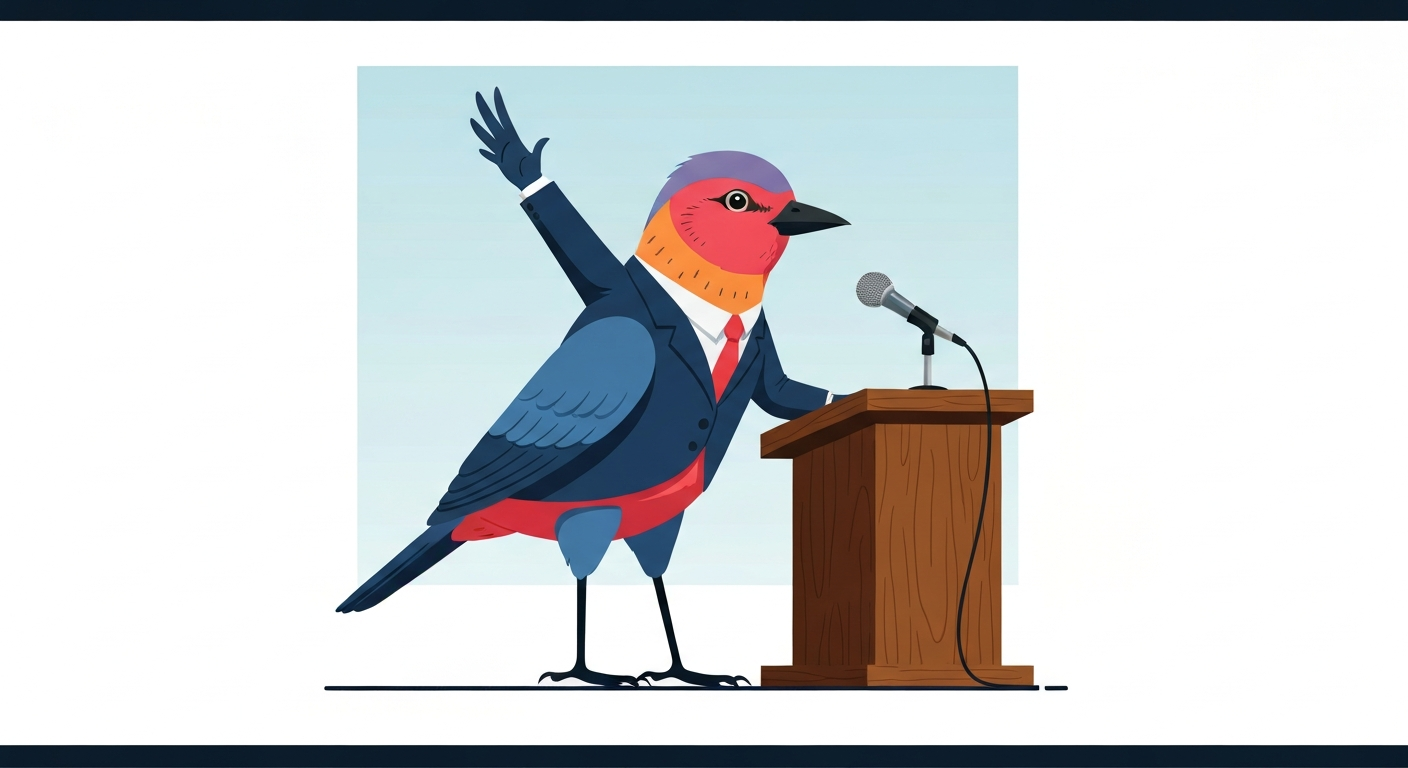
A good image for this article would be a stylized or editorial-style illustration of a brightly colored, slightly cartoonish bird perched at a podium or microphone, rendered in a way that evokes political caricature rather than natural history. Think: bold colors, exaggerated posture, maybe a tiny suit jacket. This captures both the literal bird element and the political-slang meaning without depicting any real person (which would raise attribution and defamation issues). Avoid using actual photographs of politicians alongside this phrase unless they are clearly in a documented news-reporting context with full caption attribution. The visual tone should be wry and editorial, consistent with the phrase's satirical use in commentary.
How This Fits Into Bird Slang and Symbolism More Broadly
"Wacko bird" is a useful reminder that birds in the English language do an enormous amount of figurative work. Bird itself has long served as slang for a person in both British and American English, which is why compounds like odd bird, jailbird, rare bird, and early bird all make intuitive sense even when no actual avian creature is involved. The symbolic resonance of birds as creatures of freedom, unpredictability, and voice makes them a natural fit for describing human personality types, a pattern you see across mythology, folklore, and everyday idiom. The whip-poor-will, for instance, carries a completely different set of associations in Indigenous and Appalachian traditions: its call is often linked to omens, thresholds, and the boundary between the living and the dead. That is about as far from the blunt political insult of "wacko bird" as you can get, yet both expressions reach for birds because birds, in human imagination, have always felt like they mean something.
References and Suggested Further Reading
- Merriam-Webster Dictionary: entries for "wacko" and "whirlybird" (merriam-webster.com) — for register labels, definitions, and first-known-use dates
- Cambridge Dictionary: entry for "wacko" (dictionary.cambridge.org) — learner-friendly definition and example sentences
- Oxford Advanced Learner's Dictionary: entry for "wacko" (oxfordlearnersdictionaries.com) — British/American register comparison and pronunciation notes
- Online Etymology Dictionary (Etymonline): entries for "wacko" and "wacky" (etymonline.com) — derivation from wack/wacky and dating notes
- Oxford English Dictionary (OED): entries for "wacko" and compound phrase searches (oed.com, subscription required) — authoritative dated quotations and sense development
- ABC News: "Ted Cruz: 'Count Me a Proud Wacko Bird'" (March 16, 2013) — primary attested use by Ted Cruz responding to John McCain's label
- Washington Post: reporting and opinion coverage of the McCain "wacko birds" episode, March 2013 — multiple attested uses in national press
- Green's Dictionary of Slang (greensdictofslang.com, subscription) — dated slang citations for wacko and related terms
- COCA — Corpus of Contemporary American English (english-corpora.org) — frequency data, collocates, and register distribution for "wacko bird"
- Google Books Ngram Viewer (books.google.com/ngrams) — diachronic frequency visualization for "wacko" word family
- AP Stylebook (apstylebook.com) — guidance on quoting and handling insulting or stigmatizing language in journalism
- HathiTrust Digital Library (hathitrust.org) — for historical print attestations predating major news databases
- Australian National Dictionary Centre (ANDC) — for confirming regional absence of the phrase in Australian English
- Dictionary of Canadianisms on Historical Principles (DCHP), University of British Columbia — for confirming regional absence in Canadian English
FAQ
What is the overall research plan to write an accurate, well‑sourced article defining “wacko bird”?
Follow a layered, evidence‑first workflow: 1) establish dictionary‑level sense(s) for wacko and for any attested compound “wacko bird” (authoritative dictionaries and slang lexica); 2) search historical and contemporary corpora and archives for earliest and notable attestations (OED, Google Books, newspapers, books, COCA/BNC/GloWbE); 3) collect representative example sentences across registers (news, speech, fiction, social media); 4) map regional distribution and register (US/UK/Australia/Canada) using national archives and corpora; 5) research etymology and sense development (Etymonline, OED, Green’s Dictionary of Slang); 6) prepare disambiguation checks against look‑alikes (whirlybird, whip‑poor‑will, etc.); 7) compile synonyms/alternatives and etiquette/style guidance (AP/Chicago/style guides); 8) document all sources with full citations and flag any uncertain claims. Aim to present: concise definition, tone/register label, dated citations, example sentences, synonyms, disambiguation notes, and usage guidance.
Which primary sources should I consult and why?
Essential authoritative sources: - Oxford English Dictionary (OED) — earliest attestations, dated quotations, sense history (subscription). - Merriam‑Webster, Cambridge, Oxford Learner’s — contemporary, learner‑friendly definitions and register notes. - Green’s Dictionary of Slang — dated slang citations and variant senses. - Online Etymology Dictionary (Etymonline) — quick etymology and dating hypotheses. - Major news archives (e.g., Washington Post, ABC News) — to capture notable quoted instances like 2013 political uses. - Historical/print archives (Google Books, HathiTrust, Newspapers.com, British Newspaper Archive, Trove) — to find earliest or regional uses. - Large corpora (COCA, BNC, GloWbE) — for frequency, collocates, and register distribution. - Urban Dictionary — contemporary crowd‑sourced uses (label clearly as non‑scholarly). - Style guides (AP, Chicago) — for editorial handling of pejorative expressions. Use each for specific strengths: historical evidence (OED/archives), contemporary glosses (Merriam‑Webster/Cambridge), slang history (Green’s), frequency and registers (corpora), and editorial policy (stylebooks).
What exact searches and queries should I run in archives and corpora?
Run a mix of exact‑phrase and variant searches with date filters and context windows: - Exact phrase: "wacko bird" and "wacko birds" (plural) across Google Books, Newspapers.com, British Newspaper Archive, Trove, HathiTrust; record full sentence, publication, date, and page. - Base word context: search for "wacko" near "bird" within 5–10 words (proximity search) to catch variants like hyphenation or intervening punctuation. - Time slices: filter results by decades (pre‑1950, 1950–79, 1980–99, 2000–present) to map emergence and trends; use Google Books Ngram for wacko/wacky family for broader trend. - Corpora queries: COCA/BNC/GloWbE for exact phrase and for collocates (words appearing ±5 words); filter by genre (spoken, news, fiction) and region (US, UK, Australia). - Slang sources: search Green’s Dictionary of Slang and Urban Dictionary for “wacko bird” and variants; capture submission dates and example usages. - News/media examples: site:abcnews.com "wacko bird"; site:washingtonpost.com "wacko bird"; general web search with quotes and date range for 2013‑03 to capture the political cluster. Save screenshots or permalinks for each attestation.
What specific questions should the research answer to support each article section?
Targeted research questions by section: - Definition: Is “wacko bird” attested as a fixed phrase or is it a creative juxtaposition of "wacko" + "bird"? What senses are documented? - Literal vs figurative: Are there uses describing an actual bird vs idiomatic uses for a person? Provide examples. - Register and connotation: Is it slang, informal, jocular, derogatory, reclaimed? Which dictionaries label it informal or offensive? - Origin/etymology: When and where does the phrase first appear? Is it traceable to a specific speaker, region, or cultural moment? - Regional notes: Is the phrase more common in US English than British/Australian English? Do corpora show concentration in certain countries? - Contexts: Where does it appear most (political commentary, comedy, informal speech, social media)? - Examples: Can I find representative citations across registers and dates? - Alternatives: Which synonyms/phrases convey similar meaning with lower offense (e.g., quirky person, eccentric, oddball)? - Disambiguation: Which look‑alike words/phrases are commonly confused and what authoritative definitions clarify them? - Usage guidance: When is use acceptable (informal contexts, quoted journalism) and when likely offensive (direct insults, formal writing)? - Verification: Are any claims about earliest use or etymology supported by OED or primary archive citations, or are they speculative?
How should I verify, attribute, and present attested examples and dates?
Verification steps: 1) Prefer primary sources: capture the original scan or permalink from Google Books, Newspapers.com, or the news site. 2) For each example record: exact quoted string, full citation (author, title, outlet, date, page/URL), the surrounding sentence/paragraph, and register (news, op‑ed, speech, fiction, social media). 3) Cross‑check earliest claimed date across multiple archives (OED, Google Books, newspaper databases); do not rely solely on secondary sources. 4) For etymology, prefer OED/Green’s/Etymonline; if OED subscription not available, clearly mark etymology as “hypothesized” and cite Etymonline/Green’s or earliest printed attestation found. 5) When using user‑generated sources (Urban Dictionary), present the entry verbatim, record submission date, and label reliability caveat. 6) Keep screenshots or permanent links and note access dates. 7) If conflicting dates/sources arise, present both with commentary on reliability (e.g., newspaper clipping vs. fleeting speech transcript).
What disambiguation checks and references are required to correct likely confusions?
Compile authoritative definitions and links for look‑alikes: - Whirlybird — helicopter (Merriam‑Webster, Cambridge). - Whip‑poor‑will — nocturnal bird species (ornithological sources, e.g., Audubon, Britannica). - Whistleblower/“whistleblew” — legal/public‑policy term (dictionary definitions; explain past tense confusion). - Whim bird — not an established lexical item; search corpora to show rarity and clarify probable mishearing. For each, provide: short authoritative definition, source citation, and a one‑line note explaining why readers might confuse it with “wacko bird” (sound‑alike, typing error, auto‑correct). Use these checks to produce a clear disambiguation paragraph and link suggestions to related site pages (whirlybird, whip‑poor‑will, bird idioms, slang) used in the article.
Next Article
Whim Bird Meaning: Definition, Mishearings, and Usage
Whim bird meaning: concise guide to usage, literal species (e.g., whip-poor-will), slang, misspellings, and examples.