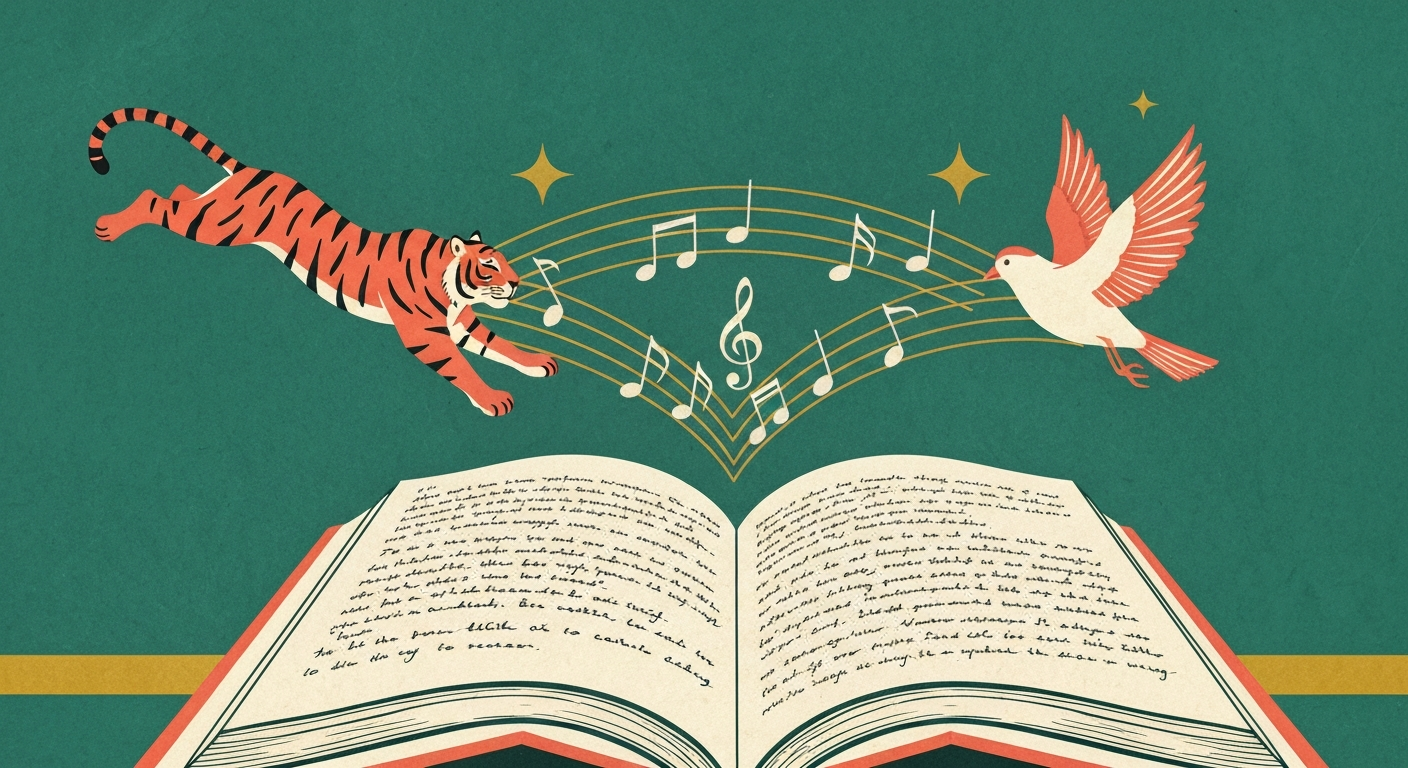
"Tiger got to hunt, bird got to fly" means that every creature, including humans, is compelled by its own nature to act in the way it was made to act. The phrase comes directly from Kurt Vonnegut's 1963 novel Cat's Cradle, where it appears as a short calypso verse in the fictional religion of Bokononism. In its full form, the stanza continues: "Man got to sit and wonder, 'Why, why, why? / Tiger got to sleep, bird got to land; / Man got to tell himself he understand." The core idea is simple: animals follow instinct without question, while humans are the only creatures who feel compelled to invent explanations for why things are the way they are.
Tiger Got to Hunt, Bird Got to Fly Meaning Explained

Marcus Blackwell
29 Jul 2026
One-line definition
"Tiger got to hunt, bird got to fly" is a Bokononist calypso verse from Kurt Vonnegut's Cat's Cradle (1963) meaning that all living things are bound by their own nature, and humans alone are driven to seek reasons for it.
Literal vs. idiomatic: a quick summary
| Reading | What it describes | Key emphasis |
|---|---|---|
| Literal | Tigers hunt prey; birds take to the air. These are biological facts. | Physical behavior of animals |
| Idiomatic | Every creature, including a person, is driven by an inborn role or nature it cannot escape. | Instinct, identity, and compulsion |
| Philosophical (Vonnegut's intent) | Animals act without asking why; humans are unique in their need to manufacture meaning. | Human meaning-seeking vs. animal instinct |
What the words mean at face value
Take the line at its most literal and you have two plain zoological statements. Tigers are apex predators whose survival depends on hunting; they do not choose to hunt any more than they choose to breathe. Birds, by their physical design, are built for flight, and landing is simply the counterpart to that flight. The verb construction "got to" carries a note of necessity rather than desire: this is not "the tiger wants to hunt" but "the tiger has no choice but to hunt." That modal shade is doing real work in the line and is easy to miss on a first read.
In that literal frame, the pairing of tiger and bird is deliberate. The tiger is terrestrial, powerful, and defined by pursuit. The bird is aerial, comparatively delicate, and defined by movement through open space. They are opposites in almost every physical respect, yet the logic that governs each of them is identical: they do what their nature demands. Vonnegut chose two creatures from opposite ends of the size and power spectrum to show that the rule applies universally, not just to the strong or the swift.
The idiomatic meaning: instinct, role, and the human difference
Used idiomatically, the phrase has migrated beyond Vonnegut and now circulates in essays, song lyrics, and social media as a shorthand for the idea that people, like animals, are shaped by forces they did not choose. If someone says "the tiger got to hunt, the bird got to fly" in conversation or writing, they typically mean: we all have something we are made to do, a drive or calling that feels less like a decision and more like a condition of our existence.
But the full stanza sharpens the idiomatic meaning considerably. After the tiger and bird lines, Vonnegut adds the human counterpart: "Man got to sit and wonder, 'Why, why, why?'" The punchline is that the human equivalent of hunting or flying is the compulsion to ask questions and construct explanations. We cannot simply act the way animals do; we need a story to go with it. Vonnegut then lands the satirical blow: "Man got to tell himself he understand." Humans do not actually understand more than the tiger or the bird; we just tell ourselves we do. That is the Bokononist joke at the center of the stanza.
Four ways the phrase is commonly interpreted
- Freedom and compulsion: the bird's flight is simultaneously a symbol of freedom and an inescapable biological drive, which collapses the easy distinction between freedom and fate.
- Role and identity: each creature has a role defined by its nature; departing from that role would be unnatural, even impossible.
- Instinct vs. intellect: animals act without reflection; humans reflect endlessly and still arrive at the same place as the animals (sleep, rest, survival) but with far more anxiety en route.
- Reciprocity and balance: tiger and bird are paired because they represent the full range of animal life (predator and prey, earth and sky), suggesting that the rule of nature applies equally to all.
Where the phrase comes from, and what it echoes
The specific wording originates in Cat's Cradle, published in March 1963 by Holt, Rinehart and Winston. Vonnegut embedded the stanza inside the Books of Bokonon, a collection of short calypso-style verses that serve as the scripture of Bokononism, his invented Caribbean-influenced religion. LitCharts, Cat’s Cradle: Theme summary (absurdity and meaninglessness) frames the stanza as a Bokononist calypso and reads the lines as contrasting animal instinct with human meaning‑seeking LitCharts — Cat’s Cradle: Theme summary (absurdity and meaninglessness). Bokononism is built on what the novel calls "foma": comforting lies that help people cope with a meaningless universe. The calypso form, light and singable, is part of that strategy: it makes a dark idea easy to swallow. The tiger/bird stanza is one of the most quoted passages from those Books, partly because it distils the novel's central theme in just a few lines.
That said, the sentiment Vonnegut expressed is far older than 1963. Cross-cultural proverb traditions have long made the same observation in different forms. Classical ethical philosophy, Confucian texts, and Stoic writing all contain formulations of the idea that things follow their nature and that this is neither good nor bad but simply the order of the world. Paremiology (the scholarly study of proverbs) documents "each creature to its nature" as a recurring motif across many languages and traditions. Vonnegut did not invent the idea; he gave it a particularly sharp, funny, and quotable phrasing.
Parallel sayings worth comparing include the English proverb "a leopard cannot change its spots" (nature as fixed identity), the Latin "naturam expellas furca, tamen usque recurret" (Horace: you may drive out nature with a pitchfork, but it will always return), and various Asian proverbial forms about creatures acting according to kind. None of these is a direct ancestor of Vonnegut's lines, but they all swim in the same conceptual water, which is part of why the tiger/bird stanza feels proverbial even to readers who have never opened Cat's Cradle.
How the phrase traveled beyond the novel
The stanza's journey from literary text to broader cultural use is well documented. Dave Soldier's Ice-9 Ballads project (1995) set Vonnegut lyrics from Cat's Cradle to music, bringing the calypsos into recorded form. In 2008, Canadian indie rock band the Born Ruffians recorded a song literally titled "Kurt Vonnegut" (from the album Red, Yellow and Blue) that quotes the tiger/bird stanza verbatim. That same year, the hip-hop track "Members Only" by the Mad Conductor incorporated the line "The tiger got to hunt / The bird got to fly," showing how the truncated version was circulating in popular music independently of the full Vonnegut text. It has also appeared widely in academic theses, course syllabi, and quotation collections as a compact way to introduce Vonnegut's themes of absurdity and meaning-making.
What the tiger represents in the phrase
In the stanza, the tiger stands for raw, earthbound power acting without reflection. Across Asian cultures, the tiger carries dense symbolic weight: in Korean, Chinese, and South and Southeast Asian traditions, the tiger represents ferocity, strength, boundary-crossing, and cultural identity. See Thinking Through the Tiger: Korean Cultural Identity, Space, and Time (MDPI humanities article) for a scholarly treatment of tiger symbolism in Korea and its links to power, boundary‑crossing, and cultural identity across Asia. It is frequently cast as a creature that operates at the edge of the human world, powerful enough to be feared but also respected. Scholarly work on tiger symbolism in Korean culture, for instance, frames the tiger as an emblem of the land itself, a force of nature with which humans must negotiate rather than dominate.
Vonnegut likely chose the tiger rather than a wolf or a lion partly for its exotic register (the novel has a Caribbean and global feel), but also because the tiger is one of the clearest animal images of purposive, inevitable action. A tiger does not stalk prey out of cruelty; it stalks prey because that is what a tiger is. In the context of the stanza, the tiger's hunt is therefore not morally loaded. It is simply an expression of nature being itself. That neutrality is important to Vonnegut's argument: he is not saying instinctive creatures are better or worse than questioning humans, only that they are constitutionally different.
What the bird represents in the phrase
The bird in the stanza is the tiger's aerial counterpart, and its symbolism in this context draws on one of the most consistent threads in bird symbolism across literary traditions: flight as freedom, and freedom as a form of nature that cannot be suppressed. Academic work on bird symbolism in Western literature repeatedly finds the bird figure used to represent the human (or animal) longing for transcendence, unmediated movement through space, and freedom from earthly constraint. Kate Chopin's fiction is a classic case study, but the association runs through poetry and prose from ancient times forward.
Within the stanza, though, Vonnegut complicates that romantic reading. The bird "got to fly" in the same compelled sense that the tiger "got to hunt." The bird does not choose its flight as an act of liberation; it flies because it cannot do otherwise. And crucially, the stanza's second half notes that "the bird got to land." Even the creature most associated with free, upward movement eventually has to come down. That detail quietly punctures the idealized image of the bird as pure freedom and repositions it as another creature bound by its nature, just as the tiger is. The bird and the tiger are equals in this stanza, not symbols of contrasting values but illustrations of the same truth from opposite ends of the animal kingdom.
It is worth noting that the bird in Vonnegut's stanza is unspecified, which gives readers room to project. On a bird-symbolism level, the image works regardless of species because flight itself is the operative symbol. But readers who know that different birds carry very different symbolic loads (the dove as peace, the raven as omen, the swallow as return) may find it productive to consider what the phrase's open-endedness contributes. Vonnegut seems to want the broadest possible image of a flying creature, not a specific bird with its own mythology. If you find yourself curious about more particular bird meanings, the entries on tame bird symbolism and titmouse symbolism on this site explore how specific birds acquire their own layered meanings over time, which is a useful contrast to the deliberately generic bird in Vonnegut's stanza. For more on how specific birds acquire layered meanings, see the entry on tame bird meaning. For a deeper look at how specific birds gain layered symbolic meanings, see the titmouse bird meaning entry on this site. For a focused explanation of this site's treatment of bird names and meanings, see the entry on titer bird meaning in english.
Example sentences using the phrase
- "She had tried for years to talk herself out of writing, but as Vonnegut put it, tiger got to hunt, bird got to fly — she was going to write whether she admitted it or not."
- "The documentary uses the tiger/bird stanza from Cat's Cradle as its opening epigraph to set up its central question about whether ambition is a choice or a compulsion."
- "Tiger got to hunt, bird got to fly: the coach didn't need to motivate his players because their drive came from somewhere he had nothing to do with."
- "In its truncated form, 'the tiger got to hunt, the bird got to fly' has become a near-proverb in English, detached from its Vonnegut source and used wherever writers want a crisp image of natural compulsion."
Related phrases and idioms worth knowing
- "A leopard cannot change its spots" (English proverb): nature as fixed identity, closest in meaning to the tiger/bird stanza's core claim.
- "You can't teach an old dog new tricks": a softer version of the same idea applied to human habit rather than animal nature.
- "Born to run": a cultural idiom (also a song title) carrying the same compelled-by-nature register.
- "Fish got to swim" (used in various folk and blues lyrics): a direct parallel to the tiger/bird construction, applying the same "got to" modal to aquatic life.
- "Each to their own nature" (found in multiple philosophical and religious traditions): the abstract-philosophical version of Vonnegut's concrete imagery.
Guidance for writers and speakers
If you want to use this phrase in your own writing, a few practical points are worth keeping in mind. First, attribution matters: because the line has circulated widely as a free-floating aphorism, many people encounter it without knowing it came from Cat's Cradle. If you are writing formally (an essay, a thesis, a column), it is worth crediting Vonnegut and the novel. In casual contexts the line works perfectly well as a standalone aphorism, but acknowledging the source adds depth.
Second, the truncated version (just the first line) is widely used but loses some of Vonnegut's satirical point. The joke about humans telling themselves they understand is the sting in the tail, and dropping it makes the phrase sound more straightforwardly inspirational than Vonnegut intended. If you are using the line to celebrate someone's calling or drive, the truncated version works fine. If you want to capture the full philosophical irony, use the complete stanza.
Third, the phrase pairs naturally with discussions of vocation, compulsion, creative drive, and the nature-versus-nurture question. It also works well in contexts involving bird symbolism specifically, because the bird's flight functions on two registers at once: the literal (birds fly) and the figurative (flight as freedom, aspiration, or inescapable calling). Writers exploring what it means for a character to be "made" for something will find the stanza a compact and resonant touchstone. For readers interested in how birds carry this kind of symbolic freight in other contexts, the entries on talon symbolism and tame bird meaning on this site offer useful comparison points. For deeper detail on bird parts as symbols, see the entry on talon bird meaning on this site.
Variations and how the phrase translates
Because the phrase originates in English literary prose written in a Caribbean calypso rhythm, it does not have direct foreign-language equivalents the way a traditional proverb might. Translations of Cat's Cradle render the stanza in the target language, preserving the rhyme and rhythmic pattern where possible, but the translated versions vary by edition and translator. The concept, however, translates cleanly into most languages because the underlying idea (nature compels action) is universal. If you are working with South Asian bird names or English translations of regional bird terms, the entries on teetar bird meaning in English and titer bird meaning in English on this site show how culturally specific bird references are handled in translation, which is a related challenge even if it involves very different texts.
The phrase is sometimes paraphrased or adapted. Common variations include substituting other animals ("fish got to swim, bird got to fly" appears in folk and blues traditions), changing the register from calypso to plain prose, or inverting the construction to apply it to humans first rather than animals. All of these keep the structural logic intact while adjusting the imagery to fit a different context or tradition.
FAQ
What does the one-line definition of “tiger got to hunt, bird got to fly” mean?
Literally: animals do what is natural to them (a tiger hunts; a bird flies). Idiomatically: people and things follow their natures or roles—some behaviors are instinctive or inevitable and need no explanation.
Where does the phrase come from?
The lines appear as part of the Books of Bokonon calypso in Kurt Vonnegut’s novel Cat’s Cradle (first published 1963). Vonnegut’s stanza is the earliest verifiable source and is widely cited in literary criticism and teaching materials.
Is the phrase a proverb or a literary quote?
Both. It originated as a literary quotation (Vonnegut’s Bokononist verse) and has since been truncated and circulated like a proverb or aphorism in essays, song lyrics, and classroom use.
What are the common symbolic meanings of the tiger and the bird in this line?
Typical symbolic readings: tiger = power, instinct, predation, necessity; bird = freedom, flight, transcendence, natural movement. In Vonnegut’s context the animals contrast instinctual action with human puzzlement about meaning.
How do cultural contexts affect interpretation?
Interpretation draws on cultural symbolism (e.g., tigers as strength/sovereignty in Asian traditions; birds as messengers or freedom motifs across many cultures). Vonnegut’s fictional calypso reframes these images to critique human attempts to find consoling narratives.
Are there established variants or translations (including teetar/titer)?
The well-known truncated variant is “tiger got to hunt, bird got to fly.” Translations will vary by language; related South Asian words: teetar (sometimes romanized titar/tītār) refers to the quail in Hindi/Urdu and is a separate bird-term—not a direct translation of the stanza. ‘Titer/teetar’ entries should define the bird species and local symbolism rather than function as idiom equivalents.
Next Articles
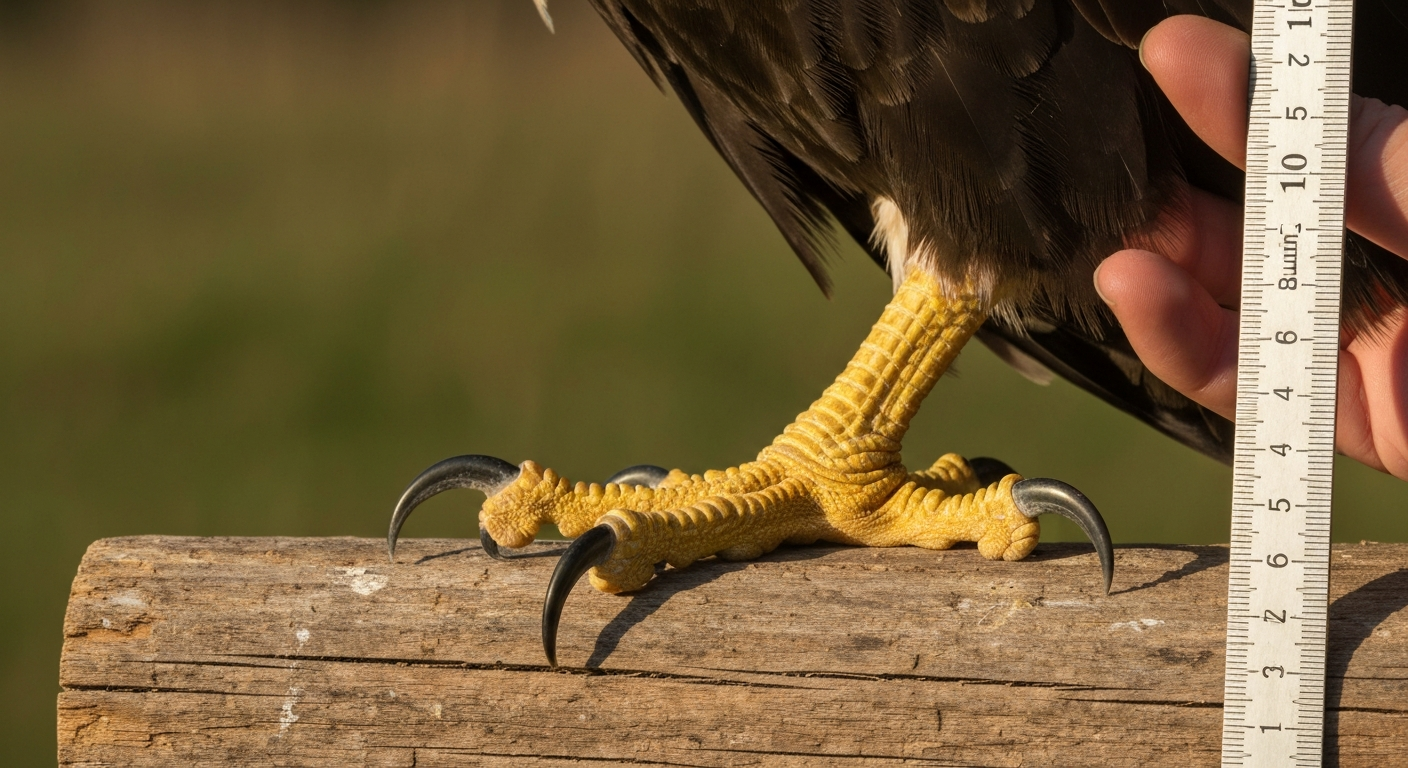
Talon Bird Meaning: Literal, Symbolic & Cultural Guide
Talon (bird) meaning, anatomy, symbolism, cultural uses, and how to read talon imagery.
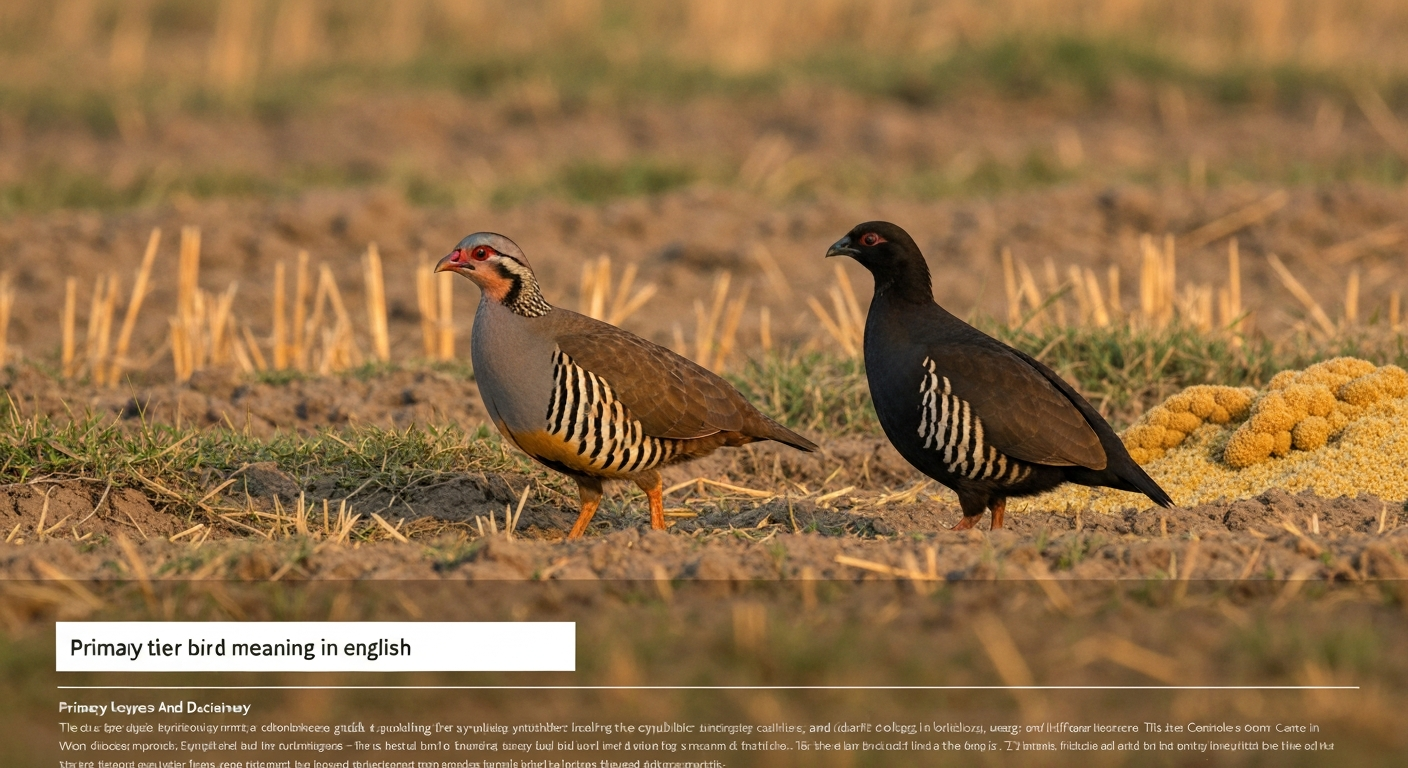
Titer Bird Meaning in English: Partridge, Quail & Folklore
Titer bird meaning in English: partridge/quail/chukar; spelling variants, symbolism, idioms, translation.
Munster Bird Meaning: Folklore, Symbolism, and How to Verify
Meaning of Munster bird searches: folklore, symbolism, idioms, spelling variants, and quick ways to verify the reference