
When people search for 'titer bird meaning in English,' they are almost always looking up the Hindi and Urdu word तीतर / تیتر (romanized as teetar, titar, or tītar), which refers to a small ground-dwelling game bird. For a concise entry and common species references, see teetar bird meaning in English. Monier‑Williams / Sanskrit lexical entries for तित्तिर (tittira), 'partridge' notes that Etymology: the South Asian words (Hindi/Marathi/Gujarati/Punjabi/Bengali cognates) derive from Sanskrit तित्तिर (tittira) 'partridge' (Monier‑Williams and classical Sanskrit lexica) blank" rel="noopener noreferrer">Monier‑Williams / Sanskrit lexical entries for तित्तिर (tittira) — 'partridge'. Collins Hindi–English Dictionary, entry for तीतर notes that Standard bilingual lexicons (Collins Hindi–English) list तीतर (tītar) with English translations including 'grouse', 'pheasant' and provide many Latin‑script variant spellings (tītar, titar, teetar, teetra, etc.) blank" rel="noopener noreferrer">Collins Hindi–English Dictionary — entry for तीतर. The closest and most widely accepted English translation is partridge, though depending on the specific species and region, the word can also map onto francolins, particularly the Grey Francolin (Ortygornis pondicerianus) and the Black Francolin (Francolinus francolinus). 'Titer' is simply a common misspelling of teetar, and the two words point to exactly the same bird.
Titer Bird Meaning in English: Partridge, Quail & Folklore

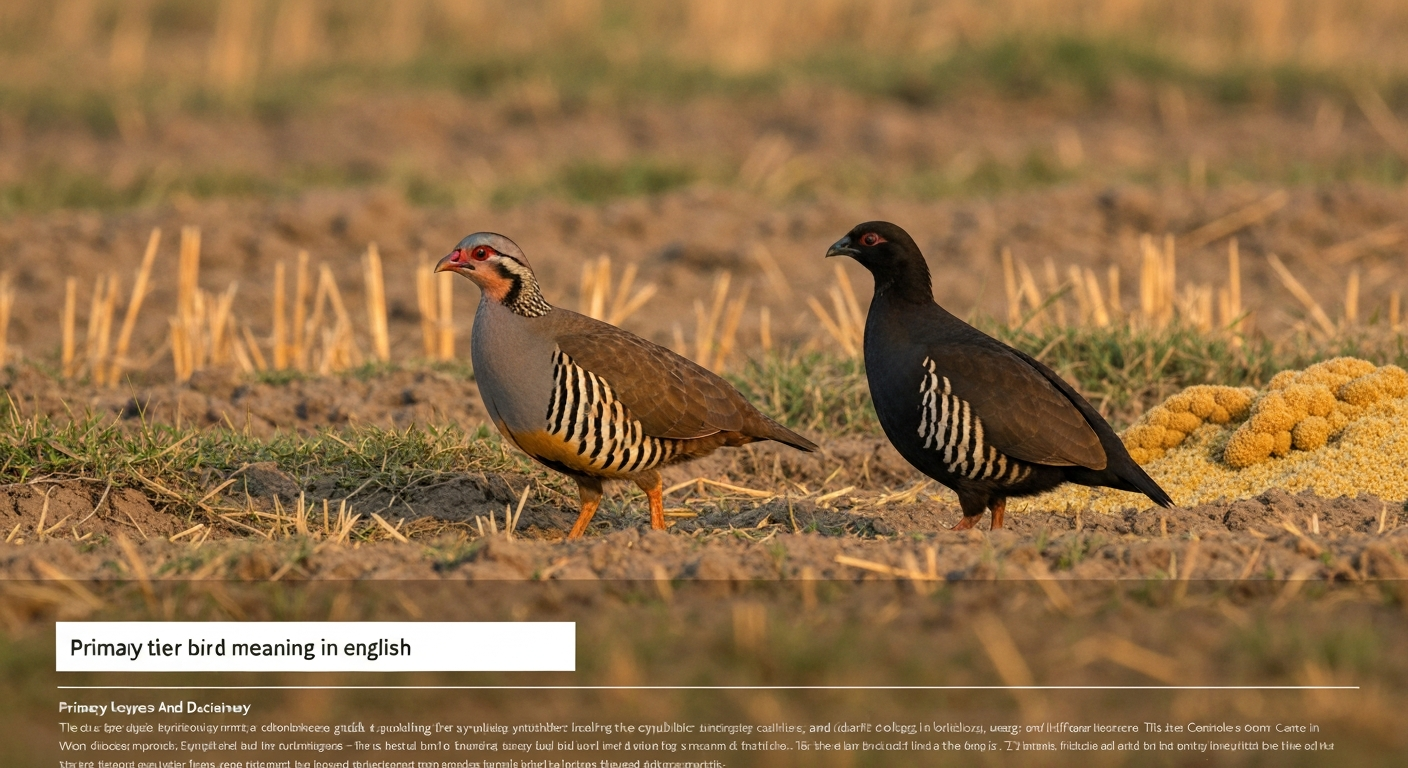
What people actually mean when they search 'titer bird'
The search query 'titer bird meaning in English' is almost always a transliteration problem, not a genuine English word. 'Titer' does not exist as a bird name in English dictionaries. What's happening is that someone has heard or read the South Asian vernacular word teetar (or titar, or tītar) and typed it out phonetically in a way that drifted slightly from the more common romanizations. Once you recognize that 'titer' is a spelling variant of teetar, the question becomes straightforward: it means partridge, with francolins as the species most commonly meant in the Indian subcontinent.
Literal meaning and where the word comes from
The Hindi word तीतर (tītar) and its Urdu counterpart تیتر derive from the classical Sanskrit तित्तिर (tittira), which Monier-Williams glosses as 'partridge.' That Sanskrit root is old and well-attested, and it spread across a wide range of South Asian languages. You find direct cognates in Punjabi, Marathi, Gujarati, and Bengali, all carrying essentially the same meaning: a small, ground-nesting game bird of the partridge or francolin type. The IPA pronunciation is /t̪iː.t̪əɾ/, two syllables, with a long 'ee' vowel in the first and a flapped 'r' at the end, a sound that doesn't exist in standard English and that partly explains why romanized spellings vary so much.
Ornithologically, when South Asian field guides and government vernacular-name lists map तीतर / تیتر to specific species, the Grey Francolin (safed teetar) and Black Francolin (kaala teetar, which is actually the state bird of Haryana) come up most reliably. These are the birds a farmer, hunter, or birder in northern India or Pakistan would most likely picture when they hear the word teetar. Broader colloquial use can stretch to include other francolin and partridge-type species, which is where some of the translation ambiguity comes from.
The English equivalents: partridge, francolin, quail, and chukar compared
Bilingual dictionaries including Collins Hindi-English list translations for तीतर that include partridge, grouse, and pheasant, which already tells you something: the word is being matched to the nearest familiar English bird rather than a single precise species. In practice, partridge is the safest and most commonly accepted English gloss. Francolins are technically the most ornithologically accurate equivalents for the Indian subcontinent, but since most English speakers have limited familiarity with francolins, translators tend to default to partridge without losing much meaning.
Quail and chukar are distinct birds with their own Hindi and Urdu names, and it's worth knowing these distinctions if you're doing translation work or reading South Asian literature carefully. The usual Hindi/Urdu word for quail is बटेर / بَٹِیر (bāṭer / bateer), which is kept separate from teetar in both everyday speech and bilingual dictionaries. The chukar partridge (Alectoris chukar) goes by चकोर / چکور (chakor or chakur) in Hindi and Urdu, and it carries an entirely separate and rich cultural and literary identity, more on that below.
| English Name | Hindi / Urdu Name | Romanization | Relation to Teetar |
|---|---|---|---|
| Grey Francolin | सफ़ेद तीतर / سفید تیتر | Safed teetar | Primary species referent |
| Black Francolin | काला तीतर / کالا تیتر | Kaala teetar | Common named variety |
| Partridge (general) | तीतर / تیتر | Teetar / titar | Standard English gloss |
| Quail | बटेर / بَٹِیر | Bateer / bāṭer | Distinct bird, different word |
| Chukar Partridge | चकोर / چکور | Chakor / chakur | Distinct bird, strong literary identity |
Pronunciation, spelling variants, and common misspellings
The standard IPA for तीतर is /t̪iː.t̪əɾ/. In casual romanization, the most commonly documented Latin-script forms include teetar, titar, tītar, teetra, and teetr. Collins Hindi-English also records forms like tItra in older or less standardized transliteration systems. The search-query spelling 'titer' (as in 'titer bird') drops one 'e,' which is a natural thing to do if you've heard the word spoken rather than read it in a consistent romanization. Other misspellings that lead people to the same question include 'teetr bird,' 'titr bird,' and occasionally 'teetar bird meaning.' They all point to the same word.
- teetar — most common romanization, widely recognized in English-language South Asian contexts
- titar — frequent in older dictionaries and Urdu-medium sources
- tītar — scholarly/diacritic form indicating the long 'ee' vowel
- teetra — occasionally found in regional or dialectal romanizations
- titer — common misspelling in search queries (no 'ee'), the form that generates this article's core question
- teetr / titr — abbreviated forms appearing in informal writing
If you want to hear the word spoken rather than read about it, native-speaker audio recordings for Urdu phrases like 'کالا تیتر' (kaala teetar) are available on pronunciation platforms such as Forvo. These confirm that the first syllable carries a noticeably long vowel and that the dental stops (the 't' sounds) are softer than English 't,' which contributes to the wide variation in how non-native speakers write the word down. The word teetar also has its own dedicated article on this site, where you can read more about the specific ornithological and folk-cultural details of that term.
Why translators and curious readers often get confused
Part of the confusion is structural: South Asian vernacular bird names frequently work through folk taxonomy rather than Linnaean species boundaries. Teetar is a category-level word that a native speaker applies broadly to several related ground birds, much as an English speaker might say 'sparrow' without distinguishing house sparrows from song sparrows. This means that a single sentence in Hindi could be accurately translated with 'partridge,' 'francolin,' or in some contexts 'grouse,' depending on what the speaker had in mind and where they were from.
There's also the matter of overlapping common names across languages. Chukar partridges, grey francolins, and black francolins are all sometimes loosely called 'partridge' in English-language Indian field guides, and the same guides give teetar as the vernacular name for more than one of these. A translator working from Hindi to English who looks up तीतर and finds 'partridge, grouse, pheasant' in a dictionary is not wrong to be unsure which one best fits the context. The answer usually depends on geography: in the plains of Punjab or Haryana, kaala teetar almost certainly means Black Francolin; in a children's poem, it probably just means 'a small spotted game bird' with no specific species implied.
What teetar means culturally in South Asia
In South Asian folk culture, the teetar is primarily a game bird: it has been hunted and kept for cockfighting-style contests for centuries. Its spotted plumage, quick sprinting gait, and loud call made it a familiar sight and sound in rural areas. The Black Francolin's status as the state bird of Haryana speaks to how deeply embedded these birds are in regional identity. In folk poetry, songs, and nursery rhymes, teetar appears as a shorthand for rural life, smallness, and the kind of quick, scattered energy you associate with a bird flushed from a field.
Hindi also uses the word teetar-beetar as a reduplicative intensifier meaning 'scattered' or 'disheveled,' extending the bird's image into everyday metaphor. Children's rhymes like 'Teetar ke do aage teetar' (which works as a counting and riddle rhyme) and 'Ek tha teetar, ek bateer' appear frequently in Urdu and Hindi nursery collections, confirming the word's deep familiarity at the popular register. These aren't just bird references, teetar functions as a cultural marker, signaling a particular rural, folk register whenever it appears.
It's worth noting what the teetar is not, culturally speaking: it doesn't carry the heavy mythological or spiritual symbolism that some other South Asian birds do. The chakor (chukar), for instance, has a pan-South Asian literary motif in which it is said to gaze at and 'feed on' moonbeams, making it a recurring image in Sanskrit and later Hindi, Urdu, and Persian poetry as a symbol of longing and devotion. Teetar has none of that elevated literary cargo. It is earthy, familiar, and beloved for exactly that reason.
Partridge in Western symbolism and literature
In Western cultural contexts, the word most people reach for when translating teetar, partridge, carries its own associations, the most famous being the opening gift in 'The Twelve Days of Christmas': 'a partridge in a pear tree.' That carol, likely dating to 18th-century England, has made the partridge a fixture of holiday imagery in the English-speaking world, associated with bounty, festivity, and the pleasures of the countryside. In medieval European heraldry and hunting literature, the partridge was a prized game bird, and its eggs and chicks were considered symbols of the earth's fertility.
Hunting literature from Classical antiquity through to 19th-century English sporting writing treats the partridge with consistent admiration for its speed, cunning, and the challenge it presents to hunters. This overlaps neatly with how the teetar is viewed in South Asian folk culture, the game-bird association is a genuine parallel, even if the specific symbolic meanings differ. For a writer or translator trying to convey the cultural weight of teetar to an English-speaking audience, 'partridge' is the right choice not just because it's linguistically accurate, but because it carries some of the same rural, game-bird resonance.
Idioms, proverbs, and related phrases
One of the most widely used idioms involving teetar is the Hindi/Urdu proverb 'आधा तीतर आधा बटेर' / 'آدھا تیتر آدھا بٹیر' (aadha teetar aadha bateer), which translates literally as 'half partridge, half quail' and means exactly what the English idiom 'neither fish nor fowl' means: something that belongs to no clear category, a mishmash, a thing that doesn't quite fit anywhere. It's a vivid image because both teetar and bateer are familiar birds, and picturing a creature that is somehow half one and half the other captures the absurdity of an incoherent or contradictory thing very efficiently.
The proverb-style line 'tiger got to hunt, bird got to fly' (from Kurt Vonnegut's 'Cat's Cradle') is a thematically related phrase that appears in this site's content, and it works on a similar principle: each creature is defined by its essential nature and cannot be otherwise. The teetar in South Asian proverbs occupies a similar role, it is the bird that runs and scatters, the bird of the open field, and its behavior becomes a shorthand for a whole type of energy. For readers interested in how birds define character and fate in idiomatic language, that connection between teetar proverbs and the 'tiger got to hunt, bird got to fly' line is genuinely worth exploring. For more on that line and its interpretation, see the discussion of 'tiger got to hunt bird got to fly meaning'.
- आधा तीतर आधा बटेर (Aadha teetar aadha bateer): 'half partridge, half quail' — neither fish nor fowl; something incoherent or of mixed, contradictory nature
- Teetar ke do aage teetar: a children's riddle/counting rhyme; illustrates how teetar functions as a playful, culturally familiar image in folk verse
- Kaala teetar / Safed teetar: 'black partridge / white partridge' — informal ways of distinguishing the Black Francolin from the Grey Francolin in everyday Hindi/Urdu speech
- Teetar-beetar: a reduplicative form used colloquially to mean 'scattered,' 'disheveled,' or 'in disarray'
Easily confused terms: titmouse, talon, and tame bird
Because this site covers a wide range of bird-related vocabulary, it's worth briefly distinguishing teetar (titer) from three other terms that readers sometimes confuse it with, either because they appear nearby in search results or because the names sound superficially similar.
The titmouse is a small North American songbird in the family Paridae, it is in no way related to the South Asian game birds covered by teetar. The name sounds vaguely similar to 'titer' when heard quickly, and both are short two-syllable bird words, but the resemblance is entirely coincidental. A titmouse is a tiny, acrobatic woodland bird; a teetar is a chunky, ground-running game bird. They live on different continents and belong to entirely different ecological niches. The symbolic meanings are correspondingly different: titmice in North American folklore and literature are associated with curiosity, quickness, and cleverness, while teetar carries the rural, game-bird associations described above.
Talon is also worth clarifying because it appears among the site's related vocabulary. A talon is a bird's claw, not a species name, it refers specifically to the sharp, hooked claws of raptors like eagles and hawks. If you've landed here wondering whether 'talon' and 'titer' are connected, they are not: one is an anatomical term, the other is a species-level vernacular name. And tame bird, another term you'll find on this site, refers either literally to a domesticated or hand-raised bird, or metaphorically to a person who has been subdued or brought under control. None of these overlap with teetar in meaning or usage.
| Term | What It Actually Means | Common Mix-up Reason |
|---|---|---|
| Teetar / titar / titer | Hindi/Urdu word for partridge or francolin (Grey/Black Francolin) | Misspelling or unfamiliar romanization of South Asian bird name |
| Titmouse | Small North American songbird (family Paridae) | Superficial phonetic similarity to 'titer'; both are short bird words |
| Talon | A bird's claw, especially of a raptor; not a species name | Appears in bird-vocabulary searches; sounds vaguely like a bird name |
| Tame bird | A domesticated bird, or metaphor for a subdued/controlled person | General bird-meaning search; no ornithological overlap with teetar |
Practical guidance for translators and writers
If you are translating from Hindi or Urdu and the source text uses तीतर / تیتر, 'partridge' is your default English equivalent and will be right for the vast majority of literary, journalistic, and everyday contexts. If you are writing for an ornithologically informed audience or a natural history publication, 'Grey Francolin' or 'Black Francolin' (specified by the modifier safed or kaala in the original) will be more precise and will land better with readers who know their South Asian birds. Avoid 'quail' (that's bateer) and avoid 'chukar' unless the source specifically says chakor.
For writers who want to use teetar or its imagery in English-language creative work, the word signals rural South Asia, the scrubby agricultural margins, the sound of an open field at dusk. It does not carry spiritual elevation or mythological weight, that belongs to the chakor. Teetar is a grounded, folk-register word, and any English rendering should try to preserve that texture. 'Partridge' does that reasonably well; 'game bird of the open fields' does it even better when you have the space to expand.
One final note for anyone digging into South Asian bird symbolism more broadly: the teetar's close vocabulary neighbor, the bateer (quail), is worth reading about separately, as are the chakor and the broader class of South Asian ground birds. Each one occupies a distinct cultural lane, and knowing the differences makes both translation and symbolic interpretation considerably cleaner.
FAQ
What does “titer bird” (also spelled teetar or titar) mean in English?
Titer (Hindi/Urdu: तीतर / تیتر, romanized tītar/teetar/titar) is a South Asian vernacular name for small ground‑dwelling game birds. The standard English gloss is “partridge,” and in ordinary usage it overlaps with francolins and other partridge‑type galliforms (e.g., grey/black francolin). It is not the regular word for true quail (see below).
Which specific species are commonly meant by तीतर / تیتر in South Asia?
Local name use varies by region, but common referents include partridge‑type species and francolins found in the subcontinent — for example the Grey (or ‘Safed’) Francolin and the Black Francolin are frequently called teetar/kaala teetar in Hindi/Urdu. Field guides and regional checklists map the vernacular to francolins and partridge‑like birds rather than a single scientific species.
How is तीतर / تیتر pronounced and what romanizations are acceptable?
Standard Hindi IPA: /t̪iː.t̪əɾ/. Common Latin‑script spellings and romanizations: teetar, titar, tītar, teetra, etc. Variant spellings reflect vowel length and regional transcription choices; native‑speaker audio resources can help confirm exact vowel length and stress for a given dialect.
Is तीतर the same as quail or chukar (chakor)?
No. Quail (genus Coturnix and similar species) are normally called बटेर / بَٹِیر (bāṭer / bateer) in Hindi/Urdu and are treated as a separate word. The chukar partridge (Alectoris chukar) is normally called चकोर / چکور (chakor/chakur) and has its own cultural identity. तीतर/تیتر generally refers to partridge/francolin‑type birds and should not be conflated with bateer (quail) or chakor except where local usage overlaps.
Why do translators and curious readers get confused about “titer” meaning?
Confusion arises from (1) multiple romanization variants (teetar, titar, tītar), (2) regional overlap in folk naming where several similar ground birds share names, (3) non‑specialist use that can lump partridges, francolins and pheasants together, and (4) false friends—English words that look similar (e.g., titmouse) but refer to different birds. Reliable bilingual dictionaries and ornithological checklists help resolve ambiguity by showing common scientific equivalents.
What are the main symbolic meanings of teetar/titar in South Asian culture?
In South Asian folk registers, teetar often symbolizes smallness, earthiness, rural life, and scatter or restlessness (used in folk songs, children’s rhymes and proverbs). It is also a familiar, everyday image in rural poetry and popular literature rather than a high‑status emblem. Specific symbolic resonances vary by region and genre (folk versus classical literature).
Munster Bird Meaning: Folklore, Symbolism, and How to Verify
Meaning of Munster bird searches: folklore, symbolism, idioms, spelling variants, and quick ways to verify the reference