The osprey is a fish-hunting raptor found on every continent except the poles, and its symbolic meaning centers on three things: razor-sharp focus, mission-driven persistence, and protection of what matters most. When people search "osprey bird meaning," they're usually looking for one of two things: a spiritual or totem interpretation, or a way to make sense of an encounter (a sighting, a dream, a tattoo idea).
Osprey Bird Meaning: Literal Facts and Symbolic Message

Marcus Blackwell
2 May 2026
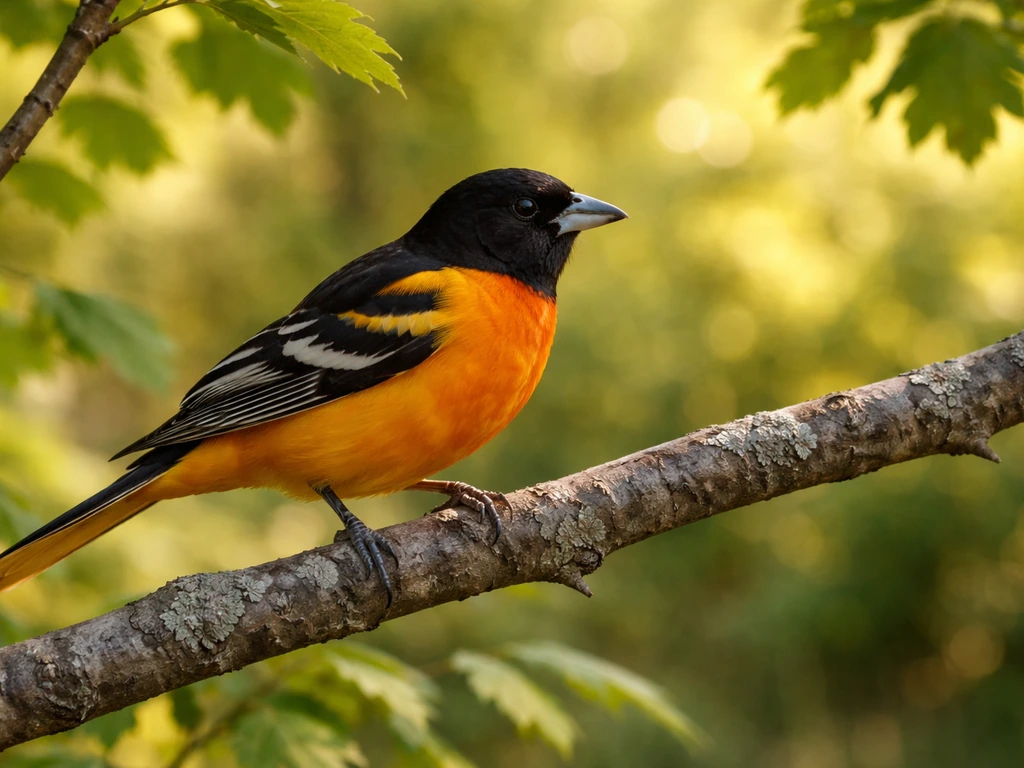
People sometimes also search for oriole bird meaning, comparing how different birds symbolize different qualities. Both are worth unpacking, and neither requires you to stretch very far from what the bird actually does in the wild. If you're also curious about oozlum bird meaning, it can help to compare that theme to the osprey's focus and protection symbolism.
What an osprey actually is (and why it stands out)
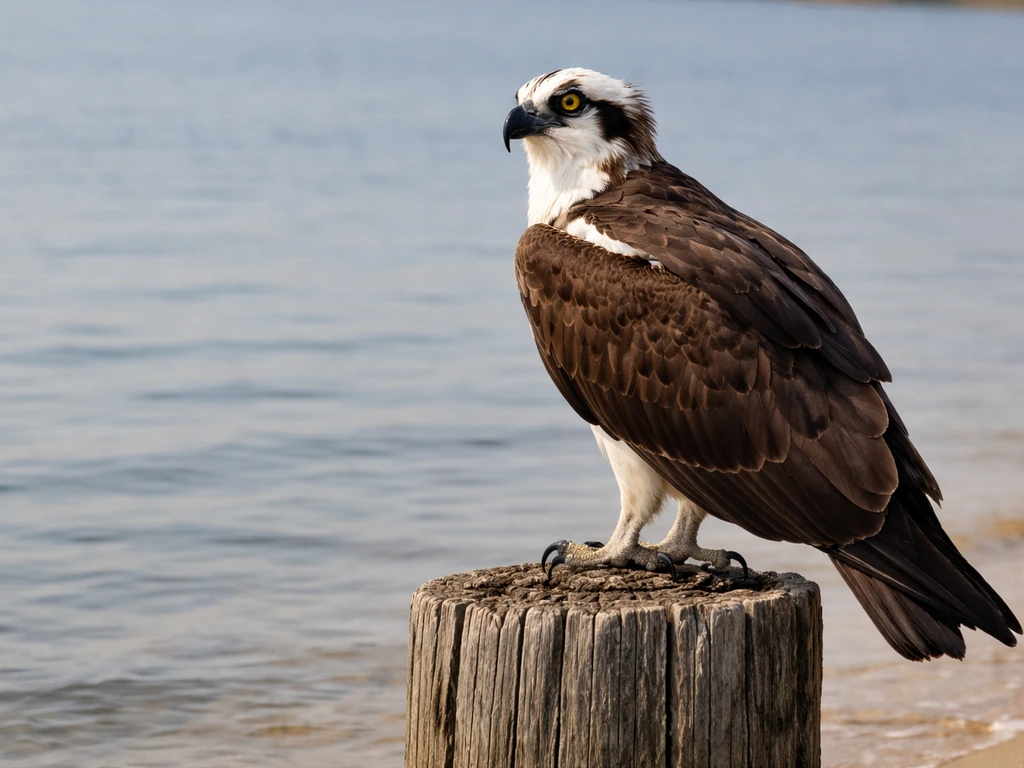
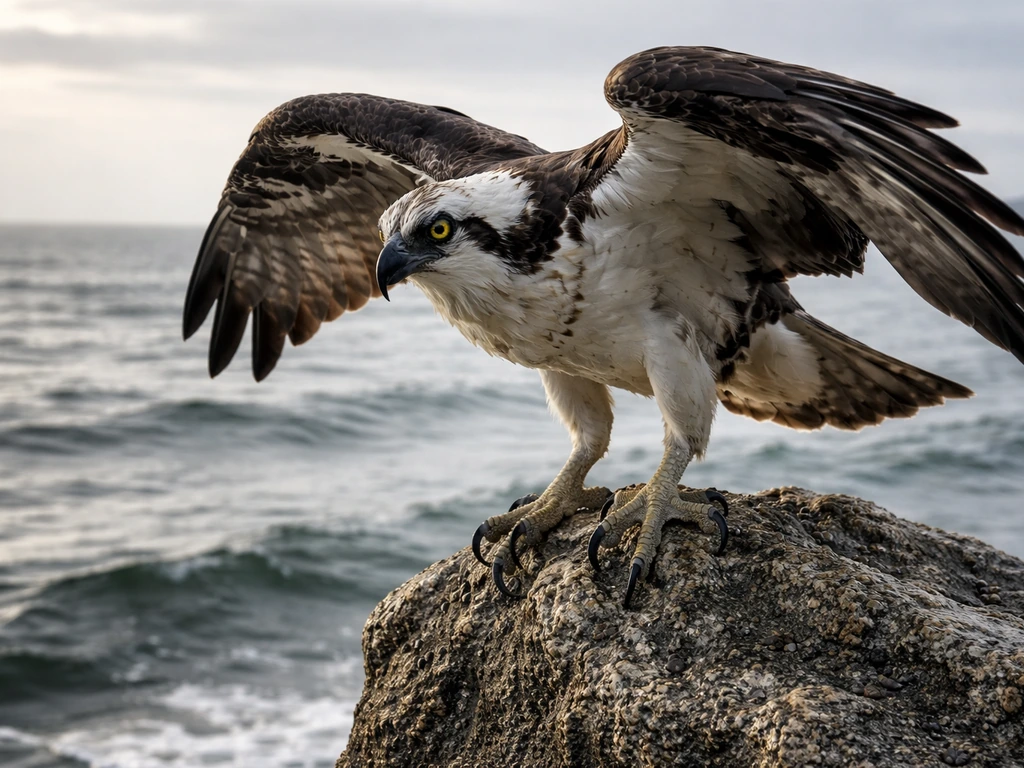
The osprey (Pandion haliaetus) is a medium-to-large raptor, measuring 22 to 25 inches long with a wingspan ranging from 4.5 to 6 feet. Its look is distinctive enough that once you know it, you won't forget it: brown upperparts, white underparts, a white head, and a bold dark brown stripe running through the eye. In flight, it shows barred wing feathers and a characteristic "crooked" or gull-like bend at the wrist. That angled silhouette is one of the best field marks you have.
What sets the osprey apart from other raptors isn't just appearance, it's lifestyle. Ospreys eat almost exclusively live fish, and they catch them by hovering 10 to 30 meters above the water's surface, locking onto prey, then diving feet-first and plunging into the water. They're built for this: reversible outer toes, barbed foot pads, and oily feathers that shed water. This is a bird that has evolved a single, highly specialized skill and executes it with precision. That behavioral reality is exactly where the symbolic meaning comes from.
You'll find ospreys near lakes, rivers, reservoirs, and coastal waters across North America (from Alaska and northern Canada down to the Gulf Coast and Florida), as well as throughout Europe, Africa, Asia, and Australia. Yellowstone's river valleys, Oregon's forested lakeshores, and Atlantic coastal estuaries are all classic osprey territory. They go where the fish are, full stop.
The core symbolic themes: focus, mission, and protection
Osprey symbolism didn't get invented out of thin air. It maps almost directly onto how the bird behaves. When you watch an osprey hunt, you're watching the biological definition of focus: hovering in place over choppy water, eyes locked on a single fish below the surface, blocking out everything else, then committing completely to a dive. That's the behavioral engine behind the meanings people assign to it.
- Focus and single-minded awareness: The osprey doesn't hunt mammals, insects, or other birds. It has one target, and it pursues it with total concentration. Symbolically, this translates to the ability to zero in on what matters and ignore distraction.
- Mission-driven persistence: Ospreys don't always succeed on the first dive. They hover, reassess, and try again. That cycle of patient observation followed by decisive action is interpreted as determination and endurance in totem traditions.
- Clarity of purpose: The osprey's specialized anatomy (those barbed feet, reversible toes, waterproof feathers) represents being built for something specific. The symbolic read is that you have unique tools for your own purpose, and the osprey prompts you to use them.
- Protection of home and family: Ospreys are strongly territorial around their nests and are known to return to the same nesting site year after year. This connects to themes of defending what you've built, loyalty, and long-term commitment.
- Power without aggression: Despite being a skilled predator, the osprey is relatively non-confrontational compared to eagles or hawks. It's powerful because it's precise, not because it's dominant. That distinction matters symbolically.
Spiritual and animal-totem interpretations
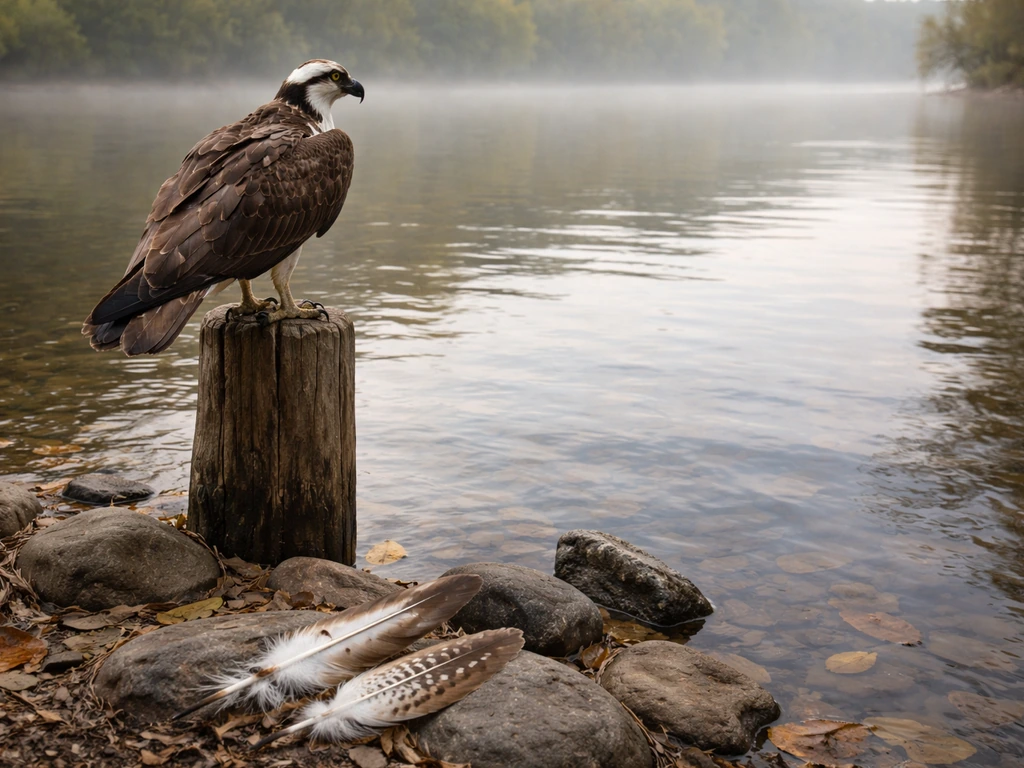
In animal-totem traditions, which draw on but aren't identical to any single Indigenous tradition, the osprey is treated as a guide for times when you need to refocus on a specific goal. If the osprey appears as your totem or spirit animal, the common interpretation is that you're being called to bring your full attention to something you've been circling around without fully committing to. The hovering-then-diving metaphor does a lot of work here: you've done the research, you've observed the situation, now it's time to act.
Some totem frameworks also connect the osprey to water as a symbol of emotion and the subconscious. An osprey diving into water to pull something out is read as the act of reaching into emotional depth or intuitive knowledge to bring something useful to the surface. If that resonates with your situation, it's a genuinely useful frame. If it doesn't, skip it. These interpretations are tools, not rules.
A spiritual encounter with an osprey (a sighting that feels significant, a recurring dream, or a meaningful appearance during a difficult period) is commonly interpreted as a message about clarity and purpose: stop scattering your energy, identify your real target, and go after it with precision. The protection angle also shows up here, particularly if the osprey is observed near its nest or defending its territory. That's often read as a reminder to guard the people and projects that genuinely matter to you. USGS reports that fish hawks (ospreys) usually return to the same nests they used the year before Fish-Hawk or osprey nest site fidelity.
Mythology, folklore, and cultural references
The osprey has a long cultural history under different names. In Native American traditions, the osprey is often called the Fish-Hawk, and it appears in the oral traditions of many tribes. Recorded legends portray the Fish-Hawk as a skilled and somewhat proud figure, valued for its fishing ability but occasionally presented with a note of arrogance tied to that specialization. The pride element is interesting: it suggests that singular mastery is admirable but can become a blind spot if you forget to stay humble.
In Finnish folklore, the osprey (known locally as "sääksi") occupies a specific place in regional stories and cultural identity. Finland's vast lake district is prime osprey habitat, and the bird's presence along shorelines made it a recognizable figure in folk tradition, often tied to water, seasonal change, and the rhythms of fishing culture.
The osprey also shows up as a name and emblem across military units, aircraft (most famously the V-22 Osprey tiltrotor), sports teams, and institutions. When an organization adopts the osprey as a mascot or symbol, they're almost always reaching for the same cluster of qualities: precision, adaptability, mission focus, and the ability to thrive in demanding environments. That's a relatively consistent cultural read across different contexts.
Worth noting: the osprey doesn't carry the same mythological weight in Western European or classical traditions as eagles do. You won't find it prominently in Greek or Roman mythology the way the eagle appears as Zeus's bird or Rome's imperial symbol. The osprey's symbolic tradition is more practical and ecological than cosmological, which is part of what makes it feel accessible rather than grandiose.
Tattoos, dreams, and everyday symbolism: how to read the osprey in context
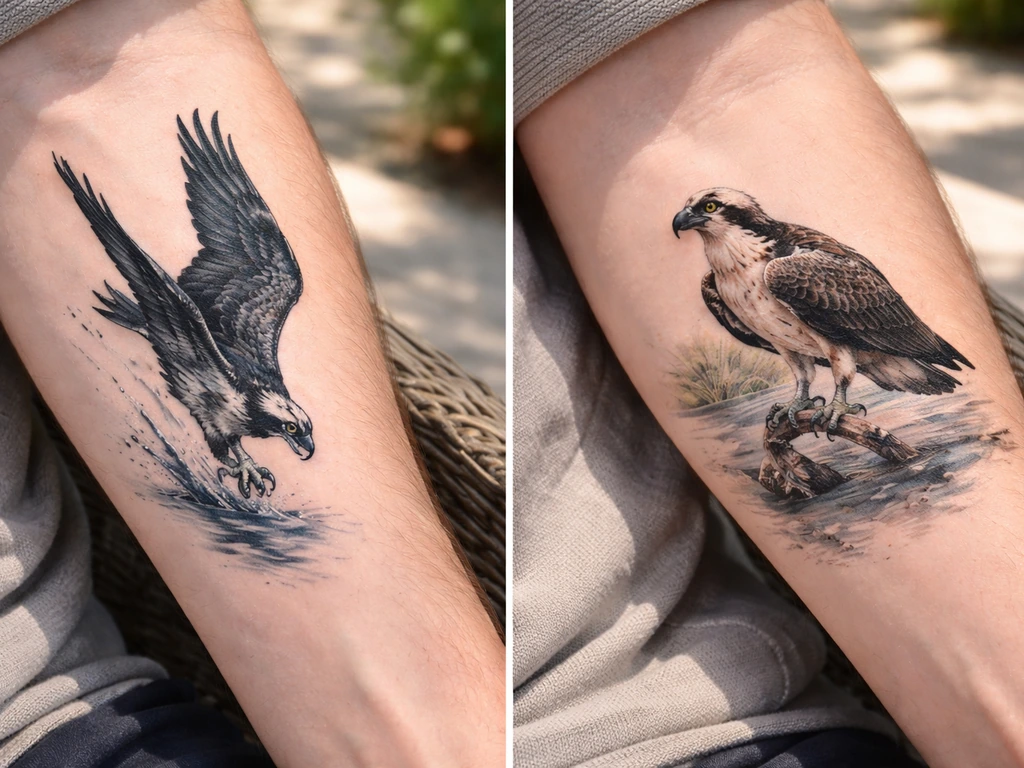
Osprey tattoos
Osprey tattoos typically land in the same symbolic space as the meaning themes above, but the specific pose matters. An osprey mid-dive usually signals commitment, decisive action, or pursuing a goal without hesitation. An osprey in a hovering posture suggests patience, observation, and strategic thinking before acting. A nesting or perched osprey tends to represent home, family protection, and rootedness. If you're designing one or interpreting someone else's, ask what the bird is doing in the image: that detail usually tells you more than the bird alone.
Osprey dreams
Dream symbolism is context-sensitive, and the osprey is no exception. A hunting osprey in a dream is commonly associated with pursuing a specific goal or being in an active phase of working toward something. A nesting osprey is more often linked to nurturing an idea, project, or relationship. An osprey that fails to catch its prey might be pointing to a need to reassess your approach rather than abandon the goal entirely.
The most practical thing you can do with an osprey dream is write it down immediately. Record where you were, what the osprey was doing, how you felt watching it, and what was happening in your life around the time of the dream. Over time, patterns emerge that are far more personally meaningful than any generic dream dictionary entry. Avoid treating any single dream as a fixed prophecy. Dreams are prompts, not prescriptions.
Brand names and mottos
When you encounter "osprey" in a brand name, motto, or organizational identity (outdoor gear, military units, athletic programs), the symbolic shorthand is almost always precision plus adaptability plus environmental mastery. The outdoor gear brand Osprey, for example, leans directly into the bird's association with carrying capacity, purposeful movement, and being at home in demanding terrain. Reading the symbol in these contexts is straightforward: find the qualities the organization wants to project, and you'll almost always find them in the list of osprey traits.
Osprey vs hawk, eagle, and other raptors: don't mix up the symbolism
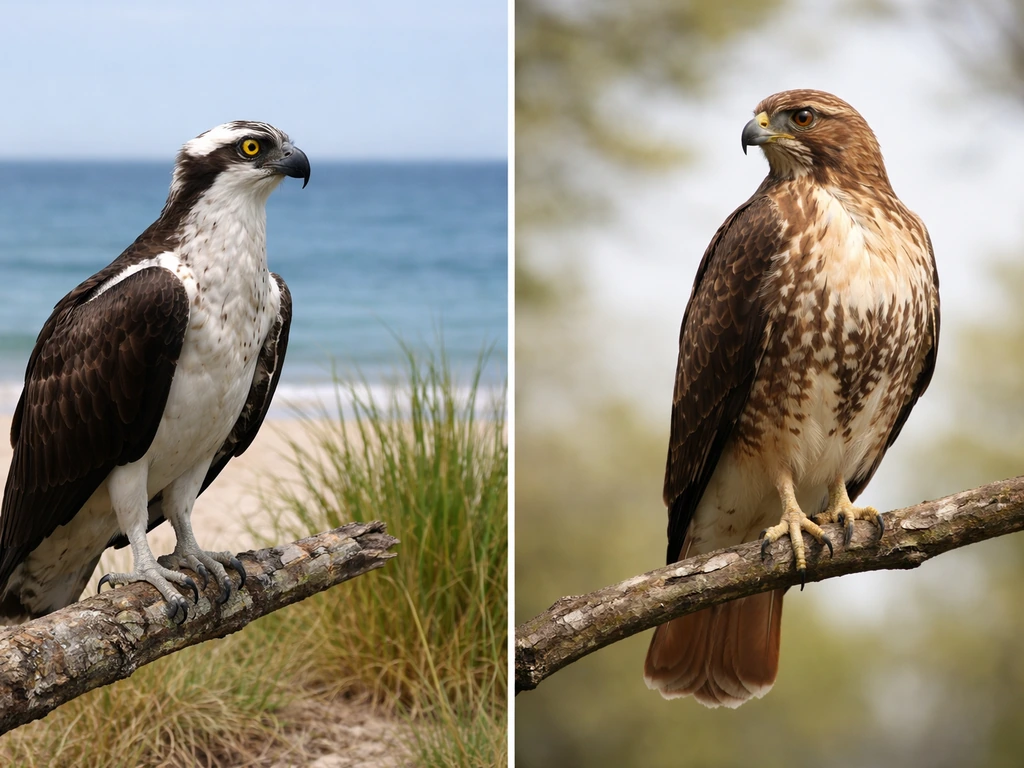
This is genuinely worth pausing on, because ospreys are commonly mistaken for other raptors, and the symbolic meanings are not interchangeable. The National Wildlife Federation specifically flags that ospreys are frequently confused with bald eagles, and the visual mix-up is easy at a distance. Both are large, fish-eating raptors with white heads. But the details separate them clearly.
| Feature | Osprey | Bald Eagle | Red-Tailed Hawk |
|---|---|---|---|
| Size | 22–25 in; 4.5–6 ft wingspan | Larger; 6–7.5 ft wingspan | Smaller; ~4 ft wingspan |
| Head pattern | White with broad dark eye stripe | All-white head (adults) | Brown head, no eye stripe |
| Wing shape in flight | Crooked/gull-like bend at wrist | Flat, plank-like | Rounded, broader |
| Diet | Almost exclusively live fish | Fish, mammals, carrion | Primarily small mammals |
| Hunting method | Hovers, dives feet-first into water | Snatches from surface or steals | Perches and pounces |
| Symbolic themes | Focus, precision, mission, protection | Power, authority, national identity | Vision, independence, strength |
If you're reading eagle symbolism into an osprey sighting, you're likely importing the wrong meaning. Eagle symbolism in Western and many Indigenous traditions carries connotations of sovereign power, divine authority, and broad leadership that simply don't match the osprey's more targeted, specialist energy. Similarly, comparing osprey to hawk symbolism: hawks are often associated with observation, messenger roles, and awareness, which overlaps with osprey but misses the osprey's defining trait of deep specialization and total commitment to a single task. The osprey isn't just a generic raptor with a fish habit. It's built for one thing, and that distinction is the whole point of its symbolism.
If you saw a large raptor near water and aren't sure what it was, look for the dark eye stripe on a white head, the bent wrist in flight, and whether it was hovering before diving. Those three cues together are almost always conclusive. Getting the identification right matters if you want the symbolic meaning to actually apply.
How to actually apply osprey meaning today
Symbolism is only useful if it connects to something real in your life. Here are practical ways to work with the osprey's meaning rather than just collecting it. If you want to narrow it down further, the or ioles bird meaning people look for often comes down to how symbols around birds connect to emotion, intention, and direction orioles bird meaning.
- Identify your fish: The osprey doesn't hunt everything. It picks one target and commits. Ask yourself what the single most important goal or project is right now, and whether you're actually treating it that way or spreading your attention too thin.
- Notice where you're hovering: Hovering is a phase, not a strategy. The osprey observes, then acts. If you've been researching, planning, or waiting for the right moment on something for a long time, the osprey is a reasonable prompt to ask whether it's time to dive.
- Journal a real or dream osprey encounter: Write down when/where you saw or dreamed about the osprey, what it was doing, what was happening in your life at that time, and what the first word or feeling that came to mind was. Don't force an interpretation immediately. Sit with it for a day and see what surfaces.
- Check what you're protecting: The osprey's nesting loyalty is part of its symbolic profile. Take stock of the relationships, projects, or commitments that deserve your active protection right now, and whether you're actually showing up for them.
- Use the archetype without overstating it: The osprey's meaning is a lens, not a forecast. If focus and mission resonance feel relevant to where you are right now, use that. If someone tells you a specific osprey sighting means something fixed and certain about your future, that's going beyond what the symbol can honestly support.
One last thing worth knowing: the osprey is one of the more grounded and coherent bird symbols to work with, precisely because its real-world behavior is so legible. Unlike some bird symbols that rely heavily on cultural overlay and mythology (the raven, the owl, the eagle all carry enormous amounts of projected meaning from many different traditions), the osprey's symbolism is largely self-evident from watching what the bird actually does.
If you came here looking for the opm bird meaning, the same idea applies: start with what the bird does and then interpret what it might symbolize for you osprey's symbolism. That makes it easier to use honestly. You don't need to accept any tradition's full framework to find something useful in the osprey's example of focused, purposeful, protective action.
If you're specifically looking for the Baltimore oriole bird meaning, it points to different symbolism than the osprey's focused, fish-hunting themes. People sometimes connect winter bird and aurora imagery to meaning about inner alignment, but it’s helpful to treat those associations as symbolic rather than universal winter bird and aurora meaning.
FAQ
I saw an osprey but I do not know if it was “a message.” How should I interpret that?
If you saw an osprey once but it does not feel personally “synchronistic,” you can treat the encounter as observational meaning, not a directive. Focus on one small choice that matches its specialist behavior (for example, one targeted next step in a project) rather than trying to extract a big prophecy.
In an osprey dream, what does it mean if the bird misses its fish?
The dream frame is different if the osprey fails, because a missed catch often points to strategy, not surrender. A practical way to use this is to identify the “obvious prey” you are chasing, then ask what is different about your timing, location, or method (for example, too much distraction, wrong conditions, or insufficient preparation).
How can I choose an osprey tattoo that reflects the meaning I want?
For tattoos, the pose usually matters more than the species name. A hovering osprey supports themes of patience and observation, a mid-dive suggests decisive commitment, and a nesting or perched osprey emphasizes home and protection. If you want the meaning to land clearly for you, choose the pose that matches your current life focus.
How do I tell the difference between a real totem-like calling and random noticing?
If you are interpreting a totem or spirit claim, look for behavioral resonance over frequency. One strong, relevant sign you can actually act on is often more useful than repeated “noticing” that does not change anything. A simple test is whether your attention becomes more precise after the encounter (even in a tiny way).
Does the osprey’s setting (calm water vs. rough weather, near home vs. away) change the meaning?
Yes, because context changes the symbol. If the bird is near water at a calm time, you might connect it to clarity and emotional depth. If it appears during active conflict, deadlines, or stress, the emphasis often shifts to focus and protective boundaries. You can also let the environment decide, since osprey symbolism is most coherent when it fits what is happening around you.
What if I think the bird was an osprey but I am not 100% sure it was?
Do not import eagle meanings if the bird is clearly an osprey. The quick identification cues are a white head with a dark eye stripe, plus the barred wings and the distinctive wrist bend in flight. If you misidentify, you are likely mixing broad sovereignty themes (eagle) with specialized focus themes (osprey).
How can I use osprey symbolism for a real-life decision without it staying vague?
If you are using bird symbolism for a decision, translate it into one measurable action within a short window (for example, 24 to 72 hours). Osprey energy works best when you pick a single target, reduce distractions, and then take a concrete step, like sending the message, making the appointment, or finishing the first draft.
Next Article
Orioles Bird Meaning: Symbolism, Omens, and What to Do
Interpret orioles bird meaning with symbolism, omens, and practical steps using season, behavior, and setting clues.