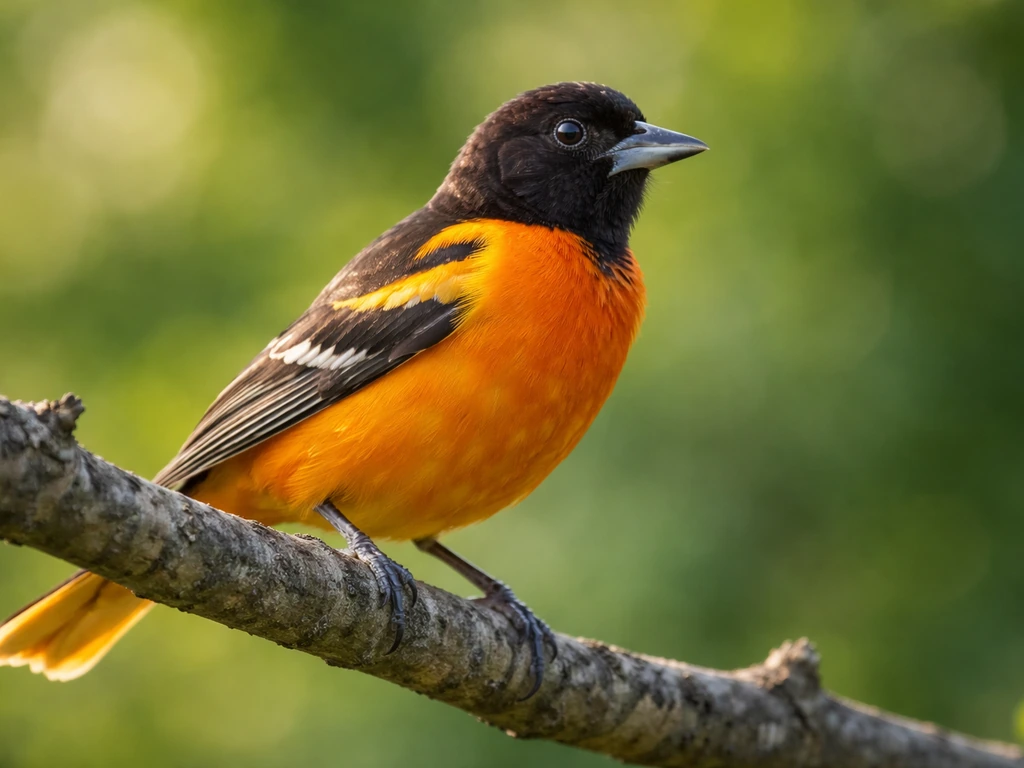
Seeing an oriole, especially that unmistakable flash of orange and black in a treetop, is widely interpreted as a symbol of joy, creativity, and positive change. In many spiritual and folkloric traditions, orioles are associated with warmth, optimism, and a nudge to express yourself more freely. If you spotted one this spring, that timing alone carries its own layer of meaning: orioles are migratory, arriving in late April through May across much of North America, so a fresh sighting often coincides naturally with themes of renewal and new beginnings. That overlap between ecology and symbolism is not a coincidence people invented, it genuinely reflects how cultures have observed and interpreted these birds for generations.
Orioles Bird Meaning: Symbolism, Omens, and What to Do

Marcus Blackwell
24 Apr 2026
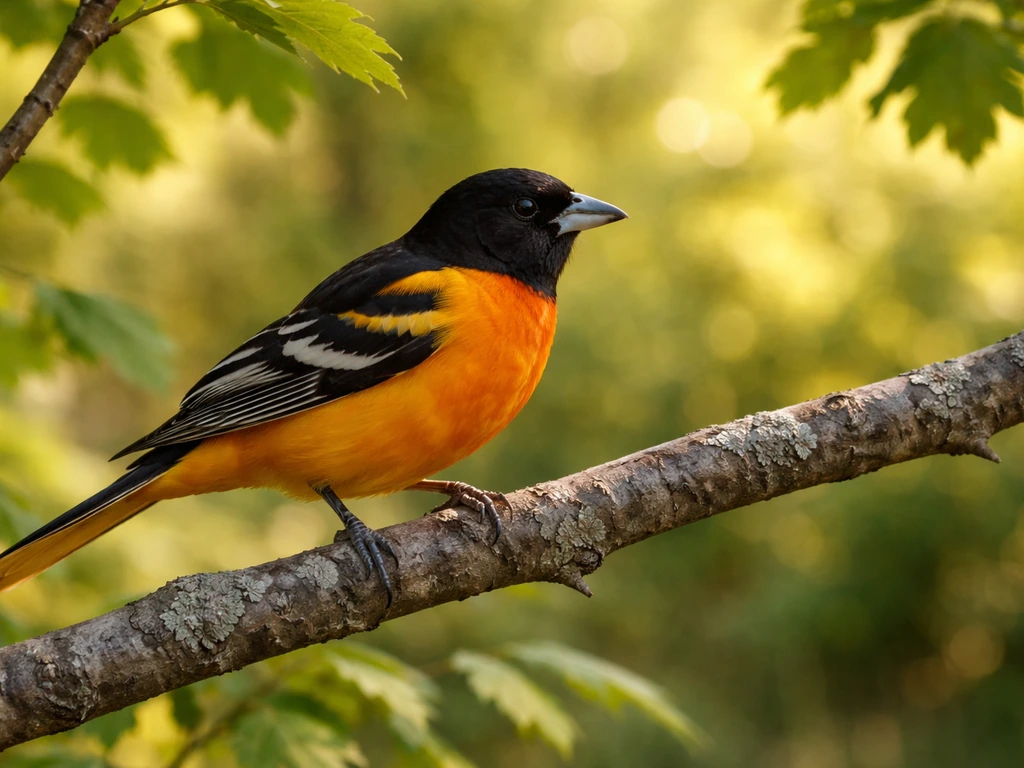
What you're actually looking at: oriole basics
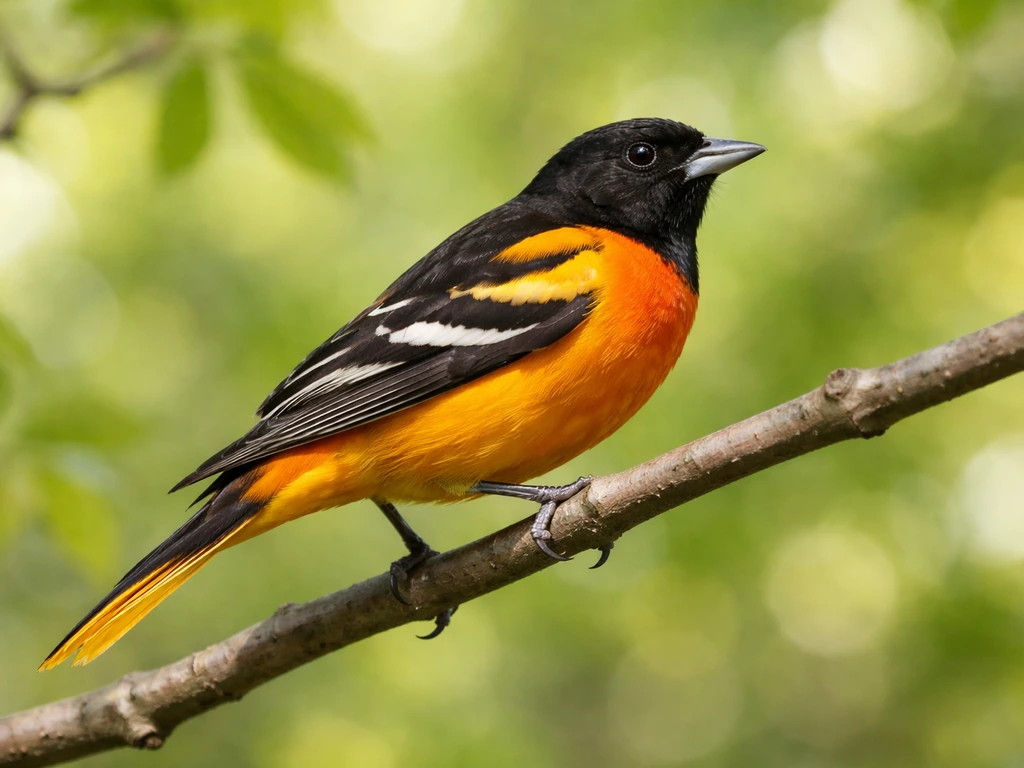
Most people in North America who spot an oriole are looking at a Baltimore Oriole, and the adult male is hard to misidentify once you know what to expect. He has brilliant orange underparts and shoulder patches, a fully black head and beak, and black wings marked with a single white bar. The lower back and rump are also orange, and the outer tail feathers carry a wash of the same color. Females and immature birds are considerably more muted: yellowish-orange on the underparts, yellowish-brown on the upper parts, darker wings with two white wingbars, and a pointed bill that stays consistent across sexes. In some lighting, a female can look almost greenish-yellow, which trips people up.
Baltimore Orioles prefer open deciduous woodlands and the edges of forests rather than deep forest interiors, which is why backyards with mature trees are prime habitat. Their range runs from central Alberta and Saskatchewan in the north all the way down to northern Colombia and Venezuela, so sightings are plausible across a huge swath of the continent during migration and breeding season. You'll typically hear them before you see them: a rich, flutelike song delivered from high in the treetops, often while the bird moves quickly through the upper canopy.
What orioles represent: core symbolic themes
Orioles don't carry the heavy mythological weight of ravens or owls in world literature, and it's worth being honest about that upfront. They are not prominently featured in classical world mythology the way eagles or doves are. In that same spirit, the eagle bird meaning people seek usually points to themes of power, vision, and spiritual elevation. Where oriole symbolism does appear, it tends to cluster in Native American traditions and in the more modern practice of animal totemism and spiritual symbolism that has grown popular over the last few decades.
Across the traditions that do engage with oriole meaning, several themes recur consistently. The bird's vibrant coloring links it to solar energy, warmth, and vitality. Its complex, melodious song connects it to themes of communication, creativity, and self-expression. The intricate hanging nest the female constructs at the tip of a tree branch is frequently cited as a symbol of craftsmanship, patience, and the care we put into building the spaces we call home. More broadly, as a migratory songbird, the oriole fits into a wider cultural category of birds that signal transition, arrival, and the return of light after a hard season.
- Joy and optimism: the orange coloring is almost universally linked to warmth, vitality, and positive energy
- Creativity and communication: the song is one of the most distinctive of any North American bird, and showing up as a vocal presence is often read as an invitation to speak, create, or be heard
- Craftsmanship and care: the female's elaborate woven hanging nest is a recurring motif in totem-based interpretations
- Transition and renewal: as a spring migrant, the oriole's arrival maps naturally onto cultural ideas about new chapters and fresh starts
- Playfulness and freedom: the bird's movement through high treetops and its bright appearance both feed into associations with lightness and ease
Meaning by situation: season, behavior, and where you saw it
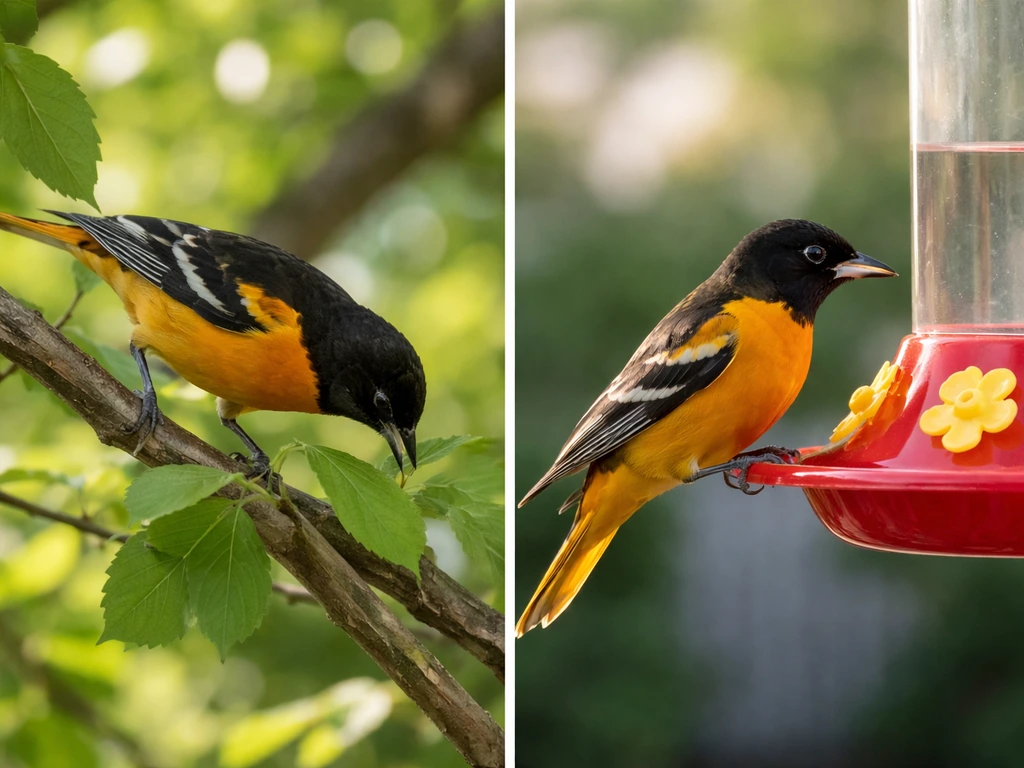
Context changes everything when you're trying to interpret a bird sighting with any accuracy. An oriole spotted in late April or May in your backyard means something ecologically specific: the bird has just arrived from its wintering grounds and is likely establishing territory or beginning to court. Because orioles arrive after spending the winter in other regions, a winter bird aurora meaning like “return of the light” can be mirrored in their seasonal return. If you're applying symbolic meaning to that, the spring timing genuinely amplifies themes of new beginnings and arriving energy. A sighting in July or August skews toward nesting and family, which might resonate differently depending on what's happening in your own life.
Behavior matters too. If you see a male doing something that looks like an elaborate bow with his wings slightly open and tail spread, that's courtship display, and it's beautiful to watch. If you see a male Baltimore Oriole courtship bow, the American Bird Conservancy describes it as an upright stretch with wings lowered or partly opened and the tail spread upward, followed by several deep bows, and females may respond with song, calls, or a wing quiver elaborate bow with his wings slightly open and tail spread. It's also a useful reminder that what you're witnessing is driven by the bird's own urgent seasonal agenda, not yours. That said, many people find that noticing these behaviors prompts genuine reflection on their own relationships and creative energy, which is exactly how bird symbolism tends to work in practice.
| Situation | Ecological explanation | Common symbolic read |
|---|---|---|
| First spring sighting (late April–May) | Migratory arrival, territory establishment | New beginnings, returning energy, optimism |
| Male singing loudly from treetop | Territory defense and courtship | Self-expression, confidence, communication |
| Female building or tending nest | Breeding season nest construction | Craftsmanship, nurturing, patience, home |
| Oriole visiting your feeder or fruit | Attracted to sugar, jelly, or oranges you've put out | Abundance, invitation, connection with nature |
| Fledgling or young bird present (late summer) | Post-breeding dispersal | Growth, transition, new independence |
| Hearing song but not seeing the bird | Bird is high in canopy or in dense foliage | Hidden creativity, inner voice, listening inward |
Orioles in dreams and folklore
Dream interpretations involving orioles tend to follow the same broad themes as waking symbolism: joy, creative expression, and positive transitions. Most dream-dictionary sources treat birds generally rather than offering species-specific meanings, which is an honest acknowledgment of how varied and personal dream experiences are. What most of them do agree on is that the setting, your emotional response, and the bird's behavior in the dream matter far more than a fixed dictionary definition.
If you dream of a bright, singing oriole in a sunlit tree, that's pretty clearly optimistic imagery by most interpretive frameworks. If the bird is caged or distressed, you're likely processing something about constraint or unexpressed creativity. A bird appearing inside your house in dreams is widely associated with transition and change regardless of species. The broader principle, which shows up repeatedly in serious dream-symbol work, is that one-size-fits-all meanings for a single species should be treated as starting points for reflection, not verdicts.
In Native American traditions, select tribal stories do feature orioles, though these stories vary significantly by region and cultural context. It's worth approaching any single compiled source on this topic with appropriate skepticism: folklore is rooted in specific communities and oral traditions, and general-purpose compilation sites often flatten important distinctions. If this dimension of oriole meaning is important to you, going directly to resources produced by specific tribal nations or ethnographic scholarship is worth the extra effort.
Baltimore Oriole vs. other orioles: sorting out the confusion
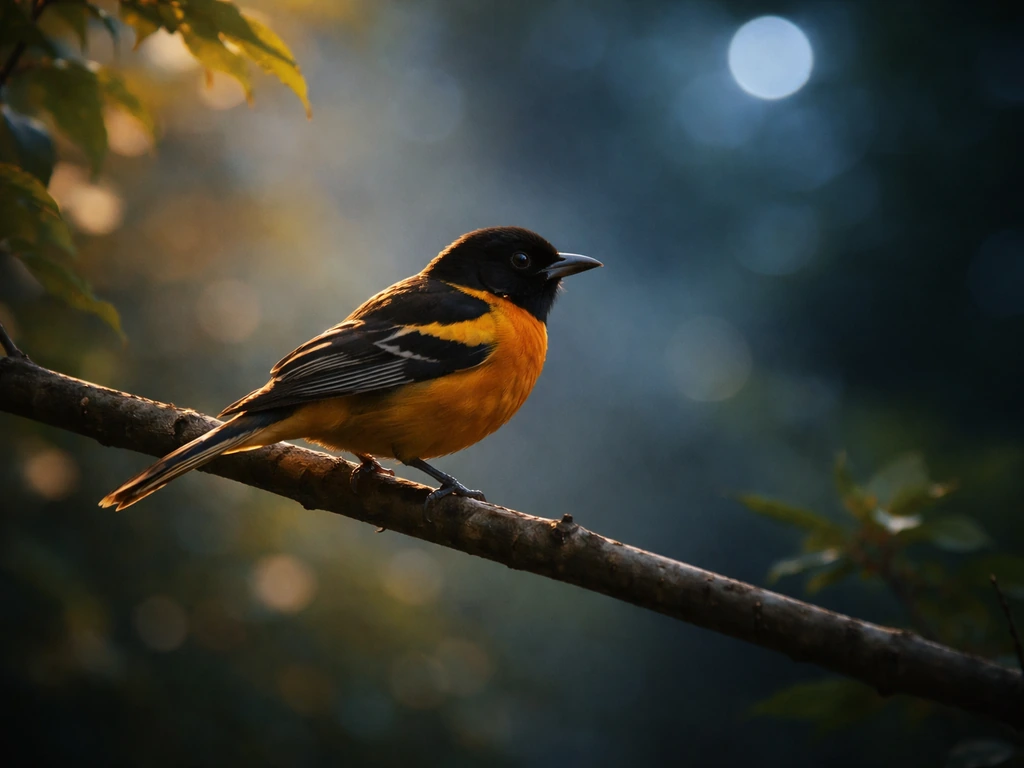
The Baltimore Oriole gets the most symbolic attention in North American bird meaning discussions, but it's not the only oriole people encounter, and misidentifications are common. The Orchard Oriole is the one most likely to cause confusion. The key difference is color: Baltimore Orioles have vibrant, almost electric orange bellies, while Orchard Oriole males are a deeper chestnut-brown on the underparts. Orchard Orioles are also noticeably smaller. If your bird looks dull rusty-brown rather than bright orange, you're probably looking at an Orchard Oriole.
In the western part of North America, the Bullock's Oriole takes over as the dominant species, and in areas of central North America, Baltimore and Bullock's Orioles overlap in range and can even hybridize, which means birds in that zone can show intermediate features. So if you're in the Great Plains or Rocky Mountain region and something doesn't quite match the classic Baltimore pattern, that's biologically explainable.
A common non-oriole mix-up is the American Redstart (a warbler) or even a Spotted Towhee, which also carry orange or rufous tones with black. But neither has the oriole's pointed bill, size, hanging-nest behavior, or the distinctive flutelike song. If you heard it singing from high in a tree canopy with a rich, varied whistle-like call, you almost certainly had a real oriole.
It's also worth noting that the Baltimore Oriole meaning and the broader oriole bird meaning share most of the same symbolic territory, since the Baltimore Oriole is the species most people are actually referring to when they search for either term. If you are specifically looking up an oozlum bird meaning, it helps to compare it with the broader oriole symbolism most people use as a reference point. If you want the wider context, the opm bird meaning is often discussed as part of the same symbolic pattern around birds and omens. The symbolic distinctions between subspecies are minimal in practice.
What to do when you spot an oriole today
The most useful thing you can do immediately is take a moment to note the details while they're fresh. Merlin Bird ID is designed to help identify birds by using both photo and audio recordings, which Cornell Lab says supports its identification and AI training tools. Where exactly was the bird? What was it doing? What time of day, and what's the current season where you are? These details sharpen both the ecological identification and the symbolic interpretation. A brief journal note, even a few sentences on your phone, gives you something concrete to reflect on rather than a vague memory of 'orange bird.'
- Note the location: backyard feeder, forest edge, urban park, or open woodland? This helps confirm the species and connects to the bird's preferred habitat.
- Note the behavior: singing, feeding, carrying nesting material, doing a courtship display? Each behavior points to a specific life-stage context.
- Check the date: late April through May is prime arrival and courtship time across most of the range; late June through August leans toward nesting and fledgling activity.
- Consider what themes feel relevant to your own life right now: creativity, communication, home-building, a new project or relationship. Oriole symbolism tends to resonate most when you let it speak to what's already on your mind.
- Look it up: if you're not certain of the species, the Cornell Lab's Merlin app can confirm an ID from a photo or even a sound recording in real time.
- Decide how to respond: if the sighting moved you, that response is the meaningful part. You don't need a formal spiritual framework to take a bird's appearance as a useful prompt for reflection.
Attracting orioles and what their behavior near your home actually means
If an oriole has shown up near your home or yard, there's usually a straightforward ecological reason: food, nesting habitat, or both. Orioles are drawn to nectar, ripe or halved oranges, grape jelly, and mealworms. If you have mature deciduous trees with long, flexible branch tips, you're also sitting on prime nesting real estate, since females build their distinctive hanging pouch nests right at those branch ends.
If you want to encourage return visits, setting up a feeder is genuinely effective. For nectar, the two most cited ratios are 1 part sugar to 4 parts water (the stronger mix, which orioles often prefer when given a choice) and 1 part sugar to 6 parts water (a slightly lighter option). Either should use plain white table sugar, no honey and no red food coloring, both of which can be harmful. Allow the nectar to cool completely before filling the feeder.
Feeder hygiene matters more than most people realize. In warm weather, nectar ferments quickly, which can make birds sick. Audubon recommends cleaning feeders every two to three days in hot conditions, using hot running water and a bottle brush to scrub out any fungal buildup. If you're also offering orange halves or jelly, replace those every day or two and keep the surface clean.
From a symbolic angle, making your yard a place an oriole chooses to return to is its own kind of meaningful practice. You're creating conditions for abundance and beauty to show up regularly rather than waiting passively for a chance encounter. That loop between observation, intention, and action is really the practical heart of what bird symbolism is pointing toward when it's at its most useful.
FAQ
How can I be more confident about orioles bird meaning if I might have misidentified the species?
Yes. If you are seeing only orange and black flashes and not hearing a high, flutelike call from the canopy, confirm the ID before leaning on meaning. Misidentifying an oriole can shift the “message” you’re drawing, because similar-looking species have different behaviors and cues.
Does orioles bird meaning change if I see one in a different month, like late summer instead of spring?
Use timing plus behavior to separate “arrival” from “nesting” symbolism. Late April to May sightings often involve territory or courtship, while July and August sightings more often align with active nesting and family activity, which usually changes how the experience feels emotionally.
What’s the most important detail in orioles bird meaning for dream interpretations?
In dreams, the bird’s condition is a key modifier. A bright singing oriole tends to reflect openness and optimism, while a caged or distressed bird often points to frustration or blocked self-expression. If the oriole flies away or repeatedly returns, that can indicate readiness to act versus lingering hesitation.
Is it meaningful to interpret orioles bird meaning from just one encounter, or should I wait for repeat sightings?
A single sighting is usually easier to interpret than a pattern. If you want symbolism that feels grounded, look for repeated “rechecks” over days (same location, similar behavior, same general timeframe). One-off sightings can be ecological chance, especially in migration.
What should I consider if an oriole is acting oddly, like staying near one tree instead of moving around?
If the bird seems focused on a specific tree tip, listen for the practical reason. Orioles prioritize nectar and insects and, during breeding, they target hanging-nest sites on flexible branch ends. That practical driver can coexist with symbolism, but it helps prevent overreading randomness.
Can using a feeder affect orioles bird meaning, and how should I interpret that?
Feeders can be meaningful in a real-world way, but also change behavior. If you set up nectar and the oriole becomes a regular visitor, you can interpret that as “invitation and return,” while still respecting that the bird is responding to food and safe nesting structure.
What are common feeder mistakes that could undermine the health of orioles I’m trying to attract?
Yes, and it’s an important caveat. Honey and red coloring can cause harm, and nectar ferments faster in heat, which can make birds sick. If you notice cloudiness, sour smell, or frequent sick-looking visits, pause and restart with cleaner, correctly mixed nectar.
What if an oriole shows up inside my house, does that change the symbolism?
Treat a bird inside your house as a “transition” cue, but also handle it as an immediate safety event. Open an exterior door or window, turn off indoor lights near the exit, and give the bird a clear path outside. The symbolic meaning is secondary to safely releasing it.
How can I tell whether orioles bird meaning in my yard is more about courtship, nesting, or family?
Look for the nesting materials and nest shape to connect symbolism to action. Orioles build hanging pouch nests, so seeing fibers or repeated visits to the same branch area can suggest patience and preparation, rather than a sudden breakthrough.
If I see a more muted oriole, does orioles bird meaning interpret differently than seeing a bright male?
Yes, the male versus female look can affect what you think you “saw.” If you don’t see the bold orange underparts and black head pattern, it may be a female or immature bird, which can shift the emphasis toward care, home-building, and ongoing work rather than the dramatic adult male display.
Next Article
Oriole Bird Meaning: Symbolism, Dreams, and Real Life Signs
Orioles in dreams and real life: symbolism of joy, messages, optimism, creativity, and how to interpret your sighting.