
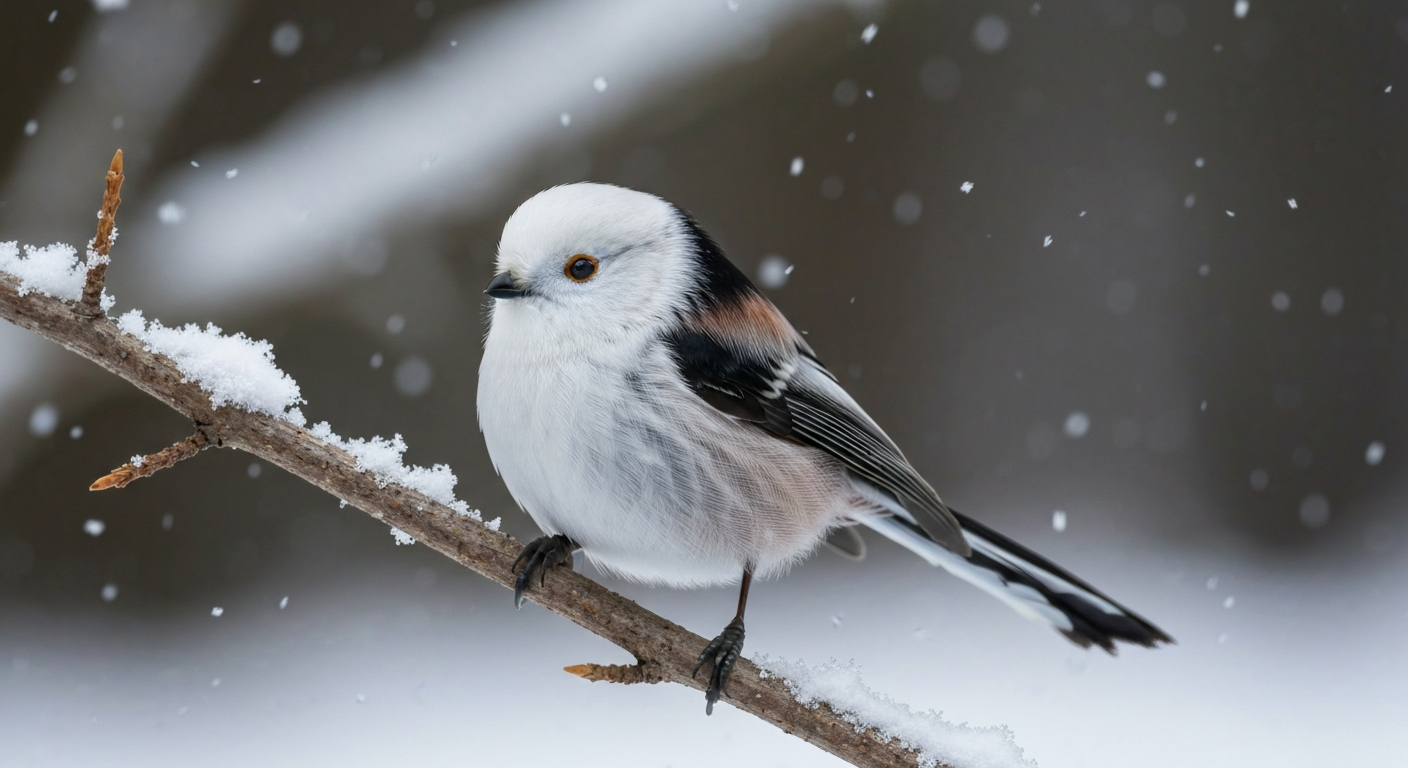
The Shima Enaga is the Hokkaido subspecies of the long-tailed tit (Aegithalos caudatus japonicus), a tiny, almost perfectly round bird with a completely white face that has made it one of the most beloved bird symbols in contemporary Japan. Its name breaks down as 'island long-tailed tit,' its white face has earned it the nickname 'snow fairy,' and its tightly knit social life gives that symbolism genuine behavioral roots. Whether you encountered it on a Hokkaido travel poster, a piece of merchandise, or a photo that genuinely stopped your scrolling, here is everything the bird actually means, where that meaning comes from, and how to treat it responsibly if you ever get to see one in the wild.
Shima Enaga Bird Meaning: Symbolism, ID, and Cultural Uses

Marcus Blackwell
26 Jul 2026
What the Shima Enaga is: a quick overview
The bird's full common name in English is the Hokkaido long-tailed tit, and its scientific designation is Aegithalos caudatus japonicus. In Japanese it is written シマエナガ (katakana) or 島柄長 (kanji), and the pronunciation runs roughly 'shee-ma eh-nah-ga,' with even stress across each syllable. Taxonomically it is treated as a subspecies of the widespread long-tailed tit (Aegithalos caudatus), a grouping recognised in the Ornithological Society of Japan's checklist and in the IOC World Bird Names authority. At the species level, Aegithalos caudatus carries an IUCN conservation status of Least Concern, reflecting a stable and broadly distributed population across Eurasia, of which the Hokkaido birds are the easternmost island representatives.
At a glance: how to identify a Shima Enaga
Long-tailed tits are genuinely small birds, and the Shima Enaga sits comfortably within the species' standard range of roughly 10 to 14 cm in total length, with the tail accounting for a surprisingly large share of that measurement. Body mass is typically around 10 grams, meaning this is a bird you could balance on a finger without noticing much weight. The key field marks are its round, fluffy body, the proportionally very long black-and-white tail, and, most critically for the Hokkaido form, a face that is entirely white with no dark eyebrow stripe or supercilium. That clean white face is the single fastest way to separate it from other Japanese long-tailed tit subspecies, which carry dark streaking across the head. One nuance worth knowing: juveniles can show faint eyebrow markings, but these fade by the bird's first winter, so any adult you see in Hokkaido snow will show that striking, unmarked white face.
| Feature | Shima Enaga (Hokkaido) | Other Japanese Long-tailed Tit Subspecies |
|---|---|---|
| Total length | ~10–14 cm | ~10–14 cm |
| Body mass | ~10 g | ~10 g |
| Face pattern | Entirely white, no supercilium | Dark eyebrow/supercilium present |
| Juvenile markings | Faint brow stripe, lost by first winter | Brow stripe retained into adulthood |
| Tail | Long, black and white, roughly half total length | Same proportions |
| Nickname | 'Snow fairy' (雪の妖精) | No equivalent popular nickname |
Where it lives: range and habitat
Shima Enaga are resident birds in Hokkaido, Japan's northernmost main island, where they breed and overwinter in forests and woodland edges. The bird's stronghold is the mixed and deciduous forest interior of Hokkaido, though it will move into parks and more open treed areas, particularly in winter when flocks roam more widely in search of food. Your best chances of encountering one in the field are during the winter months, roughly November through March, when snow cover is thick and the birds are actively flocking. Regional ornithological records published in the journal Strix have documented occasional vagrancy across the Tsugaru Strait into northern Honshu during winter, so a sighting just south of Hokkaido is not impossible, but it is unusual enough to be noteworthy. Specimen records held in the Hokkaido University Natural History Museum catalogue confirm the bird's long-established presence as a resident of the island, and prefectural wildlife surveys back up its status as a stable breeding population.
How the Shima Enaga actually behaves
Understanding the bird's behavior is not just a birdwatching footnote. It is the actual foundation for almost every symbolic meaning attached to the Shima Enaga, so it is worth spending real time here.
Feeding and flocking
Outside the breeding season, Shima Enaga move in small multi-family flocks, often dozens of individuals travelling together through woodland in tight, acrobatic groups. They forage for insects and small invertebrates by working branches and twigs with impressive agility, hanging upside down and twisting through canopy gaps. Winter flocks are often mixed with other small passerines, but the long-tailed tits tend to move as a cohesive cluster within the larger group. Observational studies on this species, including detailed winter behavior records, consistently document this flock cohesion as one of its defining social traits.
Cooperative breeding and communal roosting
The long-tailed tit as a species is one of the better-studied examples of cooperative breeding in birds. When a breeding attempt fails, the failed breeders frequently redirect their effort to help raise the chicks of related pairs, a behavior that has been quantified for its inclusive-fitness benefits in long-term field studies published in PNAS (2018) and reviewed in a 30-year synthesis in the Journal of Animal Ecology (2025). This means the flock is not just a loose feeding group: it is a network of related individuals actively investing in each other's survival and reproduction. In winter, this cooperation extends to communal roosting, where birds cluster tightly together to share warmth. Their nests are famously elaborate, insulated with hundreds of feathers, and the communal roost clusters are a direct behavioral adaptation to cold. These are not symbolic embellishments. They are documented ecological facts that give the bird's reputation for community and resilience an unusually solid base.
Etymology: what 'Shima Enaga' actually means
The name breaks into two clear components. The first, 島 (shima), means 'island' and here refers specifically to Hokkaido, distinguishing this subspecies from long-tailed tits found elsewhere in Japan. The second component is エナガ (enaga), written in kanji as 柄長, and this is where the literal description lives. It compounds 柄 (e or ei), referring to a handle or shaft, with 長 (naga), meaning 'long.' The full compound means something close to 'long-handled one' or 'the long-handled bird,' which is a vernacular way of pointing to that striking tail, imagined as a long handle attached to the small round body. So Shima Enaga translates, fairly directly, as 'island long-tailed one' or 'the long-tailed bird of the island.' The name is recorded with this etymology in Japanese lexical sources including kotobank and historical bird-name registers, and the katakana form シマエナガ has become the dominant modern spelling used in tourism, media, and popular culture since the 2010s.
Symbolic meanings and where they actually come from
The Shima Enaga's symbolism is not arbitrary. Each theme maps cleanly onto something observable about the bird, which is what makes the symbolism feel earned rather than imposed.
Innocence and purity
The entirely white face of the Hokkaido form is the visual cue driving this reading. In Japanese aesthetic tradition, white carries associations with purity, cleanliness, and the sacred, and a small bird with an unmarked white face set against winter snow is a natural vehicle for those associations. The snow fairy nickname reinforces the idea: the bird appears in deep winter, small and pale, seemingly unbothered by conditions that would stress larger animals. Innocence is compounded by the bird's physical proportions. Scholars of kawaii culture, most notably Sharon Kinsella in her foundational 1995 essay on cuteness in Japan, have explained why large eyes, round heads, and small bodies are read as baby-like and therefore innocent. The Shima Enaga's round face and compact frame tick exactly those visual cues.
Community and loyalty
This is where the behavioral basis is strongest. A bird that forms tight multi-family winter flocks, practices cooperative breeding, and huddles communally to survive cold nights is a genuinely apt symbol for loyalty, interdependence, and the value of staying close to your people. These are not metaphors invented for a tourism brochure. They describe real behavioral strategies documented in peer-reviewed ornithological literature. When someone gives you a Shima Enaga gift or image with a message about friendship or togetherness, the bird's own life history is quietly backing that sentiment up.
Resilience and winter endurance
Surviving a Hokkaido winter at 10 grams requires genuinely impressive biological and behavioral adaptation. The communal roost, the heavily insulated nest, the constant foraging in tight cooperative groups: all of these are survival mechanisms against cold that would kill a poorly adapted bird. The Shima Enaga's presence in the landscape at the harshest time of year, small and apparently cheerful in the snow, makes it a natural symbol for quiet endurance and resilience. This reading is common in Japanese winter photography culture, where the bird is often framed in snow-heavy compositions that emphasize the contrast between the harsh environment and the bird's composed demeanor.
Seasonal and spiritual associations
As a winter bird associated specifically with Hokkaido's snowy landscape, the Shima Enaga carries seasonal meaning tied to the cold months: stillness, introspection, and the quiet beauty of winter. In broader Japanese nature symbolism, animals that endure winter with grace are often read as spiritually positive presences. The snow fairy nickname positions the bird on the edge of the folkloric, suggesting a delicate creature from a world just slightly adjacent to the ordinary one. These associations are culturally plausible and widely used, though it is worth being honest that they are interpretive readings built from aesthetic and cultural tradition rather than documented formal spiritual doctrine.
How Japan uses the Shima Enaga today
The Shima Enaga's cultural moment is real and ongoing. Since roughly the 2010s, the bird has become one of the most photographed and commercially reproduced animals in Hokkaido, and its reach has extended well beyond the island.
Kawaii culture and social media
The round white face, the fluffy body, and the wide-eyed look place the Shima Enaga squarely in the category of kawaii, the Japanese aesthetic of cuteness that Kinsella identified as a powerful commercial and social force. The bird's proportions genuinely resemble the design logic behind kawaii mascots and characters: oversized round head, minimal facial features, soft silhouette. This is not a coincidence. It is why the bird moved so naturally from birdwatching publications into social media feeds, phone cases, and sticker packs. Photographer projects dedicated entirely to the Shima Enaga, including the popular book 'Boku, Shima Enaga' (roughly 'I Am the Shima Enaga'), have built large followings by presenting the bird in composed, character-like poses that lean fully into the kawaii framing.
Tourism and local mascot identity
Hokkaido municipal tourism materials and regional press use the snow fairy label consistently, and the bird has become informal shorthand for a particular kind of Hokkaido winter experience: quiet forest, deep snow, the chance of spotting something magical. Major Japanese companies, including Takara Tomy, have released products using Shima Enaga imagery, and limited-edition Hokkaido merchandise featuring the bird is a reliable fixture at airport shops and tourist markets. The bird functions simultaneously as a regional identity symbol and as a nationally recognized kawaii icon, which is a fairly unusual combination.
Wildlife photography
The Shima Enaga has driven a notable increase in wildlife photography tourism to Hokkaido, particularly to forested areas near Sapporo and the island's central region. Professional and amateur photographers document the bird extensively, and high-resolution image archives on platforms like Flickr include detailed metadata (location, date, camera settings) that contribute to both aesthetic and identification records. The bird's white face photographs exceptionally well against snow or dark woodland backgrounds, making it a technically rewarding subject.
What a sighting or gift might mean
If someone gives you Shima Enaga imagery or merchandise, the most grounded reading is warmth, closeness, and the wish for resilience through difficult times. Given the bird's behavioral life, gifts in a friendship or community context carry particular resonance. A Shima Enaga image given during winter, or during a hard period, reads naturally as an expression of solidarity and endurance. In Japan, presenting something with the snow fairy motif often communicates care and a kind of gentle hope, without requiring any formal spiritual framework.
For those who are interested in the more spiritual dimension: in Japanese folk tradition, small birds appearing unexpectedly during difficult seasons are sometimes read as auspicious signs, gentle reminders that life persists through hardship. The Shima Enaga fits this archetype well, and people in Hokkaido and beyond do sometimes frame a winter sighting as a small gift from the landscape, a moment of unexpected grace. That reading is culturally coherent and emotionally meaningful, and I see no reason to dismiss it. What I would caution against is any very specific claim, for instance that seeing a Shima Enaga means a specific event is coming, or that it represents a visit from a named spiritual entity. Those claims are not documented in any Japanese folkloric tradition I can find, and they tend to be invented recently online. The bird's symbolic power is genuine and well-grounded. It does not need embellishment.
Ethical watching and photography
The Shima Enaga's popularity has made ethical fieldcraft more important, not less. The Wild Bird Society of Japan (日本野鳥の会, WBSJ) has published birdwatching and photography manner guidelines that represent the authoritative national standard for how to behave around wild birds in Japan. Wild Bird Society of Japan (WBSJ), press release and published 'birdwatching/photography manners' guideline (Apr 26, 2022) Wild Bird Society of Japan (WBSJ) — press release and published 'birdwatching/photography manners' guideline (Apr 26, 2022). Their core recommendations translate into a short list of non-negotiable practices.
- Do not feed wild Shima Enaga. Feeding alters natural behavior, creates dependency, and can attract predators to roost sites.
- Keep a respectful distance and do not approach birds at nests or communal roosts. Flushing birds in winter costs them energy they cannot afford to spare.
- Do not use flash photography near roosts or nests. Light stress at night can disrupt communal roosting, which is a critical survival strategy in cold weather.
- Do not publicize specific nest locations online. Nest photography tourism can lead to disturbance by multiple visitors in rapid succession.
- Stay on established paths and do not alter habitat to improve a shot, including breaking branches or clearing snow from perches.
- If you are visiting Hokkaido specifically to photograph Shima Enaga, consider going with a local guide who follows WBSJ guidelines and knows the sites.
The species-level conservation status of Aegithalos caudatus is Least Concern, and the Hokkaido population is stable. That is genuinely good news. Keeping it that way as photographic interest grows requires the birdwatching community to hold the line on these practices, particularly as winter wildlife tourism in Hokkaido continues to expand. Responsible observation and genuine admiration are not in conflict. They require the same thing: taking the bird seriously as a living creature rather than a kawaii prop.
The Shima Enaga among other birds with rich meanings
What makes the Shima Enaga interesting as a case study in bird symbolism is how cleanly its meanings connect to its actual biology. Many bird symbols require a degree of projection or cultural overlay to stick. This one barely does. The community, resilience, purity, and winter endurance themes are all grounded in behaviors and visual traits that field ornithologists describe in the same terms. That coherence between the natural history and the cultural meaning is worth appreciating. If you find bird symbolism in general interesting, it is worth exploring how other birds in specific geographic or cultural contexts develop similar layers of meaning, from birds used in national heraldry and coats of arms, to birds tied to specific regional identities like the murai in Southeast Asian contexts, to birds that carry spiritual weight through their association with particular landscapes and seasons. For a related example of how a visual trait shapes cultural meaning, see our overview of camouflage bird meaning. The Shima Enaga fits naturally into that larger tradition of birds as meaningful cultural symbols, and it earns its place there. See murai bird meaning for a comparable case of how behavior and appearance shape cultural symbolism. For a related discussion of how particular species develop cultural roles, see our piece on man of war bird meaning. For a comparative example from another culture, see the Lạc bird (Vietnamese symbolism) which carries distinct regional meanings tied to Vietnam's history and mythology. For a contrasting example, see the article on iron bird meaning to explore how industrial or mechanical bird metaphors develop differently. For a cross-cultural comparison, see Cameroon meaning bird to learn how avian symbolism varies in West African contexts.
FAQ
What is the literal identification of the Shima Enaga (scientific name, pronunciation, size, appearance, range, and basic behavior)?
The Shima Enaga (Japanese: シマエナガ, shima‑enaga) is the Hokkaido form of the Long‑tailed Tit, commonly treated in Japanese checklists as Aegithalos caudatus japonicus (often treated as a regional subspecies of A. caudatus). Size is very small — total length ≈10–14 cm (the long tail is a large fraction of that) and mass around 6–12 g (Japanese guides place Shima‑enaga ≈10 g). Adult Shima‑enaga are characterized by an all‑white face that lacks the black eyebrow or head streaks seen in other Japanese subspecies; juveniles can show faint markings that fade by first winter. They are resident in Hokkaido (breeding and overwintering) with occasional vagrants to northern Honshu. Typical behaviour: active, acrobatic insect‑foragers; non‑breeding birds form small to medium mixed or single‑species flocks. Required authoritative sources: Ornithological Society of Japan checklist (OSJ/J‑Stage), Japanese field guides (e.g., Zukan entry), Hokkaido University Natural History Museum specimen catalogue, regional occurrence studies (Strix/eBird). (Cite: OSJ J‑Stage checklist; Zukan field guide; Hokkaido Univ. catalogue; Strix regional records.)
What is the etymology and written forms of 'Shima Enaga' and how should it be presented in an article?
Commonly written in katakana as シマエナガ and sometimes rendered with kanji compounds referencing the island/local form (e.g., 島柄長). Etymologically it combines 島 (shima, 'island', referencing Hokkaido) + エナガ/enaga ('long‑tailed tit'—literally a word for the long tail). Present the name with kana and romaji (Shima‑enaga), the scientific name (Aegithalos caudatus japonicus), and pronunciation guide for readers unfamiliar with Japanese. Required sources: Japanese dictionaries/kotobank or Wiktionary etymology entries and OSJ nomenclature lists. (Cite: Wiktionary/kotobank; OSJ checklist.)
Which natural‑ and social‑behaviour traits of Shima Enaga support its symbolic meanings?
Key natural/social traits that ground symbolic readings: (1) White, round facial plumage and small size that elicit 'baby‑schema' responses (visual basis for 'cuteness'); (2) Strong sociality — flocks in non‑breeding season and documented cooperative breeding/helping behaviour in long‑tailed tit species — which supports symbolism of community and cooperation; (3) Communal roosting, heavy nest insulation, and behavioural thermoregulation used to survive cold winters — which supports readings of resilience and endurance; (4) Year‑round presence in snowy Hokkaido and striking white face leading to associations with winter and purity. Required behavioural and ecological sources: long‑term peer‑reviewed studies on cooperative breeding and inclusive fitness (e.g., PNAS 2018), reviews of social ecology and communal roosting (Journal of Animal Ecology review), and field observations/guide descriptions of flocking and winter behaviour (Zukan; regional reports). (Cite: PNAS 2018 cooperative‑breeding study; Journal of Animal Ecology review; Japanese field guides and regional records.)
What are the commonly accepted symbolic themes attributed to Shima Enaga, and what is the evidential basis for each theme?
Common symbolic themes and their behavioral/visual bases: - Innocence/purity/winter: based on the bird’s white face and frequent presence in snowy Hokkaido landscapes (visual cue). - Cuteness/kawaii: based on round facial plumage and infantile appearance; supported by cultural scholarship on kawaii aesthetics explaining how baby‑like features are mobilized in Japanese popular culture. - Community/cooperation: grounded in documented social behaviours (flocking, cooperative helping at nests) in long‑tailed tits. - Resilience/endurance: grounded in communal roosting, nest insulation and thermoregulatory behaviours used to survive harsh winters. Each symbolic claim should cite the visual/behavioural observations and cultural scholarship rather than asserting value without basis. Required sources: photographic documentation and field guides for visual claims; PNAS/Animal Ecology studies for social ecology; kawaii scholarship (e.g., Kinsella) for cultural framing. (Cite: photographers’ archives/Zukan; PNAS 2018; Journal of Animal Ecology review; Kinsella on kawaii.)
How is Shima Enaga used in Japanese culture, tourism and merchandise (documented examples)?
Documented cultural uses include: - Tourism and regional branding in Hokkaido, where Shima‑enaga is promoted and nicknamed '雪の妖精' ('snow fairy') in local tourism pages and photographer projects. - 'Kawaii' merchandising and character tie‑ins: limited‑edition products and commercial goods have used Shima‑enaga imagery (example corporate press releases and product announcements). - Popular nature photography and social‑media fandom focusing on Shima‑enaga portraits. These uses are contemporary and well documented by municipal tourism pages, professional photographer projects, media stories and corporate press releases. Required sources: regional tourism or project websites, photographer project pages, mainstream press and corporate releases. (Cite: shimaenaga.jp project pages; Takara Tomy product release; local tourism/media coverage.)
How do people interpret sightings or receiving a Shima Enaga motif/gift (popular and spiritual readings), and what cautions should writers include?
Popular interpretations: sightings or images are often read as uplifting, 'cute' encounters that symbolize winter magic or gentle innocence (e.g., the 'snow fairy' nickname). Gifts or motifs may be used to convey affection, warmth, or a wish for resilience in winter. Spiritual or symbolic interpretations offered in local/new‑age contexts sometimes treat a sighting as a positive omen — e.g., reminder of closeness, community, or endurance. Cautions: these are culturally variable and not universal; avoid asserting supernatural causation. When reporting spiritual meanings, explicitly label them as cultural or personal interpretations and cite examples from local media, folklore collections or tourism narratives rather than making unsupported universal claims. Required sources: regional tourism materials, photographer/press narratives, and any ethnographic or folkloric documentation if available. (Cite: shimaenaga.jp; mainstream media articles referencing the nickname.)
Next Articles
Cameroon Bird Meaning: Definition, Symbolism, and How to Verify
Cameroon bird meaning explained: definition, symbols, common confusion, and steps to verify the exact species.

Munster Bird Meaning: Folklore, Symbolism, and How to Verify
Meaning of Munster bird searches: folklore, symbolism, idioms, spelling variants, and quick ways to verify the reference
Martin Bird Meaning: Symbolism, Folklore, and Signs
Learn martin bird meaning with symbolism, folklore, and how to identify the right species for omens and dreams.