
A 'mini feathered bird' refers to any small, feather-covered bird, but as a symbol, image, or motif it gathers a surprisingly wide range of meanings: innocence, spiritual messengership, freedom, agility, and (depending on the feather count or their absence) abundance or vulnerability. Whether you've dreamed of one, spotted a feather on your path, or you're planning a tattoo, what it means depends heavily on context, the species, the number of feathers, the cultural tradition you're drawing from, and your own associations.
Mini Feathered Bird Meaning: Symbolism, Feathers & Signs

Marcus Blackwell
25 Jul 2026
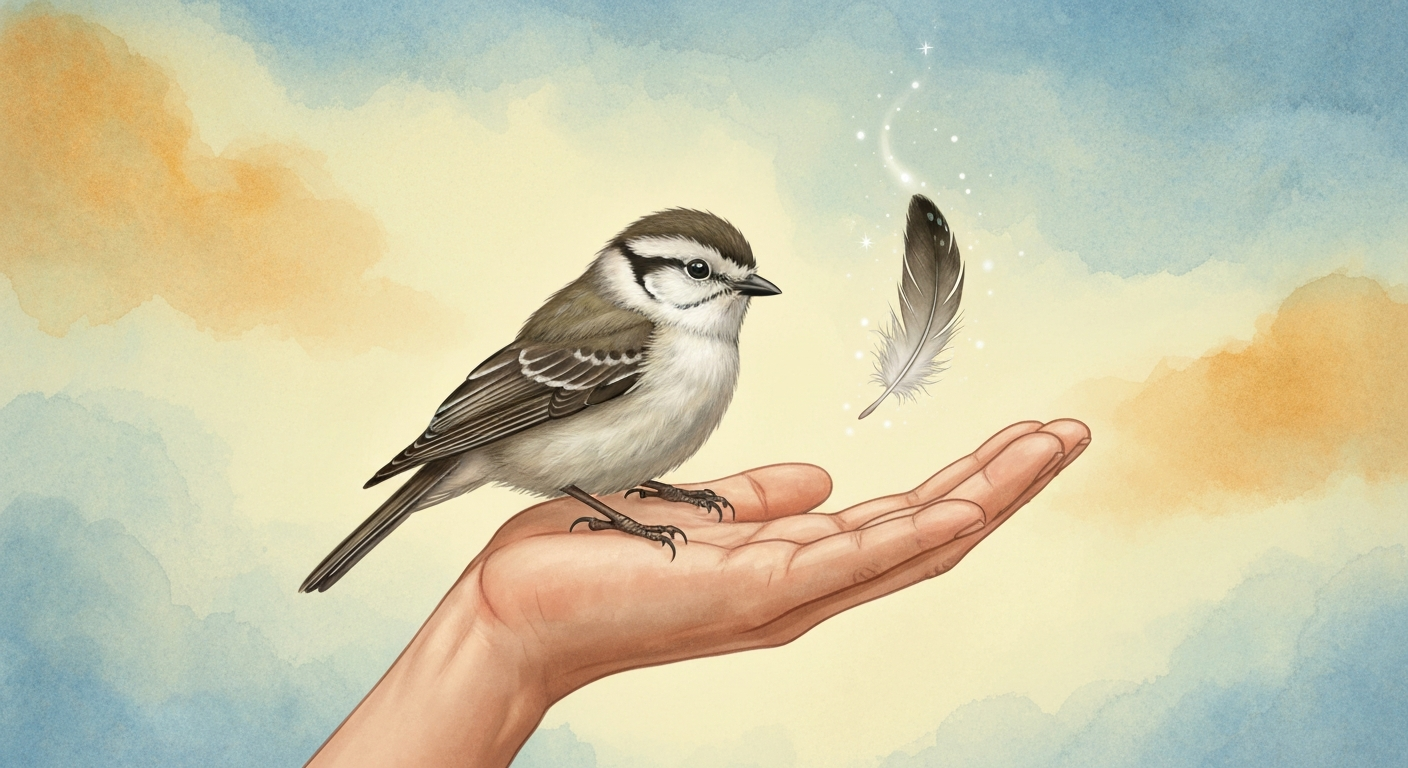
Quick definition
A mini feathered bird is a small bird distinguished by its visible plumage, a literal description that doubles as a symbolic motif representing soul, freedom, and spiritual transition across dozens of world traditions.
What small and fluffy birds actually look like
When people picture a 'mini feathered bird,' they're usually picturing something like a wren, a sparrow, a chickadee, a hummingbird, or the New Zealand fantail, birds typically under 20 cm long with dense, soft plumage that makes them look even smaller than they are. That puffed-up, fluffy appearance is often the result of feather-fluffing in cold weather, a thermoregulation behavior that traps warm air close to the body. It's functional, but it also gives small birds an almost cartoonishly round, approachable silhouette that has shaped how humans perceive and represent them in art and symbolism for centuries.
Some of the most commonly recognized mini feathered birds include sparrows (genus Passer), chickadees and titmice (family Paridae), wrens (family Troglodytidae), hummingbirds (family Trochilidae), and finches (family Fringillidae). These birds are small, highly mobile, and often strikingly patterned despite their size, which is part of why they attract so much human attention and, by extension, symbolic weight.
Many-feathered birds and fantails: plumage as the point
While most small birds wear their feathers close to the body, a distinct category stands out by making plumage the visual centerpiece. Fantails (genus Rhipidura, family Rhipiduridae) are a prime example: small, insectivorous passerine birds distributed across Australasia, Southeast Asia, and parts of the Indian subcontinent, they spread a prominent fan-shaped tail while foraging and in flight. The scientific name says it plainly, Rhipidura comes from the Greek rhipis ('fan') and oura ('tail'). The New Zealand fantail, or pīwakawaka, is about 16 cm long with roughly half of that being tail, and it moves in a characteristic zigzagging, highly energetic pattern while catching insects mid-air.
Beyond fantails, many-feathered birds in a broader visual sense include any species whose plumage is notably full, layered, or elaborate, peacocks, birds of paradise, pheasants, and cockatoos all qualify in different ways. The defining feature of this category is that the feathers themselves become expressive, communicative, and visually dominant. That quality translates directly into the symbolic meanings these birds carry, which we'll get to shortly.
The featherless bird: what it signals visually
A bird without feathers is immediately arresting precisely because it violates the expectation of what a bird should look like. Literally, featherlessness in birds has a few causes: natural molting cycles (during which birds may look patchy and unkempt), injury or illness, congenital conditions, or the nestling stage before juvenile plumage develops. A newly hatched altricial bird, a robin chick, say, is often entirely naked, eyes sealed shut, with skin translucent enough to see through. That image, so raw and exposed, is hard to look at without feeling something.
Visually and symbolically, the featherless bird sits at the opposite end of the spectrum from the fully plumed bird. Where feathers signal wholeness, vitality, and readiness, their absence signals transition, need, or incompleteness. It's worth keeping that visual cue separate from symbolic interpretation, a molting bird is not injured, and a nestling is not sick. But as a motif in art, dreams, or symbolic systems, a featherless bird almost always prompts the question: what has been stripped away, and what is about to grow back?
Bird and feather symbolism: the big picture
Across world mythologies and symbolic literature, birds occupy a consistent conceptual space: they move between earth and sky, they are associated with the soul, and they serve as messengers between the human world and whatever lies beyond it. J. E. Cirlot's Dictionary of Symbols documents this theme across dozens of traditions, noting that birds function as symbols of transcendence, freedom, and the psychopomp (the guide of souls). Ernest Ingersoll's Birds in Legend, Fable and Folklore, a wide-ranging 19th-century survey drawing on European and world folk traditions, catalogs countless examples of birds as omens, household visitors, and carriers of tokens or messages.
Feathers, as the most portable and detachable part of a bird, carry a compressed version of this symbolism. A single feather found on a path can function, in folk belief, as evidence that a spiritual presence has passed through. The specific meaning shifts dramatically by tradition, species, color, and context, but the underlying grammar of the symbol (feather = bird = sky = soul = message) is remarkably stable across cultures.
What small and fluffy birds symbolize
Small birds tend to attract symbolic meanings centered on innocence, humility, and agility. Their size makes them unthreatening; their speed and maneuverability make them admirable. In Christian iconography, sparrows in particular carry a specific theological weight, the New Testament's reference to God's awareness of even a sparrow's fall (Matthew 10:29) made the small bird a symbol of divine attention to the humble and overlooked. In Japanese culture, the sparrow (suzume) is associated with loyalty and hard work. Wrens, despite being tiny, were historically revered across Celtic Europe as 'king of birds', a small creature that outwitted larger competitors, which made them symbols of cleverness and unexpected power.
Hummingbirds add a layer of vitality and persistence to this symbolic cluster. In Aztec belief, Huitzilopochtli, the deity of the sun and war, was associated with hummingbirds, and fallen warriors were thought to return as hummingbirds in the afterlife. That's a significant symbolic upgrade for what is objectively a very small bird. The broader pattern here is that small birds, precisely because of their size, become vessels for meanings about resilience, spiritual awareness, and the power of the overlooked.
What many-feathered birds symbolize
Birds distinguished by elaborate or abundant plumage tend to symbolize abundance, vitality, display, and status. The peacock is the most obvious example: its dramatically fanned tail has been read as a symbol of pride (and its dangers) in Western traditions, but also as a symbol of immortality and divine beauty in Hinduism and Buddhism, where the peacock's ability to eat poisonous plants without harm linked it to the transmutation of negative forces. Birds of paradise, native to New Guinea, were so spectacular that early European traders assumed they never landed and must live perpetually in the air, which gave rise to a mythology of otherworldly, heaven-dwelling creatures.
The key symbolic logic here is straightforward: more feathers, more display, more vitality. Elaborate plumage in birds is often a secondary sexual characteristic, meaning it signals health, genetic fitness, and reproductive success. That biological reality maps onto symbolic meanings of abundance and celebration fairly directly. When you see a many-feathered bird in a symbolic or artistic context, it's almost always doing the work of expressing fullness, richness, or a peak state of being.
What featherless birds symbolize, and when to pause before interpreting
In symbolic systems, a featherless bird is most commonly read as a sign of vulnerability, transition, or impending renewal. The image of a naked chick in a nest is the most natural entry point: it represents the stage before capability, the raw material that will become something. In alchemical and esoteric traditions, the featherless bird can function as a symbol of rebirth, the phoenix stripped back to ash before it regenerates. In a more psychological register (Jungian analysis, for instance), a featherless bird appearing in a dream might represent a part of the self that feels exposed, unprotected, or not yet ready.
That said, it's worth applying a practical check before leaping to spiritual interpretation: if you've actually seen a featherless or patchy bird in your yard or on a walk, it's more likely molting, injured, or affected by feather mites than carrying a cosmic message. The distinction matters. Molting is a normal seasonal process; a bird that looks ragged in late summer may simply be replacing its flight feathers. Interpreting that as an omen while the bird needs practical help (or just needs to be left alone) misses the point. Use symbolic interpretation where the image is clearly figurative, in dreams, art, or literature, and literal bird welfare knowledge where the situation is real.
Fantail symbolism specifically
The fantail earns its own symbolic entry. The New Zealand fantail (pīwakawaka in Māori) carries a specific and well-documented cultural meaning in Māori oral tradition: in some iwi, the fantail's appearance in or near a house is treated as a message or omen, and in certain traditional stories it is associated with death. NZ Birds, Fantail (pīwakawaka) (species account and cultural notes) documents that pīwakawaka appears in Māori oral tradition and myth, with some iwi treating the fantail as a messenger or omen (including associations with death in some stories) and linking its appearance and distinctive flight to origin stories such as those about Māui and Mahuika NZ Birds — Fantail (pīwakawaka) (species account and cultural notes). One well-known narrative connects the fantail to the death of Māui, the trickster demigod, when a fantail's laughter alerts the goddess Hine-nui-te-pō, causing Māui's fatal attempt at immortality to fail. The fantail's characteristic behavior (flying inside buildings, following people through forest paths, its restless zigzagging movement) made it a natural candidate for messenger symbolism.
Beyond the Māori tradition, fantails and fan-tailed birds more broadly are associated with energy, adaptability, and expressive communication. A bird that fans its tail constantly is, in behavioral terms, signaling: it's a form of display and social communication. Symbolically, that translates to openness, expressive confidence, and a willingness to make oneself visible. The fantail is, in this sense, almost the opposite of a hidden or secretive bird, it announces itself constantly.
Finding feathers: single vs. many, and what context changes
Folk belief across many traditions holds that finding a feather, especially unexpectedly, in an unusual place, is a message or sign. A single feather is most commonly interpreted as a personal token: a reminder, a greeting from someone who has passed, or confirmation that you're on the right path. Finding many feathers, or a cluster, tends to amplify that sense, either intensifying the message, signaling abundance, or (in some traditions) marking a more urgent communication.
The specific bird matters where it can be identified. A white feather in Western folk tradition has been associated with purity, peace, and, more problematically in WWI-era British culture, cowardice (the 'white feather campaign' used the symbol to shame men who hadn't enlisted). A black feather is more ambiguous: in some traditions a symbol of protection, in others an omen or warning. The color, species, and location of the find all feed into interpretation.
On the practical side, it's worth knowing that in the United States, the Migratory Bird Treaty Act makes it illegal to possess most native migratory bird feathers without a permit, even if found on the ground. For details on legal handling, see USFWS, Living Around Birds / Migratory Bird legal guidance (feathers, nests, salvage), which explains prohibitions and permit and salvage pathways for found birds, feathers, nests, and eggs under U.S. law USFWS — Living Around Birds / Migratory Bird legal guidance (feathers, nests, salvage). Eagle feathers are additionally regulated under the Bald and Golden Eagle Protection Act, and are legally distributed only to enrolled members of federally recognized tribes through the National Eagle Repository. This isn't just a legal footnote, it reflects the genuinely sacred status of eagle feathers in many Native American nations. If you find a feather and want to keep it, checking which species it came from is a reasonable first step.
Dreaming of a mini feathered bird
In Jungian and comparative dream analysis, birds appear as archetypal figures: messengers, psychopomps, anima or animus figures, symbols of transcendence and aspiration. A small feathered bird in a dream might represent a fragile but genuine hope, a creative impulse, or an aspect of the self that is active, free-moving, and difficult to pin down. The dream's emotional tone matters enormously, a bird flying freely feels very different from a bird trapped in a cage, even if both are 'mini feathered birds' in purely visual terms.
Contemporary dream research (working in the Hall and Van de Castle framework developed further by G. William Domhoff at UC Santa Cruz) emphasizes that animal figures in dreams are culturally widespread but should be interpreted through personal association, emotional context, and the dream's narrative, not through fixed symbol dictionaries. So: what was the bird doing in your dream? How did you feel about it? Was it injured or healthy, caged or free, singing or silent? Those details carry more interpretive weight than the species or size alone.
| Dream scenario | Common symbolic themes | Questions to ask yourself |
|---|---|---|
| Small bird flying freely | Freedom, aspiration, creativity, hope | What area of life feels newly open or light? |
| Small bird in a cage | Restriction, repressed expression, unexplored potential | Where do you feel held back or constrained? |
| Bird landing on your hand | Trust, personal connection, a message arriving | Is there news or intuition you've been ignoring? |
| Bird with damaged or missing feathers | Vulnerability, transition, something unfinished | What feels incomplete or exposed right now? |
| Many small birds together | Community, collective energy, shared purpose | Who in your life are you thinking about? |
| Fantail or fan-tailed bird specifically | Restless energy, communication, a message from elsewhere | Is there something you've been reluctant to express? |
Mini feathered bird tattoos: meaning, design, and what to consider first
Small bird and feather tattoos are among the most consistently popular tattoo choices, and for good reason: they're visually flexible, carry rich symbolic possibilities, and scale well to different body placements. Sparrows have been a sailor tattoo staple since at least the 18th century (traditionally representing a sailor who had traveled 5,000 miles), while swallows, hummingbirds, and generic small songbirds each carry their own freight of meaning. A single small feather can stand for freedom, memory, a loved one lost, or a spiritual protection, the meaning is often as personal as the person wearing it.
Before choosing a design, a few practical questions are worth working through. First: does the design draw on a specific cultural or Indigenous tradition? Eagle feathers, war bonnets, and certain stylized bird motifs hold sacred ceremonial meaning in living Indigenous traditions, and using them as decorative tattoos raises genuine ethical concerns. Indigenous advocacy sources are consistent on this point: research the origins of the design, avoid sacred ceremonial forms unless you have a direct cultural connection, and consider commissioning an Indigenous artist if the design is rooted in a specific tradition.
Second: fine-line and miniature tattoos are technically demanding and require experienced artists. Very small, detailed line work can blur and 'migrate' over time as ink particles disperse in the skin, a process affected by placement, sun exposure, skin type, and the artist's technique. Dermatology sources note that tiny detailed tattoos typically need touch-ups more frequently than bolder work. Ask your artist specifically about their experience with fine-line small work, and plan for sun protection and maintenance.
Idioms, figurative language, and how writers use this motif
The English language is full of small birds doing symbolic work. 'A little bird told me' (meaning: I have information but won't name my source) has been in use since at least the 16th century and appears in both Ecclesiastes ('Do not curse the king... for a bird of the air will carry your words') and in Swift's writing. 'Birds of a feather flock together' uses the visual reality of bird flocking behavior to make a point about social affinity, people with shared traits naturally cluster. The 'early bird gets the worm' uses bird foraging behavior as a model for human initiative and reward.
In literature, the small feathered bird has done heavy lifting as a symbol of the fragile, the free, and the mortal. Keats's nightingale is both an actual bird and an emblem of transcendent beauty that the mortal speaker cannot access. Dickinson's poem 'Hope is the thing with feathers' gives hope the properties of a small bird: resilient, persistent, asking nothing in return. In Chekhov's The Seagull, the killed bird becomes a symbol of destroyed innocence and creative aspiration. Writers use mini feathered bird imagery precisely because it is small and therefore feels vulnerable, and because it can fly and therefore represents what we cannot quite reach.
- 'A little bird told me' — I have information from an unnamed source
- 'Birds of a feather (flock together)' — like-minded people naturally group together
- 'The early bird gets the worm' — acting early yields the best results
- 'Free as a bird' — complete freedom, unencumbered movement
- 'A rare bird' (rara avis) — an unusual or exceptional person or thing
- 'Feather in your cap' — a personal achievement worth displaying
Culture-specific notes: mythology, folk belief, and spiritual traditions
The meanings attached to small feathered birds vary significantly by tradition, and it's worth sketching a few specific examples rather than flattening them into a single 'universal' reading.
In Māori tradition, as noted, the pīwakawaka (New Zealand fantail) carries specific omen and messenger associations, particularly around death and communication from the spirit world, rooted in named mythological narratives. This is not a generic 'birds are spiritual' claim; it is a specific cultural interpretation tied to stories about particular figures (Māui, Mahuika, Hine-nui-te-pō) and to the observable behavior of the actual bird in the actual landscape of New Zealand.
In many Native American nations (and it is worth saying 'nations' specifically, because traditions differ considerably between groups), eagle feathers carry deep ceremonial and honorific significance, they are earned, gifted, and handled according to specific protocols. Smaller birds also feature in specific tribal stories: the hummingbird appears in stories from several Mesoamerican and South American traditions as a symbol of energy, joy, and resurrection. The Aztec connection between warriors and hummingbirds (through Huitzilopochtli) has already been noted.
In Celtic European traditions, the wren, arguably the most 'mini' of all the mini feathered birds, was both revered and ritually hunted on St. Stephen's Day (December 26) in Ireland and parts of Wales. The wren's legendary elevation to 'king of birds' (by hiding on an eagle's back and flying highest once the eagle was exhausted) made it a symbol of cunning intelligence over brute strength, and the ritual of the Wren Boys reflects a complex folk tradition mixing reverence, seasonal ritual, and communal celebration.
In East Asian traditions, the crane is the most symbolically weighted bird (associated with longevity, wisdom, and fidelity in Japanese, Chinese, and Korean cultures), but smaller birds carry weight too: the mandarin duck is a near-universal symbol of marital fidelity and romantic love in Chinese culture, and the magpie is considered a bringer of good luck and joy. The specific meanings in these traditions are well-documented and culturally specific, they don't transfer wholesale to other contexts.
Practical steps for interpreting a personal sign
If you've found a feather, seen a small bird in an unusual context, or had a vivid bird dream and are trying to work out what it means for you personally, the process is more useful when it's systematic rather than immediate. Start with the literal context: what species was the bird (if you can identify it)? What were the circumstances, a wild bird outside, a bird inside your home, a dream, a recurring image in art or media you've been consuming? Where were you, and what was happening in your life at the time?
- Identify the bird or feather as specifically as possible — species, color, size, condition
- Note the context: where did you encounter it, what time of day, what was your emotional state
- Record it — write it down, sketch it, or photograph it before the memory fades
- Cross-reference with cultural traditions relevant to your own background and heritage first
- Look up traditions connected to the specific species, not just 'birds in general'
- Ask what the symbol means to you personally — your own associations are legitimate data
- Notice if the motif recurs, and in what circumstances, before assigning fixed meaning
- Be honest about whether the literal situation needs a practical response (an injured bird, a legal question about feathers) before pursuing symbolic interpretation
If you keep seeing this motif: respectful, practical next steps
Recurring motifs, a small bird appearing repeatedly in dreams, finding feathers regularly, a bird image that keeps surfacing in media or art, are genuinely interesting and worth paying attention to, but they benefit from a grounded approach. Symbolic resonance is real: the human pattern-recognition system is extraordinarily good at finding and responding to recurring images, and that response itself tells you something about where your attention is being drawn. But it doesn't automatically mean the universe is sending you a targeted message.
If you've found feathers and want to engage with them respectfully: check the legal situation for your region (the U.S. Migratory Bird Treaty Act is the relevant U.S. law), research the species if possible, and handle the feather with care if you choose to keep it, noting that some traditions hold that feathers should be left where they are, returned to the earth, or given away rather than collected. If the motif is appearing in dreams or art, journaling about it over time (recording not just the image but your emotional response and what was happening in your life) is the most reliable way to develop a personal interpretation.
How writers and artists can use this motif
The mini feathered bird is one of the most versatile symbolic tools available to writers and visual artists precisely because it sits at an intersection of the familiar and the charged. Everyone has a relationship with small birds, they're in gardens, parks, and window ledges, approachable and observed daily. That familiarity lowers the entry barrier for a reader or viewer, which means a writer can use a small bird to carry quite heavy symbolic freight without it feeling forced.
The key craft question is which quality of the bird you want to foreground. A bird in flight emphasizes freedom, aspiration, or escape. A bird on a branch, still, and singing, emphasizes presence and expression. A bird on a hand or finger emphasizes trust, vulnerability, and fragile connection. A bird in a cage inverts almost all the positive symbolism and introduces themes of restriction, captivity, and suppressed potential (Maya Angelou's I Know Why the Caged Bird Sings works exactly this inversion). A featherless bird, or a bird mid-molt, introduces incompleteness and transition.
Visual artists working with feather and bird motifs in decorative or ritualistic contexts have a documented history reaching from Polynesian feather capes (held in collections at the British Museum and The Met) to pre-Columbian Peruvian featherwork textiles to Plains Indian war bonnets. These objects are not simply 'bird-themed' decorations, they are functionally and spiritually significant within their own traditions, which means artists drawing on them need to engage with those traditions, not just the visual forms.
Related entries worth exploring next
The 'mini feathered bird' topic connects naturally to several neighboring entries in this dictionary. The symbolic and practical meanings of fantail birds deserve their own page because the Māori and broader Australasian cultural context is specific enough to warrant depth beyond what fits here. See fantail bird meaning for a focused exploration of fantail symbolism across Māori and broader Australasian contexts. The fluffy bird meaning entry picks up specifically on the puffed-up, round silhouette that triggers so many of the warmth and innocence associations described above. The many feathered bird meaning entry goes further into plumage abundance and what elaborate display symbolizes across traditions. For more on plumage abundance and display, see the many feathered bird meaning entry. If you're here because of a feather you found, the finding bird feathers meaning entry covers the folk, spiritual, and legal dimensions of that experience in detail. And the bird without feathers meaning entry treats the featherless bird motif, molting, injury, and the symbolic nakedness of transition, as a standalone question. For another relevant comparison, see fluffy bird meaning. See the related entry 'bird without feathers meaning' for a deeper look at featherless bird symbolism, molting, injury, and the idea of symbolic nakedness and transition.
FAQ
Quick definition: What does “mini feathered bird” mean in one sentence?
Literally: a small bird characterized by noticeable plumage (fluffy, downy or with a fan‑shaped tail); symbolically: an image or phrase that commonly suggests innocence, agility, small‑scale abundance, messengers or subtle spiritual signs depending on context.
Literal meanings: What concrete, ornithological senses should I include?
Use standard field‑guide facts: a ‘mini feathered bird’ can refer to any small passerine with prominent plumage (e.g., chick, fledgling, or species like fantails/Rhipidura). Note size, habitat, behavior (active foraging, tail‑fanning in fantails), and plumage features (fluffy down vs. structured feathers). Cite local guides for precise ID.
Symbolic meanings: What are common symbolic themes for small or fluffy birds?
Common symbolic themes across cultures and symbol dictionaries: innocence/childlikeness, agility/quickness, humility/modesty, curiosity, vulnerability, the soul or spirit in transition, and small but lively blessings or messages.
Symbolic meanings: What does a many‑feathered or richly plumed small bird imply?
Abundance, vitality, celebration and self‑presentation; a richly plumed small bird can symbolise lively energy concentrated into a compact form, confidence in modest scale, or fertility/health of environment.
Symbolic meanings: What does a featherless or ‘bird without feathers’ motif represent?
Vulnerability, exposure, loss or grief, and sometimes rebirth or transformation (shedding the old to regrow); as with all symbols, context—emotion, narrative arc, and cultural background—matters for interpretation.
Fantail‑specific meaning: What should be noted about fantails (e.g., pīwakawaka)?
Fantails (genus Rhipidura) are small insectivores noted for tail‑fanning; culturally, the New Zealand pīwakawaka appears in Māori stories where it can act as a messenger or omen (including death in some accounts) and features in origin myths explaining its behavior—use local sources when discussing regional folklore.
Next Articles
Bird Without Feathers Meaning: Literal vs Symbolic Guide
Find the bird without feathers meaning: literal causes and symbolic themes, plus a step-by-step guide to verify your con
Many Feathered Bird Meaning: Symbolism, Dreams, Signs
Disambiguate many feathered bird meaning in folklore, dreams, and signs using species, behavior, and your emotions
Finding Bird Feathers Meaning: Identify and Interpret Symbolism
Checklist to identify found bird feathers and interpret likely symbolism in culture, folklore, and personal context.