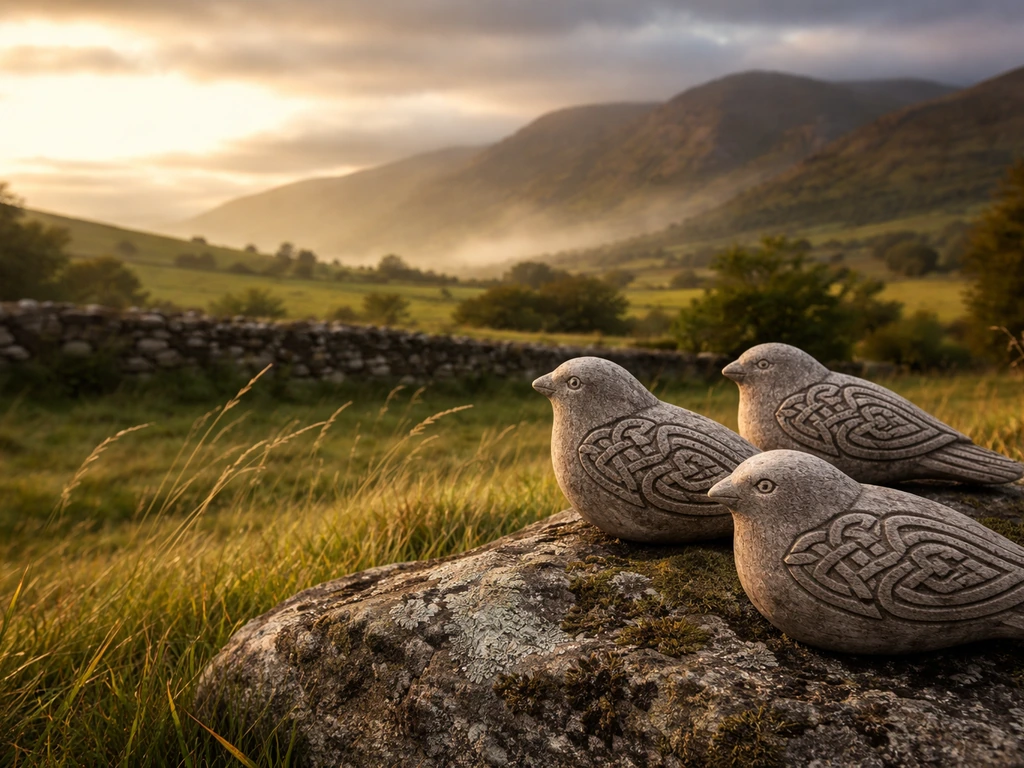
Finding a loose feather and wondering what it means is one of the most common small moments people bring to a symbolic lens. The honest answer is: the meaning depends on two things working together, what bird the feather most likely came from, and what symbolic tradition you're drawing on. Get the bird identification roughly right first, then the symbolism becomes a lot more specific and useful. If you can't identify it, broader feather symbolism still applies, but keep your conclusions loose.
Finding Bird Feathers Meaning: Identify and Interpret Symbolism

Marcus Blackwell
5 May 2026
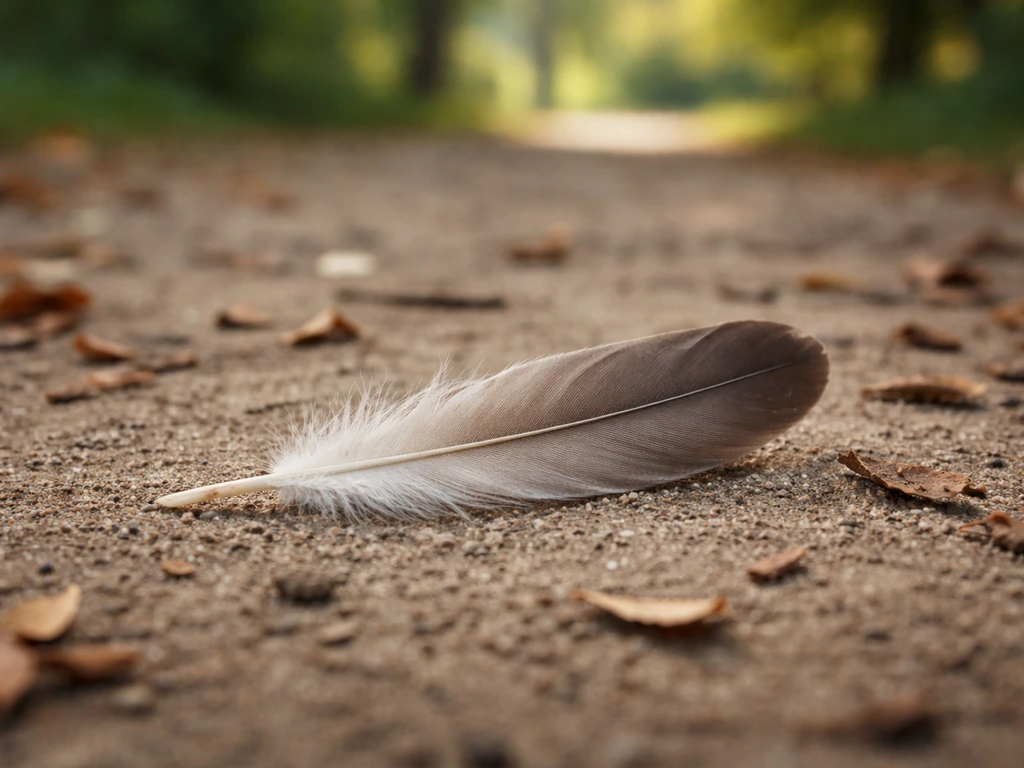
Why people look for meaning in found feathers

There's a real psychological reason why finding a feather feels significant. Humans are pattern-recognition machines, psychologists call the tendency to find meaningful connections in random events apophenia.
It's not a flaw; it's how we're wired. A feather appearing at an emotionally charged moment, or right after thinking about someone you've lost, triggers that pattern-seeking instinct hard. Superstitions and 'signs' beliefs actually serve a genuine function: research shows that [activating a good-luck belief can reduce anxiety and even improve performance on tasks like memory and problem-solving](https://pmc. ncbi.
nlm. nih. gov/articles/PMC6396703/). So if a found feather gives you a sense of comfort, calm, or direction, that's not nothing, it's doing real psychological work.
The caution is that constant sign-seeking can tip into a reassurance loop, where you need the next sign to feel okay, and the next. Keep that in mind as you read on.
Beyond psychology, birds have been carriers of symbolic meaning across nearly every human culture for thousands of years. They occupy the sky, a domain humans can't enter naturally, so they've long served as messengers between the earthly and the divine. A feather, as a physical piece of that, inherits all of that symbolic weight. That's why finding one doesn't feel like finding a stray sock.
How to identify the feather before you assign meaning
Jumping straight to symbolism without trying to identify the bird is like reading a horoscope before knowing your birthday. A little practical detective work makes everything more meaningful and more accurate. You don't need to be an ornithologist, just observe four things: color and pattern, size and shape, location, and any other birds nearby.
Color and pattern
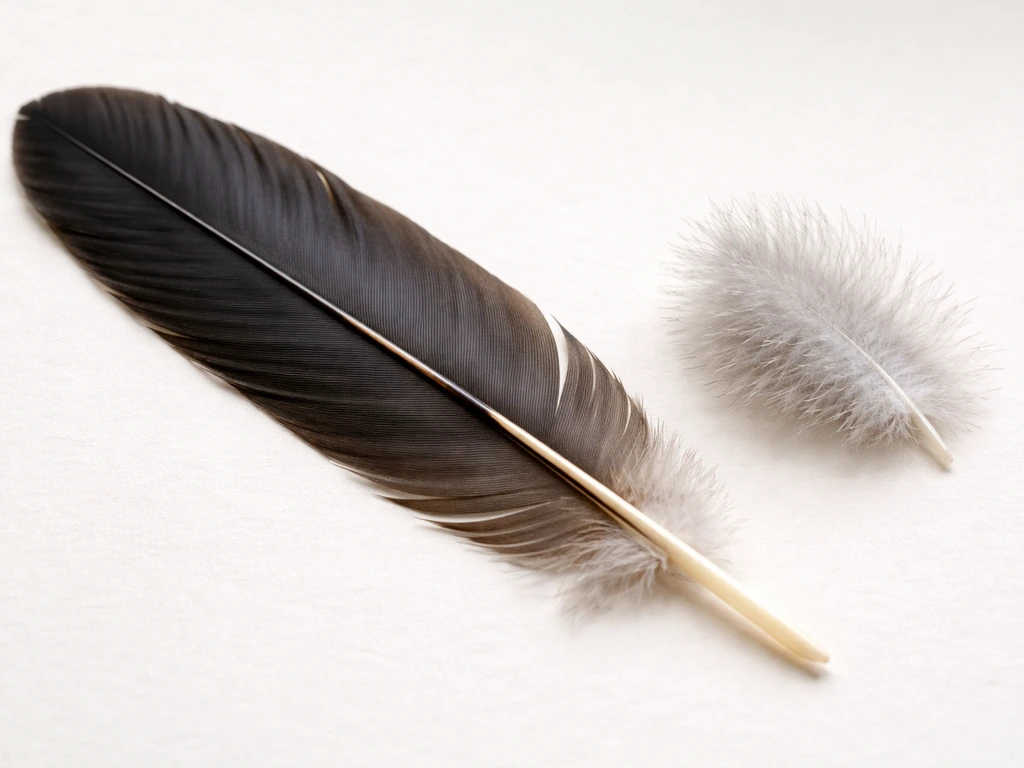
This is your strongest clue. Pure white feathers narrow the field quickly, mourning doves, swans, snow geese, and egrets are common sources. Iridescent black feathers with a blue-green sheen point strongly to crows or ravens. Barred brown-and-white patterns are typical of hawks and owls. Bright blue feathers in North America almost always come from blue jays or eastern bluebirds. Red or rust-orange typically means a cardinal or red-tailed hawk. Spotted or speckled feathers often come from thrushes, flickers, or guinea fowl. If the feather is entirely plain gray or brownish-gray with no distinctive markings, you're likely looking at a pigeon, starling, or mourning dove.
Size and shape
A large stiff feather over 10 inches is almost certainly a flight feather (primary or secondary) from a large bird, hawk, eagle, heron, turkey, or goose. A small, fluffy, down-like feather is a body feather from nearly any bird, harder to pin down but suggestive of smaller songbirds or waterfowl. Some people also search for the fluffy bird meaning, usually to connect that downy look with lighter, comforting symbolism. Long, curved tail feathers with eye-like patterns are classic peacock. A very long, narrow, iridescent tail feather could be a pheasant or magpie. If the feather is tiny (under 2 inches) and very soft, treat it as symbolically generic, you probably won't be able to ID the bird reliably.
Location matters a lot
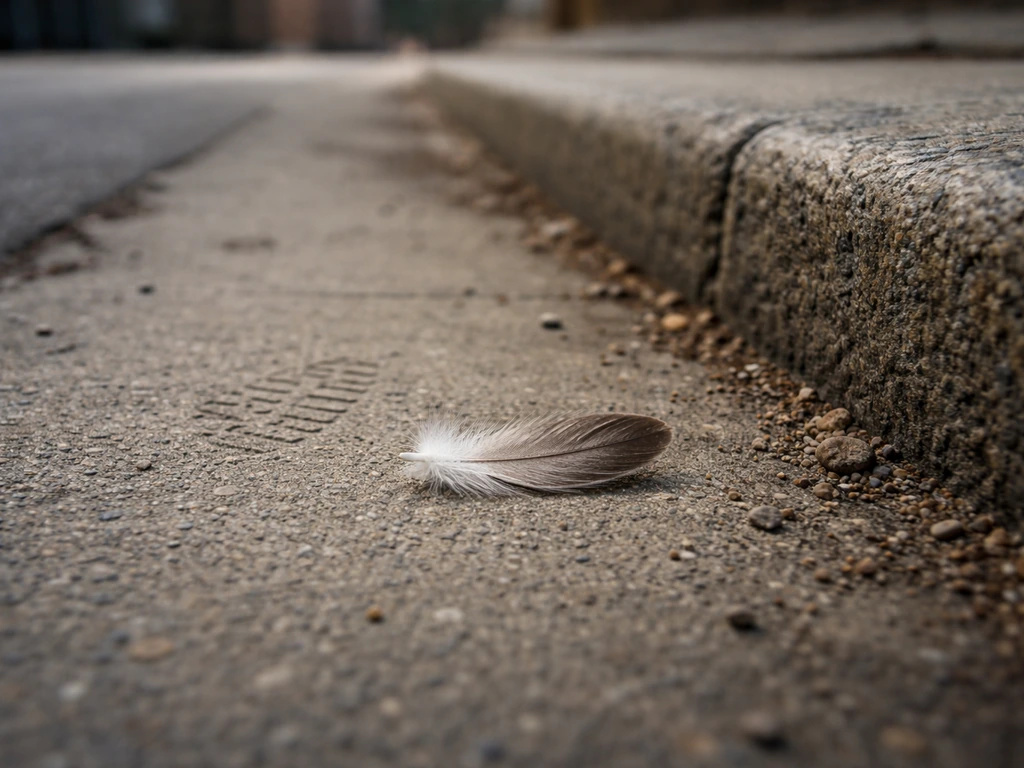
A feather found on a city sidewalk is overwhelmingly likely to be from a pigeon, sparrow, or starling, not an eagle. A feather found near water is more likely from a duck, heron, or kingfisher. Woodland finds point toward owls, woodpeckers, and thrushes. Coastal finds open up gulls, terns, and cormorants. Always let habitat filter your candidates before committing to an identification.
When you genuinely can't identify it
If you've gone through color, size, and location and still have no confident guess, that's fine, just be honest with yourself about it. A feather of unknown origin carries general feather symbolism (freedom, lightness, transition) but doesn't carry the specific symbolism of any one bird. Don't force a confident reading onto uncertain evidence. The meaning is real enough without overstating it.
What specific birds symbolize
Once you have a reasonable bird identification, the symbolic tradition attached to that bird becomes much more useful. If you are looking for the specific many feathered bird meaning, start by identifying the bird or at least the feather type, then compare a few traditions side by side bird symbolism. Here are the most commonly found feathers and their widely recognized symbolic meanings across folklore, mythology, and spiritual traditions.
| Bird | Feather Appearance | Core Symbolic Meanings |
|---|---|---|
| Crow / Raven | Glossy black, iridescent blue-green sheen | Mystery, intelligence, transformation, bridging worlds; ravens are messengers in Norse mythology and are associated with the god Odin |
| Owl | Soft, barred brown/white or gray, often with fine cross-hatching | Wisdom, the unseen, intuition, endings and new beginnings; associated with Athena in Greek tradition and with death omens in some Indigenous and European folklore |
| Hawk / Eagle | Large, brown/rust/white, firm flight feather | Vision, courage, spiritual strength, messenger of the divine; eagle feathers are sacred in many Native American traditions and represent connection to the Great Spirit |
| Dove / Pigeon | Soft gray, white, or pale brown | Peace, love, new beginnings, hope; the white dove is a near-universal symbol of peace across Western and Middle Eastern traditions |
| Robin | Small, warm brown with orange-red breast feathers | New beginnings, renewal, hope; in British and Celtic folklore, robins are messengers from those who have passed |
| Blue Jay | Bright blue and white with black barring | Boldness, communication, resourcefulness; jays in Native American lore are often trickster figures who carry messages |
| Peacock | Large, eye-patterned iridescent green/blue/bronze | Beauty, wholeness, immortality, watchfulness; in Hinduism, peacock feathers are associated with the god Krishna and protection |
| Magpie | Black and white with iridescent green-blue tail | Duality, luck (both good and bad), prophecy; the old English rhyme 'one for sorrow, two for joy' maps magpie sightings to fortune |
| Hummingbird | Tiny, iridescent, jewel-like colors | Joy, resilience, love, the sweetness in small things; in Aztec tradition, the god Huitzilopochtli was associated with hummingbirds |
| Swan | Large white, very smooth | Grace, transformation, love, the soul; in Celtic mythology, swans are supernatural beings capable of shape-shifting between bird and human form |
A note on eagle feathers specifically: in the United States, possessing eagle feathers is federally protected under the Bald and Golden Eagle Protection Act. If you find what looks like an eagle feather, photograph it and leave it where it is, or contact your local wildlife authority. The symbolism is profound, but the legal situation is real.
Folklore, idioms, and cultural traditions around feathers and birds

Bird and feather imagery runs through everyday language in ways most people don't consciously notice. 'A feather in your cap' dates to medieval and Native American traditions where warriors literally wore feathers as marks of achievement. 'Birds of a feather flock together', first recorded in English in the 16th century, speaks to the idea that shared nature draws people together. 'Light as a feather' frames feathers as symbols of ease, freedom, and the soul's weightlessness, an image used in ancient Egyptian mythology where the heart of the dead was weighed against a feather of the goddess Ma'at to judge moral worthiness.
Beyond idioms, specific folk traditions say that finding a feather on your path is a sign you're being watched over or guided. In many European folk beliefs, a white feather appearing after a loved one's death was taken as confirmation that they had arrived safely in the afterlife, the soul made visible for a moment. Black feathers carried more ambiguous readings: in some traditions, a warning to pay attention; in others (especially around crows), a sign of intelligence and coming change rather than anything ominous.
Feathers also appear symbolically in contexts adjacent to the topics of many-feathered birds, featherless birds, and even fantail birds, the tail feathers of fantail pigeons, for example, carry their own symbolic associations with display, beauty, and attraction in various folk traditions. The fantail bird meaning is often tied to themes of display, beauty, and attracting good energy fantail birds. Some people also search for the bird without feathers meaning, where the phrase often points to vulnerability, loss, or the idea of rebuilding what’s missing bird richly covered in feathers. The contrast between a bird richly covered in feathers and one that is bare or stripped also carries symbolic weight in many mythological systems, representing abundance versus vulnerability or transformation.
The personal meanings people most commonly assign
Across spiritual communities and personal belief systems, a few themes come up again and again when people interpret finding a feather. These aren't doctrinal rules, they're patterns of meaning that people consistently find resonant, which is itself worth paying attention to.
- A message from someone who has died: white feathers especially are read as signs of presence or peace from a deceased loved one, particularly when found in an unusual or emotionally charged context
- A reminder or confirmation: some interpret a feather as the universe (or a higher power, or their own intuition) confirming a decision they were already leaning toward
- A protective sign: finding a feather before or during a difficult period is often read as a sign of being watched over or shielded, which many people find genuinely comforting
- A call to pay attention: in Indigenous traditions across North America and elsewhere, a found feather is sometimes understood as a nudge to be more present and observant in your current life
- A warning to slow down: dark feathers found in stressful periods are sometimes read as prompts to pause and reconsider a direction — not as omens of harm, but as useful friction
- Pure luck: in many folk traditions, finding a feather (especially an intact one) is simply a good luck token, full stop — no interpretation required beyond keeping it or placing it somewhere meaningful
What's honest here is that the same feather, found by two different people on the same day, can carry entirely different personal meanings, and both can be valid within their own interpretive frame. The meaning you land on tends to reflect what you most need to hear at that moment. That's not a dismissal of the experience; it's actually one of the most interesting things about how bird symbolism works psychologically.
What to do next: grounded steps that actually help
If you want to take the experience seriously without losing your footing, here's a practical sequence worth following.
- Write it down immediately: note where you found the feather, what time of day it was, what you were thinking about right before you found it, and how you felt. These details matter if you want to look for genuine patterns later rather than retrofitting meaning.
- Make your best identification using color, size, shape, and location — then look up the symbolic tradition attached to that bird. Let the symbolism speak to you on its own terms before deciding whether it fits.
- Sit with one honest question: 'Does this feel like a confirmation, a warning, or just a beautiful coincidence?' Any of those is a legitimate answer. Notice what comes up without forcing a conclusion.
- Check for patterns over time: if you keep finding feathers of the same type in similar contexts, that's more interesting than a one-off. Keep a short log for a few weeks if you're curious.
- Decide whether the 'message' (if you're reading it as one) points to any real-world action. A feeling that you're being protected is fine to sit with. A feeling that you need to change direction deserves some practical reflection — write out what that change might look like, concretely.
- Avoid the reassurance loop: if you find yourself needing to find another feather to feel okay, or obsessively researching every feather you encounter for certainty, that's worth noticing. Signs and symbols are most useful when they open up thinking, not when they become a dependency.
Finally, enjoy the feather itself. Keep it somewhere visible if it resonates with you. Let it be a small, physical reminder of whatever the moment meant, without needing that meaning to be permanent or perfectly defined. The most durable symbolic objects are the ones that stay a little open.
FAQ
What should I do right after I find a feather if I want to interpret it responsibly?
Photograph it in natural light, note the exact spot and surrounding habitat (sidewalk, park, near water), then try identification using color, size, pattern, and any nearby birds. If you are unsure, treat the symbolism as general (transition, freedom, reassurance) rather than assigning a specific bird meaning.
Does the color alone determine finding bird feathers meaning?
Color is helpful, but it is not sufficient by itself. Pattern details (barred, speckled, eye-like markings), texture (downy versus stiff), and context (city versus woodland) often change the most likely bird source, which then changes the symbolism you would reasonably attach.
Why do two people get different meanings from the same feather?
Feather symbolism often reflects the interpretive frame each person brings, not just the feather’s traits. The “what you most need to hear” effect can make one reading feel comforting while another feels cautionary, and both can be psychologically valid as long as you are not forcing certainty from weak evidence.
If I cannot identify the bird, how can I still interpret it without guessing?
Use a “tiered” approach: start with general feather themes (lightness, guidance, transition), then add only the parts you can support, like whether it seems to be down versus a flight feather. Keep any claims about a specific species or message out of your conclusion if ID is not confident.
Is there a difference between down feathers and flight feathers for symbolism?
Yes, practically and symbolically. Down-like feathers tend to read as lighter, comforting, and “gentle energy,” while larger stiff flight feathers usually suggest movement, direction, or change in a more outward, action-oriented way. Even then, keep species-specific symbolism tentative unless you can identify the bird or feather type clearly.
What if the feather has unusual markings, like eye spots or strong iridescence, but I still cannot match it?
Treat distinctive features as clues for feather type rather than a final species claim. For example, eye-like markings can suggest display-related bird associations, but without reliable ID, keep the meaning at the level of themes (beauty, attention, transformation) instead of asserting a specific folklore reference.
Can a feather found near a grave or after a death have a different meaning than a feather found randomly?
Many people interpret “timing plus emotion” as more meaningful, especially if the feather appears soon after a loved one’s passing. If you choose to use that frame, focus on supportive themes (comfort, connection, closure) and avoid turning the event into a certainty about afterlife specifics if you cannot verify context or origin.
What are common mistakes people make when interpreting finding bird feathers meaning?
The biggest mistakes are forcing a species-specific message without identification, ignoring habitat context, and treating frequent sign-seeking as something you must act on. If you notice you feel you need the next “sign” to feel okay, it may help to reset by using the feather as a grounding token rather than a decision tool.
Is it safe to keep a feather, and how should I handle it?
Generally, yes if it is already shed, but avoid handling it if it looks dirty with mold or waste. Wash hands after handling, and store it dry and away from moisture. If you plan to keep it as a keepsake, a simple shadow box works better than loose storage to prevent damage.
What should I do if the feather might be from an eagle?
Do not collect it further or keep it if you suspect it is from an eagle. Photograph it, then leave it where it is and contact your local wildlife authority. Symbolism may feel profound, but legal protection is the priority when identification is even slightly uncertain.
Could “bird without feathers meaning” apply to a found feather?
Usually it refers to symbolic stories about vulnerability or rebuilding rather than about an actual shed feather. If you are using that theme, treat it as metaphor, not a literal message tied to the specific feather you found, especially if you cannot identify the bird or the feather type.
How can I check whether my interpretation is helping or harming me?
If the meaning you choose reduces anxiety and helps you act with clarity, it is likely serving you. If it increases rumination or you start waiting for additional signs to confirm basic decisions, switch to a smaller, time-limited use (a reminder you review once, then put away) to avoid an ongoing reassurance loop.
Next Article
Munster Bird Meaning: Folklore, Symbolism, and How to Verify
Meaning of Munster bird searches: folklore, symbolism, idioms, spelling variants, and quick ways to verify the reference