
Title: Conclave Bird Meaning: Assembly, Soul, and Symbolic Readings Explained Meta description: Discover the literal and figurative meanings of 'conclave bird,' from medieval bird-council allegories to soul-bird symbolism, psychopomp lore, and writing guidance.
Conclave Bird Meaning: Symbolism, Origins & Usage Guide

Marcus Blackwell
8 Aug 2026
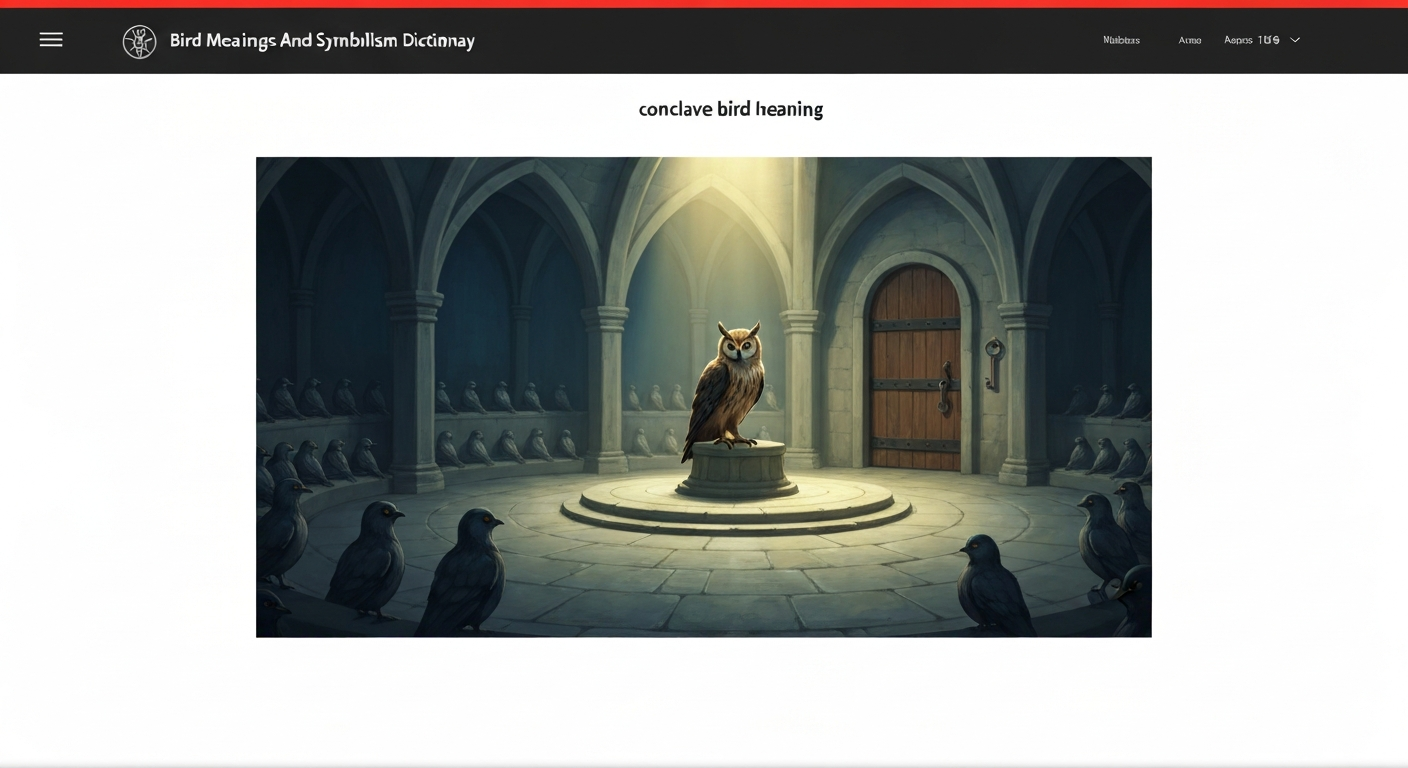
A 'conclave bird' most commonly refers to a bird appearing within, or symbolizing, a secret or sacred assembly, drawing on the word 'conclave' (a private, locked gathering) and layering it with the rich tradition of birds as messengers, soul-carriers, and presiders over councils. You will encounter the phrase in spiritual writing, literary criticism, and creative work, where it signals a bird that either convenes, witnesses, or mediates a momentous meeting. There is no single ancient text that coins the exact term 'conclave bird,' but the concept pulls from genuinely deep roots in folklore, medieval poetry, Sufi allegory, and mythological traditions across several cultures.
What 'Conclave Bird' Actually Means: Literal and Figurative Senses
In its most literal sense, a conclave bird is a bird that participates in or presides over a gathering, a council, tribunal, or secret meeting of birds depicted in story or symbol. The word 'conclave' comes from the Latin conclāve, meaning 'lockable room' (from con-, 'together,' and clavis, 'key'), and by the 16th century in English it had extended to mean any private or select assembly. Paired with 'bird,' it produces a compelling compound: a creature of flight and freedom confined, however briefly, to the solemn business of collective decision-making.
Figuratively, the phrase is used in two overlapping ways. First, as a symbol of communal wisdom or judgment, the bird that speaks for, or emerges from, a deliberating body. Second, as a psychopomp or otherworldly intermediary: a bird whose appearance at a significant threshold moment (death, initiation, revelation) suggests it has been 'appointed' by unseen forces. Both senses appear in spiritual writing and contemporary fiction, and it is worth being clear about which sense a given author intends.
Etymology and Usage: How 'Conclave' and 'Bird' Come Together
The Latin conclāve surfaces in English by the late Middle English period, initially in ecclesiastical contexts (the Papal conclave being the most famous institutional use). Oxford and Merriam-Webster both trace it through Old French from the Latin root, and the underlying PIE root carries a sense of enclosure and closure. 'Bird' and 'conclave' were probably not combined as a fixed phrase in classical or medieval literature, the union is more likely a modern literary or spiritual coinage, drawing on the long tradition of the 'parliament' or 'conference' of birds as a literary device.
The probable route of the phrase into contemporary usage goes like this: writers familiar with medieval bird-assembly poems, Sufi allegory, or esoteric traditions began using 'conclave' in place of 'parliament' or 'conference' to heighten the sense of secrecy and gravity. It is worth labeling this as a contextual or probable etymology rather than an attested historical coinage, you should treat 'conclave bird' as a productive cultural metaphor rather than a term with a fixed ancient definition.
Spiritual and Psychopomp Readings
Across many traditions, birds are assigned the role of psychopomp, a guide or escort for souls between the living world and whatever lies beyond. Odin's ravens, Huginn and Muninn, fly out daily to gather knowledge and return to whisper in the god's ear, functioning as winged ambassadors between realms. In the Prose Edda (Gylfaginning), blank" rel="noopener noreferrer">Huginn and Muninn are named as Odin's ravens who fly the world to gather information and return to him. The Egyptian Bennu, an ancient solar bird linked to creation and rebirth, influenced later phoenix imagery and represents the soul's regenerative journey. See the Bennu (iconography record), Getty/CONA for museum and scholarly notes linking the Egyptian Bennu to solar-creation imagery and its influence on later phoenix traditions blank" rel="noopener noreferrer">Bennu (iconography record) — Getty/CONA. When a bird appears at a 'conclave', a threshold moment coded as secret and significant, it naturally absorbs these psychopomp associations.
In spiritual writing, the conclave bird is often the creature that arrives unbidden at a ritual circle, a meditation, or a moment of communal grief. Its presence is read as witnessing or sanctioning the gathering. This is less a documented folk belief than a living interpretive tradition, and authors should label it as such when writing for general audiences, it is meaningful precisely because it is metaphorically active, not because every culture agreed on a formal 'conclave bird' doctrine.
Communal, Assembly, and Council Symbolism
The idea of birds holding councils has a surprisingly long and distinguished literary history. Geoffrey Chaucer's Parlement of Foules (ca. 1380s) is among the earliest and most influential English examples: birds assemble on St. Valentine's Day to debate and choose their mates, with Nature presiding. The poem encodes real social anxieties about courtly hierarchy and communal decision-making inside a fantastical bird-parliament. This is probably the single most accessible medieval English precedent for the 'conclave bird' motif.
Earlier still, and reaching a different cultural register, is the 12th-century Persian Sufi allegory Manṭiq al-Ṭayr ('The Conference of the Birds') by Farīd ud-Dīn ʿAṭṭār. In it, the birds of the world hold a council to seek their true king, the Simurgh, and must cross seven valleys of spiritual trial to find him. The title translates literally as 'Speech of the Birds,' and the assembly is explicitly a gathering in search of transcendent wisdom. This text remains a touchstone for any discussion of bird-council symbolism with spiritual weight.
The collective-noun tradition in English also feeds into this symbolism. The 'parliament of owls', one of the fanciful terms of venery from Late Medieval courtesy and hunting manuals, links specific bird species to assembly imagery in everyday language. These terms were more literary wordplay than scientific fact, but they have embedded themselves deeply enough that calling a group of owls a 'parliament' feels intuitively correct to modern readers. The crow's 'murder' and the starling's 'murmuration' work similarly: the name itself performs the symbolism.
Celestial, Otherworldly, and Soul-Bird Parallels
The conclave bird overlaps significantly with what scholars and spiritual writers call the 'celestial bird' and the 'soul bird', archetypal figures found across many traditions. The Persian Simurgh, for instance, is simultaneously the king presiding over a bird-assembly and a celestial, immortal being whose feathers can heal. The Egyptian Bennu inhabits a celestial register, rising from the primordial mound as a solar bird of creation. Both figures appear in contexts where a sacred gathering or cosmic threshold moment is being marked.
In Finnish and Baltic folk tradition, the soul is sometimes imagined as a small bird that leaves the body at death, a concept that scholars of comparative religion have labeled the 'soul bird. For more on this motif, see Finnish soul bird meaning, which explains how Finnish tradition imagines the soul as a small bird that leaves the body at death. ' This is a probable parallel to the conclave bird's psychopomp role rather than a direct equation: the Finnish soul bird is individual and intimate, while the conclave bird is collective and ceremonial. But both share the idea that birds move between states of being that humans cannot easily cross. Writers working with Finnish or Nordic imagery may find this parallel productive, though it should be framed as an analogy rather than an established doctrine.
Examples from Folklore, Myth, and Literature
The examples below are drawn from attested texts and traditions. Uncertain or reconstructed readings are labeled accordingly.
- Chaucer's Parlement of Foules (ca. 1380s, English): Birds assemble under Nature's authority to choose mates. Attested primary source; widely available in editions including Project Gutenberg (Skeat edition).
- Attar's Manṭiq al-Ṭayr ('Conference of the Birds,' 12th century, Persian/Sufi): Birds council to seek the Simurgh. Attested primary source; Penguin Classics translation available. A central example of bird-assembly with spiritual meaning.
- The Simurgh in Ferdowsi's Shahnameh (10th–11th century, Persian): The Simurgh appears as a guardian and healer bird, not presiding over a council but functioning as an otherworldly bird of supreme knowledge. Encyclopaedia Iranica provides a reliable summary.
- Huginn and Muninn in the Norse Prose Edda (13th century, Old Norse): Odin's two ravens function as a kind of two-bird conclave, gathering and delivering intelligence across realms. Attested in Gylfaginning.
- Egyptian Bennu (ancient Egyptian, dynasty-spanning): A solar/creation bird linked to the soul's journey and later phoenix imagery. Attested iconographically; documented by the British Museum and Getty/CONA.
- Parliament of Owls (Late Medieval English, term of venery): The collective noun for owls encodes assembly and judgment symbolism in everyday English. Attested in terms-of-venery lists; popularized in printed manuals.
- Medieval bestiaries and Hugh of Fouilloy's Aviarium (12th century, Latin): Bird allegories and assemblies appear in didactic bird-literature; useful for tracing the tradition in Christian medieval contexts. Bibliographic resources at bestiary.ca.
- Starling murmurations (modern, scientific and metaphorical): Empirically documented in peer-reviewed literature (PLOS ONE, Trends in Ecology and Evolution), murmurations are the most commonly invoked modern metaphor for coordinated bird-assembly. The symbolism here is probable and contemporary rather than folkloric.
Literary and Idiomatic Usage: How the Motif Functions for Writers
Safe and Effective Uses
The conclave bird motif works best in writing when it signals both collective authority and liminality, the sense that something is being decided at a threshold. A few illustrative approaches: a council of ravens that arrives at a burial might be described as a conclave bird gathering, invoking the psychopomp tradition without overclaiming it. A spiritual text might refer to 'the conclave bird within' as a metaphor for inner wisdom that surfaces when a community gathers in silence. In fantasy or mythopoeic fiction, a protagonist could witness a parliament of birds and recognize it as a conclave bird event, a moment when the natural world appears to deliberate.
The emblem-book tradition of the Renaissance, explored by scholars of Andrea Alciato's influential 16th-century emblems, also provides a visual vocabulary writers can draw on: a single bird standing above a gathered flock, or a bird holding a key (echoing the clavis root of 'conclave'), makes a potent image for illustration or chapter heading.
Cautions: What to Avoid When Using This Motif
- Do not claim that 'conclave bird' is an ancient term with a fixed definition — it is a productive modern metaphor drawing on older traditions, and presenting it otherwise misleads readers.
- Avoid attributing the soul-bird or psychopomp reading to a specific culture without checking the source — Finnish soul-bird parallels are probable analogues, not identical concepts.
- Label uncertain tradition connections clearly: if you write 'in some traditions, a conclave bird presides over the dead,' add 'this is a contextual reading drawn from psychopomp folklore' rather than presenting it as established doctrine.
- Do not conflate the assembly symbolism (Chaucer, Attar) with the individual psychopomp symbolism (Huginn and Muninn, Finnish soul bird) without acknowledging the distinction — both are valid, but they function differently.
- When referencing murmurations as a modern conclave-bird metaphor, note that this is a contemporary or probable analogy, not a folkloric or historical claim.
When to Look Up Related Bird-Meaning Pages
| Related page | Core symbol | When to consult it | Connection to conclave bird |
|---|---|---|---|
| Falcon bird meaning | Speed, precision, divine messenger, solar power | When your context involves a single bird as herald or royal emissary at an assembly | The falcon as a solo herald contrasts with the collective conclave; useful for comparing individual vs. group bird symbolism |
| Condor bird meaning | Death, renewal, high-altitude vision, South American sacred bird | When exploring birds that preside over liminal spaces (life/death threshold) or that carry souls | Shares the psychopomp/threshold role; the condor's scale and solemnity give it a presiding, conclave-adjacent quality |
| Soul bird meaning | The soul externalized as a bird, individual spiritual essence | When the conclave bird in your text functions for one person rather than a community | Direct parallel for the psychopomp sense; the soul bird is intimate, the conclave bird is communal |
| Celestial bird meaning | Cosmic, divine, otherworldly birds (Simurgh, Bennu, phoenix) | When your conclave bird is explicitly supernatural or mythological rather than folkloric | Strongest overlap — celestial birds like the Simurgh literally preside over bird assemblies in Persian tradition |
| Finnish soul bird meaning | Nordic/Baltic soul-as-bird concept, departure at death | When working with Finnish, Baltic, or broadly Nordic spiritual symbolism | Probable parallel for the liminal/psychopomp reading; label as analogy, not equivalence |
Practical Guidance for Interpretation and Writing
Before using the conclave bird motif in writing or spiritual interpretation, it helps to ask a few grounding questions: Is the bird in your text acting alone or as part of a group? (Alone suggests soul bird or psychopomp; in a group suggests council/assembly symbolism.) Is the gathering in your narrative human-centered or bird-centered? (A group of humans watched by a single bird is different from a parliament of birds deliberating.) What is the emotional register, solemn, mystical, political, grief-laden? The register determines which cultural tradition best fits the image.
- Establish whether your context is communal (assembly) or individual (soul-carrier) — this determines which traditions are most relevant.
- Choose a specific species if possible: owls carry parliamentary associations in English tradition; ravens carry Norse psychopomp associations; the Simurgh carries Persian celestial authority. The species focuses the symbolism.
- Decide your tonal register: sacred and solemn invites soul-bird or celestial-bird language; literary and allegorical invites Chaucer or Attar as models; contemporary spiritual writing may blend both.
- Label uncertain readings clearly in nonfiction or spiritual texts — readers trust writers who distinguish between 'this is attested in tradition' and 'this is a probable interpretation.'
- For image ideas: a single bird silhouetted above a circle of smaller birds, a bird holding a key or seal, a murmuration forming a shape above a landscape, or a medieval illumination-style parliament scene all visualize the conclave bird effectively.
Image and Internal-Link Suggestions for This Page
For images, consider: a high-resolution photograph of a starling murmuration at dusk (alt text: 'starling murmuration forming a collective shape at dusk, illustrating conclave bird assembly symbolism'); a medieval manuscript illustration of birds in council, such as a Parlement of Foules illumination (alt text: 'medieval manuscript illustration of birds assembled in council, from the Parliament of Fowls tradition'); a stylized illustration of the Simurgh above a gathering of birds (alt text: 'Simurgh presiding over an assembly of birds, from Persian mythological tradition'); and a close-up of an owl on a branch with atmospheric fog (alt text: 'parliament of owls conclave bird symbolism, single owl presiding'). Use JPEG or WebP formats for photography; PNG or SVG for illustrated or diagrammatic content.
For internal links, the most natural placements are: the first mention of the Simurgh and celestial birds (link to the celestial bird meaning page); the discussion of soul-carrier and psychopomp roles (link to both the soul bird meaning page and the Finnish soul bird meaning page); the comparison of individual herald birds vs. assembly birds (link to the falcon bird meaning page); and the threshold/death-and-renewal reading (link to the condor bird meaning page). These are the pages a reader would most naturally want to visit after engaging with the conclave bird concept, and the links will feel helpful rather than forced. For species-specific symbolism, see the falcon bird meaning page (internal reference 0088859f-7e44-489b-9913-8aca81fa03b6).
FAQ
What search-optimized title and meta description should I use for a 'conclave bird meaning' reference page?
Title: Conclave Bird Meaning — Literal, Figurative & Cultural Guide Meta description (≤160 chars): What does 'conclave bird' mean? Clear literal and symbolic definitions, cultural examples, writing guidance, and related bird pages.
What concise definitive meaning(s) should open the article?
Provide a two-part definition: 1) Literal: a collective or gathering of birds (an assembly, flock, or council) or an individual bird named in or used within a 'conclave' context. 2) Figurative: a symbolic motif where birds act as messengers, psychopomps, celestial or communal beings—used to suggest counsel, secrecy, spiritual guidance, or collective intelligence.
What etymology and usage notes are required for the phrase 'conclave bird'?
Trace 'conclave' to Latin conclāve ‘lockable room’ (con- ‘together’ + clavis ‘key’), with English senses of private/secret meeting from the 16th century (Merriam‑Webster/Oxford/Etymonline). Note that 'conclave' is historically applied to human gatherings; its pairing with 'bird' is usually figurative or literary, influenced by medieval/vernacular traditions of 'assemblies of birds' (e.g., Chaucer, Attar). Label any rare or speculative usages as probable or contextual.
Which grouped cultural interpretations should the article map out?
Organize interpretations into four groups with sourced examples: 1) Spiritual/psychopomp: birds as soul‑carriers or guides (Norse ravens Huginn & Muninn, Egyptian Bennu, general psychopomp motif). 2) Communal/assembly symbolism: birds as councils or collective actors (Attar’s Conference of the Birds; Chaucer’s Parlement of Foules; modern 'murmuration' science). 3) Celestial/otherworldly: mythic cosmic birds (Simurgh, phoenix/Bennu) functioning as protectors or cosmological symbols. 4) Natural/scientific bases: flocking behaviour (starling murmurations) and how biology shapes metaphors. Avoid asserting culture‑wide universals; cite authoritative references (Encyclopaedia Iranica, Prose Edda translations, PLOS ONE, Trends in Ecology & Evolution, Attar scholarship).
What specific folk or literary examples should be included and how should uncertainty be handled?
Include: Attar’s Mantiq al‑Ṭayr (Conference of the Birds) as archetypal council-of-birds; Chaucer’s Parlement of Foules as medieval English precedent; medieval bestiaries and emblem books for emblematic bird councils; starling murmurations for scientific metaphor. For folk parallels (e.g., Finnish 'soul bird' motifs), present as probable or contextual unless a direct primary source is cited; flag rare or regional claims as folkloric or comparative rather than factual generalizations.
How should literary and idiomatic usage be treated and exemplified?
Show two strands: 1) Historical/literary use: allegories and councils of birds (Attar, Chaucer), emblem books, medieval bestiary imagery. 2) Modern idiomatic/metaphorical use: 'parliament of owls' (venery term), 'murmuration' as metaphor for collective intelligence; suggest example sentences for writers (e.g., 'a conclave of gulls gathered on the pier' for a literal scene; 'the city held its conclave like a murmuration' for metaphor). Note venery names are literary conventions, not scientific group taxonomy.
Next Articles

Finnish Soul Bird Meaning: What It Symbolizes in Finland
Finnish soul-bird meaning explains the spirit-soul idea behind the term, why it appears as a bird, plus related folklore

Condor Bird Meaning: Symbol, Culture, and Practical Guide
Discover condor bird meaning in symbols, Andean culture, and everyday uses, plus a quick checklist to avoid wrong contex
Falcon Bird Meaning: Symbolism and White Falcon Meaning
Learn falcon bird meaning and white falcon bird meaning, including symbolism, context, omens, and how to interpret sight