"Gay bird" most commonly meant a merry, lively, or brightly coloured bird in English poetry and folk song from the 1700s through the early 20th century. The phrase drew on the older sense of "gay" as cheerful or showy, not on any reference to sexual orientation. In contemporary informal speech, it has taken on newer, often pejorative connotations that reflect the word "gay" in its modern sense, and those uses require real care depending on context, audience, and intent.
Gay Bird Meaning: Origins, Slang, Symbols & Modern Use

Marcus Blackwell
18 Jul 2026
Quick Definition
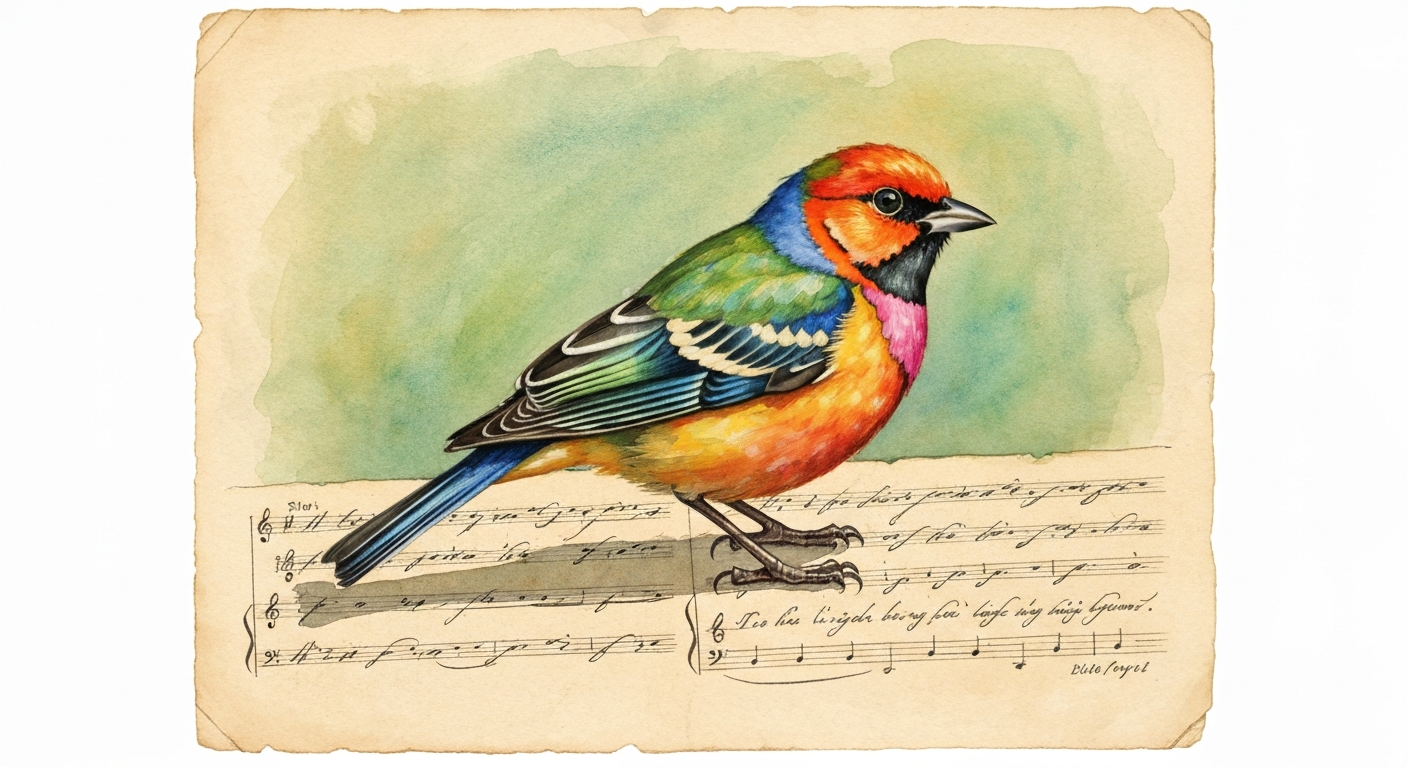
In its primary historical meaning, a "gay bird" is a joyful, colourful, or vivacious bird, typically invoked in verse to describe plumage, song, or lively spirit. The phrase is a two-word descriptive compound, not a fixed idiom, and its meaning has shifted over time alongside the word "gay" itself. Today, depending on context, the phrase can mean: (1) a brightly coloured or merry bird in older literary usage; (2) a bird exhibiting same-sex behaviour in zoological or pop-science contexts; or (3) a pejorative slang term in informal online speech.
Where the Phrase Came From
The word "gay" entered English from Old French "gai," meaning merry or cheerful. The Online Etymology Dictionary traces the root back through Middle English, noting that by the 14th century "gay" reliably meant lively, bright, and full of mirth. Its application to birds was entirely natural: brightly plumed, loudly singing birds were the obvious candidates for the adjective. The combination "gay bird" is therefore less a fixed phrase than an organic pairing of a common adjective with its most visible subject.
The earliest datable literary use I have found of the exact two-word phrase appears in John Wilson's 1812 poem "The Isle of Palms," where a stanza reads: "Vaunt not, gay bird! John Wilson's 1812 poem The Isle of Palms includes the line "Vaunt not, gay bird," as shown in the scanned edition John Wilson's 1812 poem The Isle of Palms includes the line "Vaunt not, gay bird," as shown in the scanned edition.. thy gorgeous plume." Wilson is addressing a colourful tropical bird with a mix of admiration and caution, and "gay" here unambiguously means showy or splendid. The Oxford English Dictionary documents this sense of "gay" with multiple citations across the centuries, confirming it as the standard meaning well into the 19th century.
The semantic shift that would eventually complicate the phrase began in the late 19th century. Etymology sources document an intermediate stage where "gay" carried connotations of licentiousness or loose morality (hence "gay woman" as a Victorian euphemism for a prostitute). The specifically homosexual sense is attested in late 19th and early 20th century sources, though it did not become widely dominant in everyday speech until the mid-20th century. By the 1960s and 1970s, the LGBTQ+ community had adopted "gay" as a preferred self-identifier, and that reclamation firmly shifted the word's primary modern connotation.
British, American, and Australian Slang Differences
Regional variation matters a lot with this phrase. In British English, "gay" retained its older cheerful sense in everyday speech somewhat longer than in American English, which means older British texts and some dialect speech use "gay bird" in the original merry or colourful sense without any sexual implication. In American English, the shift to the sexual-identity meaning happened more sharply through the latter half of the 20th century, so American readers encountering the phrase in older texts often need to consciously re-anchor to the historical meaning.
In Australian slang, "bird" itself carries an additional layer: it can refer informally to a person (especially a woman), so "gay bird" in colloquial Australian usage could theoretically be heard as a comment on a person rather than a literal bird. Australian English also absorbed the American shift toward the sexual-identity sense of "gay" during the 1970s and 1980s, so modern Australian usage largely mirrors American conventions. None of these regional variants use "gay bird" as a stable, dictionary-endorsed idiom; it remains a loose compound whose meaning is supplied almost entirely by context.
In Literature, Music, and Popular Culture
Victorian and Edwardian verse returns to "gay bird" imagery repeatedly. Edward William Cole's "Cole's Funny Picture Book," a hugely popular Australian children's collection from the 19th century, contains nursery-rhyme lines where birds are called gay in the merry-and-bright sense, and the phrasing is typical of the period's children's literature more broadly. The formula was a natural fit for verse: birds gave poets something visually vivid and acoustically resonant to anchor the adjective.
D. H. Lawrence used the construction into the 20th century. His poem beginning "There was a gay bird named Christine" deploys "gay" in the older, non-sexual sense, treating the bird as a playful or spirited creature. This is a useful reminder that the historical meaning did not vanish overnight; writers who grew up in the 19th century carried the older usage into the 1920s and 1930s quite naturally.
In traditional song, the adjective "gay" modifies birds constantly. Lullabies and folk melodies frequently pair it with small songbirds: "gay little dicky bird" appears in older song texts, and similar formulas show up in sentimental parlour songs of the late 1800s. The line "a gay little love melody" from a version of the Sleeping Beauty score is another example of the same convention persisting into early 20th-century popular music. Reproducing full lyric passages raises copyright questions, but the pattern is consistent enough across public-domain material to treat as established usage.
In more recent popular culture, the phrase surfaces in a different register entirely. In 2023, fans of the Angry Birds franchise debated whether a particular bird character was canonically queer, and coverage from outlets including Kotaku reported on the conversation under headlines about a "gay bird" character. The developers ultimately framed the character as an ally rather than a gay character, but the discourse itself shows how contemporary audiences map modern identity categories onto animal characters, including birds. This kind of fan interpretation is now part of the phrase's cultural life.
Symbolic and Spiritual Meanings
Birds occupy a prominent and consistent place in human symbolic imagination across cultures. In Jungian psychology, birds represent the soul, transcendence, and the life of the spirit. They mediate between the earthly and the divine in dozens of traditions, from the Egyptian Ba-soul depicted as a human-headed bird to the shamanic bird-spirit guides of Siberian and Central Asian traditions. Within this symbolic field, a "gay bird" in the older sense of showy and joyful carries a coherent spiritual reading: it is a creature associated with vitality, beauty, and the exuberant force of life.
In dream interpretation, brightly coloured birds are generally read as positive omens. Many folk traditions treat the appearance of a vivid, singing bird in a dream as a sign of happiness, creative energy, or spiritual renewal. The specific association of colour with joy (as in the bluebird of happiness or the phoenix's flame) reinforces the idea that a showy, lively bird in a symbolic context speaks to abundance and freedom rather than trouble. Folkloristic scholarship, including work published in the Journal of American Folklore, documents these symbolic roles in detail, though no scholarly source I have found treats the exact phrase "gay bird" as a technical folkloric category.
It is also worth noting that same-sex behaviour in birds is scientifically well-documented. Bruce Bagemihl's "Biological Exuberance: Animal Homosexuality and Natural Diversity" (1999) catalogues same-sex pairing and courtship across hundreds of species, including many birds. Penguins, flamingos, and albatrosses all appear in the scientific literature as species where same-sex pair bonds occur. This biological reality feeds a layer of contemporary symbolism in which certain birds carry meaning for LGBTQ+ communities as natural emblems of queer existence, though this is a modern symbolic reading rather than an ancient folkloric tradition.
Using the Phrase Responsibly Today
Here is where thoughtful writers need to pause. The word "gay" has been fully reclaimed by the LGBTQ+ community as a positive identity term, and style authorities including the GLAAD Media Reference Guide and NLGJA Stylebook are consistent on this point: "gay" should be used as an adjective, not as a pejorative, and it should not be deployed casually as a synonym for stupid, silly, or inferior. That guidance extends to compounds like "gay bird" when the phrase is used as an insult or dismissal.
Online, "gay bird" does appear in Urban Dictionary entries and on Reddit as an informal put-down, functioning similarly to how "gay" has been misused as a general-purpose insult in playground and online speech. The APA bias-free language guidelines and GLAAD guidance both identify this as a form of language that harms LGBTQ+ people by equating their identity with something negative. Writers working in educational, journalistic, or literary contexts should avoid this usage.
If you are writing about birds in the literal zoological sense and want to note same-sex behaviour, the clearest and most respectful phrasing is to describe the behaviour directly: "this species forms same-sex pair bonds" or "same-sex courtship has been documented in this population." Using "gay" as a descriptor for animal behaviour is not inherently problematic in a scientific or naturalistic context, as long as you are not anthropomorphising in a way that then gets transferred back to human beings as an insult. If you are writing historically and quoting or paraphrasing 18th or 19th-century texts, a brief gloss explaining the original meaning of "gay" saves your reader any confusion.
Practical alternatives depending on your context
- For historical or literary contexts: gloss "gay bird" as "merry or brightly coloured bird" in parentheses on first use
- For zoological or naturalistic writing: use "same-sex pair bond," "homosexual behaviour in birds," or name the specific behaviour
- For LGBTQ+ cultural commentary: use "queer-coded bird" or "gay-coded character" when discussing fan readings or media representation
- For general writing: avoid using "gay" as a synonym for strange, silly, or undesirable regardless of whether a bird is involved
- For children's education or verse quotation from older texts: provide a brief note that "gay" in this context means "happy or colourful," not a reference to sexual identity
Concrete Examples and Primary Sources
| Source | Year | Phrase Used | Meaning in Context |
|---|---|---|---|
| John Wilson, "The Isle of Palms" | 1812 | "Vaunt not, gay bird! thy gorgeous plume" | Showy, brightly coloured bird (literary poetry) |
| Cole's Funny Picture Book | 19th century | Gay bird imagery in nursery verse | Merry, lively bird (children's verse) |
| D. H. Lawrence, untitled poem | Early 20th century | "There was a gay bird named Christine" | Playful or spirited bird (lyric poetry) |
| Bruce Bagemihl, Biological Exuberance | 1999 | Same-sex behaviour documented in birds | Scientific description of homosexual behaviour in avian species |
| Kotaku news coverage | 2023 | "Gay bird" character in Angry Birds | Fan and media debate over queer-coded animated character |
The OED's entry for "gay" is the single most authoritative source for tracing this word's history, and Merriam-Webster's online entry provides an accessible summary of the same trajectory from Middle English "gai" (merry) through the intermediate licentious sense to the modern sexual-identity sense. Both confirm that the historical "gay bird" is a product of the word's oldest meaning, not its newest one.
How "Gay Bird" Sits Among Related Bird Terms
Part of what makes bird language so rich as a topic is the way individual terms cluster together and illuminate each other. Several entries on this site cover bird terms that share interesting parallels with "gay bird" in terms of how their meanings have shifted, layered, or grown ambiguous over time.
The gooney bird (a folk name for the Laysan albatross) is a useful comparison: like "gay bird," it is a phrase whose meaning depends heavily on historical and regional context, and it carries symbolic weight around themes of endurance and wandering. The goose and geese entries are relevant because geese are among the best-documented species for same-sex pair bonding in nature, making them a concrete example of the biological phenomenon that sometimes drives modern uses of "gay" applied to birds. Goslings, the young of geese, carry their own symbolic freight around innocence and transformation. See gosling bird meaning for more on the symbolism of goslings, young geese associated with innocence and transformation. For more on geese and goslings, see the related entry "goose bird meaning.".
The seagull is a bird with an extensive literary and symbolic history, including Chekhov's famous play, and its meanings have shifted across contexts in ways that parallel how bird terms generally absorb new meaning over time. The game bird entry covers a phrase where the word before "bird" is entirely non-biological but shapes the whole meaning of the compound, which is structurally similar to what happens with "gay bird." The seal bird term is a reminder that folk names for birds can be deeply counter-intuitive, generated by context and observation rather than taxonomy. For more on that folk name, see the seal bird meaning entry.
| Related Term | Primary Meaning | Shared Feature with "Gay Bird" |
|---|---|---|
| Gooney bird | Folk name for the Laysan albatross; connotations of awkwardness and endurance | Historically specific folk compound whose meaning requires context |
| Goose / Geese | Waterfowl with rich symbolic history; geese document same-sex pairing in nature | Directly relevant to the biological layer of "gay bird" discussion |
| Gosling | Young goose; symbolic associations with innocence and new life | Part of the same waterfowl symbolic cluster |
| Seagull | Bird of freedom, restlessness, and literary symbolism | Example of how a single bird term accumulates layered meanings over time |
| Game bird | Bird hunted for sport or food; the modifier shapes the entire meaning | Structural parallel: adjective before "bird" determines meaning |
| Seal bird | Folk name based on observed habitat or behaviour, not taxonomy | Illustrates how context-dependent folk bird names are |
Taken together, these related entries show that "gay bird" is not unusual in being a compound whose meaning has drifted, split, or acquired layers over time. What makes it distinctive is that the drift happened to one of the most socially significant words in contemporary English, which means getting the interpretation right matters both intellectually and ethically.
FAQ
What is the primary meaning of the phrase "gay bird"?
Historically and literally, "gay bird" means a bright, showy, or merry bird — "gay" in older senses of "merry, lively, or showy." (See Oxford English Dictionary; Project Gutenberg text of John Wilson's 1812 poem: "Vaunt not, gay bird! thy gorgeous plume.")
How did the words in "gay bird" develop (etymology and historical usage)?
"Gay" comes from Old French gai meaning "merry"; from Middle English it was used for "cheerful, bright or showy." The two‑word phrase appears in 18th–19th‑century poetry and nursery verse to describe colourful or cheerful birds (examples in John Wilson, Cole's Funny Picture Book). Over the 19th–20th centuries "gay" accrued senses of lewdness and, by the late 19th/early 20th century, an identity sense meaning "homosexual" (OED; Merriam‑Webster; Etymonline).
How does regional slang change the meaning (British, American, Australian differences)?
In British, American, and Australian English the older literary meaning can still appear in poetry or historical texts, but contemporary regional slang varies: in everyday modern use in all three regions, "gay" commonly denotes sexual orientation (Merriam‑Webster; OED). Informal online or dialectal uses sometimes turn "gay bird" into a pejorative or teasing term (user‑generated attestations on sites like Urban Dictionary and social posts). Usage depends on context, audience, and era—older texts use the non‑sexual sense; modern casual speech often invokes the sexual‑identity sense or slang insult.
Where has the phrase or concept been used in literature, music, and idioms?
Poetry and children's verse: John Wilson's 1812 poem and various Victorian nursery rhymes use "gay bird" to mean colourful or merry (primary sources: The Isle of Palms; Cole's Funny Picture Book). 20th‑century poets (e.g., D. H. Lawrence) also use the older sense. Popular music and lyrics historically used "gay" to mean cheerful in song lines; modern music and fandom sometimes use "gay bird" or "gay‑coded bird" in discussions about characters (press coverage such as Kotaku on queer readings of game characters). Note: quoting song lyrics may require permissions (publisher guidance).
What symbolic or spiritual interpretations does "gay bird" invite (dreams, totems)?
Symbolically, colourful or singing birds commonly signify joy, freedom, the soul, or transformation across cultures (Jungian and folkloristic literature). Reading "gay bird" in dreams or as a totem is likely to invoke those positive, lively associations (cheerfulness, messenger, creativity). There is no scholarly tradition treating "gay bird" as a fixed folkloric symbol distinct from general bird symbolism (see Jungian perspectives; folklore journals).
How do scientific findings about bird behaviour relate to the phrase?
Scientific studies document same‑sex behaviour in many bird species (e.g., Bruce Bagemihl's Biological Exuberance). Such findings explain why people sometimes casually describe animals as "gay" by analogy or anthropomorphism, but scientific observations do not validate using animal labels as human epithets.
Next Articles
Seal Bird Meaning: Literal ID, Symbolism & Uses
Seal bird meaning: literal IDs, symbolic interpretations, folklore, idioms, comparisons, and practical uses.
Gooney Bird Meaning: Definition, Origin, and Usage Tips
Meaning of gooney bird, its origin, whether it refers to a seabird or nickname, and how to use it in context.
Game Bird Meaning: Definition, Examples, and Usage
Clear game bird meaning: definition, qualifying species, hunting examples, and how it differs from common bird idioms.