Spiritual and omen meanings of seagulls

What the appearance of a seagull is said to signal
Across popular spirituality sources, seagulls are almost universally framed as positive omens. The most repeated interpretation is that a seagull appearing overhead, especially over water or a vessel, signals safe travel and protection. This ties into a long maritime tradition where sailors watched coastal birds closely for navigation cues. A seagull circling your boat in folklore wasn't just a bird looking for scraps; it was considered reassurance that the journey ahead was safe. Some of this belief has carried into modern spiritual interpretation almost unchanged.
A second major thread is the idea of seagulls as message-bringers, carrying news from the sea or sky to those on land. In this framing, an unexpected close encounter with a seagull is a prompt to 'pay attention.' Not necessarily to a specific event, but to shifting energy or circumstances in your life. Think of it less as a prediction and more as a nudge toward awareness. Many spiritual-sign interpretation practices recommend noting what you were thinking or doing at the exact moment the encounter happened, since that context is often where the 'message' lives.
Some sources also frame seagulls as souls of the departed, particularly dead sailors or those lost at sea, watching over the living from above. This belief is old enough to appear in various maritime cultures and gets echoed in Celtic and Nordic-adjacent spirituality online today, though the original folklore sources are sometimes inconsistent on the details.
Calls, loudness, and timing
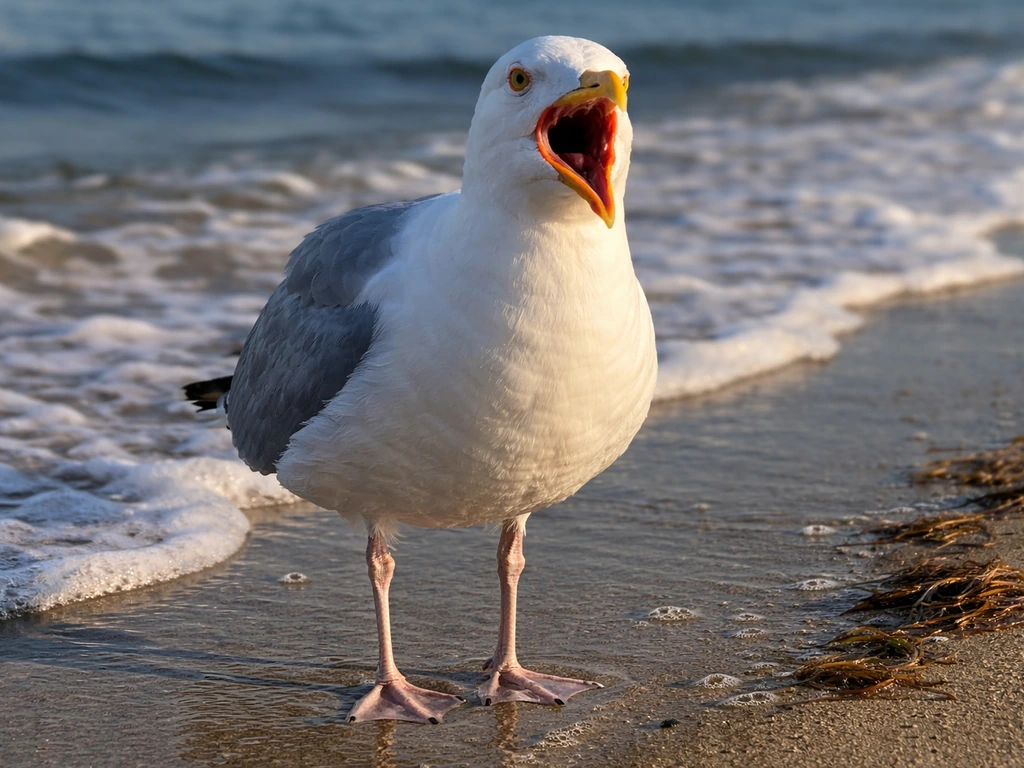
The seagull's call gets its own symbolic layer. That sharp, carrying cry is often described in spiritual contexts as an alarm from the edge, meaning the threshold between sea and land, or between the known and the unknown. Loud or repeated calling is sometimes read as urgency in the message, an intensification of whatever the appearance already signals. If a seagull is circling and calling near you rather than sitting silently on a post, some interpretations treat that as a stronger prompt for attention.
It's also worth mentioning that timing is part of the interpretation in many spiritual traditions. Encounters at dawn, during a period of personal uncertainty, or just before a significant decision tend to carry more weight in this framework than a seagull wandering around a chip shop at noon. One commonly repeated framing is that seagull sightings signal weather or energy shifts, something changing just beneath the surface of your current situation.
Symbolic traits people associate with seagulls
Beyond omens, seagulls carry a cluster of personality-level traits in symbolic language. The four most consistent ones across cultural and spiritual sources are freedom, adaptability, opportunism, and resilience. Freedom comes from the obvious: seagulls move between sea and sky without restriction, and that effortless mobility makes them an intuitive symbol of living without limitation. In literature, this gets pushed furthest in Richard Bach's 'Jonathan Livingston Seagull,' where flight is treated as a metaphor for spiritual growth and the pursuit of personal excellence beyond social expectation. In that context, a peer-reviewed study of Bach's novella describes it as a 1970 Richard Bach story using the seagull's passion for flight to explore self-discovery and personal transformation themes Jonathan Livingston Seagull.
Adaptability is the trait most grounded in actual bird behavior. Seagulls thrive in coastal environments, urban settings, landfills, harbors, and farmland. They don't lock themselves into a single food source or habitat, and that ecological flexibility becomes symbolic of a person or mindset that can function across very different circumstances. If you're going through a transition, a seagull in spiritual symbolism is sometimes read as encouragement to stay flexible rather than rigid.
Opportunism is the double-edged trait. In spiritual and positive framings, it becomes resilience: the ability to find what you need in unlikely places. In everyday language and cultural shorthand, it tips into something less flattering. The 'seagull that steals your chips' is a genuine archetype in British coastal culture, and it's informed the way the word gets used colloquially for people who swoop in and take what others have.
Cultural folklore and regional takes

The strongest regional association seagulls carry is with Celtic and northern European maritime cultures. In Irish and Scottish coastal traditions, seagulls are sometimes connected to Manannán mac Lir, the god of the sea and the otherworld. Under this lens, an encounter with a gull near the shore isn't random; it's framed as the sea god's messenger passing through. Some online sources also mention Norse associations, linking seabirds loosely to Freyja, with calls interpreted as warnings or omens, though this connection is repeated more often on spirituality blogs than in primary Norse texts.
In British culture, the European herring gull, the big white-and-grey bird most people picture when they think 'seagull,' is practically a symbol of the seaside itself. Its loud 'laughing' call is baked into the cultural identity of coastal towns in England and Wales. It shows up in postcards, poetry, and background noise in countless beach films. The mood it evokes is bittersweet: the holiday feeling tinged with chaos. That dual quality, beautiful and annoying, free and intrusive, is probably why the seagull ended up as such a rich symbolic animal.
In Celtic spiritual traditions more broadly, seabirds including gulls are sometimes grouped as messengers between this world and the otherworld, crossing boundaries that humans cannot. This connects to how readers exploring gooney bird meaning will find similar threshold symbolism attached to albatrosses, another seabird with deep maritime folklore roots. The pattern across cultures is consistent: birds that live between sea and sky occupy a symbolic space between worlds.
One honest note on Celtic folklore specifically: the seagull does not have a single consistent, canonical role across all Celtic traditions. Some scholarly sources point out that gulls are not prominently featured in certain branches of Celtic legend at all. The popular spiritual internet has a tendency to fill in those gaps, so treat detailed Celtic seagull claims with a degree of healthy skepticism unless they come with a traceable source.
Literal vs figurative: how to tell what you're actually dealing with
This is where a lot of confusion happens, and it's worth being direct about it. When a seagull lands near you on the beach, the most likely explanation is that it has learned to associate humans with food. Research on urban gull behavior shows that gulls adapt their foraging schedules to human activity patterns, clustering around beaches, fish-and-chip stands, and picnic areas at peak times. That seagull staring at you intently probably isn't delivering a spiritual message; it's calculating whether you're going to drop something edible. The 'literal vs. symbolic' question is really a context question.
Compare that to how the word 'seagull' operates in language. When someone calls a colleague blank" rel="noopener noreferrer">a 'seagull manager,' they mean someone who flies in, makes a lot of noise, dumps their opinions all over everything, and then flies away, leaving the mess for others. That's a figurative use with a specific modern meaning, completely separate from any spiritual omen reading. Similarly, when someone uses 'gay bird' meaning in an older British idiom, they're drawing on a different figurative tradition entirely, which shows how bird-based expressions often carry meaning that has nothing to do with the actual animal.
Psychology offers a useful frame here too. Confirmation bias plays a significant role in omen interpretation: if you're already in a heightened emotional state, you're more likely to notice a seagull and assign it meaning. That doesn't automatically make the experience meaningless, but it does mean that the 'message' you receive often reflects what you were already thinking. The seagull becomes a mirror rather than a sender.
| Type of encounter | Most likely explanation | What to do with it |
|---|
| Seagull near food/beach | Foraging behavior, learned food association | Enjoy the moment; it's not a sign |
| Seagull appears during a personal moment or decision | Could be meaningful symbolically; also could be coincidence | Note context and reflect; don't force a conclusion |
| Someone calls another person a 'seagull' | Figurative: opportunistic, noisy, disruptive behavior | It's an idiom; no bird symbolism involved |
| Seagull over water or during travel | Traditional maritime good-luck omen in folklore | Take it as encouragement if it resonates |
| Seagull calling loudly near you | Territorial defense or nest protection (nesting season) | Check if there's a nest nearby; it's likely behavioral |
Common sayings and idioms involving seagulls

The phrase 'seagull manager' has become firmly established in workplace language, especially in British English. It describes a management style where someone swoops in unexpectedly, creates noise and disruption, and leaves without solving anything, analogous to how seagulls behave around food at the beach. It's a neat piece of figurative language because it captures an entire behavior pattern in one image most people instantly recognize.
'Like a seagull' in casual conversation usually means chaotic, loud, opportunistic, or thieving, depending on context. 'He went through the leftovers like a seagull' paints a very specific picture. The bird's food-stealing reputation, well earned based on actual gull behavior at UK beaches, has made this a shorthand for someone who takes without hesitation or remorse. This is worth contrasting with how other coastal birds carry their own figurative weight: exploring geese bird meaning, for instance, reveals that geese in idioms tend to represent very different qualities, like loyalty, communal honesty, and aggression in defense rather than opportunism.
In British and Irish everyday speech, 'seagull' on its own can be used as a mild insult for someone noisy and presumptuous. It doesn't carry the same weight as harsher terms, but the implication is clear: you're behaving like the bird that yells and steals rather than the one that soars majestically. There's also a softer tradition of using seagulls poetically to evoke freedom and the coast, appearing in song lyrics, travel writing, and memorial contexts (where the image of a seagull can signal peace or watching over).
How to interpret your specific seagull moment
If you had a seagull encounter that felt significant, the most useful thing you can do is slow down and gather context before jumping to an interpretation. Where were you? What were you doing or thinking about at the time? Was the bird behaving in a way that felt unusual, or was it doing what seagulls typically do in that location? These questions matter because the same bird in different circumstances points in entirely different directions.
Spiritual sign interpretation practices consistently recommend one practical step above all others: write it down. Not because journaling makes omens real, but because documenting the circumstances (time of day, your emotional state, what was on your mind, whether the bird's behavior was unusual) gives you something concrete to reflect on rather than a vague feeling. It also creates distance from the raw emotion of the moment, which tends to produce clearer thinking. This applies whether you're curious about seagull symbolism or about any other kind of seal bird meaning and wildlife-based sign encounter: the details you remember are the data.
If you're trying to figure out whether you've heard a figurative use of 'seagull' in conversation, the context is almost always a giveaway. Figurative uses cluster around noise, opportunism, and chaos. Spiritual uses cluster around water, transitions, and personal reflection. If someone at your office said it, it's probably the idiom. If you're standing on a pier processing something difficult and a gull lands quietly beside you, you're in different territory.
One thing worth resisting is the urge to treat a seagull sighting as a definitive prediction about the future. The more grounded spiritual interpretation frameworks treat omens as prompts for reflection, not prophecy. A seagull doesn't tell you what's going to happen; at most, it gives you a moment to check in with yourself about what's already in motion. That's a healthier frame whether you fully believe in signs or are just curious about the symbolism.
For practical next steps: if the encounter felt spiritually significant, sit with the themes of freedom, transition, and adaptability and ask which of those is most relevant to where you are right now. If the seagull was doing something specific, like calling loudly, landing on something unusual, or appearing somewhere far from its normal habitat, those behavioral details feed into the interpretation. And if you're just trying to decode an idiom or phrase you heard, the meaning almost certainly points back to that noisy, chip-stealing bird doing what seagulls do best.
If you find yourself interested in the broader family of coastal and water birds and what they represent symbolically, it's worth exploring how similar birds carry adjacent but distinct meanings. The goose bird meaning, for example, covers a whole different range of traits from loyalty to vigilance, and comparing the two shows how much symbolic territory separates birds that share the same habitat. Seabirds as a category punch above their weight in folklore precisely because they live at the edge of what humans can reach, which is why they've collected so many meanings over so many centuries.
If you want to go deeper into the spectrum of bird symbolism generally, including birds that occupy more specific cultural niches, articles covering game bird meaning or gosling bird meaning show how different types of birds collect very specific symbolic identities based on their behavior, habitat, and cultural role. The seagull sits in an interesting position within that world: familiar enough to be an everyday insult, evocative enough to carry genuine spiritual weight, and wild enough that its actual behavior keeps undermining our attempts to pin it down.