
There is no bird officially named the 'seal bird' in modern taxonomy, but the term is genuinely attested in historical field guides, regional vernacular lists, and Arctic expedition reports. Depending on who is using it and when, 'seal bird' most likely means one of four things: a historical common name for the slender-billed (short-tailed) shearwater, a regional nickname for the Ivory Gull in parts of Newfoundland and Labrador, a simple typo or near-miss for 'seabird' or 'seagull,' or a symbolic/folkloric motif combining seal and bird imagery from Northern European or Inuit traditions.
Seal Bird Meaning: Literal ID, Symbolism & Uses

Marcus Blackwell
12 Jul 2026
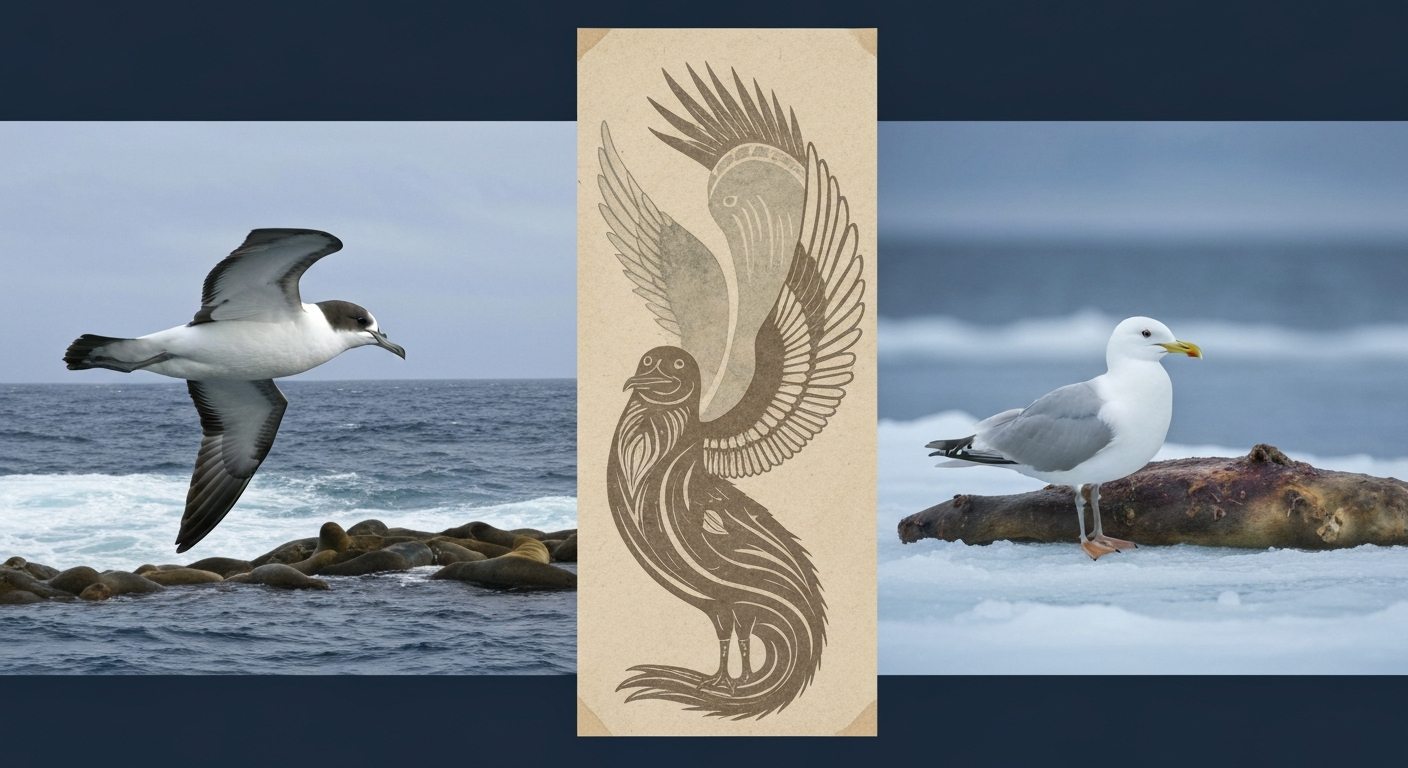
Quick disambiguation: what are you actually looking for?
Before going any deeper, it helps to figure out which of these four distinct roads you are on. Each one leads somewhere different, so a quick scan of the options below should get you oriented fast.
- Historical species name: In 19th- and early 20th-century natural history works, 'seal bird' (or 'Seal-Bird') appears as a vernacular name for the slender-billed shearwater (Ardenna tenuirostris), particularly in Australian field guides and U.S. Arctic expedition reports. If you found the term in an old text, this is almost certainly what it means.
- Regional vernacular for the Ivory Gull: In parts of Newfoundland and Labrador, the Ivory Gull (Pagophila eburnea) was locally called a 'seal bird' because of its habit of scavenging at seal carcasses and seal kills. This usage is documented in Canadian government COSEWIC species assessments.
- Typo or near-miss query: Online search data and Reddit threads show that many people type 'seal bird' when they mean 'seabird' (any bird that habitually feeds at sea) or 'seagull' (the colloquial name for gulls, family Laridae). If you landed here after a quick search, this may be your situation.
- Symbolic or folkloric motif: If you encountered 'seal bird' in a poem, artwork, tattoo concept, or dream journal, you are likely dealing with the mythic overlap of seal and bird imagery, drawing on selkie lore from Scottish, Irish, and Norse traditions, or on Inuit transformational art where seal-bird hybrid figures appear.
Literal definitions and likely readings
The historical species name: shearwaters and Arctic gulls
The most concrete, dictionary-supported meaning of 'seal bird' is a historical common name for the slender-billed shearwater, now standardized as the Short-tailed Shearwater (Ardenna tenuirostris). John Albert Leach's 'An Australian Bird Book,' available via Project Gutenberg, lists 'Seal-Bird' as one of the vernacular names for this species. Separately, U.S. expedition reports from Kotzebue Sound in Alaska in the late 19th century recorded an indigenous name for Puffinus tenuirostris that translates roughly as 'Seal Bird,' noting that local observers connected the species with the presence of seals. Modern taxonomic authorities such as Avibase do not list 'seal bird' as a current standardized name, but the historical lexicographic record, including Wiktionary's entry for 'seal-bird,' preserves the usage clearly.
The Ivory Gull reading is more regionally specific but equally well-documented. COSEWIC's Canadian species assessment for Pagophila eburnea notes that 'seal bird' was used locally in Newfoundland and Labrador, and the ecological logic is straightforward: Ivory Gulls are high-Arctic scavengers that follow polar bears and concentrate at seal kill sites. See the Ivory Gull (Pagophila eburnea), COSEWIC assessment (Canada government species account) for documentation that 'seal bird' was used locally in Newfoundland and Labrador Ivory Gull (Pagophila eburnea) — COSEWIC assessment (Canada government species account). A bird that shows up reliably wherever seals are being killed is going to earn a name that reflects exactly that behavior.
The typo and near-miss: seabird vs. seagull vs. seal bird
The vast majority of people searching 'seal bird' online are almost certainly looking for information about seabirds or seagulls. Merriam-Webster defines 'seabird' simply as a bird that habitually frequents the open ocean, covering everything from petrels and albatrosses to gannets and auks. 'Seagull' is the popular name for members of family Laridae and is covered in depth in our seagull bird meaning entry. The phonetic similarity between 'seal' and 'sea' makes this a very natural keyboard slip, and Reddit threads confirm it: users regularly post photos asking what a 'seal bird' is when they mean a swift, a tern, or a gull they spotted near water. A Reddit pareidolia thread shows users calling a swift a 'seal bird' when reacting to a photo blank" rel="noopener noreferrer">Reddit: pareidolia thread — users calling a swift a “seal bird”.
The symbolic reading: when 'seal' functions as a motif, not a mammal
A third literal reading treats 'seal' not as the marine mammal but as a symbolic element, a stamp of meaning, a closing or marking. In this frame, 'seal bird' becomes a metaphorical compound: a bird that carries a sealed or hidden message, or that marks a liminal crossing. This reading is less common in everyday speech but appears in certain poetic, tarot-adjacent, and dream-interpretation communities. It is worth acknowledging, though it is the rarest of the four interpretations.
How to tell seabirds, gulls, and shorebirds apart in the field
If you are trying to identify what you actually saw, rather than decode a word, here is a practical breakdown of the visual differences between the main groups that get lumped under 'seal bird' queries. The groups overlap in coastal habitats, which is exactly why people confuse them.
| Bird group | Body shape | Wing shape | Key field marks | Typical habitat |
|---|---|---|---|---|
| Shearwaters (e.g., Short-tailed) | Slender, torpedo-like | Long, narrow, stiff | Low gliding flight over open water, alternating flap-glide | Pelagic (open ocean) |
| Ivory Gull | Medium, stocky | Broad, rounded tips | Entirely white plumage, dark eyes, yellowish-tipped bill | High Arctic, sea ice edges |
| Herring/Kelp Gull | Large, robust | Broad with black wingtips | White body, grey mantle, pink legs, yellow bill with red spot | Coastal, harbors, beaches |
| Terns | Slim, fork-tailed | Pointed, swept back | Forked tail, black cap, hovering then plunge-diving | Coastal and offshore |
| Albatross (Gooney Bird) | Very large, broad-shouldered | Extremely long and narrow | Effortless soaring, hooked bill, massive wingspan up to 3.5 m | Pelagic (open ocean) |
| Auks/Puffins | Compact, upright stance | Short, whirring | Black-and-white pattern, rapid wingbeats, often on rocky cliffs | Coastal cliffs, cold seas |
When trying to narrow down what you saw near seals or seal colonies, watch specifically for feeding behavior. Ivory Gulls and kelp gulls will land on or near seal carcasses and pups. Shearwaters tend to follow fish schools stirred up by marine mammals rather than scavenging directly on seal tissue. Peer-reviewed studies have documented kelp gulls (Larus dominicanus) and dolphin gulls causing perineal wounds on South American fur seal pups by pecking at them directly, so the ecological association between certain gulls and seals is not just symbolic; it is well-documented predatory and scavenging behavior. See the peer‑reviewed study 'Kelp and dolphin gulls cause perineal wounds in South American fur seal pups, Peer‑reviewed article (PMC)' for detailed documentation Kelp and dolphin gulls cause perineal wounds in South American fur seal pups — Peer‑reviewed article (PMC).
What seal birds represent: cultural, spiritual, and symbolic meanings
Spiritual and cross-cultural symbolism
Seabirds as a broad category carry remarkably consistent symbolism across cultures: freedom, navigation through uncertainty, the soul journeying between the living world and the beyond, and endurance in hostile conditions. If you meant 'gosling' (a young goose) rather than seabirds, see gosling bird meaning for the distinct symbolic associations of goslings in folklore and dream work. If you are specifically interested in the symbolism of geese rather than seabirds in general, see geese bird meaning for a focused discussion of their cultural and spiritual associations. The shearwater, the specific bird most historically called a 'seal bird,' reinforces these themes. In Māori tradition, the tītī (muttonbird, closely related to the short-tailed shearwater) is a deeply significant species tied to seasonal migration, communal harvest, and ancestral connection to the land. The bird's extraordinary transoceanic migration, covering roughly 30,000 km in a figure-eight loop from Tasmania to the North Pacific and back, makes it a natural symbol of perseverance and cyclical return.
The Ivory Gull, the other main 'seal bird' candidate, carries different symbolic weight. Its pure white plumage in one of the harshest environments on Earth has given it associations with purity and survival against the odds. In the context of Arctic Indigenous peoples, the gull's presence at seal kills connects it to themes of abundance, opportunism, and the predator-scavenger balance that governs Arctic life.
Dream interpretations
In dream symbolism, a seabird appearing near a seal, or a bird described as a 'seal bird' in a dream journal, is often interpreted as a message about emotional boundaries and freedom. The sea represents the unconscious; a bird navigating it suggests the dreamer's capacity to move through emotional depths without being submerged. The seal element adds a layer of secrecy or hiddenness, a message not yet opened, or an intuition not yet articulated. Dream dictionaries in the Jungian tradition tend to emphasize the liminal quality of seabirds: they belong to neither the sea nor the land fully, which maps onto psychological states of transition.
Tattoo symbolism
In tattoo culture, shearwaters and seabirds broadly signal a maritime identity, long voyages, and return. Traditional sailor tattoo conventions, dating from at least the 18th century, used seabirds (especially swallows and albatrosses) to mark nautical miles sailed or to invoke good luck at sea. A seal-and-bird paired tattoo in contemporary usage often draws on the selkie tradition, representing dual natures, the pull between wild and domestic life, or a connection to Northern European heritage. The Ivory Gull's pure white form translates well into black-and-grey tattoo work and is increasingly chosen to represent Arctic or Scandinavian ancestry.
Psychological and literary symbolism
Psychologically, seabirds in literature tend to function as alter egos for isolated, wind-buffeted characters: figures who are observers of human drama from the margins, free but also exposed. Jonathan Livingston Seagull is the most commercially famous example, but the trope runs much deeper. In Arctic and North Atlantic literature, the seabird's appearance at the edge of the known world marks the boundary of the human and the beyond. When a bird is specifically linked to seals in a literary text, the pairing almost always signals transformation or threshold-crossing, which connects directly to selkie mythology.
Folklore, myth, and literary examples
The richest vein of mythology linking seals and birds together comes from the selkie tradition of Scotland, Ireland, the Faroe Islands, and Iceland. Selkies, creatures that are seals in the ocean and humans on land when they shed their skins, are among the most documented shape-shifting figures in Northern European folklore. Academic work such as university theses on 'selkie studies' trace these figures as liminal, gender-fluid symbols of longing, freedom, and the cost of domestication. Birds appear in selkie narratives as messengers or doubles: where the selkie crosses between sea and land, birds cross between sea and sky. In some regional variants, particularly from Orkney and Shetland, birds are described as the souls of drowned sailors taking animal form, a role also assigned to seals in other tellings. The two animals become interchangeable carriers of the same spiritual freight.
In Inuit artistic and oral traditions, the boundary between seal and bird is similarly permeable. Museum and foundation archives documenting Inuit art record carvings and prints in which seal-bird hybrid figures appear, representing transformational beings or shamanic helpers that move between environments. The short-tailed shearwater's appearance in Kotzebue Sound expeditions in the 1870s and 1880s, where it was recorded under the Inupiaq-translated name 'Seal Bird,' is consistent with a broader Indigenous tradition of naming animals by their ecological relationships rather than their morphology.
In 19th- and early 20th-century Australian natural history literature, the 'Seal-Bird' name for the shearwater reflects the same ecological-naming logic: the bird was associated with seal rocks and seal colonies along southern Australian and Tasmanian coasts, and early colonists adopted or adapted existing vernacular names into the field-guide record. Leach's 'An Australian Bird Book' (available on Project Gutenberg) is the most frequently cited printed source for this usage.
Idioms, slang, and figurative uses
'Seal bird' itself does not appear as a fixed idiom in modern English, but it exists in the same neighborhood as a cluster of bird-related slang terms worth knowing if you are researching bird language and figurative uses. See the entry on goose bird meaning for related idiomatic and symbolic uses of birds in English, including vernacular names and their cultural histories. The gooney bird, a slang name for the albatross (especially the Laysan Albatross around Midway Atoll), shares the same vernacular-naming tradition as 'seal bird': a colorful, locally specific nickname that captures something about the animal's perceived personality or behavior rather than its taxonomy. Our gooney bird meaning entry goes into this in more detail. Similarly, the term 'gay bird' has its own figurative history worth tracing separately in that dedicated entry. See the dedicated entry on gay bird meaning for that figurative history and its usage.
In broader bird idiom territory, 'seabird' functions almost exclusively as a literal term in modern English and has not developed significant figurative senses the way that 'albatross around the neck' or 'a little bird told me' have. The phrase 'seal bird' occasionally appears in online posts as a playful compound, usually meaning a seabird that someone spotted near seals on a wildlife tour or a coastal walk. Trip listings combining 'seal, bird, and penguin islands' watching tours confirm that the phrase is common in experiential travel language, though purely as a descriptive label rather than a fixed expression.
It is also worth noting the difference between 'seabird' and 'game bird,' two terms that represent almost opposite ends of the ornithological spectrum in terms of human relationship with birds. Game birds, covered in our game bird meaning entry, are defined partly by their role as quarry; seabirds are almost universally protected species in modern conservation frameworks. The symbolic registers are correspondingly different: game birds carry associations with hunting tradition, masculine ritual, and rural heritage, while seabirds sit in the register of wildness, freedom, and ecological fragility.
Comparing nearby and related birds
| Bird / Term | Most common name used | Primary symbolic meaning | Ecological niche | Main confusion with 'seal bird' |
|---|---|---|---|---|
| Seagull | Seagull / Gull (Laridae) | Freedom, opportunism, coastal life | Coastal, harbors, open sea | Phonetic near-miss; most common search intent behind 'seal bird' |
| Gooney Bird / Albatross | Albatross (Diomedeidae) | Burden, fate, long voyages, bad luck if killed | Pelagic (open ocean) | Also a colorful vernacular name; shares seabird identity |
| Ivory Gull | Ivory Gull (Pagophila eburnea) | Purity, survival, Arctic endurance | High Arctic, sea ice | Directly attested as 'seal bird' in Newfoundland vernacular |
| Short-tailed Shearwater | Short-tailed Shearwater / Muttonbird | Migration, ancestral return, endurance | Pelagic, Southern Ocean to North Pacific | Directly attested as 'Seal-Bird' in historical Australian sources |
| Goose / Geese | Goose (Anatidae) | Community, loyalty, seasonal change | Wetlands, coasts, grasslands | Sometimes confused in coastal settings; see geese bird meaning and goose bird meaning |
| Gosling | Gosling (young goose) | New beginnings, vulnerability, growth | Wetlands, ponds | Rarely confused, but shares coastal/water habitat framing; see gosling bird meaning |
| Game Bird | Game Bird (Galliformes broadly) | Tradition, hunting, rural ritual | Woodland, moorland, farmland | Opposite symbolic register; unlikely confusion but worth noting |
Practical guidance by audience
For writers
If you are writing a story, poem, or essay and want to use 'seal bird' as a term, decide first which layer you are working in. If you want historical verisimilitude in a 19th-century Australian or Arctic setting, 'Seal-Bird' as a name for the shearwater is fully attested and adds period-accurate texture. If you are writing contemporary fiction set in Newfoundland or Labrador, calling the Ivory Gull a 'seal bird' is regionally grounded. If you are working in a mythic or folkloric register and want to evoke Northern European or Inuit transformational imagery, the seal-bird pairing carries genuine cultural weight that your readers familiar with selkie lore will recognize. Whichever you choose, be specific in your notes or glossary: the term is rare enough that most modern readers will need a cue.
For researchers and students
If you are compiling vernacular name lists, note that 'seal bird' / 'seal-bird' falls into the category of historical common names that are lexicographically attested but not currently used in standardized nomenclature. Avibase and the IOC World Bird List are your primary authorities for modern common names. For historical uses, Project Gutenberg holds Leach's 'An Australian Bird Book' in full text. For the Newfoundland Ivory Gull usage, the COSEWIC species assessment for Pagophila eburnea is the recommended citable source. For the Kotzebue Sound/Alaska usage, the 1877-1881 U.S. natural history collections report from Alaska is the primary historical document.
For tattoo seekers
If you want a tattoo that captures the 'seal bird' concept, your best options are a shearwater in flight (emphasizing migration, endurance, and the Southern Ocean or North Pacific), an Ivory Gull (emphasizing Arctic purity and the seal-scavenging association), or a seal-and-bird paired design drawing on selkie imagery (emphasizing transformation, dual nature, and Northern European heritage). Talk to your tattooist about which tradition resonates and whether you want the design to read as naturalistic field-guide art, traditional nautical style, or something more stylized and mythic.
For dream interpreters
A dream featuring a bird near a seal, or a creature described as part-bird and part-seal, typically sits in the territory of liminality and transformation in Jungian-influenced dream work. The sea as unconscious, the bird as the aspect of self that can navigate or transcend it, and the seal as something hidden or protected (a message sealed away, an instinct not yet surfaced) combine into a fairly coherent symbolic picture. If the bird in your dream was white, the Ivory Gull symbolism of purity and survival under pressure is worth reflecting on. If the bird was dark and swift, flying low over open water in a skimming, shearing pattern, the shearwater's associations with long journeys and faithful return to origin points may be more relevant.
How to refine your search when 'seal bird' gives confusing results
Because 'seal bird' is not a current standardized species name, general search engines will return a mix of historical texts, tour listings, Reddit confusion threads, and symbolism articles. Here is how to get to what you actually want faster.
- If you want to identify a bird you saw near seals: search the specific region and habitat (e.g., 'white gull Arctic sea ice identification' or 'seabird following seal colony southern Australia') rather than 'seal bird.'
- If you want the historical species name: search 'slender-billed shearwater vernacular names' or 'short-tailed shearwater Australian common names' and cross-reference with Leach's field guide.
- If you want the Ivory Gull: search 'Ivory Gull Pagophila eburnea Newfoundland' or 'COSEWIC Ivory Gull assessment' for the full vernacular-name documentation.
- If you want seabird symbolism broadly: search 'seabird symbolism folklore' or specify the tradition ('shearwater Māori symbolism' or 'albatross literary symbol Coleridge').
- If you are researching selkie or seal-bird hybrid mythology: search 'selkie folklore Scotland Ireland' or 'Inuit transformational art seal bird' with museum or academic source filters.
- If you want to cross-check related bird terms: look at seagull bird meaning for gull-specific symbolism, gooney bird meaning for albatross slang history, and geese bird meaning or goose bird meaning for waterfowl-adjacent coastal birds.
Further reading and reliable sources
For field identification and modern taxonomy, Cornell Lab of Ornithology's All About Birds platform (allaboutbirds.org) and Avibase are the two most reliable free online resources. They use current standardized common names and include range maps, which quickly resolve whether a species could have been what you saw.
For historical vernacular names, J. A. Leach's 'An Australian Bird Book' (available free on Project Gutenberg) is the primary printed source for the 'Seal-Bird' name as applied to the slender-billed shearwater. The 'Report upon Natural History Collections Made in Alaska between the Years 1877 and 1881' (also accessible through archive.org) provides the Kotzebue Sound record of 'Seal Bird' as a translated Indigenous name.
For the Ivory Gull's Newfoundland vernacular, the COSEWIC Assessment and Status Report on Pagophila eburnea is freely available through the Canadian government's Species at Risk Public Registry. It cites Montevecchi and Tuck's 1987 seabird synthesis, which remains the standard reference for ecological relationships between Arctic seabirds and marine mammals.
For the ecology of gulls and seals, the peer-reviewed literature on kelp gull and dolphin gull interactions with South American fur seal pups (indexed on PubMed Central) provides the scientific backbone for understanding why some gulls acquire 'seal bird' associations in the first place. For selkie mythology, academic folklore journals and university theses indexed through JSTOR or institutional repositories offer rigorous treatments of the Scottish, Irish, and Norse traditions. For Inuit art with seal-bird motifs, the Inuit Art Foundation's archives and publications are the recommended starting point.
FAQ
What does the search term “seal bird” most likely mean?
“Seal bird” has several possible meanings: (1) a historical or regional vernacular name for certain shearwaters or scavenging gulls (rare in modern taxonomy); (2) a typo or confusion for “seabird” or “seagull”; (3) a descriptive phrase for a bird seen near seals (ecological association); or (4) a symbolic/figurative motif combining seal and bird imagery (folklore, art, tattoos, dreams). Modern authoritative checklists do not list “seal bird” as a standard species name, so the intent is usually one of the four senses above (supported by historical field guides, regional accounts, ecological studies and folklore sources).
Is “seal bird” a recognized species name in modern birding or taxonomy?
No — major contemporary taxonomic authorities and bird checklists do not list “seal bird” as a current standardized common name. The phrase survives mainly as a historical or local vernacular name (for some shearwaters and, regionally, for scavenging gulls) rather than a modern species-level name.
Which species have historically or regionally been called “seal bird”?
Historical records and regional accounts have used “seal‑bird” as a vernacular name for certain shearwaters (e.g., slender‑billed/short‑tailed shearwater, sometimes called muttonbird) and for gulls that scavenge at seal kills (in some Newfoundland/Labrador accounts, the Ivory Gull has been called a “seal bird”). These uses are attested in older natural‑history works and government species accounts.
Could “seal bird” just be a typo for “seabird” or “seagull”?
Yes. A common modern search intent is a misspelling or misphrasing: people searching “seal bird” often mean “seabird” (birds that habitually feed at sea) or “seagull” (colloquial for gulls, family Laridae). Social search examples and forum posts show users typing “seal bird” when they intended those standard terms.
What ecological relationship between seals and birds might lead to the phrase “seal bird”?
Seabirds—especially gulls and some terns—often scavenge at marine‑mammal carcasses or follow marine mammals to feed on scraps. In some regions gulls have been recorded pecking at fur‑seal pups or scavenging placenta/tissues, which led observers to use names referencing seals (e.g., “seal bird”) for birds frequently seen at seal colonies.
What symbolic meanings could a “seal bird” motif convey in art, literature or tattoos?
A hybrid or paired “seal + bird” motif can suggest liminality, transformation, freedom vs. home, sea/sky connection, migration or boundary crossing. Regional folklore (e.g., selkie stories) emphasizes shape‑shifting, longing, and dual identity; Arctic art sometimes pairs seal and bird imagery to express kinship with both land/sea and air/sea realms. Interpretations depend on cultural context and the viewer’s cultural lens.
Next Articles
Gooney Bird Meaning: Definition, Origin, and Usage Tips
Meaning of gooney bird, its origin, whether it refers to a seabird or nickname, and how to use it in context.
Game Bird Meaning: Definition, Examples, and Usage
Clear game bird meaning: definition, qualifying species, hunting examples, and how it differs from common bird idioms.
Seagull Bird Meaning: Omens, Traits, Idioms, and What to Do Next
Decode seagull bird meaning: omens, traits, idioms, and how to interpret clues without overthinking.