If you searched 'gaol bird meaning,' you're almost certainly looking for 'gallows bird,' a centuries-old English idiom that means a person who deserves to be hanged. The phrase "commodore bird" is often confused online with older bird-meaning idioms, so it's worth checking the original wording and context commodore bird meaning. It has nothing to do with an actual bird species. 'Gaol' is simply the old British spelling of 'jail,' and the phrase most people are trying to decode is 'gallows bird,' not 'gaol bird.' The confusion is completely understandable given how archaic the spelling looks, and once you know the connection, the meaning clicks immediately.
Gaol Bird Meaning: What People Mean and Where It Shows Up

Marcus Blackwell
4 Jun 2026
What 'gaol' actually means (and why it's tripping you up)
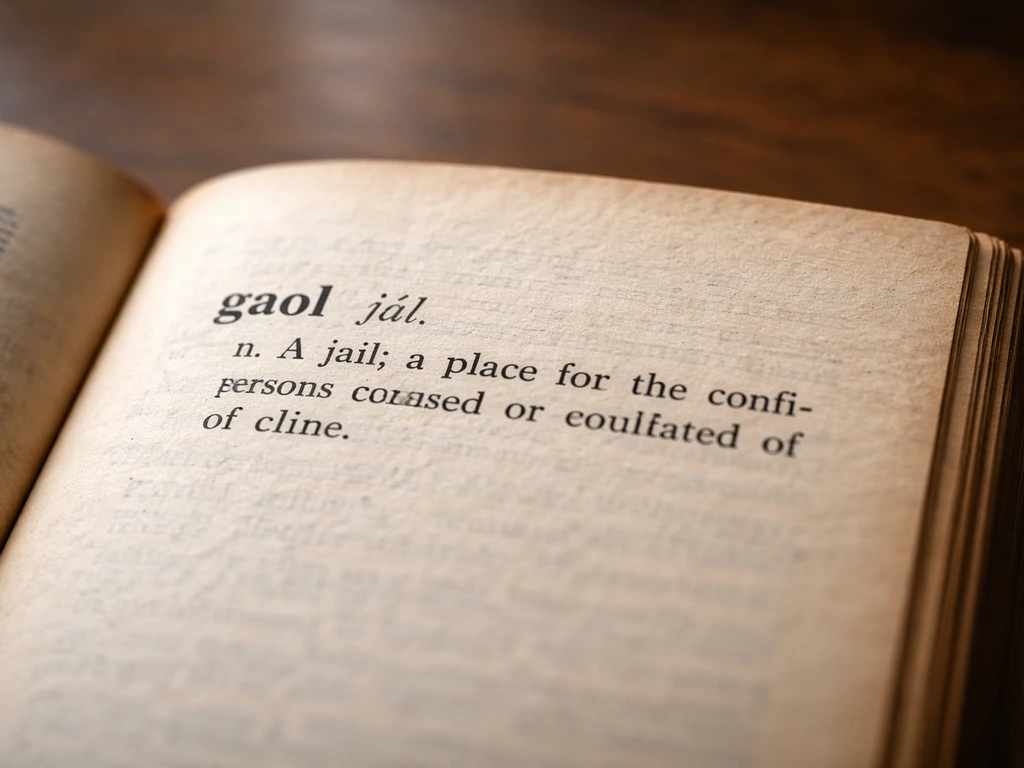
'Gaol' is the chiefly British spelling of 'jail,' meaning a prison or detention facility. Merriam-Webster and Cambridge both list it as a UK variant, and it shows up consistently in older British legal documents and historical texts. The word traces back to Norman French, while the more familiar 'jail' spelling came through a slightly different Old French route. Both words mean the same thing: a place of confinement.
In modern usage, 'gaol' is considered obsolete in everyday speech but still appears in older texts, historical fiction, and legal writing from the British Isles. So when you see 'gaol bird' written somewhere, it's not a separate cultural term with its own folklore. It's a spelling variant pointing you directly toward the gallows bird idiom, which lives at the intersection of crime, punishment, and folk judgment.
Worth noting: there is an English rock band called Gaol Bird, which sometimes surfaces in search results and adds to the confusion. Wikipedia has a separate entry titled “blank" rel="noopener noreferrer">Gaol Bird,” but that page is about an English rock band, which can cause search-result confusion for “gaol bird” queries. That's a band name, not a phrase with symbolic meaning. If you found it in a quote, a novel, or an old dictionary, you're looking at the gallows bird idiom spelled with the archaic 'gaol' in place of 'jail.'
The actual bird (or non-bird) people mean: gallows bird
'Gallows bird' is not a real bird species. It's an idiom, and a pointed one. Merriam-Webster defines it as 'a person who deserves hanging,' with first known use traced to around 1785. Collins English Dictionary puts the earliest recorded period at 1775 to 1785, and the American Slang Dictionary from roughly the same era described it as a blank" rel="noopener noreferrer">'young thief' likely to end up at the gallows. The 'bird' in the phrase follows a long tradition in English slang where 'bird' refers to a person, especially someone of a particular character or type. Think of phrases like 'odd bird,' 'rare bird,' or 'jail bird,' which carry that same sense.
The word 'jailbird' (also spelled 'gaolbird' in older British texts) is a close relative. A jailbird is someone who has been in prison or who belongs in prison. A gallows bird is a step further: someone whose crimes, in the speaker's view, warrant execution. Both expressions use 'bird' as a slang stand-in for 'person,' and both carry a tone of contempt or mock severity.
The symbolic weight of the gallows bird in folklore and idioms
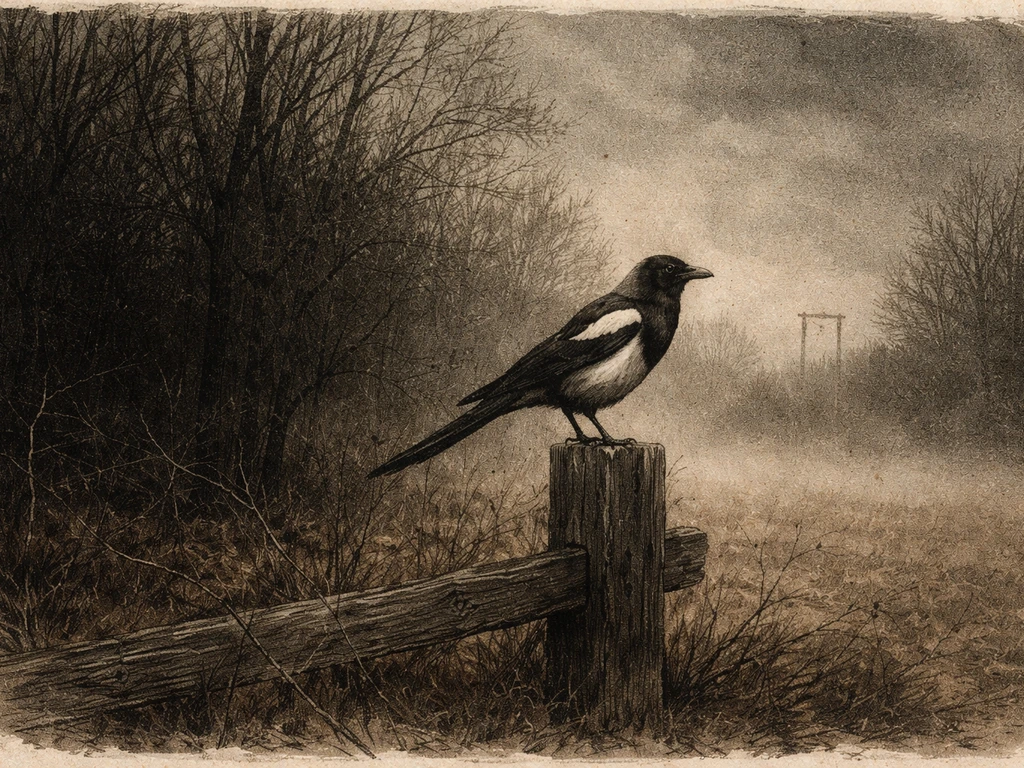
Even though gallows bird doesn't refer to a literal bird, it pulls from a rich tradition of birds as omens, especially birds associated with death, crime, and judgment. In British and broader European folklore, certain birds perched near gallows or execution sites were seen as bad omens, and the gallows itself was a powerful cultural symbol of moral reckoning. Ravens, crows, and magpies all carry folklore associations with ill fortune and death, which is part of why the image of a 'gallows bird' lands with such force: it summons that whole symbolic atmosphere without needing to name a species.
Magpies in particular have a long history as birds of ill omen in British culture. The nursery rhyme 'One for Sorrow' has roots in ornithomancy, the practice of reading omens from birds, and dates back to at least the early sixteenth century. While a magpie is never explicitly called a 'gallows bird,' the cultural logic is the same: a bird associated with bad fortune, crime, or death. The gallows bird idiom borrows that symbolic energy and applies it to a person rather than a species.
If you're exploring this site's wider subject matter, you'll notice a similar pattern in the gallows bird entry (a sibling topic here), which deals more directly with that specific phrase and its historical roots. Terms like gale bird and gaulin bird take the 'bird as symbol' concept in very different directions, showing how flexibly the word 'bird' has been used across slang, folklore, and regional speech. If you meant “gaulin bird meaning” specifically, it also falls under the broader “bird as symbol” idea, with the right definition depending on the source text and spelling variant. If you meant gale bird meaning specifically, that term has a different origin than gaol bird or gallows bird.
Where you'll actually encounter this phrase
Gallows bird (and its older spelling gaol-bird or gaolbird) shows up in a few reliable contexts:
- Historical fiction and adventure novels set in the 17th to 19th centuries, especially those dealing with pirates, outlaws, or colonial courts. Rafael Sabatini's 'Captain Blood' includes the line 'You don't leave Port Royal, my fine gallows bird,' using it as a sneering insult.
- 19th-century British periodicals and essays: Blackwood's Edinburgh Magazine used it in 1847 to describe a shady trading consul as 'somewhat of a gallows bird,' implying dishonesty and low moral character rather than a literal death sentence.
- Archival slang dictionaries, where it appears alongside other colorful expressions for criminals and social outcasts.
- Stage and theatrical writing, where 'gaol-bird' appears as character description or dialogue, often to establish someone as a rogue or villain.
- Modern usage is rare, but it occasionally appears in historical drama, period games, or as a deliberate archaism for stylistic effect.
The tone is almost always contemptuous or wryly insulting. Nobody calls someone a gallows bird as a compliment. It's a judgment, and often a theatrical one, the kind of thing a villain or a sneering authority figure might say to underscore someone's worthlessness in their eyes.
How to read it correctly when you find it in context
If you've come across 'gaol bird' or 'gallows bird' in a text and you're trying to interpret it, the key is to look at how it's being used: is it directed at a person, or does it seem to describe an actual animal? If it's directed at a person, it's almost certainly the idiom meaning a criminal or someone deserving punishment. If you meant a different phrase like gander bird meaning, you can confirm it by checking how the term is used in context. If the text is about an actual bird species and uses the phrase 'gaol bird,' it's possible the original term is something else entirely and there's a transcription or OCR error in play.
In practice, these questions help you pin it down quickly:
- Is the phrase describing a person or a character? If yes, it's the gallows bird idiom.
- Is the text historical British writing, legal records, or 18th to 19th century fiction? If yes, 'gaol' is just the period-correct spelling of 'jail.'
- Is there any mention of a bird species, feathers, habitat, or behavior? If not, it's not a literal bird.
- Does the surrounding sentence carry a tone of contempt, judgment, or mockery? That's a strong signal you're reading the idiom.
- Could the phrase be a different bird term entirely? Check whether the original source might say 'gale bird,' 'gallows bird,' or 'gander' before assuming it's a unique term.
Spelling variants and similar terms that cause confusion
This is where a lot of the search confusion originates. Here's a quick reference to sort out what's what:
| Term | What it actually is | Meaning |
|---|---|---|
| Gaol bird | Archaic British spelling of 'jailbird' | A criminal; someone who has been in or belongs in prison |
| Gallows bird | English idiom, first recorded circa 1775-1785 | A person who deserves to be hanged; a rogue or scoundrel |
| Jailbird | Modern standard spelling | A person who has served time in prison |
| Gaol | British spelling of 'jail' | A prison or place of detention (not a bird-related term) |
| Gale bird | Separate regional/folk bird term | A different bird expression with its own meaning and folklore |
| Gallows bird (band) | Not an idiom | An English rock band, sometimes a confusing search result |
| Gander | Literal: a male goose; figurative: a look or glance | Used in idioms like 'take a gander' |
The single most common source of confusion is seeing 'gaol' and not recognizing it as 'jail.' Once you make that substitution mentally, 'gaolbird' becomes 'jailbird,' and the meaning is obvious. The step from 'jailbird' to 'gallows bird' is a short one: both are insults, both use 'bird' as slang for a person, and both live in the same historical and cultural neighborhood.
If you're still unsure after checking the context, the fastest fix is to find the original source of the quote and look at the surrounding paragraph. The tone and the character being described will almost always confirm which meaning you're dealing with. And if the text is genuinely about birds and their symbolism rather than about people, you're likely looking at a transcription error or a regional bird name that needs separate investigation.
FAQ
If I see “gaol bird” in a quote, how can I tell whether it’s definitely the “gallows bird” insult?
Check whether the sentence targets a person (with verbs like “is,” “deserves,” “belongs,” or references to crime, punishment, or hanging). If the surrounding text discusses an animal, location, or bird behavior, treat it as a possible OCR or transcription error rather than the idiom.
Is “gaol bird” ever used to mean “jailbird” instead of “gallows bird”?
Sometimes, but it depends on tone. “Jailbird” is typically about someone who has been in prison, with less emphasis on deserved execution. If the wording or context suggests execution or capital punishment, it is more likely “gallows bird.”
What’s the difference in meaning between “jailbird” (or “gaolbird”) and “gallows bird”?
“Jailbird” usually labels a person tied to prison, often in a mocking way. “Gallows bird” adds a harsher judgment, implying the person’s crimes warrant hanging. The key decision point is whether punishment is implied as past confinement or as deserved execution.
Could “gaol bird” refer to a real bird species or bird name?
In most English-language contexts, no. The phrase is primarily an archaic-looking spelling pathway to “gallows bird.” If you’re reading a passage about ornithology, wildlife, or natural history, the most likely explanation is misread text (like OCR) or a different original phrase.
Why do “gaol bird,” “gaolbird,” and “jailbird” show up in search results like they are separate terms?
Spelling shifts over time and across regions. “Gaol” is an older British form of “jail,” and “bird” was often fused into one word in older writing. Search engines surface variations, but the underlying slang meaning tracks back to the same root idea.
Does “gallows bird” always mean someone deserves hanging, or can it be used more loosely?
It usually keeps the contemptuous, deserved-execution flavor, not a neutral description. However, modern retellings in novels or scripts can sometimes soften the threat into general condemnation, so the safest approach is to judge how the speaker character frames the judgment.
If I want to cite the phrase accurately, should I use “gaol bird,” “gaolbird,” or “gallows bird”?
Use the spelling that appears in your primary source. If you are quoting or analyzing an old British text, “gaolbird” or “gaol bird” may be historically faithful. For general explanations, “gallows bird” is the clearest standard form.
What are common transcription mistakes that make “gaol bird” look like something else?
OCR frequently confuses letters and word breaks, so “gaol bird” might actually be a different phrase with similar-looking characters, or “gallows bird” could be partially mangled. If you can, compare the text to a scanned image or another edition, especially when the passage mentions birds literally.
I’m searching for “gaol bird meaning” but only seeing band-related results. How do I avoid the wrong definition?
Treat “Gaol Bird” with capitalization as a proper noun (a band name) rather than an idiom. If the context includes music, discography, or entertainment, you’re not dealing with slang meaning.
Where does the “bird” slang usage come from, and does it change the meaning?
In English slang, “bird” can stand in for a person, often an odd or contemptible character. It does not signal an actual bird species, it intensifies the insult by using a recognizable slang pattern, so meaning is driven by the first word (“jail” versus “gallows”), not by the literal bird image.
Next Article
Munster Bird Meaning: Folklore, Symbolism, and How to Verify
Meaning of Munster bird searches: folklore, symbolism, idioms, spelling variants, and quick ways to verify the reference