
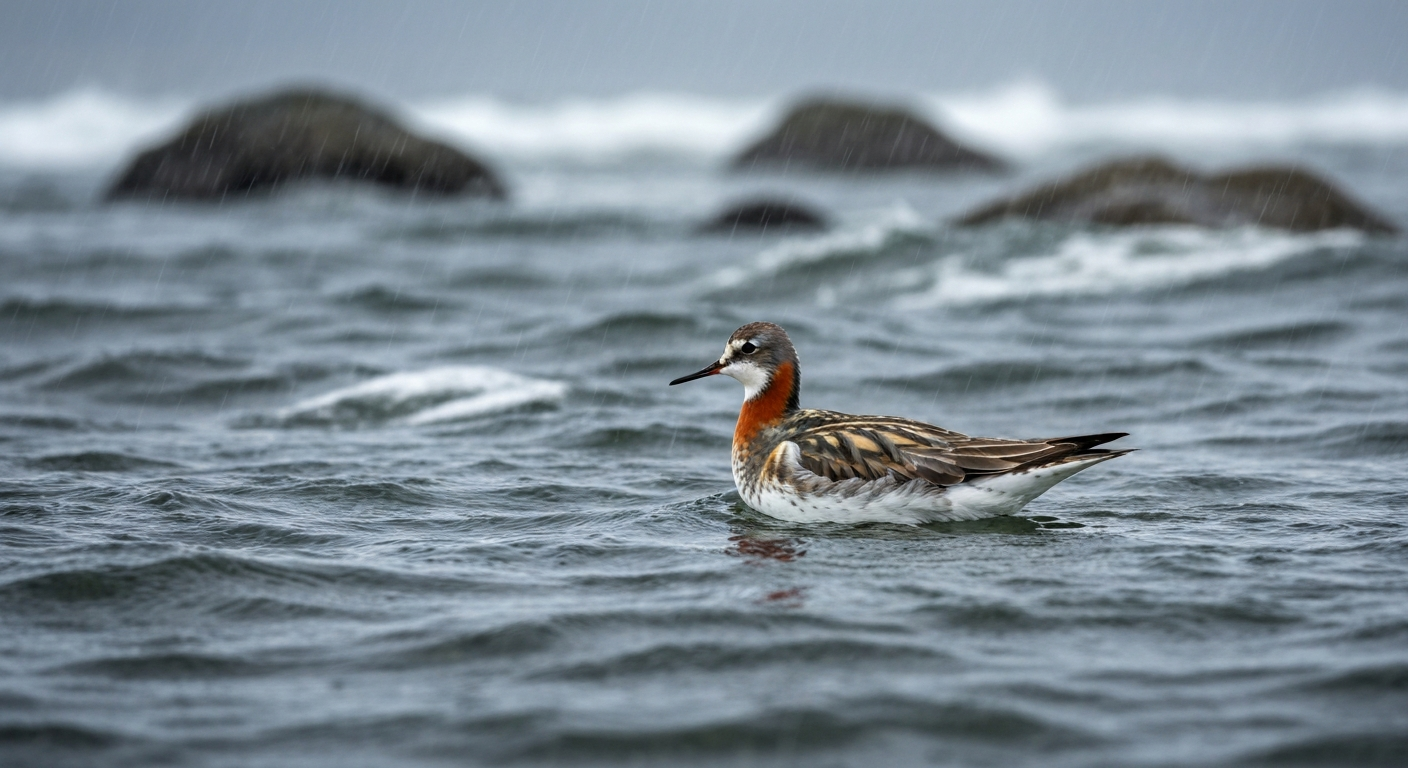
When most people search 'gale bird meaning,' they are either looking for a regional English dialect name for certain shorebirds (specifically phalaropes on the Newfoundland and Labrador coast), or they have encountered a spelling or typing variant of a closely related term like 'gallows bird,' 'gaol bird,' or 'gander.' In its most documented literal sense, 'gale bird' is a vernacular name recorded in Newfoundland English for the Red-necked Phalarope and related small shorebirds, birds that appear in rough coastal weather and inspired the atmospheric name. Outside of that ornithological context, 'gale bird' does not carry a fixed idiomatic or slang meaning, so if you found it in a non-ornithological passage, you are likely dealing with a creative proper name, a spelling variant, or a transcription error.
Gale Bird Meaning: Definition, Confusions, Etymology & Use

What 'gale bird' most commonly means
The clearest and best-documented meaning of 'gale bird' is a local English name for phalaropes, especially the Red-necked Phalarope (Phalaropus lobatus), on the Labrador and Newfoundland coast. Canadian natural-history accounts from the early twentieth century explicitly note that the northern phalarope 'bears the name gale bird on the Labrador coast,' and the Dictionary of Newfoundland English (Memorial University) records both 'gale bird' and the variant 'gill bird' as dialect names for these small shorebirds. Idaho Fish and Game's species catalog also lists 'Gale Bird' among the vernacular and local names for the Red-necked Phalarope, confirming its reach into North American regional usage more broadly. Idaho Fish and Game's species catalog entry for Phalaropus lobatus (Red‑necked Phalarope) lists 'Gale Bird' among its vernacular and local names Idaho Fish and Game's species catalog entry for Phalaropus lobatus (Red‑necked Phalarope) lists 'Gale Bird' among its vernacular and local names..
The name makes intuitive sense for anyone who has spent time on a windswept Atlantic coast: phalaropes are small, energetic birds that spin on the water surface and appear reliably in blustery weather. Calling them 'gale birds' is the kind of practical, descriptive naming that coastal communities excelled at. It tells you something about the bird and something about the people who named it.
Beyond ornithology, 'Gale Bird' also appears as a proper name in modern creative contexts. There is a Charleston, South Carolina band that uses it as their official name, and the phrase turns up in public radio program descriptions and media references as a title or character name. These uses are essentially independent of the dialect bird name and should be treated as coincidental proper nouns rather than evidence of a broader symbolic or idiomatic meaning.
Pronunciation and spelling variants to watch for
Pronounced exactly as it reads: GAYL BURD, with the stress on the first word. The spelling 'gale bird' is the most common written form, but 'gale-bird' (hyphenated) appears in older natural-history texts and dialect records. The variant 'gill bird' shows up in the same Newfoundland English sources and almost certainly refers to the same species, the phonetic shift between 'gale' and 'gill' likely reflecting regional accent variation rather than a distinct naming tradition.
The most consequential spelling confusion, though, is between 'gale bird' and 'gaol bird.' The word 'gaol' is the British spelling of 'jail' and is pronounced exactly the same way: JAYL. So a reader who sees 'gaol bird' in print and types what they heard will almost certainly arrive at 'gale bird' as their search. This phonetic overlap is probably responsible for a significant portion of searches on this phrase, and it is worth checking your original source carefully before assuming which term was intended.
| Written form | Pronunciation | Most likely meaning |
|---|---|---|
| gale bird | GAYL BURD | Regional name for phalarope (Labrador/Newfoundland) or proper name |
| gale-bird | GAYL BURD | Same as above; hyphenated form in older texts |
| gill bird | GIL BURD | Dialect variant; same shorebird referent |
| gaol bird | JAYL BURD | British spelling of 'jailbird'; prisoner |
| gallows bird | GAL-ohz BURD | Slang for a criminal deserving hanging |
| gander | GAN-der | Male goose; or the idiom 'take a gander' (to look) |
Immediate alternatives at a glance
If you are not looking for a shorebird name, here are the three terms most likely to be what you actually encountered. Each has a distinct meaning and a well-documented history in English slang and idiom.
- Gallows bird: an established English slang term for a person deserving to be hanged, or more broadly a notorious criminal. First known use is documented around 1785.
- Gaol bird / jailbird: an informal term for someone who has been in prison. 'Gaol bird' is the British and historical spelling; 'jailbird' is the modern standard form in most dictionaries.
- Gander: literally the male of the domestic goose, and figuratively the verb in the idiom 'take a gander,' meaning to take a quick look at something.
Gallows bird: what it means and how it differs
A 'gallows bird' is someone so thoroughly criminal that they deserve the gallows, meaning execution by hanging. Merriam-Webster places the first known use of the term around 1785, putting it firmly in the late eighteenth century when public hanging was still common in Britain and America. Merriam‑Webster records the first known use of 'gallows bird' at about 1785 (gallows bird, Merriam‑Webster.com (definition + word history)) blank" rel="noopener noreferrer">gallows bird — Merriam‑Webster.com (definition + word history). The term appears in Francis Grose's The Dictionary of the Vulgar Tongue (1811), which records it in the criminal cant register with senses that include a thief or pickpocket and someone who associates with that crowd. Grose's dictionary is a primary source for English criminal slang of the era, so finding 'gallows bird' there confirms it was genuinely in circulation among those who knew (or studied) the criminal underworld. See gallows bird meaning for a focused explanation of the term's history and usage.
The difference from 'gale bird' is fundamental: 'gallows bird' is a human insult, applied to a person, and it carries moral weight. 'Gale bird' names a real animal. The two phrases do not overlap in meaning or usage. If you found the term in a historical novel, a true crime account, or a period drama, 'gallows bird' is almost certainly the word in play.
Gaol bird and jailbird: the prisoner sense
The word 'gaol' is simply the older British spelling of 'jail,' and both words are pronounced identically: JAYL. So 'gaol bird' and 'jailbird' are the same expression in different orthographic dress. Cambridge Dictionary lists 'gaolbird' as the variant British spelling and notes that 'jailbird' is the common modern form. The meaning is straightforward: an informal, slightly dismissive label for a person who has spent time behind bars. For more on the usage and nuance of the prisoner sense, see further discussion of gaol bird meaning in British and American English.
This is the term most likely to be misread or misheard as 'gale bird.' Because 'gaol' is a sight-word trap for anyone unfamiliar with British spelling conventions, a reader who hears the phrase spoken aloud and later tries to search for it will naturally write 'gale bird.' If you found 'gale bird' in a context involving crime, imprisonment, or a character's criminal background, there is a very strong chance the original text said 'gaol bird.' The meaning, the history, and the entire cultural register are different from the shorebird name.
Gander: the bird and the idiom
A gander is simply the male of the domestic or wild goose (Anser anser domesticus and related species). In that literal ornithological sense it is a precise, unambiguous term: a male goose is a gander, a female is a goose, and a young goose is a gosling. The word is old Germanic in origin and has been in continuous English use for centuries.
The idiomatic use, 'take a gander,' meaning to have a look at something, is the more culturally loaded sense. It is informal, predominantly British and American, and carries a casual, unhurried quality: you take a gander when you glance at something out of curiosity rather than intense scrutiny. The connection between the verb sense and the bird is thought to derive from the way a goose stretches and cranes its neck to look around, which is a convincingly visual etymology. Unlike 'gallows bird' or 'gaol bird,' the gander idiom has no criminal or moral connotation whatsoever. It turns up most naturally in everyday speech and informal writing.
'Gander' is far enough from 'gale bird' in both sound and spelling that direct confusion between the two is less common than the gaol/gale mix-up, but it is worth knowing the gander entry is closely related in this family of bird-related terms and expressions. For more on the bird sense and idiomatic use, see gander bird meaning.
Commodore bird and gaulin: rare and uncertain forms
Searches for 'commodore bird' turn up no reliable results in major ornithological field guides, scientific checklists, or authoritative bird registries. The hits that do appear are forum pages, consumer Q&A threads, and miscellaneous non-specialist content, none of which constitute evidence that 'commodore bird' is an established common name for any species. Until a documented source from a recognized ornithological authority can be identified, this term should be treated as unverified. If you encountered it in a specific text, tracking down that original source is the right move before drawing any conclusions.
'Gaulin,' on the other hand, is real but highly localized. The Dutch Caribbean Species Register lists 'Gaulin' and 'Little Gaulin' as alternative English names for the Green Heron (Butorides virescens) on islands including Saba and St. Eustatius. It is a legitimate vernacular bird name within that specific Caribbean context, but it is obscure enough outside the region that most English speakers will never encounter it. It is not related to 'gale bird' in etymology or usage. If you found 'gaulin' in a Caribbean-focused text about local wildlife or folklore, it refers to the Green Heron. Anywhere else, it is likely a misspelling or a transcription of an unfamiliar dialect word.
| Term | Documented? | Type | Meaning if attested |
|---|---|---|---|
| commodore bird | No reliable sources found | Unverified | Treat as unknown until sourced |
| gaulin / little gaulin | Yes, Caribbean registries | Localized vernacular | Green Heron (Butorides virescens) in Dutch Caribbean islands |
Etymology and historical usage
Gale bird: attestation and regional roots
The ornithological use of 'gale bird' is attested in nineteenth and twentieth century Canadian natural-history literature and in the Dictionary of Newfoundland English, which is the primary scholarly resource for words and phrases specific to that region. Proceedings of the United States National Museum from the nineteenth century also record local names of this kind in their shorebird catalogues, reflecting a broader tradition of documenting vernacular bird names alongside scientific ones. The name itself is descriptive: phalaropes are small birds associated with open water and breezy coastal conditions, making 'gale bird' a geographically and behaviorally apt label.
Gallows bird: from cant to general slang
Merriam-Webster's first known use date of approximately 1785 puts 'gallows bird' in a period of rich criminal slang development in Britain, when cant vocabularies were being collected and published for the first time by scholars like Francis Grose. Grose's 1811 edition of The Dictionary of the Vulgar Tongue explicitly includes 'gallows bird' in the criminal register, defining it in terms of thieves and their associates. By the nineteenth century the term had moved slightly upward into more general informal usage, where it could be deployed as a colorful insult for anyone of disreputable character, not only a convict. That broadening of meaning is typical of criminal slang making its way into mainstream speech.
Gaol bird and jailbird: a parallel history
The word 'gaol' itself comes from Old Northern French 'gaiole' and ultimately Latin 'caveola,' a diminutive of 'cavea' meaning cage or enclosure. The compound 'gaolbird' follows naturally from this: a person caged like a bird. The same logic underlies 'jailbird,' which is simply the same compound with the Americanized spelling. Both forms have been in use for centuries and carry the same meaning. Cambridge Dictionary records 'gaolbird' as the recognized British variant, confirming it is not an error but a legitimate alternate spelling that has confused generations of readers unfamiliar with the gaol/jail equivalence.
Gander: an old Germanic word with a lively second life
The word 'gander' traces back to Old English 'ganra' and is cognate with similar words in Dutch and German for the male goose. It has been a straightforward zoological term in English since the Anglo-Saxon period. The idiomatic use, 'take a gander,' emerged in informal speech much later and is well-established by the twentieth century in both British and American English. The neck-craning visual metaphor has given this modest bird-word a second life in everyday idiom that has outlasted most people's familiarity with actual geese.
How to decide which term fits your context
The context of the sentence or passage almost always resolves the ambiguity. A few quick diagnostic questions will point you in the right direction.
- Is the subject a bird, a coastal region, or a natural-history description? Then 'gale bird' as a phalarope dialect name is the likely reading.
- Is the subject a person with a criminal past or a morally disreputable character? Check whether the original text might say 'gaol bird' or 'gallows bird.' Remember that 'gaol' is pronounced exactly like 'jail.'
- Is the passage about a person condemned to death or described as deeply criminal? 'Gallows bird' fits that register, particularly in historical British or American texts.
- Is someone casually looking at something or inspecting an object? 'Take a gander' is the idiom you want, and it has nothing to do with crime or shorebirds.
- Is the source a Caribbean natural-history text or local species list? Then 'gaulin' as a Green Heron name is plausible. Does it refer to a waterbird in an Atlantic Canada context? 'Gale bird' as phalarope is the better fit.
- Did you find 'commodore bird' and cannot verify it? Suspend judgment and trace the original source before drawing conclusions.
The bird-naming tradition in English is genuinely rich in regional variation and historical layering, which is exactly what makes these overlaps both interesting and occasionally maddening. A small shorebird on the Labrador coast, a condemned criminal in a Georgian London court, a prisoner in a Victorian gaol, and a goose stretching its neck in a farmyard all ended up sharing corner space in the English lexicon through the simple mechanism of the word 'bird' being attached to vivid descriptors. Each term has its own story, and none of them mean the same thing.
FAQ
What does “gale bird” mean when I encounter it in text or speech?
Most often “gale bird” is a regional/local English name for certain small shorebirds — notably phalaropes (e.g., the northern/Red‑necked phalarope) recorded on the Labrador/Newfoundland and North Atlantic coasts in 19th–20th‑century sources. It can also appear as a modern proper name (band, artist) or other creative use. It is not the same word as the slang criminal terms spelled “gallows‑bird” or “gaol/jailbird.” (Sources: Dictionary of Newfoundland English; Canadian natural‑history accounts; Idaho Fish & Game.)
How can I tell “gale bird” apart from similar/confusable phrases like “gallows bird” or “jailbird/gaolbird”?
Compare spelling, context, and meaning cues: - If the surrounding text refers to birds, shorelines, migration, or natural history, “gale bird” likely names a shorebird (phalarope). - If it refers to criminals, thieves, hanging, prisons, or cant language, the intended term is almost certainly “gallows‑bird” or “gaol/jailbird.” - Pronunciation alone may sound similar in rapid speech; written form and contextual semantic field are decisive. Historical and dictionary sources treat these as distinct lexemes. (Sources: Merriam‑Webster; Francis Grose; regional bird references.)
Is “gale bird” an established ornithological name?
Gale bird is a documented vernacular/local name — not a modern standardized English common name used across major field guides — for certain phalaropes in Atlantic Canada and adjacent regions. Authoritative regional sources and older natural‑history accounts list it among local names for Phalaropus species. Modern official checklists tend to prefer standardized names (e.g., Red‑necked/Northern Phalarope), while preserving dialectal names in regional glossaries. (Sources: Dictionary of Newfoundland English; historical museum/catalogue records; Idaho Fish & Game.)
What about “commodore bird” and “gaulin”? Could those be the same as “gale bird” or other variants?
- Commodore bird: Searches of authoritative bird lists and field guides produce no evidence that “commodore bird” is an established bird name; online hits are non‑ornithological or informal. Treat it as unverified/rare and verify with local/regional sources before assuming it names a bird. - Gaulin: This token appears in Caribbean bird name lists as an alternative/local name (e.g., for the Green Heron in Dutch Caribbean registries). It is an independent regional name and not a simple variant of “gale bird.” (Sources: Dutch Caribbean Species Register; web searches.)
What is the etymology and historical usage of “gale bird”?
Etymology: “Gale bird” is recorded in dialect and regional glossaries as a local name for small shorebirds encountered on stormy/coastal seas; the exact origin of the local name is poorly documented but appears in 19th–20th‑century Newfoundland/Labrador sources and in coastal natural‑history accounts. Historical usage: 19th‑century proceedings, regional bird notes, and 20th‑century Canadian natural‑history writings explicitly cite the name for phalaropes on the Labrador coast. The name survives in dialect dictionaries and some modern local lists. (Sources: Proceedings of the US National Museum; Dictionary of Newfoundland English; 20th‑century Canadian accounts.)
Can “gale bird” ever mean a criminal or someone deserving hanging?
No. That sense belongs to the unrelated phrase “gallows‑bird,” an established slang term from cant and historical slang dictionaries (first attested in late 18th century) meaning a criminal or one worthy of hanging. Don’t conflate spellings: gallows‑bird (criminal) ≠ gale bird (shorebird/regional name). (Sources: Merriam‑Webster; Grose’s Dictionary of the Vulgar Tongue.)},{

Learn gallows bird meaning, its origins in execution imagery, figurative uses, and examples plus near-confusable phrases

Unpack gaol bird meaning: likely spelling variants, which bird people mean, and its folklore or figurative symbolism.

Meaning of Munster bird searches: folklore, symbolism, idioms, spelling variants, and quick ways to verify the reference