
The scissor tail bird, most commonly the Scissor-tailed Flycatcher (Tyrannus forficatus), symbolizes freedom, grace under pressure, and the power of display. In folk symbolism it is most often read as a spirit of open skies and restless movement. As Oklahoma's official state bird since 1951, it also carries a regional identity that runs deep in the southern Great Plains. Whether you spotted one on a fence post, dreamed about those impossibly long tail feathers, or came across the name in a story or tattoo design, this guide covers what the bird actually is, what it means across different traditions, and how to use it confidently as a symbol.
Scissor-tail Bird Meaning: Scissortail Flycatcher Symbolism & ID

Marcus Blackwell
24 Jul 2026
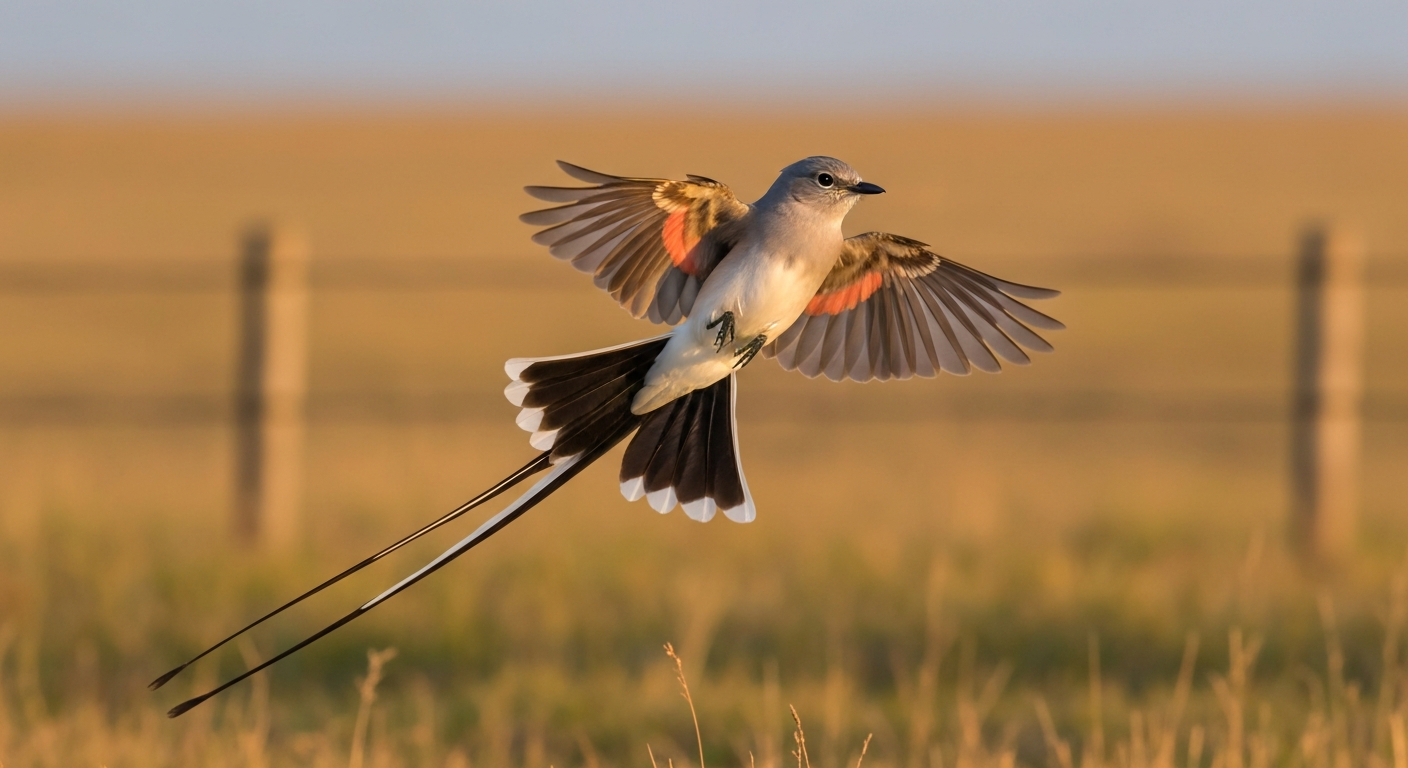
Quick answer: what does the scissor tail bird mean?
The Scissor-tailed Flycatcher is a living symbol of freedom, agility, and bold self-expression. Its extraordinary forked tail, used in dazzling aerial courtship displays, makes it a natural emblem of elegance in motion. Regionally, it stands for Oklahoma pride and the wide-open spaces of the southern Plains. In spiritual and dream contexts, it is most often interpreted as a sign of adaptability, clear vision, or an invitation to embrace change without losing your balance.
What the scissor tail bird actually looks like
Once you see a Scissor-tailed Flycatcher, you will not confuse it with anything else. The bird measures roughly 36 to 38 cm (about 14 to 15 inches) in body length, but the tail streamers on adult males can add another several inches to that, making the total length striking by any standard. The Scissor‑tailed Flycatcher, Audubon Field Guide lists length about 36–38 cm (14–15 in), wingspan about 38–43 cm (15–17 in), and describes the gray head, white breast, salmon‑pink flanks, and long black-and-white forked tail Scissor‑tailed Flycatcher — Audubon Field Guide. The wingspan runs from approximately 38 to 43 cm (15 to 17 inches). The head and back are pale gray, the breast is white, and the flanks shade into a warm salmon-pink that is especially vivid under the wings when the bird takes flight. The tail is the defining feature: a long, deeply forked structure in black and white that opens and closes like a pair of scissors, which is exactly where the name comes from.
Sexual dimorphism is real and measurable here. Research by Regosin and Pruett-Jones (published in The Auk in 2001) documented that males carry significantly longer tail streamers than females, and that tail length is linked to breeding success and timing. Younger males have shorter tails than fully mature adults, so tail length is also a rough age indicator in the field. Females are similar in color but noticeably shorter-tailed. Both sexes share the salmon-pink flash under the wings, which you catch in a split second as the bird pivots in the air.
The voice is a series of sharp, repeated calls, often described as a rapid barking or popping sound. It is a loud bird for its size. Extensive recordings are held in the Macaulay Library at Cornell and on Xeno-Canto if you want to hear exactly what to listen for.
| Feature | Detail |
|---|---|
| Scientific name | Tyrannus forficatus |
| Total length | ~36–38 cm (14–15 in), plus tail streamers |
| Wingspan | ~38–43 cm (15–17 in) |
| Head and back | Pale gray |
| Breast | White |
| Flanks and underwing | Salmon-pink |
| Tail | Very long, deeply forked, black and white |
| Tail dimorphism | Males longer; increases with age |
| Voice | Sharp, rapid barking calls |
| Conservation status | Least Concern (IUCN); G5 (NatureServe) |
Where it lives, where it goes, and how it behaves
The Scissor-tailed Flycatcher breeds across the south-central United States, with the core range centered on Oklahoma, Texas, Kansas, and parts of Nebraska, Missouri, Arkansas, and Louisiana. In winter it moves south into Central America, primarily Mexico through Panama. eBird Status and Trends data shows a strong concentration in Oklahoma and north Texas during the breeding season from roughly April through August, with migration pushing birds through the Gulf Coast corridor in spring and fall.
Its preferred habitat is open country with scattered trees, shrubs, fence lines, or utility wires. It is an aerial insectivore, catching grasshoppers, beetles, and other insects in swooping, acrobatic flights from exposed perches. The courtship display is spectacular: males climb high and then dive in a series of zigzag loops, the long tail feathers streaming and spreading behind them. Nests are placed in isolated trees or shrubs, and the species shows documented cases of extra-pair paternity. It is not shy about humans and is a familiar roadside bird throughout its range.
Names, spellings, and common mix-ups
The official English name, as listed by the IOC World Bird List and used by Cornell's All About Birds, is Scissor-tailed Flycatcher (hyphenated). The IOC World Bird List lists Tyrannus forficatus under the English name Scissor‑tailed Flycatcher Scissor‑tailed Flycatcher — IOC World Bird List. Merriam-Webster documents both 'scissor-tailed flycatcher' and the shorter variant 'scissortail', and the closed-form 'scissortail' appears regularly in Oklahoma regional usage. You will also encounter 'scissor tail' as two words, which is a casual variant rather than a formal error. All three forms refer to the same bird.
Because the name is unusual and the bird is regional, misspellings are common in search queries. People sometimes search for 'scisor tail bird', 'scissortailed flycatcher', or conflate it with other long-tailed birds entirely. If you were actually searching for 'spatsy bird meaning', check the entry on spatsy bird meaning for that specific term. If you have come across an unfamiliar bird name that sounds like 'scissortail' or 'scissor-tail', Tyrannus forficatus is almost certainly what is meant. The bird is closely related to the Western Kingbird and the Eastern Kingbird, both in the genus Tyrannus, and it is worth knowing that distinction if you are writing about it.
It is also worth separating this bird from a few others that sometimes appear in similar symbol or meaning searches. The shrike is a different predatory passerine known for impaling prey, carrying much darker symbolism. The snipe is associated with the well-known idiomatic wild-goose-chase sense of 'snipe hunt'. For more on the snipe's cultural and idiomatic uses, see snipe bird meaning. Sparrows carry their own rich symbolism of humility and resilience. For a concise summary of these associations, see sparrow meaning bird which covers their links to humility, resilience, and community. None of these are related to the Scissor-tailed Flycatcher, but they do share the bird-meanings search space.
What the scissor tail symbolizes in folk and popular culture
In folk and popular symbolism, the Scissor-tailed Flycatcher clusters around three core ideas: freedom, agility, and the willingness to make a bold display. The bird's life is spent largely in open air, covering ground in sweeping arcs, and that visual impression translates directly into the symbolism people attach to it. A bird that can hover, pivot, and dive with those extraordinary tail feathers trailing does not read as cautious or hidden. It reads as confident movement through open space.
The tail itself carries specific symbolic weight. In many folk interpretations, a deeply forked tail represents duality or balance: two paths, two possibilities held in tension but moving together. The scissors shape adds an association with cutting through, making clean decisions, or separating what matters from what does not. For related symbolism about curling or twining tails, see the article on spiral bird meaning. These are informal folk readings rather than ancient codified meanings, but they are the ones that circulate in tattoo culture, nature journaling communities, and spirit-animal discussions online.
Change and migration are also part of the picture. Because the bird moves seasonally between North America and Central America, it appears in regional consciousness as a marker of seasonal transition. Seeing the first scissortail of spring in Oklahoma is genuinely meaningful to people who have grown up with the bird as a regional emblem, in much the same way the first robin of spring signals change in the northeast.
Indigenous and regional cultural attributions
This section requires some honest flagging. The Scissor-tailed Flycatcher lives in the territory of several Plains peoples, including the Kiowa, Comanche, Wichita, and Osage, among others. Ethnographic and museum literature, including material from the Penn Museum's Expedition journal, notes that Plains tribal art and ceremonial imagery drew on local birds as messenger figures and symbolic elements. The scissortail, with its distinctive tail and aerial behavior, is plausibly part of that visual and symbolic vocabulary.
However, I want to be direct: specific, well-documented tribal teachings about the Scissor-tailed Flycatcher are not universally available in published sources, and secondhand summaries of Indigenous symbolism are frequently oversimplified or misattributed. The American Folklife Center at the Library of Congress and the Journal of American Folklore are appropriate archival starting points if you are researching this seriously. For anything beyond general reference, direct consultation with specific tribal cultural programs is the right approach. Treating any single published account as the definitive Indigenous interpretation of this bird would be a mistake.
What is documented and unambiguous is the bird's official regional status. The Scissor-tailed Flycatcher was adopted as Oklahoma's state bird in 1951 under Oklahoma Statutes §25-98. That decision reflects genuine regional affection: the bird is widespread, visible, and visually arresting across the state. In Oklahoma, it functions as a point of local pride in a way that goes beyond official designation. You see it on local murals, sports team logos, and regional branding regularly.
Spiritual meanings and dream interpretations
In contemporary spiritual interpretation, a sighting or dream featuring a Scissor-tailed Flycatcher is most commonly read as a message about freedom of movement and trusting your own instincts in open, uncertain situations. The bird does not hide. It hunts in plain sight, performs its courtship display openly, and perches where it can be seen. Spiritually, that tends to translate into encouragement toward visibility and bold action rather than caution and concealment.
Dream interpretations in popular spiritual traditions read the scissortail's tail as a symbol of balance maintained through change: you can stretch and extend yourself dramatically without losing your center. The forked tail specifically is sometimes interpreted as needing to hold two truths or two directions simultaneously. These are common frameworks in bird-dream interpretation and are consistent with how the bird looks and moves, which is probably why they persist.
A practical caution worth noting: much of the spiritual symbolism attributed to this bird in online spaces is recent, informal, and not connected to any specific cultural tradition. That does not make it meaningless, but it does mean you should treat it as contemporary folk interpretation rather than ancient or tribal teaching. If you are a writer, spiritual practitioner, or educator using this symbolism, the distinction matters.
The scissortail in literature, idioms, and everyday language
The Scissor-tailed Flycatcher has not given English any fixed idioms in the way that ravens, sparrows, or swallows have. You will not find 'scissortail' in the same phrase-book sense as 'a bird in the hand' or 'the early bird gets the worm'. What it has contributed is a strong regional literary presence, particularly in writing rooted in Oklahoma, Texas, and the southern Plains.
In regional literature, poetry, and nature writing, the scissortail often serves as a shorthand for the character of the Plains landscape itself: wide open, beautiful in a way that is not soft or lush, and belonging to people who know how to read the land. When a writer places a scissortail on a fence post at the edge of a wheat field, that image is doing quiet symbolic work about place, season, and a particular kind of unshowy confidence. It is the kind of symbol that rewards readers who know the bird and still lands clearly for those who do not.
In everyday language, the name most often appears in the form 'scissortail' (one word) in Oklahoma vernacular, used the way New Englanders might say 'loon' or Texans might say 'mockingbird': as a piece of regional shorthand that implies belonging and familiarity with the land. Using it in writing signals that you know this specific place and its creatures.
Practical notes for writers, tattoo artists, and designers
- The silhouette is unmistakable and works beautifully at small scales: the forked tail reads clearly even as a simple graphic, making it strong for logos, tattoos, and illustrations.
- A CC0 (free to use, no attribution required) vector silhouette of Tyrannus forficatus is available through PhyloPic if you need clean line art.
- In prose, 'scissortail' (one word) is the most natural informal usage; 'Scissor-tailed Flycatcher' (hyphenated, capitalized) is correct for formal or ornithological writing.
- When using the bird as a symbol of freedom or change, the aerial display context grounds the image: this is a bird that performs its most dazzling moves in open sky, not in shelter.
- If you are designing around Oklahoma identity, the scissortail is the state bird and functions as a culturally resonant choice with no risk of regional misattribution.
- Avoid claiming specific Indigenous ceremonial meanings without a documented, tribally sanctioned source. General messenger-bird symbolism is safer and more honest ground.
How the scissortail compares to similar birds in symbol and search
If you arrived here searching for a long-tailed or unusual-sounding bird name, it helps to know where the scissortail fits in the broader landscape of bird symbolism. The shrike, for example, is a predatory bird known for storing prey on thorns, and its symbolism runs toward ruthlessness or dark strategy rather than freedom and display. The snipe carries the cultural baggage of the 'snipe hunt' prank, rooting it in ideas of gullibility and deception. Sparrows, across dozens of traditions, carry meanings of humility, community, and small-but-persistent resilience. None of these overlap much with the scissortail's core symbolic territory.
| Bird | Core symbolic territory | Notes |
|---|---|---|
| Scissor-tailed Flycatcher | Freedom, agility, bold display, regional pride (Oklahoma) | Formal English name; 'scissortail' is common informal variant |
| Shrike | Predation, dark strategy, impalement imagery | Unrelated to scissortail; very different symbolism |
| Snipe | Evasiveness; associated with 'snipe hunt' deception | Different family and ecology entirely |
| Sparrow | Humility, resilience, community, small but significant | Much broader cross-cultural tradition; covered separately |
The 'scissortail' name also occasionally gets confused with other birds that have forked or elongated tails, including certain swallows and some scissor-tailed species found outside North America. If you are researching a different forked-tail bird, checking the scientific name is the quickest way to confirm you have the right species. If you're also researching related terms, see the entry on spur bird meaning for a direct comparison of how different long-tailed and regionally significant birds are interpreted.
A bird worth knowing
The Scissor-tailed Flycatcher earns its symbolic reputation honestly. It is genuinely striking, genuinely aerial, genuinely tied to a specific landscape in a way that makes its regional symbolism feel earned rather than assigned. The freedom-and-agility readings are not a stretch: they come directly from watching the bird do what it does. The tail really does open and close like scissors. The courtship display really is a spectacle in open sky. When a symbol and the creature it is drawn from line up this cleanly, the meaning tends to stick.
FAQ
What primary scientific and field‑guide sources are required for an accurate identification section on the Scissor‑tailed Flycatcher (Tyrannus forficatus)?
Use authoritative ornithological references: Cornell Lab of Ornithology (All About Birds) and Audubon for appearance, measurements, behavior and habitat; IOC World Bird List and major checklists for current scientific name/English‑name conventions; the Regosin & Pruett‑Jones (Auk 2001) paper for tail‑length sexual dimorphism and age effects; and eBird/All About Birds range maps for distribution and seasonal occurrence.
Which datasets and media repositories should I cite for range maps, abundance trends and sounds/photos?
Cite eBird Status & Trends for weekly range and trend maps and abundance estimates; All About Birds/eBird maps and USGS/Neotropical Birds for complementary printable maps; Macaulay Library and Xeno‑Canto for audio recordings and sonograms; Macaulay Library and Wikimedia Commons for high‑quality photos; and PhyloPic for CC0 silhouette vectors.
What sources support conservation status and population trend statements?
Use BirdLife/IUCN species factsheet for global Red List status and BirdLife assessments; NatureServe for global/state ranks; and eBird Status & Trends or Audubon climate vulnerability tools for recent trend visuals and context on range changes.
What references are needed to document common names, spelling variants and usage (e.g., 'scissortail' vs 'scissor‑tailed')?
Reference authoritative dictionaries and usage guides such as Merriam‑Webster (which records hyphenated and closed variants) and major checklists (IOC World Bird List) and reputable field guides (Audubon/All About Birds) to show accepted forms and common variants in print and databases.
Which cultural, historical and emblematic sources should I consult for symbolic meanings and regional uses (e.g., Oklahoma state bird)?
Cite state statute/official adoption documents (Oklahoma statutes §25‑98) and Oklahoma Historical Society materials for emblem status. For regional folklore and oral history, consult archives such as the Library of Congress American Folklife Center and the Journal of American Folklore. For museum/ethnographic context on Indigenous artistic depiction, use peer‑reviewed museum publications (e.g., Penn Museum/Expedition) but flag uncertainties and recommend tribal consultation for interpretation.
What is the best approach to researching folk, Indigenous and spiritual symbolism while avoiding unsupported claims?
Use primary archival sources (American Folklife Center, regional folklore journals), peer‑reviewed ethnography and museum publications for documented uses. Clearly distinguish documented attributions from speculative or secondary claims, cite sources, and note when cultural meanings require direct consultation with the relevant Indigenous community before publication or interpretation.
Next Articles
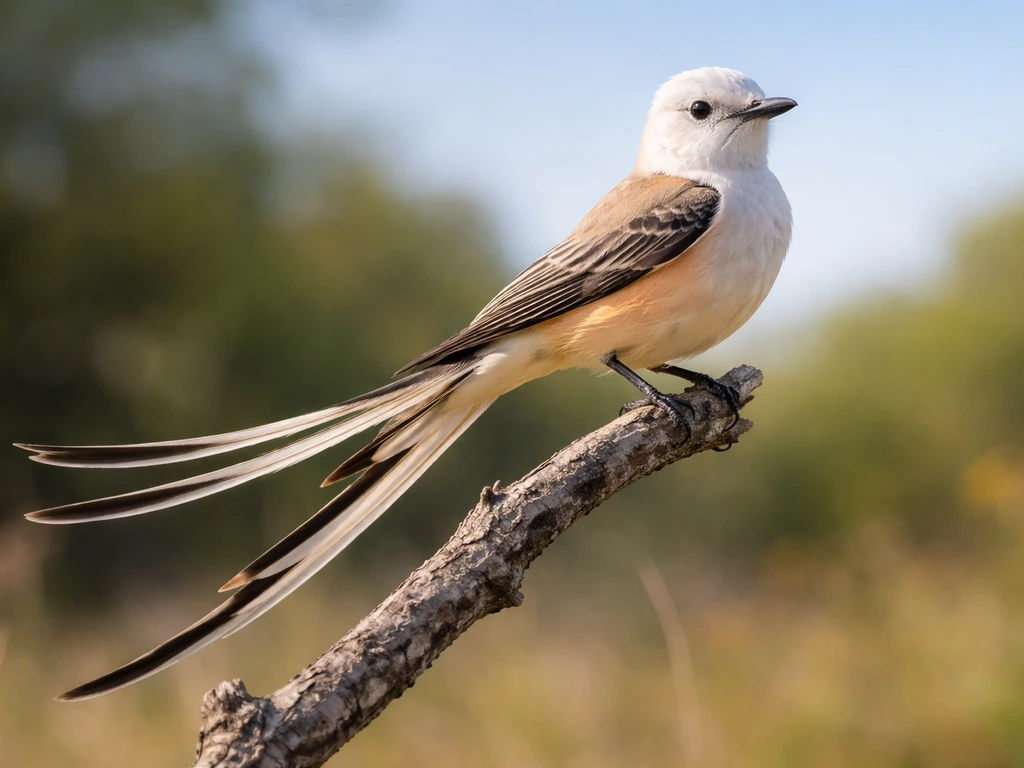
Scissortail Bird Meaning: Symbolism, Traits, and Context
Learn scissortail bird meaning: ID traits, symbolism, and how context changes interpretations from folklore to modern me
Munster Bird Meaning: Folklore, Symbolism, and How to Verify
Meaning of Munster bird searches: folklore, symbolism, idioms, spelling variants, and quick ways to verify the reference
Martin Bird Meaning: Symbolism, Folklore, and Signs
Learn martin bird meaning with symbolism, folklore, and how to identify the right species for omens and dreams.