
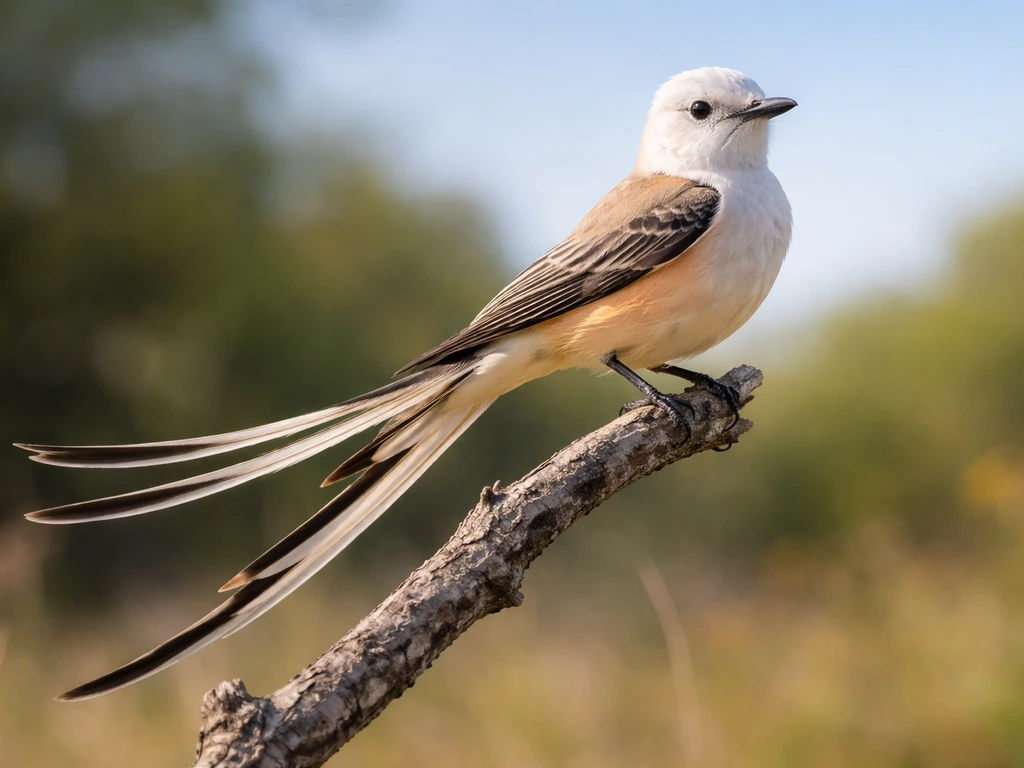
The scissortail bird is the scissor-tailed flycatcher (Tyrannus forficatus), a slender, elegant songbird named after its most obvious feature: a dramatically long, deeply forked black-and-white tail that can stretch up to nine inches on its own. In symbolic terms, it's most commonly associated with grace, agility, freedom of movement, and the idea of cutting away what no longer serves you. It's also the official state bird of Oklahoma, which gives it a strong civic and regional identity quite apart from any spiritual reading.
Scissortail Bird Meaning: Symbolism, Traits, and Context

Marcus Blackwell
5 Jun 2026
What the scissortail bird actually is (and how to tell it apart)
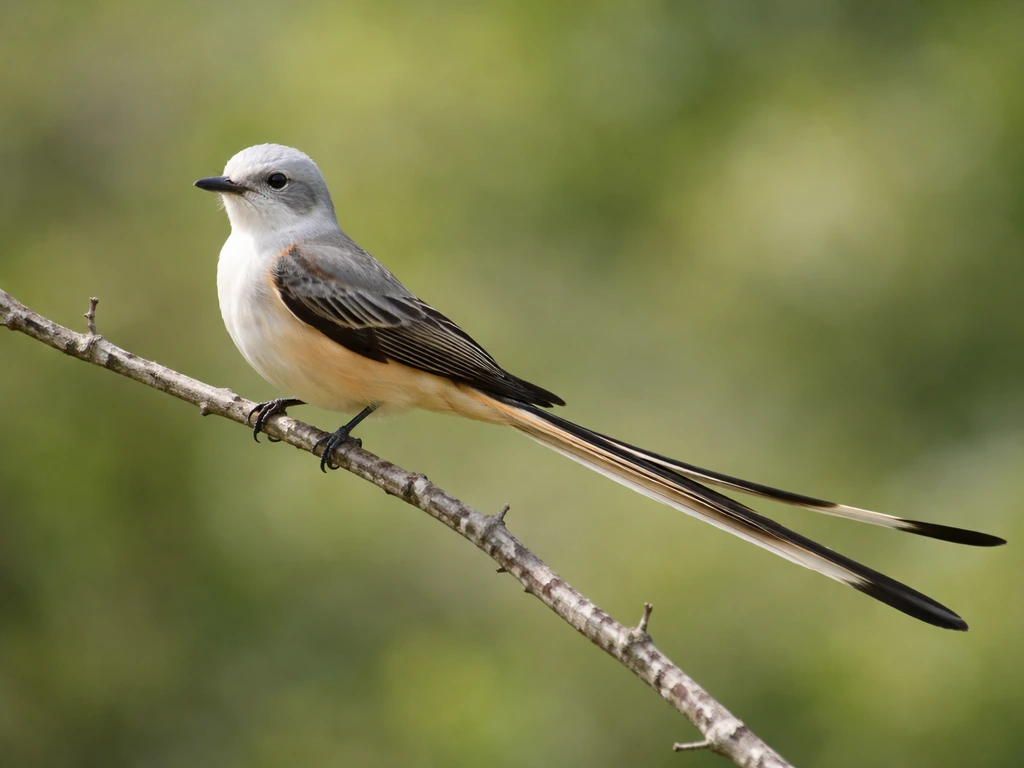
The scissor-tailed flycatcher is about 14 inches long in total, but more than half of that length is pure tail. The body itself is pale gray on top, with salmon-pink coloring visible under the wings when the bird takes flight. Adult males have pale gray upperparts, a crisp white belly, and that signature black-and-white forked tail that opens and closes like a pair of scissors mid-air. It's a conspicuous bird: it loves to perch on utility lines, fence posts, and treetops while scanning for insects, which makes it surprisingly easy to spot once you know what you're looking for.
National Geographic calls it 'our only regular long-tailed kingbird,' which is a useful framing. If you're in the southern Great Plains, Texas, or Oklahoma, and you see a long-tailed bird sitting on a wire with a strongly forked tail, this is almost certainly your bird. The key ID moment comes when it flies: the salmon-pink underwings flash and the tail streamers flare wide, which no lookalike can quite replicate.
Common lookalikes and how to rule them out
At a distance, especially when perched, the scissortail can look like a slim, long-tailed mockingbird. The western kingbird is another common comparison, particularly for immature scissortails, but the western kingbird has pure yellow tones on the belly and a much shorter, less forked tail. Once you see the scissortail in flight, the confusion clears up fast. The salmon-pink flash under the wings and the wide-spreading tail streamers are unique identifiers.
Why people search 'scissortail' in the first place (name origin and spelling tangles)
The name is both a description and a definition. The common name comes directly from the tail's shape, and so does the scientific name: forficatus is Latin, derived from forfex (a pair of scissors), because the forked tail literally resembles open scissor blades. The English word 'scissortail' as a written compound dates to around 1830 to 1840 in recorded usage, and it appears in dictionaries as both one word ('scissortail') and in hyphenated or two-word forms ('scissor-tailed flycatcher'). That spelling variation is one reason searches come in so many different forms.
The bird has also gone through a taxonomic rename. It was previously classified under the genus Muscivora as Muscivora forficata before being moved to Tyrannus forficatus. That historical shift occasionally shows up in older texts and creates minor confusion when people try to trace 'meaning' through older sources. Wiktionary also notes the synonym 'Texas bird of paradise,' a vivid folk name that hints at how much the bird's appearance has captured regional imagination over time.
People also land on this search for a range of reasons that don't always overlap. Some want a simple species ID. Some want to know why it's Oklahoma's state bird. Some saw it in a dream and are looking for spiritual meaning. If you are specifically looking for spiral bird meaning, the best place to start is by separating dream-style symbolism from widely documented cultural context.
If you're searching for sparrow meaning bird specifically, it's a different set of symbolic associations from the scissortail's dream interpretation angle spiritual meaning. If you’re searching for spatsy bird meaning, it helps to compare that phrase against how scissortail symbolism is described in the rest of this article spiritual meaning. Because people often search for spiral bird meaning alongside scissortail spirituality, it helps to know that each symbol has its own specific cultural and interpretive history spiritual meaning.
Some found 'scissortail' in a brand name or a place name and want the backstory. Each of those contexts has a genuinely different answer, which is worth knowing upfront.
What the scissortail symbolizes: the core meanings
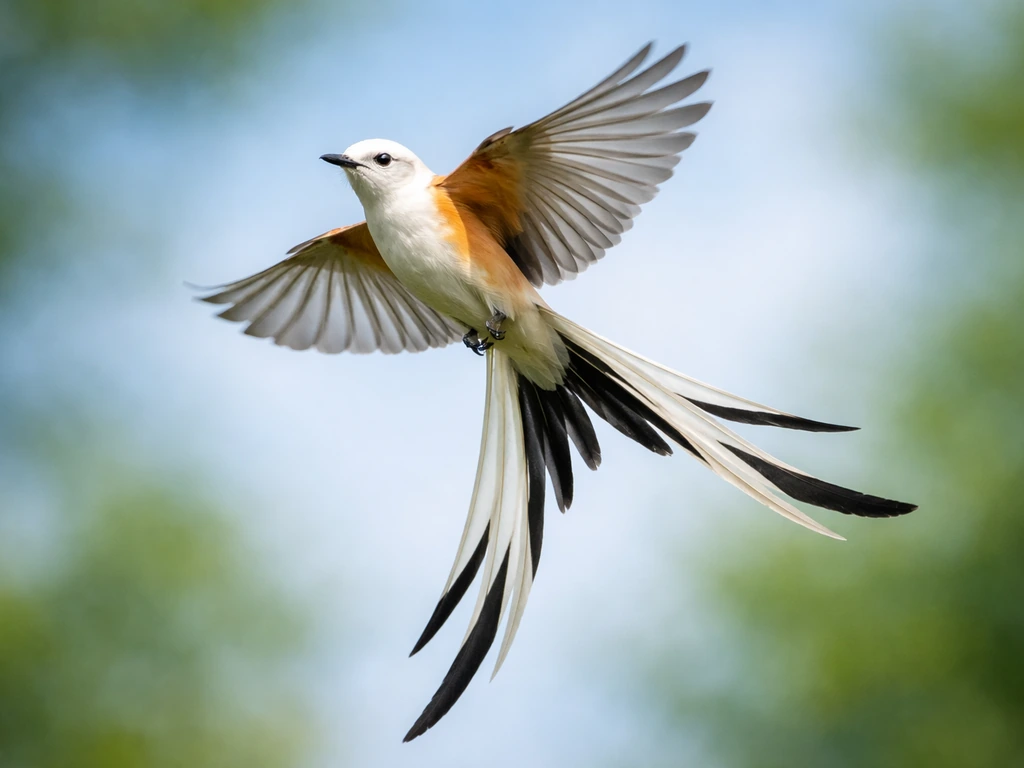
The scissortail's symbolic weight comes almost entirely from its physical presence. The long, forked tail that opens and closes in flight is the bird's defining feature, and most symbolic readings flow directly from that image. Here are the traits most commonly attributed to the scissortail across symbolic and cultural discussions:
- Agility and precision: the tail gives the bird extraordinary aerial control, and it's regularly used as a symbol of graceful, purposeful movement
- Freedom: the dramatic flight display, including a spectacular courtship zigzag, reads as uninhibited expression and movement
- Resilience and adaptability: the scissortail thrives in open country and adjusts to landscapes shaped by human activity, including farms, roadsides, and suburban edges
- Cutting away the unnecessary: the scissors imagery is frequently interpreted as a metaphor for releasing negative influences or clearing what doesn't serve you
- Balance: the tail acts as a stabilizer in flight, which lends itself to readings about equilibrium and poise under pressure
- Civic pride and regional identity: especially in Oklahoma and Texas, the scissortail stands for a deep sense of place and natural heritage
These aren't arbitrary projections. Each one connects to something the bird actually does or visibly is. That's what makes the scissortail a particularly satisfying symbol to work with, whether you're writing about it, tattooing it, or using it in a brand.
Cultural and traditional context: where scissortail symbolism lives
The most concrete and well-documented cultural meaning is the state bird designation. Oklahoma officially named the scissor-tailed flycatcher its state bird on May 26, 1951. The reasoning wasn't mystical: the bird was chosen in part because it nests primarily within Oklahoma's borders and because it eats large quantities of harmful insects, making it ecologically valuable. That's a pragmatic kind of symbolism, but it's real and meaningful to Oklahomans.
The bird's civic profile in Oklahoma is hard to overstate. It appears on the reverse of the Oklahoma Commemorative Quarter, shown in flight with its tail feathers spread wide. Scissortail Park, an urban greenspace in Oklahoma City (the upper section opened in 2019, the lower in 2022), uses a stylized scissortail silhouette in its logo. The bird is, in a very real sense, a visual shorthand for Oklahoma identity and pride in the state's natural landscape.
Outside of that civic framing, scissortail symbolism in regional folklore is relatively sparse compared to birds like ravens, owls, or sparrows, which carry centuries of cross-cultural myth. The scissortail's symbolism is more recent, more rooted in the American South and Great Plains, and more tied to direct observation than to inherited legend. If you're looking for deep pre-Columbian or Native American traditional stories specifically about this bird, those require research into specific tribal traditions rather than a general folklore database.
Spiritual and dream interpretations: what's commonly said and what to weigh carefully
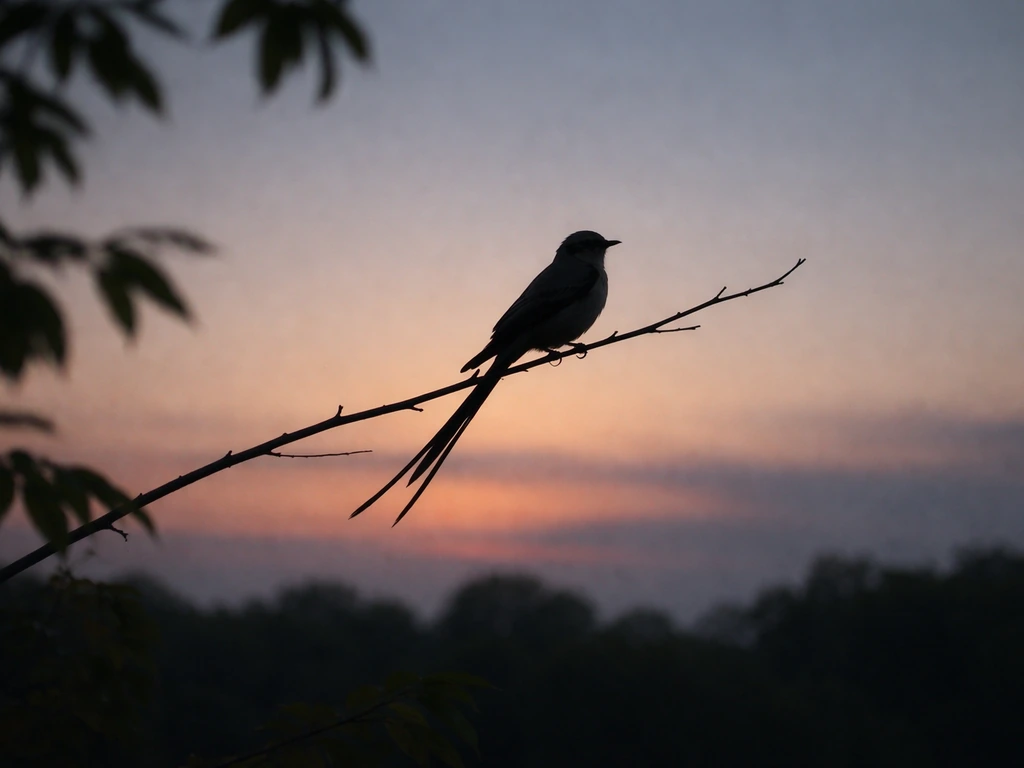
If you searched 'scissortail bird meaning' after a dream or a spiritual experience, you'll find plenty of websites ready to give you a detailed symbolic reading. Common claims include the bird as a sign of personal transformation, a message to cut away negative influences (leaning hard on the scissors imagery), a call toward balance and graceful change, and an omen of freedom ahead.
If you are searching for the scissor tail bird meaning, it helps to separate common themes like transformation and freedom from the fact that these interpretations are not universally agreed upon. Some sites structure this as '7 signs' or 'spiritual messages,' which is a popular format in animal symbolism content. AngelicalBalance also discusses [“7 signs” or “spiritual messages”](https://www. angelicalbalance.
com/spirituality/scissor-tailed-flycatcher-spiritual-meaning/) as a common way these animal-meaning interpretations are structured.
Here's the honest framing: none of these interpretations come from established religious traditions, verified folklore, or documented Indigenous teachings. They're modern, intuition-based symbolic readings that extrapolate from the bird's physical traits. That doesn't make them useless. If the 'cutting away negativity' metaphor resonates with what you're going through, there's real personal value in that. But you should know that these are contemporary spiritual interpretations, not ancient wisdom, and different websites will give you different (sometimes conflicting) readings based on the same imagery.
Dream interpretation follows the same pattern. The claim that dreaming of a scissortail signals transformation is a generalized template that could apply to almost any striking, unusual bird in a dream. If you're working through a specific tradition (Jungian, Indigenous, religious), the scissortail's meaning in that framework would need to come from someone grounded in that tradition, not from a general symbolism website.
Idioms, metaphors, and slang: how 'scissortail' shows up in language
There's no widely established idiom built around 'scissortail' the way 'bird in hand' or 'early bird' function in everyday English. The word operates almost entirely as a species name rather than a figurative phrase. That said, the scissors metaphor embedded in the name does get pulled into casual metaphorical use: describing someone's sharp, decisive movements as 'scissortail-like,' or using the image of the forked tail in poetry or prose to suggest duality, precision, or elegant division.
In branding and place-naming, 'scissortail' functions as a regional identifier with positive connotations of natural beauty, agility, and local pride. Scissortail Park in Oklahoma City is the clearest example of this in action. If you encountered the word 'scissortail' in a brand name, a logo, or a place name, it's almost certainly being used in this civic-identity sense rather than as slang or an omen.
Compare this to birds like the shrike or the sparrow, which carry much heavier figurative loads in idiom and metaphor across multiple languages and centuries. If you're also wondering about the shrike bird meaning, note that the shrike is often tied to older symbolism themes that differ from the scissortail's newer, scissors-based imagery. The scissortail is a younger symbolic presence, and its figurative usage is still relatively localized to American Plains culture and modern spiritual writing.
How to pin down the exact meaning you're after
The most practical step is to identify which 'meaning' question you're actually asking. These are the four main categories, each with a different path to an answer:
| Your question | What you're really after | Best next step |
|---|---|---|
| What is a scissortail bird? | Species ID and natural history | Check Cornell Lab's All About Birds or your state wildlife department's field guide |
| Why is it called scissortail? | Name origin and etymology | Look at the Latin forficatus and the English compound-name history from the 1830s onward |
| What does it mean as Oklahoma's state bird? | Civic and cultural symbolism | The Encyclopedia of Oklahoma History and Culture covers the selection rationale and legal adoption in 1951 |
| What does it mean spiritually or in a dream? | Personal/intuitive interpretation | Treat online spiritual readings as modern metaphor, not documented tradition; cross-check with any specific tradition you follow |
If you're using scissortail symbolism for a tattoo, a writing project, or a personal brand, the core images to work with are the forked tail (precision, decisiveness, duality), the aerial agility (freedom, grace under pressure), and the regional identity layer (rootedness in the American Great Plains). These meanings are grounded in the bird's actual behavior and appearance, which makes them more durable than purely speculative spiritual claims.
For verifying locally relevant folklore or Indigenous traditional meanings, the better approach is to consult resources specific to the tribal nations of Oklahoma and Texas rather than relying on general symbolism sites. State archives, tribal cultural centers, and regional naturalist societies are more likely to hold documented traditional associations, if they exist in recorded form.
If you're exploring bird symbolism more broadly, the scissortail sits in interesting company. Birds defined by their tails or flight patterns, including the snipe (another bird whose name carries strong idiomatic weight) and various flycatcher relatives, often attract symbolism tied to movement, elusiveness, and precision. The scissortail's closest symbolic sibling in this category is really its own scissor-tail imagery: the bird's meaning is, unusually, baked directly into its name. If you came here because you want the snipe bird meaning, it helps to compare how the name gets tied to behavior and how that symbolism shifts by context.
FAQ
Is “scissortail bird meaning” the same as “scissor tail bird meaning”?
They usually refer to the same species (the scissor-tailed flycatcher), but the spelling affects search results. In content or symbolism discussions, “scissor tail” sometimes appears as a separate phrase and can pull in unrelated imagery or generic “cutting negativity” posts, so confirming the species ID first helps.
How do I confirm it is actually a scissortail flycatcher and not a lookalike when I see it on a wire?
Use the flight cues, not just the silhouette. The salmon-pink underwings flash when it moves, and the long tail streamers flare widely, which helps separate it from lookalikes that may have a less forked or differently colored tail.
What does it mean if I dream about a bird with a long, dramatic tail (but I cannot tell which species)?
Most “spiritual message” sites assume the scissortail specifically, but that is a big leap when the species is uncertain. If you cannot reliably identify the bird, treat the dream interpretation as “bird-like symbolism” (movement, change, attention to flight) rather than a scissortail-specific omen.
Are the spiritual or “signs” meanings for scissortail birds supported by a specific religious tradition?
In general, no. The common transformation or “cut away negativity” readings are modern, intuition-based interpretations tied to the bird’s appearance, not established religious teaching or documented ancient folklore. If you follow a particular tradition, you would need a tradition-specific source or practitioner to ground the interpretation.
What is the most reliable “official” meaning of the scissortail?
The most concrete meaning is its civic role as Oklahoma’s state bird, chosen for practical reasons including regional nesting and insect-eating benefits. If you want meaning with the fewest interpretive leaps, start with that state identity rather than symbol lists.
Does the scissortail have different meanings in different seasons or behaviors (perched vs. flying)?
Symbolically, most readings focus on what is easiest to observe, the forked tail movement and aerial agility during flight. In practice, a perched bird might lead people to overemphasize “patience” or “watching,” so it can help to note which behavior you actually saw when you connect it to your own intention.
Can the scissortail meaning change if it appears in a tattoo design versus writing versus a brand logo?
Yes, because the context shapes the emphasis. Tattoos and prose often lean into duality and precision from the forked tail, while branding and place names tend to use the bird as a regional pride symbol. A good test is to ask whether you want the meaning to feel identity-based (Great Plains pride) or trait-based (grace, decisive movement).
Why do older books sometimes use a different scientific name (taxonomy confusion) when discussing “meaning”?
Older references may use a previous genus name, which can break continuity for readers searching today. If you are tracing meanings through older sources, focus on the species concept and physical description, not the historical Latin label, because “meaning” claims often get reused without verifying the taxonomy.
Is there an idiom or common English phrase that uses “scissortail” the way “early bird” does?
Not broadly. “Scissortail” is mostly used as a species or proper-name identifier. When it appears figuratively, it is usually an occasional metaphor (like describing sharp, splitting motion), so don’t assume it carries a long-standing idiomatic meaning.