The baya bird is the Baya Weaver (Ploceus philippinus), a sparrow-sized songbird native to South and Southeast Asia, best known for the extraordinary pendant nests the males weave from grass strips. In English, 'baya' is a direct borrowing from the Hindi/Urdu word bayā (बया), and Merriam-Webster records the pronunciation as /ˈbaɪ.ə/ (roughly 'BY-uh'). Beyond its literal identity as a weaver bird, the baya carries centuries of cultural weight in South Asian poetry, folklore, and everyday metaphor, symbolizing patience, devotion, and architectural ingenuity.
Baya Bird Meaning in English: ID, Symbolism & Usage

Marcus Blackwell
12 Aug 2026
Quick definition and pronunciation
When someone searches 'baya bird meaning in English,' they are almost always looking for the translation of a South Asian vernacular name. The answer is straightforward: baya = Baya Weaver. The full scientific name is Ploceus philippinus (Linnaeus, 1766), placed in the family Ploceidae (the true weavers). The species was originally described by Linnaeus as Loxia philippina, based on an earlier account by Brisson (1760), whose type locality of the Philippines was later recognized as an error; subsequent authors designated Ceylon (Sri Lanka) as the correct type locality, and the species was moved to the genus Ploceus.
| Detail | Value |
|---|---|
| Common English name | Baya Weaver |
| Scientific name | Ploceus philippinus (Linnaeus, 1766) |
| Family | Ploceidae (true weavers) |
| Pronunciation of 'baya' | /ˈbaɪ.ə/ — rhymes roughly with 'fire' without the 'r' |
| Source of English name | Hindi/Urdu bayā (बया / بیا) |
| IUCN status | Least Concern |
| Checklists | Clements, HBW/BirdLife, Avibase, World Bird Names |
Identification at a glance
The Baya Weaver is often described as sparrow-sized, and that is a useful anchor. Adults measure approximately 12 to 15 cm in length, which puts them at or slightly smaller than a House Sparrow. blank" rel="noopener noreferrer">Specimen measurements and field-guide size notes in the ResearchGate report confirm adult length around 12–15 cm, with published wing and tail values consistent with sparrow-sized proportions. The species shows strong sexual dimorphism, but only during breeding season. Outside breeding, both sexes look so similar that telling them apart in the field genuinely takes practice.
| Feature | Breeding Male | Female / Non-breeding Male |
|---|---|---|
| Crown | Bright golden yellow | Streaky brown |
| Upperparts | Darker brown, streaked | Streaky brown above |
| Underparts | Yellowish breast, paler below | Buff-white, lightly streaked |
| Face/throat | Darker face pattern, contrasting ear coverts | Plain buff-brown |
| Bill | Stout, conical, pale | Stout, conical, pale |
| Length | 12–15 cm | 12–15 cm |
| Key field mark | Golden crown unmistakable in breeding plumage | Resembles large sparrow; colony context helps |
The single most reliable field mark is the breeding male's golden-yellow crown, which is unmistakable once you have seen it. In mixed flocks of non-breeding birds at a paddy field, the baya blends with other small seed-eaters, so location and behaviour (especially proximity to pendant nests) become your best identification tools.
Natural history: nests, breeding, diet, and daily habits
The architecture of the nest
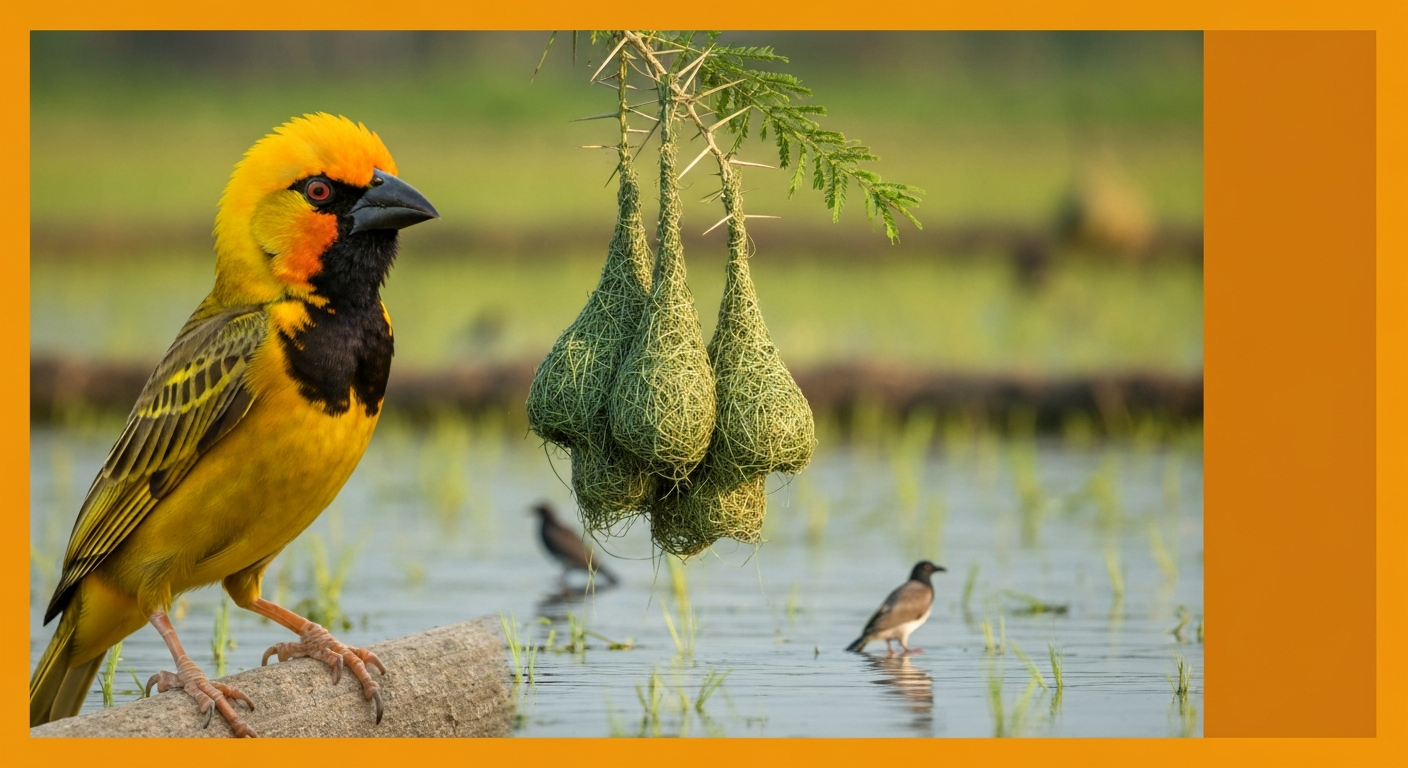
The Baya Weaver's nest is genuinely one of the most sophisticated structures built by any bird. Males weave a pendant, retort-shaped nest from long, ductile strips torn from live grasses and paddy leaves. The finished structure has a closed bulbous brood chamber at the top and a downward-pointing vertical entrance tube at the bottom, which the male may continue lengthening even after eggs have hatched. Empirical research published in The Auk (Quader, 2006) has shown that entrance-tube length, nest height, and placement on thorny branches or over water all influence nest survival, primarily by reducing snake and rodent predation. It is a remarkable piece of evolutionary engineering: the long tube forces a predator to navigate against gravity to reach the eggs.
Males build nests in colonies, sometimes with hundreds of nests clustered on a single favoured tree, often a thorny acacia or a palm frond above a pond or river. A male typically constructs multiple nests in a season and practices polygyny, meaning a single male can mate with more than one female. The female inspects each candidate nest carefully before accepting it and laying. Males that fail to attract a female may strip and rebuild, which explains why you sometimes see incomplete 'helmet' stage nests alongside finished ones in the same colony.
Diet and feeding habits
Baya Weavers are omnivorous, leaning granivorous. Their staple diet is grass seeds, rice, and wheat grains, gleaned from the ground or plucked directly from stalks. During breeding season they shift toward insects to provision nestlings with protein-rich food. Large flocks foraging on ripening paddy or wheat fields can cause measurable agricultural damage, and regional pest-management literature from Pakistan and India documents the species accordingly. Outside breeding, they gather in open cultivated areas, paddy fields, and grasslands in sociable, twittering flocks.
Habitat and range
The Baya Weaver is one of the most widespread weavers in Asia. Its range stretches from Pakistan through the Indian subcontinent (India, Nepal, Bangladesh, Sri Lanka) and continues east through Myanmar, Thailand, the Malay Peninsula, and parts of the Sunda islands, with different subspecies occupying different parts of this range. See Avibase, species range, subspecies and habitat summary for detailed maps and subspecies distributions across South and Southeast Asia Avibase — species range, subspecies and habitat summary. Within that broad band, it prefers open and semi-open landscapes: cultivated plains, paddy fields, scrubby grasslands, reedbeds, and mangrove edges. It is rarely found in dense forest or at high elevation. Seasonal and local movements follow rainfall and food availability, so a site that hosts a large colony in the monsoon-influenced breeding season may have few birds in the dry months.
For writers or researchers needing precise current distribution data, eBird Status and Trends maintains regularly updated occurrence maps and seasonal abundance products for Ploceus philippinus, and GBIF provides georeferenced specimen and observation records. The IUCN Red List classifies the species as Least Concern, reflecting its wide range and lack of evidence for rapid population decline, though agricultural habitat modification is noted as a local pressure.
- Pakistan: western and central plains, especially Sindh and Punjab
- India: widespread across the subcontinent, absent in dense Himalayan forest zones
- Nepal: terai lowlands and cultivated valleys
- Bangladesh and Sri Lanka: common resident
- Myanmar, Thailand, Malay Peninsula: extending into Southeast Asia
- Parts of the Sunda islands: some subspecies presence
A note on range maps: any printed range map in a book has a publication date, but the bird's actual distribution shifts with land-use change. For the most current picture, the eBird species page for Baya Weaver is the best single free resource, updated continuously by citizen-science records.
Photos and visuals
Good images make identification stick in a way that text descriptions simply cannot. Below are suggested photo subjects and captions for anyone illustrating this article or a field guide entry. Freely licensed images of all these subjects are available on Wikimedia Commons (search: Ploceus philippinus), and the Macaulay Library at Cornell Lab of Ornithology holds a curated catalog of verified photographs and audio recordings. Always check the individual license and credit metadata before republishing.
| Image subject | Suggested caption |
|---|---|
| Adult male in breeding plumage | Baya Weaver male (Ploceus philippinus) in breeding plumage, showing the diagnostic golden-yellow crown. Photo: [photographer/license] |
| Adult female or non-breeding male | Female (or non-breeding male) Baya Weaver — streaky brown plumage resembles a large sparrow. Photo: [photographer/license] |
| Active nest colony on thorny tree | A colony of pendant Baya Weaver nests woven from grass strips, clustered on a thorny acacia over water. Photo: [photographer/license] |
| Close-up of a finished nest | The retort-shaped nest showing the closed brood chamber (top) and downward entrance tube — one of the most complex nest structures built by any songbird. Photo: [photographer/license] |
| Range map | Distribution of Ploceus philippinus across South and Southeast Asia. Data: eBird Status and Trends / BirdLife International |
Etymology and regional names
The English word 'baya' is a direct loanword from Hindi/Urdu bayā (बया in Devanagari; بیا in Nastaliq script). Merriam-Webster traces this etymology explicitly and records the English pronunciation as /ˈbaɪ.ə/. The name entered English-language ornithological literature through colonial-era naturalists working in the Indian subcontinent, who adopted the vernacular name alongside the Linnaean binomial. It is one of several South Asian bird names that passed into standard English dictionaries largely because no pre-existing English common name existed for the bird.
Across South Asia the bird carries a rich web of regional names, each rooted in local languages but often referring to the same defining features: the woven nest, the yellow crown of the male, or the bird's association with rainy seasons and paddy cultivation.
| Language / Region | Name | Notes |
|---|---|---|
| Hindi / Urdu | बया / بیا (bayā) | Source of the English loanword; the most widely recognized South Asian name |
| Bengali | বাবুই (bābui) | Used across Bangladesh and West Bengal; also a common poetic name |
| Tamil | தும்பிக்கரி (thumbikari) / வலை குருவி (valai kuruvi) | Refers to the woven/net sparrow |
| Telugu | బట్టు పిచ్చుక (battu pichuka) | Approximate; 'weaving sparrow' |
| Sinhala (Sri Lanka) | Thalagoya kurullo / Wadu kurulla | Wadu = woven/builder |
| Marathi | सुगरण (sugaran) | Means 'the skilled one'; reflects admiration for nest-building |
| Punjabi | baya / wāvā chiriyan | Wāvā chiriyan = 'woven sparrow' |
The diversity of regional names is itself significant. Nearly every language group that lives alongside this bird has developed a name that reflects what humans find most striking about it: the weaving. This cross-linguistic convergence on the same characteristic tells you something real about how deeply the bird's behaviour registers on human observers.
Cultural and symbolic meanings in South Asia
Folklore and poetry
In South Asian literary and folk traditions, the baya is above all a symbol of devoted craftsmanship and patient love. The male's tireless nest-building, repeated and refined across weeks, became a natural metaphor for the effort required in courtship and in creative work. Classical Urdu and Hindi poetry uses the baya (bayā) as an image of the earnest, industrious lover who prepares a home in the hope of being accepted, only to face an indifferent or demanding beloved. The poet labors; the female inspects and may reject. The parallel to the human condition was irresistible to Sufi-influenced poets, who were already comfortable with birds as vehicles for spiritual longing.
In Bengali literature and folk song, the bābui (the Bengali name for the same bird) appears as an exemplar of self-reliance and pride in one's own home. The 19th-century Bengali poet Shamsur Rahmani and folk traditions of rural Bengal contrast the bābui's own woven nest with the borrowed shelter of the sparrow, using the comparison to argue that dignity comes from one's own labor rather than dependency. This theme recurs in Bengali proverb and school-level literature to the present day.
Metaphors, proverbs, and common sayings
Several proverb-type expressions involving the baya circulate in Hindi, Urdu, and Bengali-speaking communities. Their meanings center on a consistent cluster of ideas: skillful construction, perseverance in difficult conditions, and the relationship between effort and reward.
- 'Baya ki tarah ghar banana' (Hindi, roughly: 'to build a home like the baya') — used to describe painstaking, careful labor on any project, not only literal house-building
- The baya nest built over water is frequently cited in folk sayings about prudence and planning: placing the nest above a stream is understood as protection against ground predators, and the image transfers to advice about preparing for threats in advance
- In contexts of unrequited love or unappreciated effort, the image of a male baya whose finished nest is rejected by the female becomes a shorthand for thankless work — an indirect, poetically polite way of expressing that grievance
- The baya's rainy-season nesting is sometimes linked symbolically to renewal and hope in monsoon-associated folk culture across the Gangetic plain
Omen associations and spiritual readings
Unlike some birds (owls, crows, and certain herons carry heavy omen associations in South Asian traditions), the baya is not strongly coded as a bird of ill omen. Its associations lean positive: industry, ingenuity, and domestic devotion. In some regional folk beliefs, seeing a large active baya colony at the start of the monsoon is taken as a sign of a good season ahead, linking the bird's breeding activity to agricultural fortune. However, I want to be careful here: these associations are diffuse and regionally variable, not a single codified tradition. They reflect the accumulated folklore of agricultural communities who lived alongside the species for centuries rather than any single authoritative text.
The baya in English idiom and figurative usage
Unlike birds such as the robin or the raven, the baya has not entered standard English idiom or proverb. Its figurative life remains largely within South Asian language traditions. When the word 'baya' appears in English-language writing, it is almost always in one of three contexts: ornithological or natural-history description, translation of South Asian literary or folk texts, or cultural journalism explaining South Asian traditions to an English-speaking audience. Writers and translators working with Hindi, Urdu, or Bengali texts should treat 'baya' in the source text as a culturally loaded term, not merely a bird name. A flat translation to 'weaver bird' loses the folk resonance; a note explaining the symbolism is usually worth adding.
Practical usage examples for writers and translators:
- Ornithological: 'The baya, or Baya Weaver (Ploceus philippinus), builds one of the most complex pendant nests of any Asian bird.'
- Literary translation note: 'The poet invokes the bayā as a figure of devoted, unrewarded labor — a common trope in classical Urdu ghazal.'
- Cultural journalism: 'In Bengali folk tradition, the bābui (baya) is praised for building its own home rather than sheltering in another creature's abandoned nest.'
How the baya compares to similarly named local birds
If you are working with South Asian bird names in English, the baya sits alongside several other vernacular names that can confuse non-specialist readers. The bagla (Hindi: बगला) is the heron or egret, a large wading bird with completely different ecology, symbolism, and taxonomy. In South Asian proverbial usage, the bagla carries quite different connotations: the bagla bhagat (the 'heron saint') is a stock figure of hypocrisy, a bird standing motionless as if in meditation but actually waiting to snatch a fish. The baya and bagla share nothing except regional origin; confusing them in translation would be a significant error in meaning.
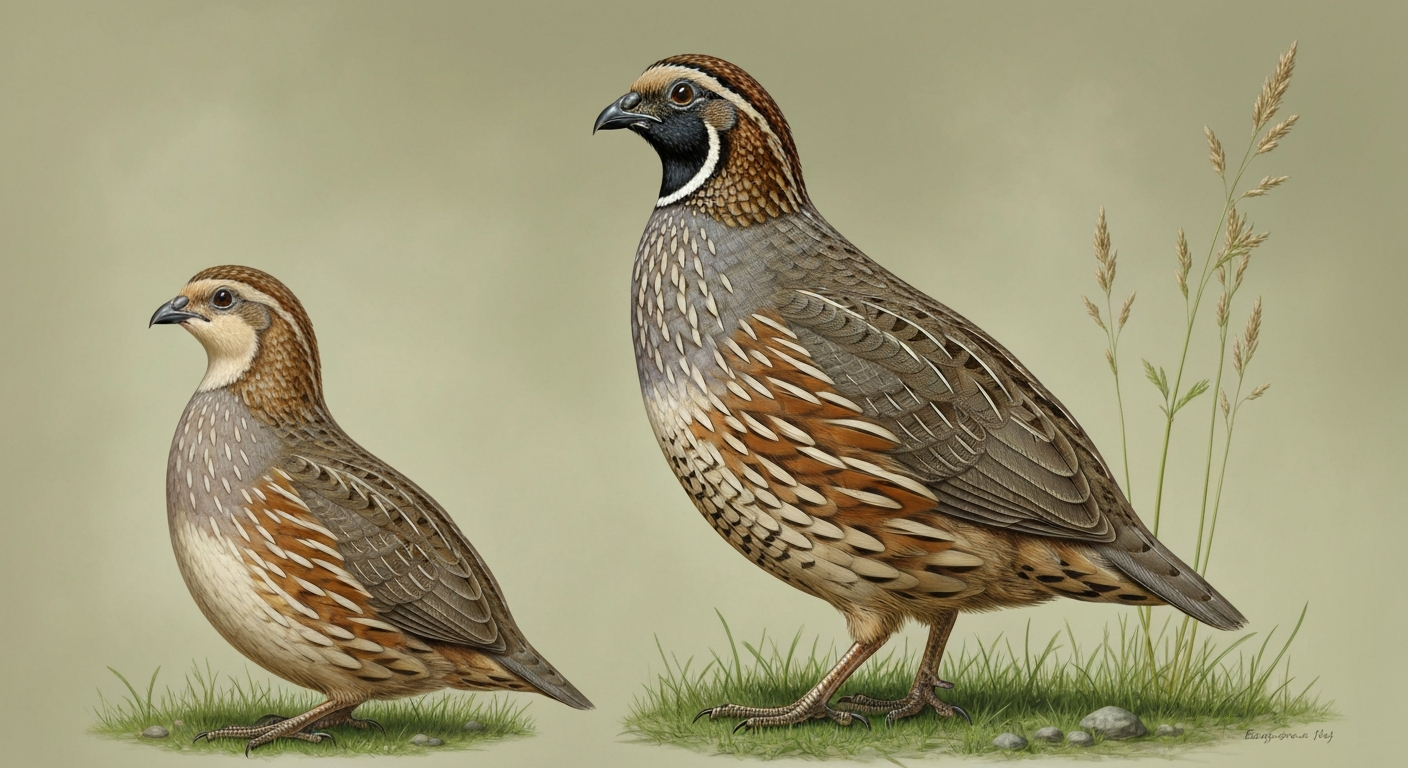
The bakula is a different matter entirely: bakula refers to the Mimusops elengi tree and its associated fragrant flower rather than a bird species, though the name appears in Sanskrit literary contexts and can cause confusion for readers unfamiliar with classical Indian poetry. The barbet (various species in the family Ramphastidae/Megalaimidae) is a broader English common-name category covering brightly colored, loud-calling Asian forest birds with no direct vernacular link to 'baya.' The bater is the quail, specifically the common quail (Coturnix coturnix) or related species in South Asian usage, another ground-dwelling bird with its own distinct symbolism. For readers wondering about the term, a brief entry on bater bird meaning in English explains that 'bater' refers to the common quail (Coturnix coturnix) in South Asian usage. And the bok (or bak) in some regional usages refers to herons or egrets, overlapping in territory with bagla usage. For clarification of regional usages and the bok bird meaning in English, see the entry on bok bird meaning in English.
| Vernacular name | English equivalent | Family | Key symbolic association |
|---|---|---|---|
| Baya (बया) | Baya Weaver (Ploceus philippinus) | Ploceidae | Industrious nest-building, devoted craftsmanship, patient love |
| Bagla (बगला) | Heron / Egret (Ardeidae spp.) | Ardeidae | Hypocrisy (bagla bhagat proverb), patience, stillness |
| Bakula | Not a bird — a flowering tree (Mimusops elengi) | N/A | Fragrance, poetic beauty, classical Sanskrit imagery |
| Barbet | Barbet (Megalaimidae spp.) | Megalaimidae | Loud call, forest voice, seasonal rain associations |
| Bater (बटेर) | Quail (Coturnix spp.) | Phasianidae | Cockfighting tradition, agility, ground-dwelling |
| Bok / Bak | Heron / Egret (regional variant) | Ardeidae | Overlaps with bagla symbolism in some regional usages |
Getting these distinctions right matters most in literary translation and cultural writing. A translator who renders both bagla and baya as 'bird' is erasing a meaningful contrast that the source author almost certainly intended. Each of these names keys into a specific set of folk associations, and the baya's association with patient, skillful construction is the one you want to preserve.
FAQ
What does “baya bird” mean in English?
In English “baya bird” refers to the Baya Weaver (Ploceus philippinus), a small passerine in the weaver family (Ploceidae) native to South and Southeast Asia. The name ‘baya’ comes from South Asian vernacular (Hindi/Urdu bayā/baiyā).
How do you pronounce “baya”?
Common English pronunciations are /ˈbaɪə/ or ˈBY-ə (respellings: bī-ə, bī-ˈä). Merriam‑Webster notes variants roughly like “BY-uh.”
What are the key identification features (size, plumage, sexual dimorphism)?
Size: about 12–15 cm long (sparrow-sized). Non‑breeding males and females are streaky brown above and buff below. Breeding males show distinctive yellow crowns and yellowish breasts with darker streaked upperparts and contrasting face/ear‑coverts; females and non‑breeding males lack the bright yellow head and are more uniformly streaked. Juveniles resemble non‑breeding adults.
What is distinctive about the baya’s nests and nesting behaviour?
Males build elaborate pendant, retort‑shaped woven nests from long flexible grass or paddy leaf strips: a closed bulbous chamber with a long downward‑pointing entrance tube. Nests are often colonial, built on thorny trees or palms (commonly over water). Males may construct multiple nests to attract females; the species is polygynous and females inspect nests before accepting one.
What does the baya eat and where does it live?
Diet: omnivorous granivore–insectivore—feeds on grass and crop seeds (rice, wheat) and on insects (especially when provisioning young). Habitat: open cultivation, paddy fields, grasslands, reedbeds, scrub with scattered trees, and mangrove edges. Range: widespread across the Indian subcontinent into Southeast Asia (Pakistan, India, Nepal, Bangladesh, Sri Lanka, Myanmar, Thailand, Malay Peninsula and nearby islands).
What is the scientific name and taxonomic note?
Scientific name: Ploceus philippinus (Linnaeus, 1766). Historically described as Loxia philippina by Linnaeus (based on earlier accounts); later placed in genus Ploceus (family Ploceidae). Standard checklists (Clements, HBW/BirdLife, Avibase) accept Ploceus philippinus.
Next Article
Bater Bird Meaning in English, ID, Spelling, Symbolism
Discover what 'bater' likely means in English, possible species, pronunciation, ID tips and cultural symbolism.