The word 'bater' (Hindi/Urdu: बटेर / بَٹیر) means quail in English, specifically the small, ground-dwelling game bird belonging to the genus Coturnix. In South Asian vernacular usage, bater is the standard everyday name for what field guides call the Common Quail (Coturnix coturnix), and the same word, sometimes with a prefix, covers the Rain Quail (Coturnix coromandelica) as well. If you have encountered this word in a Hindi or Urdu text, a translation, or a regional bird list, quail is almost always the right English equivalent.
Bater Bird Meaning in English, ID, Spelling, Symbolism

Marcus Blackwell
30 Jul 2026
At a glance: bater bird summary
Bater is a well-documented Hindi and Urdu word that translates cleanly to quail in English. It appears in major bilingual dictionaries including Collins Hindi-English and Rekhta, and 19th-century Hindustani-English lexicons record it in the same sense. Rekhta lists बटेर / بَٹیر with the English meaning 'quail'. The word most often refers to the Common Quail (Coturnix coturnix), a migratory galliform found across South Asia, Europe, and Africa, though regional usage also applies it to the Rain Quail (Coturnix coromandelica) and occasionally to other small ground birds depending on the district. Pronunciation: approximately buh-TAIR (IPA: /bə.ʈeːɾ/). Common spelling variants: bater, bateer, batair, baṭer, baṭēr.
How to pronounce bater and what spelling variants look like
The Hindi IPA for बटेर is /bə.ʈeːɾ/. Breaking that down for English speakers: the first syllable is a short, unstressed 'buh'; the second syllable carries the stress and sounds like 'TAIR' (rhyming with English 'fair'), but the 't' in the middle is a retroflex consonant (ʈ), produced with the tongue curled slightly back. English speakers without exposure to South Asian languages often approximate it as buh-TAIR or even buh-TEER, which is close enough for practical purposes.
Romanization is inconsistent across sources, which is why you will see several spellings in the wild. Collins Hindi-English shows multiple variants at the same headword, and 19th-century Hindustani dictionaries (working before standardized romanization) often wrote the word as 'bater' in running text. None of these variants represents a different word, they are all attempts to render the same Hindi/Urdu sound in the Roman alphabet.
- bater — the most common simplified romanization
- bateer — reflects the long vowel in the second syllable
- batair — approximates the vowel sound for English readers
- baṭer / baṭēr — uses a diacritic dot to mark the retroflex ṭ
- bateyr — rare, found in some older printed texts
Where the word comes from
The etymology of बटेर traces back through Prakrit and Sauraseni to the Sanskrit root वर्तीर (vartīra), which the Monier-Williams Sanskrit dictionary and the Cologne Digital Sanskrit Dictionaries identify as an early word for a type of quail or partridge. The sound shift from Sanskrit vartīra to Prakrit forms and eventually to the Hindi/Urdu baṭer follows regular phonological patterns seen across many Sanskrit-derived bird names in the subcontinent. This is a deep-rooted, genuinely indigenous name, not a borrowing from Persian or Arabic (even though Urdu borrowing from those languages is common for many other words). The Urdu spelling بَٹیر uses the native Perso-Arabic script but represents the same Hindi-origin word.
Is bater a local name, a misspelling, or a dialect form?
This is a fair question to ask, because many 'bird name queries' in English originate from romanized local words that turn out to be misspellings or phonetic guesses. In the case of bater, it is a legitimate, dictionary-attested local vernacular name, not a misspelling of an English bird name, and not a corrupted form of something else. You will not find 'bater' in an English ornithological checklist as an official common name, because the bird it refers to is listed under quail or Common Quail in English-language field guides. The confusion typically arises when someone sees the Hindi word romanized and wonders whether it has an English equivalent.
There are a few situations where the identification gets murkier. In some districts, speakers use bater as a loose general term for any small ground-running bird, which can include buttonquails (Turnix spp.) and bush-quails (Perdicula spp., sometimes called 'jungli batera' to distinguish them). If you are working with a regional field record and the observer has written only 'bater' without further description, it is worth checking the local checklist for that area before assuming Coturnix coturnix. See ENVIS vernacular table / regional checklist extract, buttonquails, bush‑quails and 'bater' entries for district-level examples where buttonquails (Turnix spp.) and bush‑quails (Perdicula spp.) are recorded with bater‑like vernaculars and require local checklist disambiguation ENVIS vernacular table / regional checklist extract — buttonquails, bush‑quails and 'bater' entries. The word is reliable at the family level (small galliforms, quail-like birds) but can be imprecise at the species level depending on geography.
The nearest English common name
The direct English equivalent of bater is quail. More precisely, the default referent is Common Quail (also called Grey Quail), Coturnix coturnix. This is the species that most Hindi and Urdu dictionaries point to, and it is the bird that classical Hindustani-English lexicons from the 19th century describe when they gloss 'bater' as 'a kind of quail.' When a regional prefix is added, the mapping shifts: 'china bater' and 'chinaga bater' are vernacular names recorded for Rain Quail (Coturnix coromandelica), while 'bada bater' (literally 'big quail') and 'ghagus bater' also map to Common Quail in some regional lists. Without a prefix, translate bater as quail and flag Common Quail as the most likely species.
Likely species: who exactly is the bater?
Common Quail (Coturnix coturnix), the primary candidate
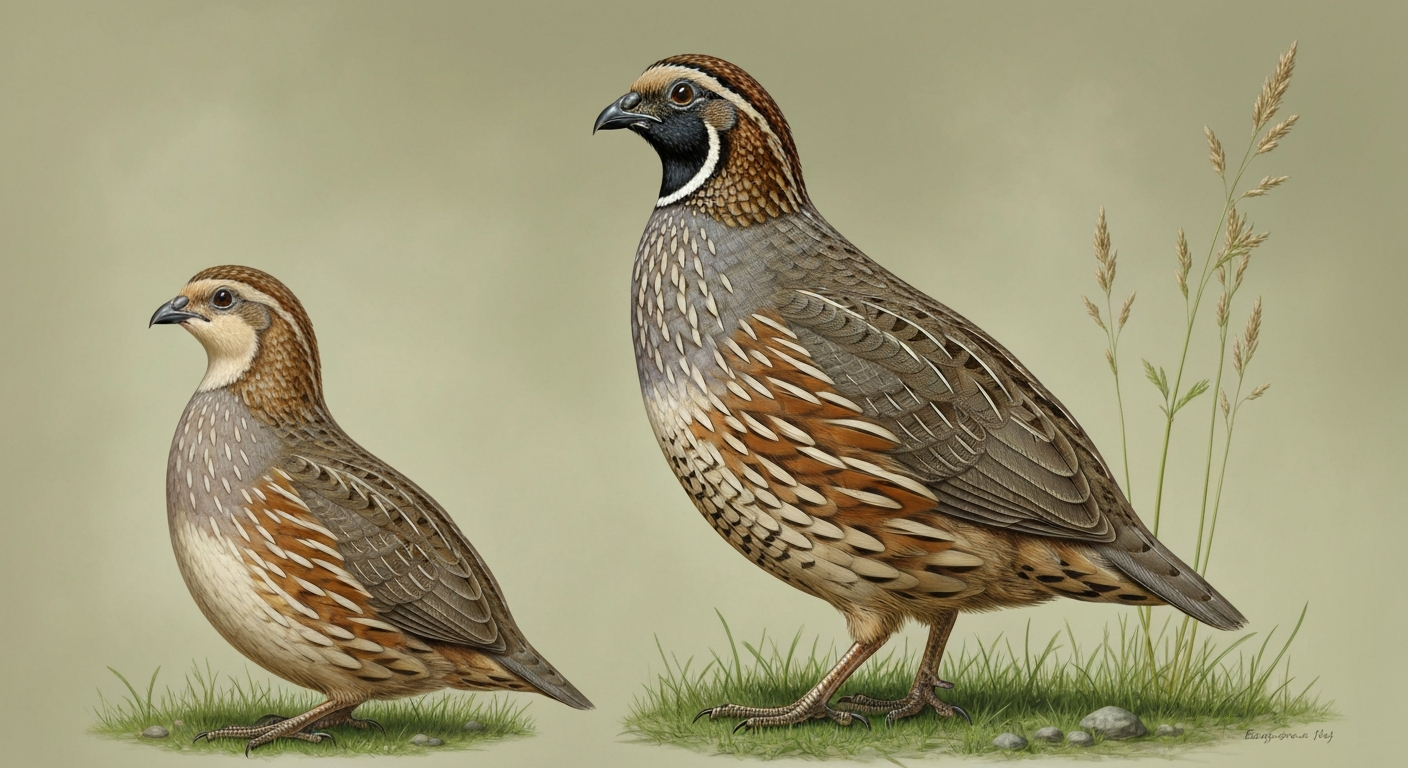
The Common Quail is the bird most consistently called bater across Hindi and Urdu-speaking regions of South Asia. It is a migratory galliform, meaning it moves through the subcontinent on seasonal routes, and it has historically been an important quarry bird, which probably explains why it has such a deeply embedded vernacular name. At 16 to 20 cm in length, it is small and compact, with a short tail and cryptically streaked brown-and-buff plumage that makes it difficult to spot on the ground. Males have a distinctive anchor-shaped mark on the throat. The call is a loud, far-carrying three-note whistle often written as 'wet-my-lips' in English mnemonic guides. Habitat: open grasslands, agricultural fields, and low scrub, exactly the kind of terrain common across the Indo-Gangetic plain.
Rain Quail (Coturnix coromandelica), the secondary candidate
The Rain Quail is smaller than the Common Quail and in many ways more striking, at least in the male. It has a prominent pale crown-stripe and a bold black-and-white face pattern that makes it easier to identify than its more widespread cousin. It is a South Asian resident rather than a long-distance migrant, found across the Indian subcontinent in grasslands and fields, and it is especially associated with the monsoon period, hence the name 'Rain Quail.' Regional checklists derived from Grimmett, Inskipp and Inskipp record 'china bater' and related forms as its vernacular name in Hindi, distinguishing it from the plain 'bater' of the Common Quail. If someone in a specific part of peninsular India calls a bird 'bater,' this species is a plausible candidate.
Buttonquails and bush-quails, occasional regional overlap
In some regional contexts, particularly where observers are not specialist birdwatchers, the word bater can drift to cover Turnix buttonquails and Perdicula bush-quails. Buttonquails (family Turnicidae) are not true quails at all, they look superficially similar but belong to a different lineage. Jungle Bush-Quail (Perdicula asiatica) is more often called 'lowa' or 'jungli batera,' but dialect variation means the line is not always clean. If you are doing a species-level identification from a field record, do not assume the entry means Coturnix without checking the geographic and contextual notes.
Field identification cheat sheet
| Feature | Common Quail (Coturnix coturnix) | Rain Quail (Coturnix coromandelica) |
|---|---|---|
| Local name | Bater / bada bater / ghagus bater | China bater / chinaga bater |
| Size | 16–20 cm | Slightly smaller than Common Quail |
| Plumage (male) | Streaked buff-brown; anchor throat mark | Bold black/white face; pale crown stripe |
| Habitat | Open fields, grassland, scrub | Grassland, crops; monsoon-associated |
| Status in South Asia | Migratory (passage and winter) | Resident breeder |
| Call | Three-note 'wet-my-lips' whistle | Series of soft calls |
| Scientific name | Coturnix coturnix | Coturnix coromandelica |
How bater compares to other local bird names in the same family of queries
Bater sits in an interesting group of South Asian bird names that English speakers often search for in translated or romanized form. Comparing it to sibling terms in this dictionary helps show how the naming logic works across different bird families. Bagla, for instance, is a heron, a tall wading bird, so the English equivalent sits in a completely different ecological guild from the ground-running bater. Baya is the baya weaver (Ploceus philippinus), famous for its elaborately woven hanging nests, again a very different bird from a quail. For more on this species and the baya bird meaning in English, see the entry on the baya weaver (Ploceus philippinus). Bakula is a term associated with the Indian cuckoo in some traditions. Barbet (discussed separately on this site) is actually an English name that already looks like an Anglicized version of a local name. See the site's article on barbet bird meaning for the full discussion of barbets. Bok is another local name category. For the bok bird meaning in English, see the separate entry on bok which explains that 'bok' is a local vernacular name and gives its closest English equivalent. What all these searches share is that the questioner has a romanized local word and needs an English bridge, bater is one of the cleaner cases because it maps almost directly to a single English word.
| Local name | English equivalent | Bird family | Primary region |
|---|---|---|---|
| Bater / baṭer | Quail (Common Quail) | Phasianidae | South Asia (Hindi/Urdu-speaking belt) |
| Bagla | Heron / egret | Ardeidae | South Asia |
| Bakula | Indian Cuckoo (one attribution) | Cuculidae | South Asia |
| Barbet | Barbet (already English) | Capitonidae / Megalaimidae | Pan-tropical |
| Baya | Baya Weaver | Ploceidae | South Asia |
| Bok | Regional / context-dependent | Varies | Varies |
Cultural meanings and symbolic associations of the quail
The quail carries a surprisingly rich symbolic weight across cultures, and understanding it adds depth to any encounter with the word bater in literary or religious texts. In the Hebrew Bible, quails appear twice as a miraculous food source, once in Exodus and again in Numbers, sent to feed the Israelites in the desert. This association links the quail to divine provision and abundance, an image that recurs in Islamic commentary on those same Quranic passages (the Arabic 'salwaa,' often translated as quail, refers to the same events).
In ancient Greek tradition, the quail was sacred to Artemis and appeared in myths connected to Delos, the sacred island. The island was supposedly once called Ortygia, from the Greek 'ortyx' (quail). This gives the bird a connection to transformation myths and sacred geography. In Roman augury, the quail's behavior was observed as an omen, particularly related to battles, quail fights were also a popular sport in ancient Greece and Rome, giving the bird a combative, spirited connotation alongside its more gentle associations.
In South Asian contexts, the bater's role as a game bird is inseparable from its cultural presence. Quail fights (bater-baazi in Urdu) were historically a popular pastime in Mughal and post-Mughal urban culture, particularly in the cities of the Indo-Gangetic plain. The bater in this context symbolizes feistiness and courage disproportionate to size, a small bird that fights hard. Urdu poetry occasionally uses the quail as a metaphor for the underdog, the one who punches above their weight. The phrase 'bater ki tarah ladna' (to fight like a quail) captures exactly this sense.
Idiomatic and figurative uses involving the quail
The English verb 'to quail' (meaning to flinch, shrink back in fear) is etymologically unrelated to the bird quail, it comes from a separate Middle Dutch root. This is worth knowing because it seems like it should be connected but is not. In figurative English, the bird quail is rarely the subject of idioms, but it does appear in the phrase 'quail on toast,' a British expression for something luxurious or slightly pretentious (quail being a prestige game bird in British culinary tradition). The phrase 'quailing' as in cowering has no bird symbolism behind it, despite the spelling.
In Urdu and Hindi, the bater is more idiomatically active. Bater-baazi (quail-fighting) is a compound that by extension can refer to any small-scale but fierce rivalry. The image of the bater as a bird that is small but hard to catch and stubborn in a fight runs through folk sayings in Rajasthan and Uttar Pradesh. In some folk traditions, a quail calling near the house is considered a sign of rain coming, consistent with the Rain Quail's seasonal associations, and in others it is treated as a mild omen worth noticing but not fearing.
The bater in Mughal culture and classical Urdu literature
The bater has a specific cultural niche in the Mughal and post-Mughal literary and courtly world that makes it worth dwelling on for anyone reading classical Urdu prose or poetry. Quail keeping and quail fighting were aristocratic pastimes documented in Mughal court records. The Akbarnama and later texts mention the care and training of fighting quails. In this context, the bater is a bird of leisure and display, associated with refined urban culture and the courts of Lucknow and Delhi. Urdu poets used it occasionally as a vehicle for ideas about captivity, the paradox of fighting spirit in a caged creature, and the transience of small pleasures.
How to verify a local bird name like bater
If you encounter the word bater in a field record, a regional text, or a conversation and you want to confirm the species identification, a few practical steps help. First, check the geographic region: if the observer is in the northern plains of India or Pakistan during the winter months, Common Quail is by far the most likely referent. If the sighting is in peninsular India during the monsoon, Rain Quail becomes more probable. Second, look for prefix qualifiers: 'china bater,' 'bada bater,' or 'chota bater' (small quail) each narrow the identification. Third, cross-reference against Grimmett, Inskipp and Inskipp (Birds of the Indian Subcontinent) or the Handbook of the Birds of India and Pakistan, both of which include vernacular name tables. Avibase's species pages for Coturnix coturnix and Coturnix coromandelica also list regional vernacular names and are freely accessible online.
For sound-based identification, Xeno-canto hosts call recordings for both species under their scientific names. The Common Quail's three-syllable whistle is distinctive once you know it, and hearing it alongside a regional sighting description is often enough to confirm the identification without needing to see the bird clearly, since quails are notoriously secretive on the ground.
What bater is not
It is worth being direct about a few things bater is not, because confusions do arise. It is not a type of heron or egret (that would be bagla). It is not related to the weaver bird or baya. It is not a term for a raptor or predatory bird. It is not a variant of 'baiter' in English (a person who provokes), despite the similar spelling. And it is not a species-specific English ornithological name, you will not find 'bater' on a standard English-language checklist. It is purely a South Asian vernacular term that translates cleanly to quail, with the species-level nuance depending on regional context.
FAQ
Title and meta description for an article answering “bater bird meaning in English”
Title: "Bater (bird) — Meaning in English: Quail, variants, ID & symbolism"; Meta description (≤160 chars): "Bater (Hindi/Urdu) usually means ‘quail’ in English — pronunciation, spelling variants, likely species, ID tips and cultural meanings."
Quick answer: What does 'bater' mean in English?
Quick answer: In Hindi/Urdu, bater (बटेर / بَٹیر) most commonly translates to “quail” in English — typically referring to small Coturnix quails (Common Quail Coturnix coturnix or Rain/Coromandel Quail Coturnix coromandelica). Regional usage can be ambiguous, and in some areas the same local name may refer to other small ground birds (buttonquails or bush‑quails).
Spelling, romanization and pronunciation variants
Common spellings/variants: bater, bateer, batair, baṭer, baṭēr. Pronunciation (approx.): /bə.ʈeːɾ/ — “bə‑ṭeːr” with a retroflex ṭ (Hindi/Urdu). Alternative local pronunciations/tones vary by dialect and script (Devanagari/Arabic‑Perso‑Arabic forms shown: बटेर / بَٹیر).
Etymology note (brief)
Etymology: The Hindi/Urdu word बटेर / بَٹیر traces back through Prakrit/Sauraseni to Sanskrit vartīra (वर्तीर), historically used for a kind of quail or partridge. Modern dictionary sources list bate r as the standard Hindustani word for quail.
Which species does 'bater' most likely refer to?
Most likely species: Common (Grey) Quail Coturnix coturnix and Rain (Coromandel) Quail Coturnix coromandelica are the primary candidates in South Asia. Field guides and vernacular name lists also show regional composites (e.g., ‘china bater’ for Rain Quail). Note: in some districts 'bater' can be applied to buttonquails (Turnix spp.) or bush‑quails (Perdicula spp.), so species-level ID requires local confirmation.
Identification checklist for a bird called 'bater' (typical Coturnix quail)
Size: small galliform, about 16–20 cm long (Common Quail around this range). Color/pattern: compact, short‑tailed, cryptically streaked brown/grey upperparts; males may show more distinct face/crown pattern (Rain Quail male has black/white face contrast and crown stripe). Call: soft whistling/ticking calls and short repeated whistles — regionally variable; use local recordings for confirmation. Habitat: open farmland, grassland, stubble fields and scrub; often secretive and ground‑dwelling. Behavior: ground‑running, flushes in small coveys when disturbed.
Next Article
Bakula Bird Meaning in English: ID, Etymology & Symbolism
Bakula bird meaning in English: definition, likely species, cultural symbolism, ID tips and reliable sources.