
In English, 'bakula bird' most likely refers to a heron or egret, specifically through a dialectal South Asian usage where 'bakula' (बकुला) functions as a regional variant of 'bagula' (बगुला), the Hindi word for heron. The Indian Pond Heron (Ardeola grayii) is the single most probable species when someone uses 'bakula' as a bird name in everyday conversation across northern India and neighboring regions. That said, 'bakula' carries a second, entirely different meaning in classical Sanskrit and Bengali literary tradition, where it refers not to a bird at all but to the fragrant Mimusops elengi tree and its blossoms. Understanding which meaning is intended depends entirely on context, and both strands of meaning are worth knowing.
Bakula Bird Meaning in English: ID, Etymology & Symbolism

Marcus Blackwell
15 Jul 2026
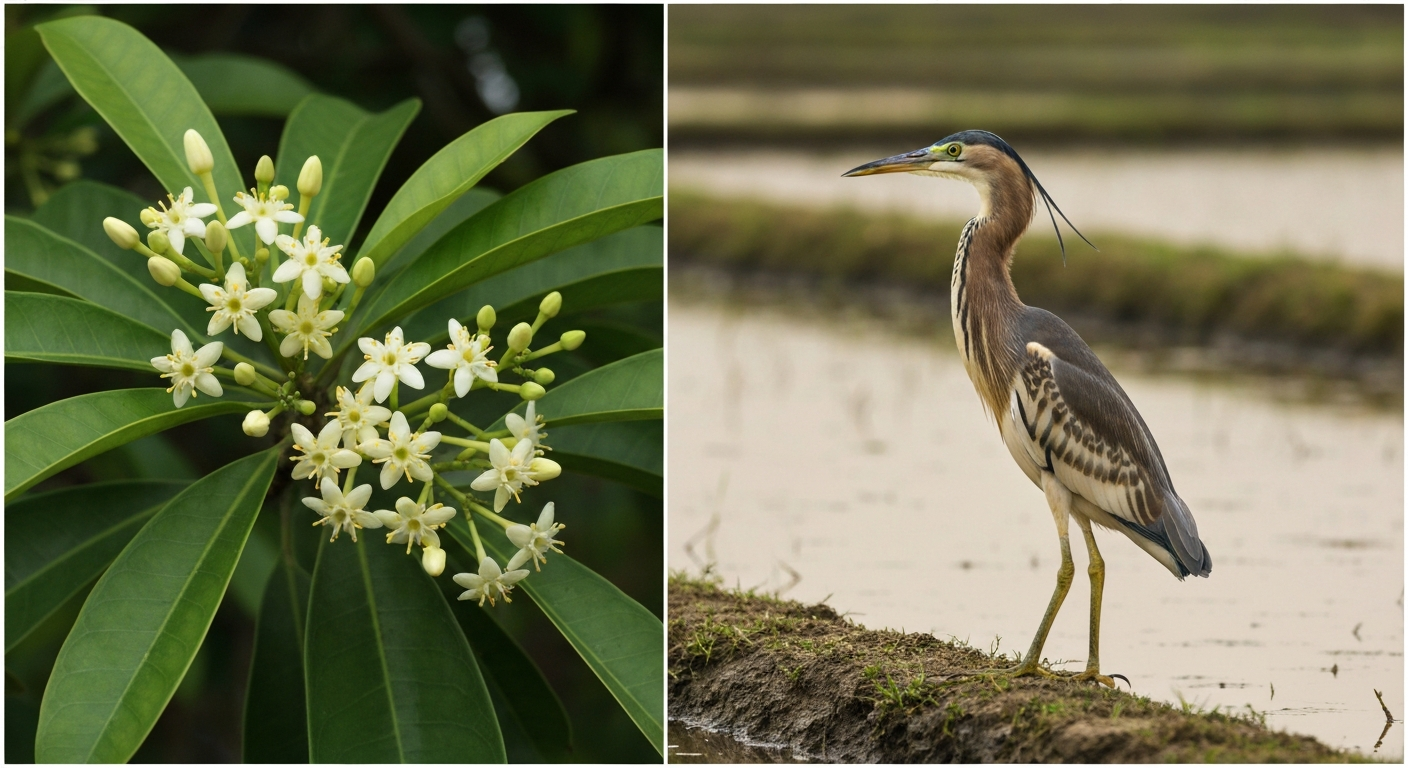
The quick answer: tree, bird, or both?
'Bakula' operates in two distinct semantic streams in South Asian languages, and confusing them is very easy. The classical, literary stream points to a tree. The dialectal, everyday bird-naming stream points to wading waterbirds. If you are decoding a Hindi or Bhojpuri speaker who called a waterbird at a wetland a 'bakula,' they almost certainly mean a heron or egret from the family Ardeidae. If you are reading a Tagore poem or a Sanskrit text and the word 'bakula' or 'bakul' appears, it is the fragrant Mimusops elengi tree or its tiny star-shaped flowers. The overlap in everyday speech is real and documented, and this article untangles both meanings.
Etymology, pronunciation, and how the name travels across regions
The word 'bakula' traces back to Sanskrit bākula (also written vakula), recorded in classical lexica including Monier-Williams. In its original Sanskrit context the word denotes Mimusops elengi, the Indian medlar or Spanish cherry tree. Some etymological treatments suggest a possible Dravidian substrate origin, though the classical attestations are firmly Sanskrit. Merriam-Webster lists 'bakula' as an English loanword with the pronunciation ˈbəkələ and defines it straightforwardly as the Spanish cherry tree. That borrowing into English reflects the botanical rather than the avian meaning.
Across the modern Indo-Aryan languages, the spelling and pronunciation shift slightly by region. In Bengali it is বকুল (bakul) or বকুলা (bakula). In Hindi and Marathi the Devanagari forms बकुल and बकुला are both used. Romanized variants you will encounter in print and online include bakul, bakula, bakool, and bakoolah. Wiktionary, 'Bakul' entry (variants and script forms) lists bakul, bakula, bakool and bakoolah and shows Devanagari बकुल/बकुला and Bengali বকুল/বকুলা Wiktionary — 'Bakul' entry (variants and script forms). All of these forms are effectively interchangeable depending on the script and language of the source. The critical point for bird-meaning research is that in many spoken northern Indian dialects, particularly Bhojpuri and related registers, the form बकुला shifted to cover the same referent as बगुला (bagula, meaning heron), possibly through phonological proximity and the frequent presence of herons near the same riparian and wetland environments where bakul trees grow.
What the bird actually looks like: identification clues
Because 'bakula' as a bird name can refer to several Ardeidae species depending on the locality, it helps to know the field marks of the most likely candidates. The Indian Pond Heron (Ardeola grayii) is the dominant candidate for most northern Indian contexts. Standing roughly 42 to 45 centimeters tall, it is a compact, stocky wading bird. In non-breeding plumage it looks almost entirely streaked brown and buff while it stands motionless at the edge of a pond or paddy field, making it deceptively inconspicuous. The diagnostic moment comes when it takes flight: suddenly, brilliant white wings appear, producing a striking contrast that makes the bird look completely different from the dull form crouching at the waterside. This 'flash of white' is the field mark most commonly remarked upon by regional observers.
The call of the Indian Pond Heron is a rough, hoarse croak, less musical than its reed-bed relatives and typically heard at dusk or when the bird is flushed. Verified recordings are available through the Macaulay Library (example: ML108956) and Xeno-canto, both of which are the standard reference repositories for South Asian bird vocalizations. Habitat is shallow freshwater: rice paddies, village tanks, river margins, mangrove edges, and roadside ditches. It is genuinely one of the most familiar waterbirds across the Indian subcontinent, which likely explains why a colloquial regional name for it would end up well established in local speech.
Which specific species is 'bakula' most likely to mean by region
No single official taxonomic assignment exists for 'bakula' as a bird name, which is an important caution. Regional vernacular names are not standardized, and Bhojpuri and related dialect bird-name compilations show 'bakula' attached to several Ardeidae species. The table below maps the most likely species matches with a confidence assessment.
| Species | Scientific name | Likely region | Confidence | Key distinguishing feature |
|---|---|---|---|---|
| Indian Pond Heron | Ardeola grayii | Northern India, Bangladesh, Nepal | High | White wings flash in flight; streaked brown at rest |
| Little Egret | Egretta garzetta | Widespread South Asia | Moderate | All white; black bill; yellow feet |
| Grey Heron | Ardea cinerea | Widespread South Asia | Moderate | Large (90–98 cm); grey, black, and white plumage |
| Black-crowned Night Heron | Nycticorax nycticorax | Wetlands across South Asia | Low–Moderate | Stocky; black cap; red eye; crepuscular |
| Black Bittern | Ixobrychus flavicollis | South and Southeast Asia | Low | Dark sooty plumage; secretive reed-bed habitat |
The Indian Pond Heron earns the highest confidence rating because it is by far the most common and widely encountered Ardeidae species across the agricultural and village landscapes of northern India where 'bakula' as a bird name is most frequently recorded. If someone in rural Bihar or Uttar Pradesh points to a waterbird and calls it a 'bakula,' the odds strongly favor Ardeola grayii. However, it is honest to acknowledge that without a direct ethnobiological survey tying the name to the species in a specific locality, a degree of uncertainty remains. Context, geography, and the speaker's description of the bird should all inform any confident identification.
Symbolism: what bakula means in folklore, religion, and literature
The richest symbolic tradition around 'bakula' belongs to the tree meaning, not the bird. In South Asian literary and religious culture, the bakul flower (Mimusops elengi) is a symbol of fragrant, enduring beauty, quiet devotion, and the bittersweet passage of time. The tree is associated with Vishnu and appears in temple gardens and ritual garlands across India. Ayurvedic texts reference 'bakuladya taila,' a medicated oil preparation, and the flowers are used in offerings, strung as garlands for deities, and scattered at shrines. In Bengal, the bakul flower is so culturally embedded that it functions almost the way cherry blossoms do in Japanese aesthetics: an emblem of transient loveliness.
Rabindranath Tagore returned to the bakul repeatedly across his poetry and songs. Lines referencing বকুল (bakul) in his songs evoke evening breezes, half-remembered longing, and the mingling of fragrance with memory. For Bengali readers, the word alone carries enormous emotional freight. It is one of those cases where a plant name becomes a poetic shorthand for a whole atmosphere of feeling. None of that symbolism transfers directly to the bird usage, which is a separate linguistic development.
The bird meaning, where 'bakula' overlaps with 'bagula' (heron/egret), inherits the symbolic associations of the heron in South Asian culture. The heron and egret in Hindi-Urdu folk tradition are often associated with patience, stillness, and a certain watchful cunning. Egrets standing motionless beside grazing cattle or at the water's edge were a familiar sight to rural communities, and this stillness fed directly into idiomatic use. A bird that waits absolutely without moving, then strikes with sudden precision, naturally accumulates metaphorical meaning around deception, pretense, and hidden intent.
Idiomatic and figurative uses you will actually encounter
The most important idiom to know in this territory is not one that uses 'bakula' directly but one that uses its near-synonym 'bagula': the Hindi-Urdu expression बगुला भगत (bagula bhagat), literally 'heron devotee' or 'heron saint.' It refers to someone who adopts an outward appearance of piety or virtue while harboring selfish or predatory intentions, exactly like a heron standing motionless and apparently serene at the water's edge, waiting to snatch a fish. It is a sharp, vivid idiom and appears frequently in Urdu proverb collections and Hindi literature. Because 'bakula' is used interchangeably with 'bagula' in several dialects, the figurative charge of the heron image attaches to 'bakula' in those speech communities as well.
In its tree-meaning register, 'bakula' or 'bakul' appears as a figurative word for something beautiful, fragrant, and fleeting. Bengali poets use it to signal nostalgia and the sweetness of impermanence. Saying someone 'smells of bakul' or associating a memory with bakul flowers is a way of invoking tender, transient loveliness, not serenity or cunning. The two figurative registers, deceptive stillness from the bird meaning and fragrant ephemerality from the tree meaning, coexist in the same word family without much risk of confusion when context is clear.
How bakula compares to other similar-sounding bird names
Because the name 'bakula' sits close in sound to several other South Asian bird names, confusion is genuinely common. For the unrelated barbet and its distinct meaning, see barbet bird meaning. For the bater bird meaning in English, note that 'bater' commonly refers to small gamebirds such as quail rather than herons. Bagla, barbet, bater, baya, and bok are all names you might encounter in similar research contexts, and each refers to something distinct. For the baya (baya weaver) and its English meaning, see the baya bird meaning in English (reference id 4369d9be-3a8e-4ff9-acd1-a2d965de6c1e). The table below gives a practical disambiguation at a glance.
| Name | Primary English meaning | Likely species / family | Language / region of main use | Key confusion risk with bakula |
|---|---|---|---|---|
| Bakula (bird sense) | Heron or egret (dialectal) | Ardeidae, esp. Indian Pond Heron (Ardeola grayii) | Hindi, Bhojpuri (northern India) | Is itself the source of confusion: tree vs. bird meanings |
| Bagla / Bagula | Heron or egret | Ardeidae (general) | Hindi-Urdu (widespread) | Phonetically closest; bakula is often a variant form of bagula |
| Barbet | Stocky, colorful forest bird with a stout bill | Megalaimidae (Asian barbets) | English; South Asian vernaculars vary | Completely different bird; name sounds vaguely similar to English ear |
| Bater | Quail | Coturnix coturnix / C. coromandelica | Urdu, Hindi | Completely different; small ground-dwelling gamebird, not a waterbird |
| Baya | Weaver bird | Ploceus philippinus (Baya Weaver) | Hindi, widespread South Asia | Completely different; famous for intricate woven nest |
| Bok | Heron (in some South/Southeast Asian languages) | Ardeidae (various) | Regional South/Southeast Asia | Moderate: also a heron family name, could overlap in meaning |
The most important caution in this cluster is the bakula-bagla pair. Because these are phonological variants of the same word in many dialects, any source that mentions a 'bakula bird' is almost certainly describing what a bagla or bagula source would call a heron or egret. For details see the entry on bagla bird meaning in English, which explains the term's avian sense and regional variants. They are not two different birds; they are two regional pronunciations of the same bird name. Barbet, bater, and baya are phonetically suggestive to English-speaking readers but refer to entirely unrelated species. Bok, used in some South and Southeast Asian traditions to denote herons, is worth cross-referencing if you are working with sources from those regions. If you need clarification from English-language sources, see 'bok bird meaning in English' for how 'bok' is used in some South and Southeast Asian traditions to denote herons.
A practical note on uncertainty, sources, and further reading
Because 'bakula' as a bird name is a dialectal and non-standardized vernacular term, any confident species identification should be treated as a working hypothesis rather than a fixed fact. The most reliable way to verify which species a local speaker means is to ask for a description or observe the bird directly in the field. For confirmed audio reference, Xeno-canto and the Macaulay Library are the go-to repositories for all candidate Ardeidae species, and both are freely accessible online. Xeno‑canto hosts species recordings including Little Egret (Egretta garzetta) that serve as field‑call examples Xeno‑canto species recordings (example: Egretta garzetta). For the botanical and literary meanings, Monier-Williams's Sanskrit-English Dictionary, eFlora of India's Mimusops elengi entry, and Merriam-Webster's 'bakula' entry are solid starting points. The IIT Bombay Hindi Shabda-Mitra lexical database is the clearest academic source confirming the बकुला to बगुला synonymy in Hindi lexicography.
From a conservation standpoint, the Indian Pond Heron (the most likely bakula bird species) is currently listed as Least Concern by the IUCN, with a stable and widespread population across the Indian subcontinent. Loss of shallow wetland habitat and rice-paddy conversion are the primary ongoing pressures on the species, as they are for most Ardeidae in the region. If you are researching bakula in a wildlife or conservation context rather than a linguistic one, the species account on the IUCN Red List and Birds of India field guides are the appropriate references.
FAQ
What does 'bakula bird' mean in English — is it a specific species or a name with multiple meanings?
'Bakula' most reliably refers to the fragrant bakul tree (Mimusops elengi) in classical South Asian usage, but in many modern Indo‑Aryan dialects the spoken form 'bakula/बकुला/বকুলা' is also used as a local name for wading birds (herons, egrets, bitterns). So 'bakula bird' is not a single, universally agreed species — it can mean either the tree's floral motif or, regionally, several Ardeidae species (see specific candidates below).
Concise evidence‑based definition for a publication: how should I define 'bakula bird' in one sentence?
'Bakula bird' (regional usage) — a dialectal name applied in parts of South Asia to various herons and egrets (family Ardeidae); otherwise, 'bakula' primarily denotes the bakul tree (Mimusops elengi) and its fragrant flowers in classical sources.
Which bird species is 'bakula' most likely to refer to regionally?
Depending on locality and context, speakers using 'bakula' for a bird are likely referring to common Ardeidae of South Asia such as Indian Pond Heron (Ardeola grayii), Little Egret (Egretta garzetta), Grey Heron (Ardea cinerea), Black Bittern (Ixobrychus flavicollis) or Night Herons (Nycticorax spp.). Exact identity varies by dialect and habitat; field verification (photo/audio) is recommended when precision matters.
How certain are species identifications when someone calls a bird 'bakula' in South Asia?
Certainty is low-to-moderate without additional context. 'Bakula' as a bird name is dialectal and can label several Ardeidae species. Use habitat, plumage notes (e.g., white wings in flight), size, and vocalizations to narrow to a specific species; consult local checklists or ask the observer for a photo or call recording for reliable ID.
What identification clues (appearance, call, habitat) help identify which Ardeidae 'bakula' refers to?
Key clues: habitat — shallow freshwater wetlands, rice paddies and margins suggest Indian Pond Heron or little egret; plumage — Pond Heron non‑breeding streaked brown, shows white wings in flight; Little Egret small, mostly white; Grey Heron large and grey with long neck; bitterns secretive and shorter with streaky brown. Calls and behaviour (e.g., foraging stance, flight silhouette) help further; use Xeno‑canto/Macaulay Library for reference calls.
What is the etymology and pronunciation of 'bakula' and its variants?
Etymology: classical Sanskrit bakula (बकुल/वकुल) denotes the bakul tree (Mimusops elengi) and its flowers; some sources suggest Dravidian substrate influences. Pronunciation variants and romanizations include bakul, bakula, bakool, bakoolah; Devanagari बकुल/बकुला and Bengali বকুল/বকুলা. Dictionaries (Monier‑Williams, Merriam‑Webster) give pronunciations such as ˈbəkələ for the loanword form.
Next Article
Munster Bird Meaning: Folklore, Symbolism, and How to Verify
Meaning of Munster bird searches: folklore, symbolism, idioms, spelling variants, and quick ways to verify the reference