
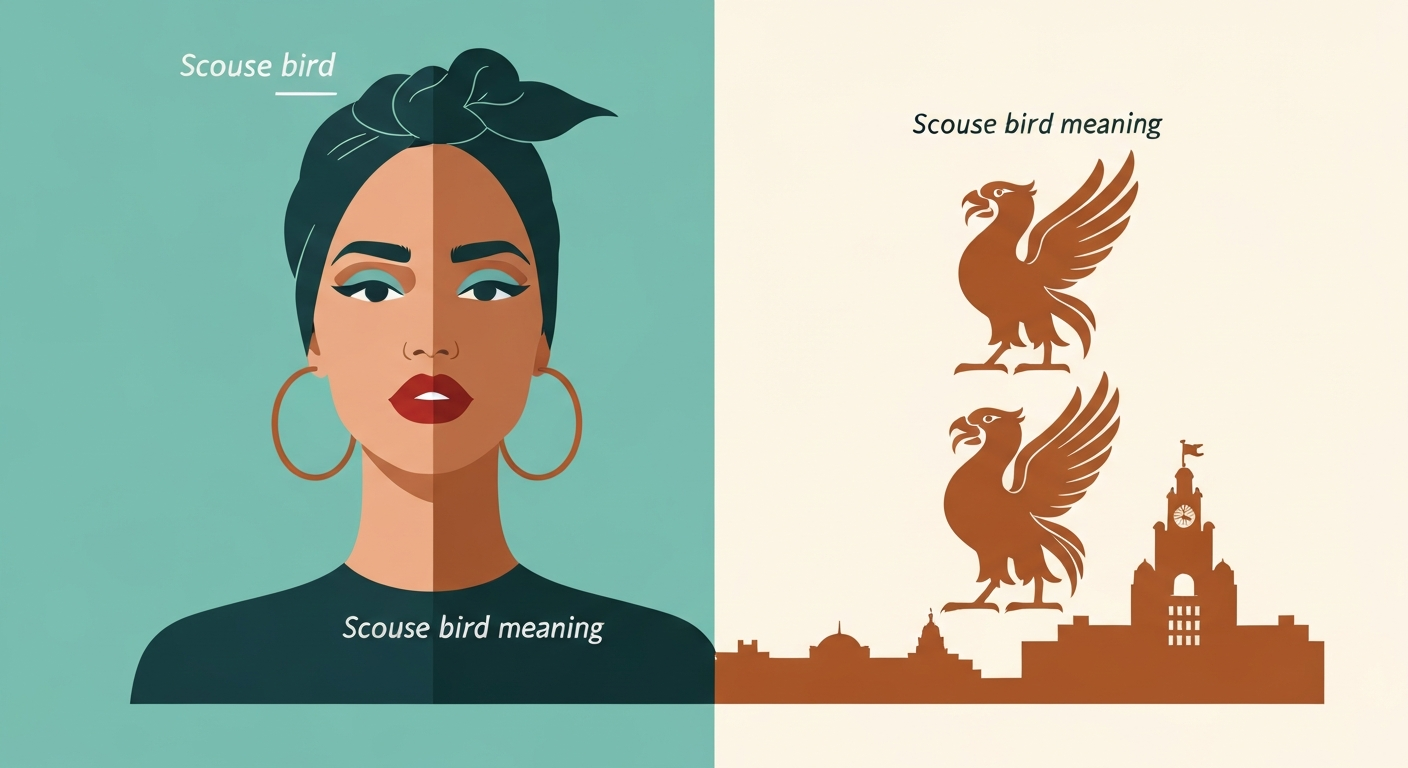
A 'Scouse bird' is a woman from Liverpool. It combines 'Scouse' (the informal term for Liverpool people and their distinctive dialect) with 'bird' (long-standing British slang for a girl or young woman). The phrase is most commonly used affectionately or neutrally within Liverpool itself and by those familiar with the city's culture, but it carries a gendered edge that makes it feel outdated or offensive to others. There is no actual bird species called a Scouse bird, so if you landed here from a wildlife search, the phrase you want is probably the Liver Bird, Liverpool's heraldic emblem.
Scouse Bird Meaning: Definition, Slang Use & Liverpool Context

Marcus Blackwell
16 Jul 2026
Quick definitions: literal and slang meanings at a glance
There are two ways someone might encounter 'Scouse bird,' and they point in completely different directions.
| Sense | Meaning | Example context |
|---|---|---|
| Slang (most common) | A woman from Liverpool, England | Everyday conversation, social media, blogs, merchandise |
| Misread literal | A bird species from Liverpool or with a Scouse connection | Wildlife/ornithology searches — this sense does not exist |
| Identity/brand label | A self-identifying term used proudly by Liverpudlian women | Blogs, podcasts, small businesses, local media |
| Heraldic (often confused) | The Liver Bird — Liverpool's mythical civic emblem | Coat of arms, Royal Liver Building, Liverpool FC crest |
The slang sense is the one that matters linguistically. The heraldic Liver Bird is its own topic entirely, and confusing the two is extremely common in online searches, so I will address that distinction properly further below. If you were actually looking for 'pirate bird meaning' (a different topic), see that entry for clarification.
What 'Scouse' actually means, accent, people and local identity
The word 'Scouse' comes from 'lobscouse,' a cheap sailor's stew associated with Liverpool's port history. Over time it transferred first to the people of Liverpool and then to the dialect they speak. Today both Cambridge and Merriam-Webster record 'Scouse' as the Liverpool accent and demonym, it functions as an adjective ('a Scouse accent'), a noun for the dialect ('he speaks Scouse'), and a noun for a Liverpool native ('she's a Scouser'). The accent itself is unmistakable: rapid, melodic, with distinctive vowel sounds that mark it out immediately from the surrounding Lancashire and Cheshire speech varieties.
Linguists at the University of Liverpool have studied Scouse as a locally indexical dialect, meaning that speaking Scouse signals belonging to Liverpool in a way that goes well beyond pronunciation. Research on Liverpool and Wirral speech (published in Cambridge's English Today) documents how even slight differences within the region carry social meaning. Being 'Scouse' is, in short, a point of identity, pride, and sometimes stereotype, all of which feed into what it means to be called a 'Scouse bird.'
British slang: the long history of 'bird' meaning a woman
British English has used 'bird' as informal slang for a girl or young woman for well over a century. The OED traces early attestations to around 1852, and the usage likely evolved from the Middle English word 'burde,' meaning a young woman. By the mid-20th century the slang sense was widespread across the UK. Collins English Dictionary lists it as a current British informal term, while Oxford Advanced Learner's Dictionary flags it as 'old-fashioned, slang' and notes it can be offensive, two descriptions that capture the word's dual status perfectly.
In practice, British speakers use 'bird' across a wide register. 'My bird' means girlfriend in casual northern and Midlands speech without any intended slight. At the same time, Urban Dictionary's crowd-sourced entries capture how 'bird' can shade toward the dismissive or objectifying depending on context. Reddit threads in communities like r/AskBrits show the same split: many UK users describe the word as entirely neutral and routine, while others call it patronising or dated. The tone, the speaker, and the relationship between speaker and subject are what determine which end of that spectrum the word lands on.
Putting the two together: what 'Scouse bird' typically refers to
Combine Scouse (a Liverpool person) with bird (a woman) and the meaning is straightforward: a woman from Liverpool. What makes the phrase more interesting is the cultural weight it carries. Academic research on gender and language, including peer-reviewed work published on ResearchGate examining what scholars call the 'enregisterment' of the Scouse bird persona, shows that the phrase has evolved into a recognised social stereotype. That stereotype encompasses specific styling cues (think large hair, dramatic makeup, fake tan, high heels), a confident and outspoken attitude, and sharp Scouse wit. The term functions simultaneously as a persona, a regional identity marker, and a gendered label.
Scholars describe this as a 'gendered local persona', a socially shared image attached to a place. That dual quality is what makes 'Scouse bird' so linguistically interesting: it can be an empowering self-description for Liverpudlian women reclaiming a stereotype, or it can be wielded as a reductive put-down depending entirely on who is using it and how.
Urban Dictionary and how people use the phrase online today
Urban Dictionary entries for 'Scouse bird' lean positive, written largely by Liverpudlians or people affectionately familiar with the city. Common themes across submissions include: confident, glamorous, funny, fiercely loyal, loves a night out, and proud of her city. The entries tend to celebrate rather than mock, reflecting the self-identifying use of the term in Liverpool's own online communities.
On social media, 'Scouse Bird' appears prominently as a brand name. Scouse Bird Blogs is one of the most well-known examples, a blog and merchandise operation that uses the phrase deliberately as a place-based, positive identity label for Liverpool women. The Guide Liverpool has featured content from this outlet, embedding the phrase in mainstream local media. On Twitter and Instagram, the hashtag appears in contexts ranging from self-deprecating humour to genuine regional pride, tourist curiosity, and the occasional outsider using it less charitably.
Examples in context: affectionate, neutral and derogatory tones
Seeing the phrase in actual sentences makes its tonal range much clearer than a definition alone can.
| Tone | Example sentence | What makes it that tone |
|---|---|---|
| Affectionate / proud | 'She's a proper Scouse bird — wouldn't swap her for the world.' | Said by a Liverpudlian about a friend; 'proper' reinforces local pride |
| Neutral / descriptive | 'Half the cast were Scouse birds from the same estate in Toxteth.' | Documentary or journalistic register; simply geographic and gendered |
| Self-identifying / reclaiming | 'Scouse Bird Blogs — by us, for us.' | Community branding; the speaker owns the label deliberately |
| Cheeky / laddish | 'She was a Scouse bird, straight-talking, no messing.' | Admiring but casual; acceptable within many peer groups, eyebrow-raising outside them |
| Derogatory | 'Just another Scouse bird thinking she's it.' | Dismissive framing; the phrase becomes an insult via context and speaker attitude |
The sentences above use identical words but land very differently. That is the crux of why this phrase needs handling carefully.
Tone, connotation and register: friendly, cheeky or offensive?
Whether 'Scouse bird' reads as friendly or offensive depends on three things: who says it, who hears it, and what surrounds it. Within Liverpool, especially among women who identify as Scousers, the phrase is often warm and communal. It indexes a shared identity in the same way a New Yorker might say 'a Brooklyn girl' with unmistakable affection. The 'Scouse bird' persona as documented in academic literature carries counterhegemonic qualities, Liverpudlian women sometimes use the label to push back against both class prejudice and the expectation that they should be demure.
Step outside that community and the phrase becomes more loaded. BBC Editorial Guidelines caution against language that may cause unjustified offence on the basis of gender, and 'bird' specifically sits in the zone where reasonable people disagree. A male outsider describing a group of Liverpool women as 'Scouse birds' in a written article is working with a very different register than a Liverpudlian woman using the same phrase about herself and her friends. Age matters too: the term feels entirely natural to older Liverpudlians and quite dated to others.
The Liver Bird: a completely different kind of 'bird'
A significant share of people who search 'Scouse bird meaning' are actually thinking of the Liver Bird, Liverpool's heraldic symbol. The two are unrelated in meaning, origin, and use, and it is worth separating them clearly. If you meant the phrase 'lute meaning bird' (a different topic about bird terminology), see the related note on lute meaning bird for that distinct lexical discussion.
The Liver Bird is a mythical creature resembling a cormorant that has appeared on Liverpool's coat of arms for centuries. The two copper sculptures on top of the Royal Liver Building (completed 1911) are among the city's most recognisable landmarks, and Liverpool's museum materials document the bird's role as a civic emblem stretching back to the city's earliest heraldic records. Liverpool FC also uses a stylised Liver Bird in its club crest, a formal, registered trademark that is legally and visually distinct from any slang usage of the word 'bird. For more detail on Liverpool FC bird meaning, see the section about the club crest and how the stylised Liver Bird functions as a formal emblem of the team. See discussions such as luffy meaning bird reddit for examples of how online searches can mix slang and pop-culture references. blank" rel="noopener noreferrer">Liverpool FC Brand Guidelines (May 2016) show the Liver Bird is used as the club's formal, registered emblem distinct from slang uses of 'bird'. ' If you are researching Liverpool FC's emblem or the city's heraldic history, that is an entirely separate thread, and it connects more naturally to topics like the Liverpool FC bird and the Liver Bird as a symbol of civic identity. For a separate topic concerning the phrase 'luffy' and its bird-related sense, see luffy meaning bird.
When to avoid the phrase, practical guidance
If you are a writer, translator, visitor to Liverpool, or someone producing professional content, here is straightforward guidance on when 'Scouse bird' is fine to use and when it is better avoided.
- Use it freely when quoting a Liverpudlian who uses it themselves, especially in self-identification.
- Use it in informal creative writing or fiction set in Liverpool when character voice demands authenticity.
- Avoid it in formal journalism, official reports, HR documents, or any professional context where gendered slang would be inappropriate.
- Avoid it if you are not from Liverpool and the audience does not share the cultural context — it can read as condescending or mocking from an outsider.
- Avoid it in translated content: the phrase has no direct equivalent in most languages and the gendered slang element will likely either disappear or cause unintended offence.
- If you are visiting Liverpool and unsure: listen to how local women use it about themselves. Follow their lead.
Neutral alternatives worth knowing
| Instead of | Try | Notes |
|---|---|---|
| Scouse bird | Liverpudlian woman | Formal, unambiguous, no gendered slang |
| Scouse bird | woman from Liverpool | Clear and neutral in all registers |
| Scouse bird | Scouser (for the person, not gendered) | Removes the gendered element; widely accepted |
| Scouse birds (plural) | Liverpool women / women from Liverpool | Works in both journalistic and everyday contexts |
How this fits into the broader language of birds and identity
It is worth noting that 'Scouse bird' belongs to a much wider tradition of using bird language to describe people and places. British English is full of bird-based idioms and slang, from 'bird' as slang for a prison sentence to the 'early bird' of common proverb. The Liver Bird sits in a separate symbolic tradition altogether, functioning more like heraldic and mythological birds that carry civic meaning rather than personal description, closer in spirit to the ravens of the Tower of London than to colloquial speech. Similarly, the 'lifer bird' in birding culture and the 'frigate bird' in maritime folklore represent entirely different registers where birds carry symbolic or subcultural weight. 'Scouse bird' is unusual in that it bridges local dialect, gendered slang, and a contested but real community identity all at once.
That layering is what makes it worth understanding properly rather than reaching for a quick definition. The phrase means different things to a Liverpudlian woman saying it about herself, a linguist studying regional identity, a tourist who overheard it, and a search engine user who typed it in hoping to identify a wading bird. Knowing which meaning you are dealing with, and who holds it, is most of the work.
FAQ
What does the phrase “Scouse bird” mean — literal and slang senses?
Literal: a bird (animal) found in the Liverpool area — rarely used. Slang: an informal British expression meaning a woman from Liverpool (a Scouser). Depending on context it can mean simply ‘a Scouse woman,’ ‘my girlfriend’ (colloquial), or a locally enregistered persona/stereotype (‘the Scouse bird’ as a particular style/identity).
What does ‘Scouse’ mean?
‘Scouse’ is the demonym and dialect label for people and speech from Liverpool. It refers to the accent, local vocabulary, and the city’s cultural identity; people from Liverpool are regularly called Scousers and described as Scouse.
How is ‘bird’ used in British slang?
In British English, especially informal speech, ‘bird’ is a slang word for a girl or young woman (e.g., ‘my bird’ = my girlfriend). Dictionaries record both neutral/affectionate uses and older/derogatory senses; tone, speaker and context determine whether it’s harmless or offensive.
Where does the ‘bird’ sense come from and is it old or new?
The ‘bird’ meaning for a woman goes back through English history (Middle English roots) with slang attestations from the 19th century and wider use in 20th‑century British slang. Its modern colloquial use remains widespread but variable in perceived politeness.
How is ‘Scouse bird’ used in contemporary Liverpool culture?
It appears in everyday speech, social media, local blogs, merchandise and as a self‑identifying label. Uses range from affectionate or humorous (‘she’s a Scouse bird’) to performative identity (a stylized ‘Scouse bird’ persona in dress and speech). Academics note it is an enregistered, gendered local persona that can be empowering or contested.
Is ‘Scouse bird’ offensive?
It can be either neutral/affectionate or patronising/derogatory — context matters. If used respectfully in informal local contexts it’s often accepted; used by outsiders, in formal writing, or in a demeaning tone it can read as objectifying or sexist. When in doubt, avoid it in formal or editorial contexts.