In the 2024 animated film Flow, the secretary bird is a full character, not a background detail. It's one of the animal companions who ends up on a small boat after catastrophic flooding, and its symbolic weight in the film comes from what the secretary bird actually is in the real world: a long-legged, sharp-eyed predator from sub-Saharan Africa that is built for calculated, ground-level power. The film uses that biology deliberately. The secretary bird represents vigilance, strategic strength, and the tension between dominance and vulnerability, and once you understand what the bird is, every scene it appears in clicks into place.
Flow Movie Secretary Bird Meaning Explained

Marcus Blackwell
30 May 2026
What the secretary bird actually is
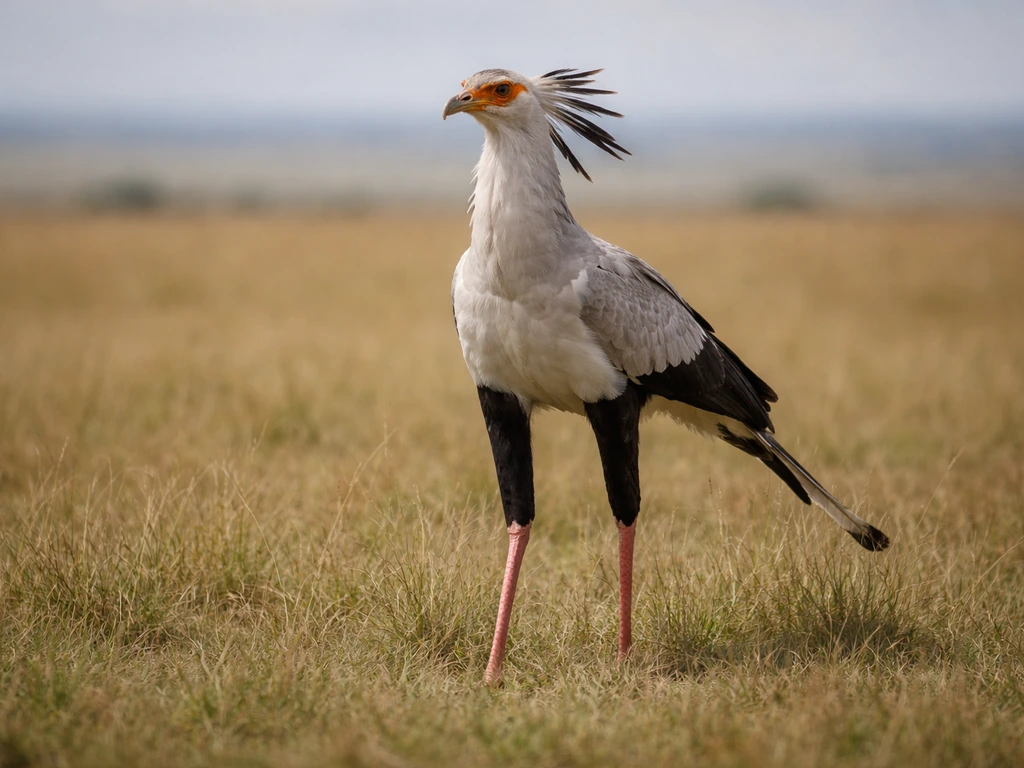
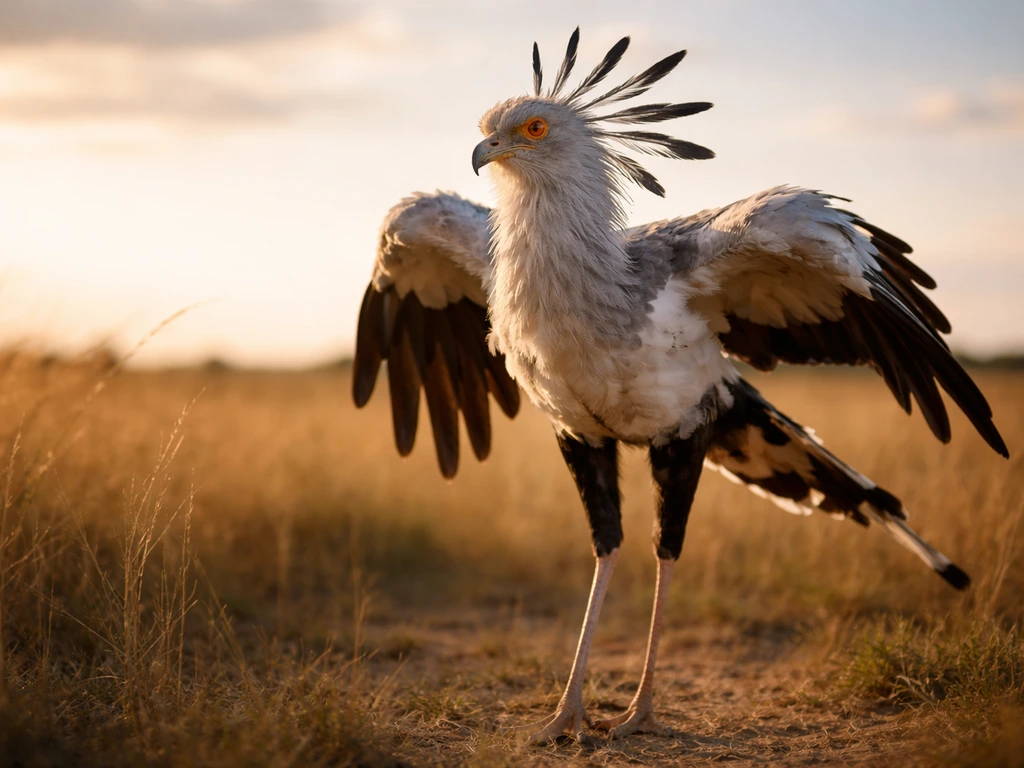
The secretary bird (Sagittarius serpentarius) is a raptor native to sub-Saharan Africa, but it looks nothing like a typical bird of prey. It stands tall on extraordinarily long legs, has a slender body, a wide wingspan, and a dramatic black crest of feathers that fans out from the back of its head. That crest is likely how the bird got its name: the quill-like plumes supposedly resembled the quill pens that 18th-century secretaries tucked behind their ears.
What makes the secretary bird genuinely unusual, and symbolically rich, is how it hunts. It does not dive from the sky like a hawk. It walks. It stalks prey on foot through grasslands, then delivers powerful, precise stomping kicks to kill snakes and other ground animals. That combination of aerial capability and terrestrial, methodical hunting is rare. The secretary bird is a creature of two worlds: sky and ground, grace and force, patience and sudden lethal action.
- Species name: Sagittarius serpentarius (Latin for 'arrow-bearing snake hunter')
- Native range: open grasslands and savannas of sub-Saharan Africa
- Key physical traits: long legs, black crest, slender body, broad wingspan
- Hunting method: ground-level stalking and stomping, not aerial diving
- Primary prey: snakes, lizards, small mammals, large insects
- National symbol of Sudan and South Africa, featured on South Africa's coat of arms
That national symbol status matters for the film's symbolism. The secretary bird carries pre-existing cultural weight as an emblem of authority, protection, and strategic power before the filmmakers even put it on screen.
How the secretary bird shows up in Flow
Flow (2024), directed by Gints Zilbalodis, is a wordless animated film. There is no dialogue, which means every character communicates entirely through behavior, posture, and visual design. The premise: a cat survives apocalyptic flooding and ends up sharing a boat with a small group of animals, including a capybara, a dog, a lemur, and a secretary bird.
The secretary bird is not just scenery. According to the film's plot, there is a flock of secretary birds, and a younger one first encounters the cat during the film's events. That younger bird pleads with the flock's leader to spare the cat's life, gets into a duel over it, loses, and ends up with an injured wing before being abandoned by its own flock. That narrative arc is crucial: the secretary bird begins as part of a rigid, hierarchical group and ends up cast out, vulnerable, and forced into the unlikely fellowship on the boat.
The key scenes to watch for are the initial flock encounter, where the hierarchy and the bird's instinct toward mercy first clash; the duel sequence, where the cost of that mercy becomes physical and real; and then the quieter moments aboard the boat, where a creature built for dominance and solitary precision has to learn communal survival. Those are the emotional beats the bird is carrying.
What the secretary bird symbolizes in the film
The secretary bird in Flow symbolizes the cost of choosing compassion over hierarchy, and the painful but necessary transformation from dominant loner to community member. That reading emerges directly from its narrative arc, but it is also reinforced by what the bird represents in cultural and natural history.
The bird arrives in the story as an emblem of power and order. Its flock has a leader, rules, a clear social structure. The younger bird's decision to advocate for the cat breaks that structure, and the consequence is exile and injury. In the context of a film about survival after catastrophe, that exile is reframed as liberation. The secretary bird, stripped of its flock's rigid hierarchy, has to find another way to exist. What it finds is the boat, and the messy, imperfect solidarity of different species figuring out how to coexist.
There is also a subtler symbolic thread here involving the bird's hunting identity. The secretary bird is, by nature, a killer of snakes: a creature associated in countless traditions with danger, deception, and hidden threat. A bird that hunts snakes carries an implicit association with clarity, the ability to see and neutralize what is concealed and lethal. In a film with no words, putting that kind of bird alongside a small, vulnerable cat is a deliberate choice. The secretary bird is the one that could be dangerous, and chooses not to be.
The themes it carries through the film
- Mercy vs. hierarchy: the bird defies its flock's authority to protect another creature
- Vulnerability as transformation: the injured wing strips away the bird's identity as a dominant predator
- Belonging: a creature built for solitary strength must learn communal dependence
- Restrained power: the secretary bird's size and capability are never fully deployed against its companions, which is itself a symbolic choice
- Watchfulness: the bird's natural vigilance makes it a guardian figure within the boat's ensemble
The cultural and folklore background behind the symbolism
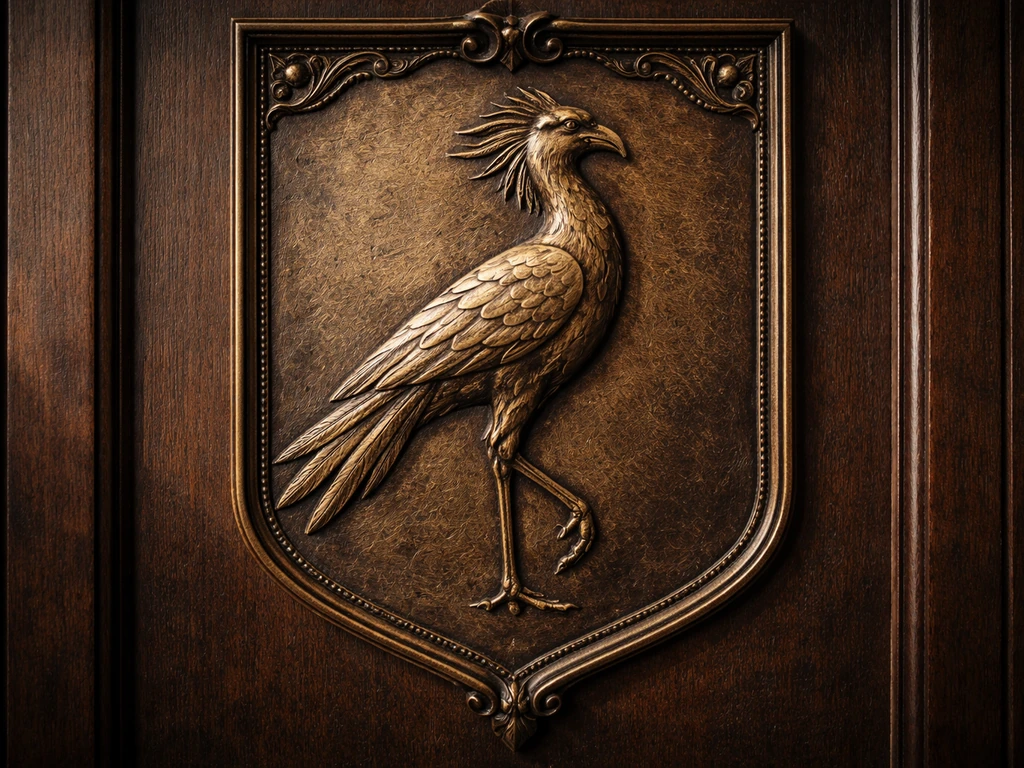
The secretary bird has carried symbolic meaning in African cultures long before any film got hold of it. In South Africa, it appears on the national coat of arms alongside a springbok and other emblems of the nation's identity: its presence signals vigilance, justice, and the protection of the state from hidden enemies (the snake-hunting function, rendered heraldic). Sudan's coat of arms also features the secretary bird, similarly connected to strength and guardianship.
In broader African folklore, the secretary bird occupies an interesting position: it is respected rather than feared. Unlike vultures or certain owls, which carry ominous associations in some traditions, the secretary bird tends to be read as a sentinel. It patrols. It watches. It deals with threats on the ground before they become aerial problems. That quality of proactive, ground-level protection maps directly onto the role the bird plays in Flow.
The Latin species name, Sagittarius serpentarius, translates roughly as 'the archer who hunts serpents.' That is a remarkable name for a bird that is used in a story about mercy and survival. The archer who hunts serpents chooses, in this film, to protect a cat instead of maintaining the serpentine logic of its flock's hierarchy. The name itself becomes part of the irony the film is working with.
It is also worth noting that the secretary bird's visual distinctiveness plays into its symbolic function. Films use visual contrast to carry meaning without words. Among the boat's ensemble, the secretary bird stands noticeably taller, more formal, more architecturally striking than the rounded capybara or the small cat. That visual authority signals 'this creature has power' before any action occurs. The filmmakers are using the bird's actual appearance as symbolic grammar.
How to read the secretary bird scenes yourself
Because Flow has no dialogue, interpreting any character requires watching body language, spatial relationships, and what each animal does or does not do. Here is a practical framework for reading the secretary bird scenes specifically.
- Watch where the bird positions itself physically. A creature that stands tall and apart is signaling status and separateness; when it moves closer to the group, that shift carries emotional weight.
- Pay attention to the injured wing after the duel. Every time the bird cannot fly or cannot use that wing, the film is showing you a dominant creature in a state of enforced humility. That is not incidental framing: it is the symbolic core of the bird's arc.
- Notice the bird's stillness versus the other animals' movement. Secretary birds are naturally watchful and still. When the film uses that stillness, it is often evoking the bird's guardian function rather than threat.
- Track the bird's relationship with the cat specifically. The cat is the film's central perspective character. How the secretary bird relates to the cat at different points in the story tells you where the bird sits thematically: adversary, guardian, reluctant companion, something else.
- Look for moments where the bird could act aggressively and does not. In a wordless film, restraint is a form of speech. A predator choosing not to predate is making an argument about community and survival.
If you want to cross-check your interpretation, compare the secretary bird's behavior to the other animals in the ensemble. The lemur, the dog, and the capybara each carry their own symbolic registers. The secretary bird's arc tends to be the most explicitly hierarchical and the most dramatically resolved, which is one reason it stands out in discussions of the film's symbolism.
Misconceptions worth clearing up
The most common confusion around 'flow movie secretary bird meaning' is the assumption that 'secretary bird' must be a metaphor or nickname for a character type, the way you might use 'secretary bird' to describe someone officious or bureaucratic. In this film, it is not a metaphor. The character is literally a secretary bird, the actual African raptor. The symbolic meaning comes from what that real bird is and does, not from any figurative slang usage.
A related confusion: some people assume the bird is a minor background character, a visual detail. It is not. The secretary bird has a defined narrative arc with a specific turning point (the duel and injury) that affects its entire role in the story. RogerEbert.com similarly highlights the secretary bird as a key companion in Flow, noting the “majestic secretary bird” among the animal group traveling on the boat after the flooding defined narrative arc with a specific turning point (the duel and injury). If you have been skimming reviews and only caught that a secretary bird is 'in' the film, you may be underestimating how much symbolic and narrative work it is doing.
There is also occasional confusion between the secretary bird and other long-legged birds that appear in symbolic or cinematic contexts, particularly cranes, storks, and herons. These birds share some visual similarities but carry very different symbolic traditions. Cranes are associated with longevity and fidelity in East Asian traditions; storks with birth and renewal in European folklore. The secretary bird's specific associations are African, heraldic, and predatory. Mixing those traditions up will send your interpretation in the wrong direction.
On this site, you may also encounter discussions of birds in related symbolic roles: the spy bird meaning explores birds as figures of secret watchfulness, the wise bird meaning looks at birds as repositories of knowledge, and the scheme bird meaning examines birds associated with cunning strategy. The secretary bird in Flow overlaps with all three of those registers at different points in its arc, but it is most closely aligned with the strategic and guardian functions rather than the purely wise or purely deceptive ones. So if you are wondering about the wise bird meaning, Flow’s version leans more toward strategic guardianship than an abstract label of wisdom.
Quick recap and how to confirm your own reading
Here is the short version: the secretary bird in Flow is a real African raptor with a distinctive visual identity, a history of heraldic authority, and a natural reputation for vigilance and snake-hunting. The film uses all of that consciously. The bird's arc, from flock hierarchy to exile to unlikely solidarity, mirrors the film's larger theme about survival requiring the abandonment of rigid dominance in favor of cooperative vulnerability.
| Element | What it represents in Flow |
|---|---|
| Long legs and tall stance | Authority and dominance within its social hierarchy |
| Crest feathers | Visual marker of distinctiveness and status among the ensemble |
| Snake-hunting identity | Capacity to deal with hidden threats; potential for lethal force |
| Flock and its leader | Rigid social order and the cost of challenging it |
| The duel and injured wing | Sacrifice and enforced vulnerability as the price of compassion |
| Life on the boat | The transformation from solitary dominance to communal dependence |
| Restraint toward companions | The film's central argument: power is meaningful when it chooses not to destroy |
To confirm your own interpretation as you watch: if the bird is being visually framed with height and stillness, read authority and watchfulness. If the injured wing is in frame, read vulnerability and transformation. If the bird is physically close to the cat, read the development of unlikely trust. The film is consistent in its visual language, and once you have the key, the secretary bird's scenes become one of the cleaner symbolic threads in the whole story.
If you want to go deeper after watching, look into the secretary bird's role in South African heraldry and the Sagittarius serpentarius etymology. Both will add texture to why the filmmakers chose this specific bird rather than, say, a crane or an eagle. The choice was not arbitrary, and tracing the bird's real-world symbolic history will make the film's use of it feel even more deliberate.
FAQ
Is “secretary bird” in Flow meant as a metaphor for an officious character?
No. In Flow, the bird is consistently treated as an actual secretary bird with its distinctive long-legs, crest, and ground-hunting posture. The meaning comes from the animal’s real behavior and cultural associations, not from a slang-style label for an “official” or “bureaucrat.”
What part of the secretary bird storyline do I need to watch closely to get the symbolism right?
If you miss the early flock scenes, you can still interpret the later boat moments, but you will lose the key contrast. The film establishes hierarchy first, then breaks it through the duel and exile, so that later solidarity feels earned rather than random.
Why does the injured wing and being left behind carry extra symbolic weight in Flow?
The injury and abandonment matter because they change the bird’s “default” social role. Without the flock, its learned dominance mechanics stop working, and the bird has to adapt to an environment where cooperation is the only stable strategy.
How should I read the secretary bird’s body language since the film has no dialogue?
Focus less on species-versus-species “morals” and more on how the bird’s posture and spacing function. Height and stillness read as sentinel authority, while closer, less guarded body language signals a shift from enforcement to coexistence.
How can I tell whether a scene is using the secretary bird’s real hunting identity versus general “bird of prey” symbolism?
A practical check is to verify whether the film frames the bird with “ground threat” cues, like stalking and foot-based action, versus sky-based diving. Secretary birds are walkers and stompers, so scenes that emphasize ground control align more strongly with the bird’s natural identity.
Is it safe to interpret the Flow secretary bird using meanings from cranes, storks, or herons?
Don’t automatically swap it with cranes, storks, or herons. Those birds come with different regional meanings, so mixing them can distort Flow’s intended emphasis on vigilant ground-level guardianship and structured hierarchy being disrupted.
What does the secretary bird symbolize before versus after it leaves its flock?
If the bird is shown as part of a rigid group, interpret it through rules, rank, and consequences. If it appears after separation, interpret it through vulnerability, learning limits, and building new social ties across species.
Does Sagittarius serpentarius etymology change how I should interpret the bird’s choice to protect the cat?
The name etymology supports the film’s irony, but the stronger takeaway is behavioral. The “archer who hunts serpents” idea mirrors how the bird is built to neutralize hidden danger, then in Flow it chooses protection and mercy toward a vulnerable cat instead.
Is the secretary bird in Flow just a symbol of vigilance, or does it represent more than that?
The bird is not only “vigilance.” In Flow it becomes a cost-bearing figure of strategic strength, meaning the film shows what dominance costs when it is challenged. That is why the duel and exile feel like the emotional pivot of its arc.
What quick rewatch checklist can help me track the secretary bird’s arc in Flow?
If you rewatch, consider using a scene checklist: flock encounter (hierarchy), duel (the cost of compassion), injured exile (vulnerability), and boat proximity (trust without control). Seeing these beats in order makes the symbolic thread much clearer.
Next Article
Munster Bird Meaning: Folklore, Symbolism, and How to Verify
Meaning of Munster bird searches: folklore, symbolism, idioms, spelling variants, and quick ways to verify the reference