
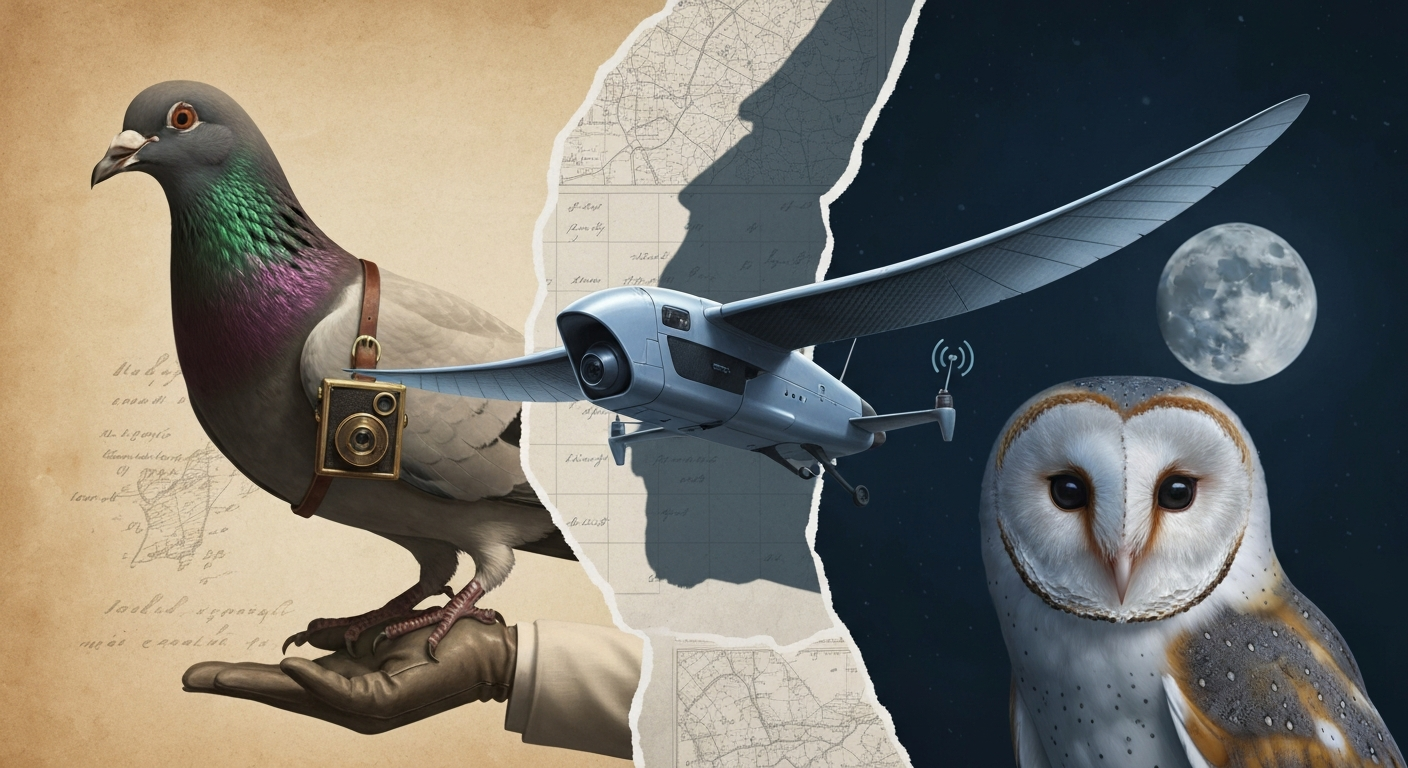
There is no single dictionary entry for 'spy bird,' but that is exactly why the phrase keeps turning up in so many different places at once. It describes a real pigeon strapped with a tiny camera in a Cold War archive, a bird-shaped drone tumbling out of the Pakistani sky, a tagged stork detained by Egyptian authorities, and an owl peering silently from a branch in a Gothic novel. Depending on the context, a spy bird can mean a literal surveillance tool, a naturally stealthy species associated with watching and knowing, or a figurative shorthand for secrecy, cunning, and the quiet transfer of information.
Spy Bird Meaning: Symbolism, Species, History & Practical Guide

Marcus Blackwell
22 Jul 2026
When you encounter the phrase 'spy bird'
You might first meet the phrase in a news headline about a wildlife tracker that border guards mistook for espionage equipment. Or you find it in a dream dictionary, a tattoo description, a fantasy novel, or a tech article about ornithopter drones. The phrase is not lexicified, meaning you will not find it as a headword in Merriam-Webster or Cambridge. What you will find is a web of related meanings that cluster around birds and the act of watching, informing, or moving unseen. That cluster is genuine and historically deep, which is why 'spy bird' keeps reappearing across such different domains.
The most useful way to decode it is to treat the phrase as a compound idea rather than a fixed term. 'Spy' carries at least three distinct weights: covert observation, the relay of secret information, and the act of noticing something others miss. Birds, meanwhile, have occupied all three of those roles in real history and in cultural imagination for centuries. Once you see the overlap, the phrase starts to make sense wherever it lands.
Literal meanings: real birds and historical surveillance
The most documented literal use of birds as spy tools involves homing pigeons. Julius Neubronner, a German apothecary, patented a breast-mounted time-delay camera for pigeons in 1907 and exhibited the resulting aerial photographs publicly before the World Wars. The technology was practical enough that military intelligence services on both sides of those conflicts took notice. By the Cold War, the CIA had developed cameras small enough for pigeons to carry on reconnaissance missions, and the agency has acknowledged these programs in its public history of 'Natural Spies.'
Homing pigeons (Columba livia domestica) are genuinely remarkable navigators. Recent genomic research has identified hippocampal and neural adaptations, including candidate magnetoreception mechanisms, that explain their ability to return home across hundreds of miles. See Genomic and Phenotypic Analyses Reveal Mechanisms Underlying Homing Ability in Pigeon, Molecular Biology and Evolution (Oxford Academic) for genomic and transcriptomic evidence linking hippocampal adaptations and candidate magnetoreception mechanisms to homing ability Genomic and Phenotypic Analyses Reveal Mechanisms Underlying Homing Ability in Pigeon — Molecular Biology and Evolution (Oxford Academic). That biological reliability is exactly what made them indispensable as message carriers in wartime. Cher Ami, the WWI pigeon associated with the rescue of the Lost Battalion at Meuse-Argonne in 1918, is perhaps the most famous example: a bird that delivered a message under fire, saving nearly 200 soldiers. The Smithsonian holds both Cher Ami's preserved body and B.F. Skinner's pigeon-guided missile nose cone from Project Pigeon (later Project Orcon), a 1940s U.S. experiment in which trained pigeons pecked visual targets to steer a missile before electronic guidance made the idea obsolete.
On the other end of literal 'spy bird' encounters are wild birds mistaken for surveillance equipment. In 2013, Egyptian authorities detained a stork carrying a satellite transmitter, initially suspecting espionage before scientists confirmed it was a standard wildlife tracking device. These incidents are more common than many people expect. Researchers in cultural anthropology have noted that such episodes tend to cluster around geopolitically tense borders, where anxiety about surveillance runs high enough to make a tagged migratory bird look suspicious. The birds themselves are entirely innocent, of course, but the episode reveals how deeply the idea of a bird-as-spy is embedded in collective imagination.
Bird-shaped surveillance devices and bird-like drones
The idea of machines that look and move like birds for surveillance purposes is no longer science fiction. Festo's SmartBird, first demonstrated publicly in 2011, is a documented ornithopter with a wingspan of roughly 2 meters and a weight of about 450 grams. It uses a bionic design modeled on the herring gull, with an onboard microcontroller and radio telemetry. Festo positioned it as an industrial research platform rather than a spy device, but engineers working on micro aerial vehicles (MAVs) frequently reference it as a benchmark for bird-mimicking flight.
Academic and engineering research on flapping-wing MAVs has grown substantially since then, with peer-reviewed papers documenting autonomous take-off, landing, and lightweight sensor payloads. The appeal for surveillance is straightforward: a device that looks and moves like a real bird is far harder to identify as a drone than a conventional quadcopter. That same year Festo showed off the SmartBird, a strange birdlike drone crashed in Pakistan, generating significant press coverage and public speculation about whose device it was and what it had been doing. That kind of ambiguity is exactly what makes bird-mimicking technology both technically interesting and culturally provocative.
If you are a writer or dream interpreter wondering whether a mechanical bird in your source material counts as a 'spy bird,' the answer is almost always yes in symbolic terms. The bird-drone concept carries the full weight of the spy-bird metaphor: it watches without being watched, moves silently through a natural environment, and reports back to an unseen handler.
Species and behaviors that evoke 'spy' imagery
Certain birds lend themselves to spy associations more naturally than others, based on their physical adaptations and behavioral traits. Here is how the most commonly cited species map onto 'spy' qualities.
Owls: silent watchers
Barn owls (Tyto alba) have leading-edge feather fringes that break up turbulence, facial discs that funnel sound, and asymmetrically placed ears that allow them to triangulate prey in complete darkness. These are not metaphors: they are documented anatomical adaptations for near-silent flight and hyper-accurate sound localization. Behavioral and neurobiological research on owls, especially the barn owl Tyto alba, documents leading‑edge feather fringes, facial discs, and ear asymmetry that enable near‑silent flight and hyper‑accurate sound localization (Evolution and Ecology of Silent Flight in Owls and Other Flying Vertebrates, PMC) Evolution and Ecology of Silent Flight in Owls and Other Flying Vertebrates — PMC (Integrative Organismal Biology, review). An owl can hear a mouse under snow from 30 meters away and reach it without making a detectable sound. That suite of abilities maps directly onto spy competencies: undetected approach, superior sensory gathering, and precision. Combined with nocturnal habits and eyes that appear to hold a fixed, knowing gaze, owls became the natural symbol for surveillance long before anyone coined the word. The wise bird meaning tied to Athena's owl in Greek tradition and the more sinister omen-bird of Roman and some Native American traditions are two sides of the same coin: a creature that knows things others do not.
Hawks and falcons: aerial observation
Hawks are daytime observers where owls are nocturnal. A red-tailed hawk perched on a highway overpass is doing exactly what a surveillance camera does: watching a wide field of movement from an elevated position. The word 'hawkeyed' entered English as a direct acknowledgment of this behavior, and military targeting systems have borrowed the visual metaphor ever since. In espionage fiction, a hawk character or hawk symbol almost always stands for the intelligence operative who watches before they act.
Swifts: speed and elusiveness
Swifts are among the fastest birds in level flight and spend more of their lives airborne than almost any other species. They are also exceptionally difficult to track. In spy contexts, swift symbolism tilts toward the messenger or courier rather than the static observer: get in, deliver the intelligence, and vanish before anyone can respond. This maps onto the darting bird quality of certain fictional spy characters and covert couriers. The swift meaning in symbolic terms emphasizes speed, agility, and the ability to pass through without leaving a trace. See the swift meaning bird entry for more on the swift's symbolism of speed, elusiveness, and its role as a messenger.
Pigeons: the original spy birds
As covered above, pigeons are the only birds with a documented, archival record of literal espionage service. Their symbolic meaning in 'spy bird' contexts is therefore unusually concrete: they are not just symbols of the concept, they are its historical origin. Messenger pigeons carried encrypted military communications, wore cameras, and inspired at least one weapons guidance project. That history makes the pigeon an unlikely but legitimate candidate for the most important actual spy bird in human history.
Secretary bird: the scheme bird
The secretary bird of sub-Saharan Africa is a raptor that hunts on foot, methodically stalking prey through grassland with a deliberate, almost administrative precision. It is the subject of its own symbolic discussion on this site (see the Flow movie secretary bird meaning entry and the scheme bird meaning entry), but it earns a mention here because its behavioral signature, patient, systematic, ground-level intelligence gathering, maps neatly onto a spy archetype that is less dramatic than the hawk but arguably more effective. See the scheme bird meaning entry for a focused discussion of the secretary bird's association with methodical, scheme-like hunting and symbolic 'ground-level' intelligence.
Figurative meanings: the full symbolic range
When writers, dreamers, or tattoo seekers use 'spy bird' as a symbolic concept rather than a literal label, they are drawing on a cluster of related figurative meanings. These meanings are not arbitrary: each one is grounded in observable bird behavior or historical association.
- Secrecy: Birds appear and disappear from view without explanation, making them natural emblems of hidden knowledge and concealed presence.
- Surveillance: The elevated vantage point of a perched or circling bird directly parallels the observer who watches without being watched.
- Vigilance: Many birds, especially sentinels like geese and crows, alert others to danger. In folklore and literature this translates to a watchful guardian figure.
- Stealth: Owls, night herons, and bitterns move through their environments with minimal disturbance, symbolizing the ability to act without leaving a trace.
- Messengership: From Homeric gods to wartime pigeons, birds have served as carriers of information between parties that cannot communicate directly. The idiom 'a little bird told me,' documented in Cambridge and Collins dictionaries with roots traceable to biblical texts and 19th-century English usage, encapsulates this figurative role perfectly.
- Speed and agility: Swifts and falcons symbolize the rapid relay of information and the ability to outmaneuver pursuit, a quality prized in both espionage and in dream symbolism about escape and freedom.
- Cunning: Ravens, crows, and magpies appear in folklore worldwide as tricksters and schemers. Their problem-solving intelligence and tendency to collect objects have made them the go-to 'scheme bird' of mythology.
- Wisdom: The Athenian owl carries this meaning most prominently, but broader bird wisdom symbolism (the wise bird meaning) connects to any species associated with deep observation and knowing what others do not.
In dreams specifically, a spy bird tends to represent either a fear of being watched or a desire to know something that is being kept from you. Tattoo interpretations generally lean toward personal resonance: someone choosing a spy bird tattoo often wants to express alertness, the keeping of secrets, or the ability to observe the world without being fully seen. The specific species matters in those contexts: an owl tattoo centers on wisdom and nocturnal vigilance, a raven on cunning and mystery, a swift on freedom and speed.
Literal vs. symbolic: a direct comparison
| Context | Spy Bird Type | Key Qualities | Representative Example |
|---|---|---|---|
| Historical military use | Homing pigeon with camera or message | Reliable navigation, covert transport, documented field use | Cher Ami (WWI); CIA pigeon cameras (Cold War) |
| Early technology | Pigeon with breast-mounted camera | Aerial photography, time-delay mechanism, public exhibition | Julius Neubronner's pigeon photography, 1907 |
| Experimental weapons | Pigeon-guided missile | Trained behavioral targeting, replaced by electronics | B.F. Skinner's Project Pigeon / Project Orcon, 1940s |
| Modern drone technology | Ornithopter / flapping-wing MAV | Bird-mimicking flight, sensor payload, harder to identify | Festo SmartBird (2011); MAV research platforms |
| Mistaken identity | Tagged wild bird (e.g., stork) | Scientific tracker misread as espionage device | Egyptian stork incident, 2013 |
| Symbolic / literary | Owl as silent watcher | Stealth, nocturnal vigilance, wisdom, observation | Athena's owl; Gothic fiction; dream symbolism |
| Symbolic / literary | Hawk as aerial observer | Elevated surveillance, precision, 'hawkeyed' vigilance | Military metaphor; espionage fiction |
| Symbolic / figurative | Pigeon or swift as messenger | Speed, information relay, covert communication | 'A little bird told me'; wartime courier narrative |
| Symbolic / cunning | Raven or crow as schemer | Trickster intelligence, collecting information, deception | Norse mythology (Odin's ravens Huginn and Muninn) |
| Film and fiction | Bird motif or bird-drone character | Surveillance stand-in, hidden observer, plot device | Spy thrillers; fantasy novels; sci-fi bird-drones |
Historical and cultural contexts
Messenger pigeons and wartime intelligence
The use of pigeons to carry military intelligence predates modern espionage by centuries. By the time of the First World War, organized pigeon lofts were standard military infrastructure. Cher Ami's famous 1918 flight, delivering a message that saved the Lost Battalion despite being shot through the breast and losing a leg, became one of the most celebrated instances of animal service in U.S. military history. The bird is preserved at the Smithsonian. What often gets less attention is the parallel development of pigeon-borne cameras: Neubronner's work preceded WWI, and Cold War-era refinements by U.S. intelligence agencies pushed the concept further. The CIA's own documentation confirms that pigeons fitted with cameras were used for clandestine photography during the Cold War, with the equipment now residing in agency museum collections.
Folklore and mythology
The idea of birds as information carriers for divine or supernatural intelligence is ancient and cross-cultural. In Norse mythology, Odin sent two ravens, Huginn (Thought) and Muninn (Memory), out across the world each day to gather intelligence and report back. The parallel to a spy network run by a single intelligence chief is remarkably precise. In classical Greek tradition, Athena's owl was a symbol of wisdom because it could see in the dark, which ancient Greeks read as the ability to perceive hidden truths. Roman augury treated bird flight and bird calls as messages from the gods, making every bird a potential carrier of divine intelligence. The biblical and 19th-century roots of 'a little bird told me' reach into this same tradition: birds know things, and they tell people.
Film, fiction, and modern media
Spy birds appear consistently in fiction as either literal surveillance tools or as symbolic shorthand. Alfred Hitchcock's use of birds as agents of unseen menace in 'The Birds' is perhaps the most famous Western example of avian surveillance anxiety translated into film. In fantasy and science fiction, mechanical or magical birds that report back to a controller are a recurring motif, from the mechanical owl in the original 'Clash of the Titans' to spy-drone birds in contemporary dystopian fiction. These fictional uses draw directly on the historical and mythological reservoir: the bird that watches, remembers, and reports is a deeply familiar cultural figure even when the reader or viewer has never consciously encountered the original myths.
Modern tech and the spy bird in the news
The 2011 crash of a birdlike drone in Pakistan generated substantial media coverage and public uncertainty about the device's origin and purpose. Wired and other outlets covered it as an example of how bird-mimicking surveillance technology, once a speculative concept, had entered real-world operational contexts. Alongside that, documented incidents of tagged wild birds being reported as espionage tools (the 2013 Egyptian stork being the most widely cited) have created a minor but recurring news genre: the accused spy bird. Cultural anthropologists who study border anxiety have noted that these incidents are not coincidental. They emerge from places and times where surveillance is a genuine social concern, and where the sudden appearance of a bird with unfamiliar equipment attached to it touches a pre-existing nerve about being watched from above.
If you are researching spy bird meaning for writing, a tattoo, or dream interpretation, the most useful takeaway is this: the phrase sits at a genuine intersection of documented history, biology, folklore, and modern technology. It is not a made-up metaphor. Birds have been spies, have symbolized espionage, and have been mistaken for surveillance agents across dozens of cultures and several centuries. Whichever version of the spy bird you have encountered, that long history is part of what gives it weight.
FAQ
What primary facts should I verify before writing about the literal uses of “spy bird” (animals and devices)?
Confirm documented historical uses (Julius Neubronner’s pigeon photography; Cher Ami in WWI; B.F. Skinner’s Project Pigeon/Orcon) and modern technical programs (CIA accounts of animal reconnaissance, ornithopter projects like Festo’s SmartBird). Use primary museum pages (Smithsonian), agency histories (CIA), peer‑reviewed biology/neuroscience papers for homing/navigation, and engineering conference/journal papers for flapping‑wing MAVs. Cite: Neubronner (Google Arts & Culture), Smithsonian object pages, CIA “Natural Spies,” Festo SmartBird brochure, Molecular Biology & Evolution pigeon genomics article.
Which species and species traits should I discuss that commonly evoke ‘spy’ imagery?
Cover homing/feral pigeon (Columba livia domestica) for messengership/navigation, owls (Tyto alba and others) for silent nocturnal vigilance and secrecy, raptors (hawks, falcons) for surveillance/keen sight, swifts and swallows for speed/agility, and secretary bird for watchful stalking imagery. For each, add the biological trait that supports the figurative meaning (e.g., owl silent flight—PMCID review; pigeon homing—genomics paper).
What reliable sources support claims about historical animal-based espionage or messaging?
Use primary or reputable secondary sources: CIA’s “Natural Spies” story for intelligence experiments; Smithsonian and Army museum pages for Project Pigeon, Cher Ami artifacts; History.com summary of pigeon cameras; peer‑reviewed history of technology articles when available. Where possible cite museum object pages and agency histories rather than unverified press anecdotes.
How should I present evidence about bird‑like drones and ornithopters?
Cite engineering project pages and technical brochures (Festo SmartBird) and peer‑reviewed conference/journal work on flapping‑wing MAVs. Use mainstream tech press (Wired) for public incidents (e.g., 2011 Pakistan crash) but make clear distinction between reported incidents and confirmed capabilities. Mention limits: payload, endurance, autonomy challenges (cite aerospace/robotics papers).
What examples illustrate how birds are mistaken for surveillance devices in the news?
Documented cases include the 2011 Pakistan birdlike drone crash (Wired) and the 2013 Egyptian stork detained with a satellite transmitter (news/AP coverage). Use these as case studies to show how telemetry tags or unusual devices on birds can cause suspicion—and cite the original news reports to avoid speculation.
What cultural and literary contexts should I research and cite?
Trace the idiom “a little bird told me” via learner/reference dictionaries (Cambridge, Collins) and older literary attestations; survey classical owl symbolism (Athena/Minerva) via Cambridge UP chapters on owl traditions; use folklore and anthropology essays on migration and surveillance anxieties (e.g., Cultural Anthropology field notes). For film/fiction motifs, cite specific works when used (e.g., novels or films that weaponize messenger birds or portray bird‑drones) with appropriate references.