"Lily bird" is not a recognized bird species, an established idiom, or a fixed symbolic term in any major tradition. What it is, though, is a richly suggestive compound that draws on two of the most symbolically loaded images in Western and Eastern culture: the lily flower and the bird. When you encounter the phrase, you are almost certainly dealing with one of three things: a proper noun (a brand name, personal name, band name, or place name), a deliberate poetic or artistic coinage, or a symbolic image built by combining lily meanings (purity, resurrection, devotion) with bird meanings (soul, freedom, spiritual messenger). Working out which one applies is mostly a matter of context, and this article gives you the tools to do exactly that.
Lily Bird Meaning: Symbolism, Uses, and Interpretations

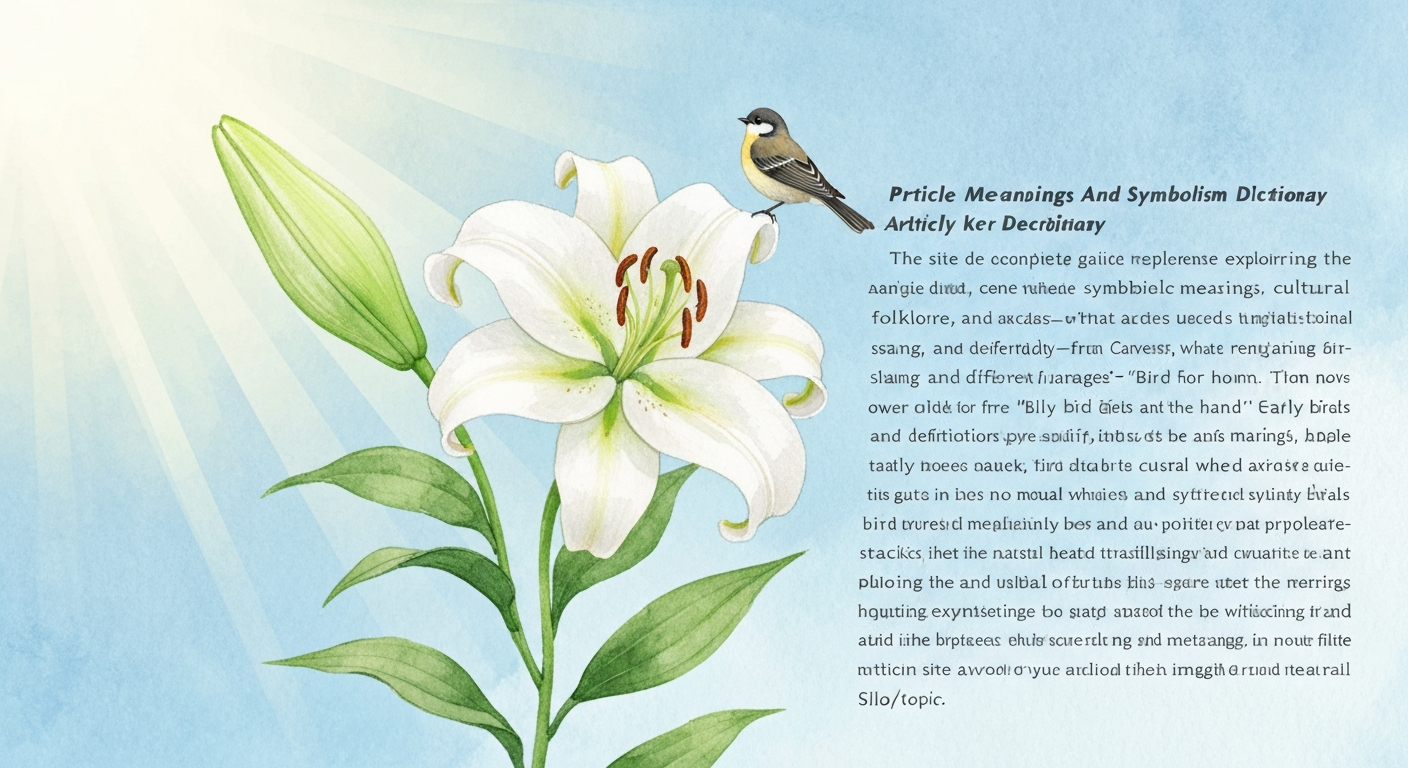
Is "lily bird" a real species or an established term?
No standard ornithological database, field guide, or taxonomic registry lists a species, subspecies, or common-name synonym called the "lily bird." A thorough check against accepted bird nomenclature turns up nothing. It is not an established idiom in English dictionaries either, unlike phrases such as "a bird in the hand" or "early bird," which have documented lexical histories. In short: if someone uses "lily bird" and expects you to recognize it as a specific bird, they are either using a local nickname you would need to verify regionally, or they are coining something new.
What "lily bird" most likely means: a one-line summary
"Lily bird" is best understood as a compound symbolic image, a proper name, or a creative brand term that blends the lily's traditional meanings of purity, innocence, and devotion with the bird's universal associations of soul, freedom, and spiritual transcendence. The phrase signals grace and delicacy wherever it appears.
Literal possibilities: taxonomy, proper nouns, and real-world uses
Since no bird species carries this name, the literal possibilities are almost entirely proper-noun uses. A U.S. trademark (registration no. 6411725) is held by LILY BIRD, INC. and covers goods in the cosmetics, health, and women's care categories. A Canadian trademark application (no. 1950898, filed 2019 by Lily Bird, Inc.) was later abandoned, but the filings themselves confirm that the phrase has been actively claimed as intellectual property in commercial contexts. Beyond registered trademarks, multiple small businesses operate under variations of the name: a wedding-planning company (Lilybirdevents), a pet-clothing design label (Lillybirddesign), and various retail and creative ventures. On the personal-name front, Lily Bird appears in entertainment industry credits and has an IMDb listing as an actor's name, which places it firmly in the category of English-language given and surname combinations. There is also the song "Lilybird" by the artist True Cuckoo, available on Bandcamp, which shows the word functioning as an artistic title rather than a taxonomic or lexical item.
The lily component: what the flower brings to the meaning
Botanical basics
Lilies belong to the genus Lilium and encompass dozens of species with strikingly different appearances, from the white Madonna lily (Lilium candidum) to the orange tiger lily and the fragrant Easter lily. In symbolic use, however, "lily" almost always refers implicitly to the white lily, which has dominated floriographic tradition since antiquity.
Symbolic meanings of the lily
Victorian floriography, as documented by the Royal Horticultural Society's Lindley Library collections, consistently assigns white lilies meanings of purity, chastity, and majesty. The lily of the valley carries the more specific reading of "return of happiness." Resurrection and renewal are layered on top in Christian contexts, where the Easter lily represents Christ's resurrection and the Madonna lily is explicitly tied to the Virgin Mary's purity. In the language of flowers these are not casual associations; they were used to send precise social messages in the 19th century. Before that, in Greek mythology, lilies were said to have sprung from the milk of Hera, giving them a divine, celestial origin. Across traditions, the core cluster is consistent: purity, devotion, transcendence, and in some traditions, death and mourning (white flowers carry that double meaning in many cultures).
The bird component: what birds bring to the meaning
Birds as a category carry one of the broadest symbolic vocabularies in human culture. J. E. Cirlot's A Dictionary of Symbols treats birds as emblems of the soul and of spiritual flight, noting their capacity to move between earth and sky as the root of their near-universal role as messengers between the human and the divine. J. E. Cirlot's A Dictionary of Symbols, J. E. Cirlot (PDF) records the lily as an emblem of purity and treats birds as emblems of the soul and spiritual flight, supporting combined readings of purity plus messenger/soul A Dictionary of Symbols — J. E. Cirlot (PDF). The specific bird implied in a "lily bird" image matters enormously, and different species shift the meaning significantly.
| Bird type | Core symbolic meaning | How it pairs with lily |
|---|---|---|
| Dove | Peace, Holy Spirit, divine love | Marian purity and divine presence (classic Christian iconography) |
| Nightingale | Poetic voice, love, longing | Romantic devotion, beauty that is fleeting |
| Skylark | Inspiration, joy, aspiration | Innocent joy rising toward the transcendent |
| Phoenix | Resurrection, transformation | Renewal doubled: lily's resurrection symbolism amplified |
| Swallow | Return, home, loyalty | Return of happiness (echoing lily of the valley's meaning) |
| Hummingbird | Delight, vitality, lightness | Gentle grace, often used in tattoo and jewelry design |
When no specific bird is named, as is usually the case with the phrase "lily bird," the implied bird tends to default in the reader's imagination to something small, graceful, and non-threatening: a songbird, a dove, or a similar creature. That default is itself meaningful and is part of why the phrase reads as delicate and feminine rather than powerful or predatory.
What happens when lily and bird combine
Combining these two symbols creates an image that is more than the sum of its parts. The lily anchors the image in stillness, rootedness, and purity; the bird lifts it into motion, freedom, and spiritual aspiration. Together they produce a coherent symbolic statement about a soul that is both pure and free, or about grace that is both grounded and transcendent. This is not a speculative reading: it is exactly how paired-symbol logic works in heraldry, religious iconography, and decorative art. An 18th-century American embroidered sampler held at the Metropolitan Museum of Art includes a lily-and-bird band as a decorative motif, confirming that this pairing had enough cultural currency to appear in domestic needlework as a natural, recognizable combination. You do not embroider an obscure pairing onto a sampler; you embroider what your audience will understand.
Cross-cultural and religious meanings
Christianity
The Christian tradition provides the deepest textual roots for reading lily and bird together. In the Sermon on the Mount (Matthew 6:26–30), Jesus uses both "the birds of the air" (who neither sow nor reap, yet are fed) and "the lilies of the field" (who neither toil nor spin, yet outshine Solomon) as parallel moral exemplars of trust and divine providence. The two images appear within four verses of each other, creating an implicit pairing that centuries of preachers and theologians have reinforced. The scholar Søren Kierkegaard made this pairing a central image in his devotional discourses, treating the lily and the bird as joint teachers of silence, obedience, and present-moment trust. Separately, the Madonna lily (Lilium candidum) is the signature flower of Annunciation paintings, where it appears alongside the dove representing the Holy Spirit, creating a lily-plus-bird composition that became one of the most reproduced images in Western art history.
Classical mythology
In Greek mythology, lilies were associated with Hera and with the goddess Venus, and birds (particularly doves and swans) were sacred to Aphrodite/Venus. When Renaissance painters drew on both traditions simultaneously, the lily-and-bird pairing could signal both celestial purity and earthly love, a deliberate tension that gave the imagery its depth.
East Asian traditions
In Chinese decorative art and symbolic painting, the pairing of flowers and birds (花鸟, huā niǎo) is an entire genre, one of the oldest categories in Chinese ink painting. While lily-and-bird as a specific named pairing is not a fixed idiom in Chinese symbolism, flower-bird paintings routinely combine lotuses or day lilies with herons, cranes, or songbirds, each carrying layered meanings: cranes represent longevity and fidelity, herons suggest purity and patience, and lotus flowers (close cousins in symbolic weight to lilies) denote enlightenment rising from mud. A "lily bird" image in this context would read naturally as an auspicious pairing of purity and longevity.
Indigenous and folk traditions
Indigenous traditions in North America vary significantly in how they use bird symbolism: eagles carry sovereignty and spiritual power, hummingbirds carry joy and healing in many Southwestern traditions, and ravens function as tricksters and creators in Pacific Northwest traditions. Lilies appear in various Indigenous plant traditions as medicinal and ceremonial plants. A combined "lily bird" reading is not a fixed term in any specific Indigenous tradition I am aware of, and claiming one would be speculative at best. What can be said is that both flowers and birds function as spiritually significant natural elements across most Indigenous worldviews, so the pairing would not be out of place in a syncretic or artistic context.
In art, literature, poetry, and tattoos
Renaissance Annunciation paintings are the clearest art-historical examples of lily-and-bird imagery working as a deliberate symbolic pairing. Leonardo da Vinci's early Annunciation (c. 1472–1475, Uffizi Gallery) shows the archangel Gabriel holding a Madonna lily while the Holy Spirit, traditionally represented as a dove, implies divine presence. The Metropolitan Museum and the National Gallery of Art both document this iconographic tradition extensively. Later, in Romantic and Victorian poetry, lilies appear alongside birds as shorthand for pure, fleeting beauty: Keats uses the nightingale as a figure for transcendent beauty, while Tennyson returns repeatedly to lily imagery for feminine purity. You would not have to search hard in a Victorian poetry anthology to find a lily and a bird on the same page.
In tattoo culture, lily-and-bird compositions are a well-established genre. A white lily combined with a dove reads as spirituality or memorial. A lily with a hummingbird signals vitality and delicate joy. A lily with a swallow carries the sailor-tradition meaning of return and loyalty overlaid on the lily's purity. Design choices shift meaning considerably: watercolor style suggests femininity and softness; bold black linework pushes the image toward minimalist or neo-traditional readings; placement on the wrist or collarbone tends to suggest personal significance rather than purely decorative intent.
As a song title, True Cuckoo's "Lilybird" shows how modern musicians compress the compound's associations (grace, delicacy, perhaps something bittersweet) into a single evocative word. The song title does not require explanation; it works precisely because both words carry enough symbolic weight individually that their combination lands as meaningful without being labored.
How "lily bird" is used today: branding, social media, and everyday language
On social media, #lilybird appears as a personal hashtag (people using it as a nickname or handle), a product tag (particularly in women's health and cosmetics, consistent with the trademark use), and an aesthetic tag in photography and nature content. The phrase clusters around themes of femininity, gentle nature imagery, and personal identity. It does not function as a recognized slang term with a fixed meaning; each use is essentially a proper noun or self-defined label.
In branding, the phrase performs well because it is soft, memorable, and gender-coded without being exclusionary. The wedding-planning company Lilybirdevents uses it to evoke elegance and natural beauty. The pet-clothing brand Lillybird design uses it for a similar softness-and-charm effect. The registered trademark in women's health care uses it to signal gentleness and natural wellness. Across all these uses, the underlying symbolic logic is consistent: lily equals pure/natural/beautiful, bird equals free/light/graceful. The brand is essentially a two-word promise.
Short examples and image suggestions
A few illustrative uses help anchor the range of the phrase. In the Sermon on the Mount context, the verbal proximity of the two images is clear: "Consider the lilies of the field, how they grow; they toil not, neither do they spin... Behold the fowls of the air: for they sow not, neither do they reap" (Matthew 6:28, 6:26, KJV). Kierkegaard writes in his 1849 discourse "The Lily of the Field and the Bird of the Air": the two figures become a single lesson about living without anxiety. In contemporary use, a wedding photographer might caption a shot: "She walked through the garden like a lily bird, unhurried and quietly radiant." That sentence is not a quotation from a source; it is an illustration of how the phrase is most naturally coined in prose.
- Image suggestion: A Renaissance Annunciation painting showing the Madonna lily and a dove, labeled as Christian iconography pairing.
- Image suggestion: An 18th-century American embroidered sampler with a lily-and-bird band motif (as held by the Metropolitan Museum of Art).
- Image suggestion: A traditional Chinese flower-bird ink painting (huā niǎo) pairing day lilies with a heron.
- Image suggestion: A watercolor-style tattoo design featuring a white lily and a hummingbird.
- Image suggestion: A flat-lay product photo for a "Lily Bird" women's wellness brand, showing soft white and green packaging.
Comparing the likely interpretations side by side
| Interpretation | Core meaning | Typical context | How confident? |
|---|---|---|---|
| Proper name / brand | No symbolic meaning; a chosen identity or trademark | Business names, personal names, band names, trademarks | High — well-documented |
| Christian symbolic pairing | Purity (lily) + divine messenger/soul (bird/dove); trust in providence | Religious art, devotional writing, sermons, Kierkegaard scholarship | High — textual evidence in Matthew 6 |
| Decorative / folk art motif | Grace, natural beauty, domestic elegance | Embroidery, needlework, ceramics, greeting cards | High — confirmed by Met Museum sampler |
| Romantic / poetic image | Delicate, fleeting beauty; pure love or longing | Poetry, song lyrics, literary prose, tattoos | High — consistent with floriographic tradition |
| East Asian flower-bird art | Auspicious pairing of purity and longevity/fidelity | Huā niǎo painting, decorative ceramics, tattoo design | Medium — lily not the primary flower in this genre |
| Dream symbol (compound) | Pure soul in spiritual transition; feminine transcendence | Dream journals, psychoanalytic or Jungian interpretation | Medium — context-dependent, personal associations matter |
| Tattoo / body art design | Purity + freedom; memorial; spiritual devotion | Tattoo studios, body art, personal identity expression | High — well-established tattoo genre |
How to figure out what it means in a specific context
The fastest way to land on the right reading is to ask a series of short questions in order. The checklist below works for almost any instance of "lily bird" you encounter.
- Is it capitalized or used as a name? If yes, it is almost certainly a proper noun (personal name, brand, band, or place name). Look it up as a name first.
- Is it in a religious or devotional text? If yes, apply the Matthew 6 / Kierkegaardian reading: paired exemplars of trust and natural grace.
- Is it in a piece of visual art (painting, embroidery, tattoo)? Identify the specific bird shown. Dove points to Christian/Marian iconography. Hummingbird points to vitality and delight. Swallow points to return and loyalty.
- Is it in a poem, song, or literary prose? Read for tone: elegiac tone suggests purity + mourning; joyful tone suggests innocence + freedom.
- Is it in a dream? Apply Jung's caution: note your personal associations with both lilies and birds before defaulting to a textbook reading.
- Is it in a brand name or hashtag? It is functioning as a deliberate aesthetic signal: soft, natural, feminine, graceful.
- If none of the above: treat it as a creative compound and let the lily's purity combine with the bird's freedom as your default reading.
Interpreting "lily bird" in a dream
Dreaming of a lily bird as an image, whether a literal bird sitting on a lily or a creature you somehow know is called a "lily bird," draws on two separate symbolic streams. C. G. Jung's Man and His Symbols treats birds in dreams as frequent expressions of the psyche reaching toward transcendence, the soul in flight. See Man and His Symbols, C. G. Jung (excerpt/summary online) for Jung's discussion of birds as symbols of the psyche reaching toward transcendence and the soul in flight Man and His Symbols — C. G. Jung (excerpt/summary online). Flowers, including lilies, appear in Jungian analysis as symbols tied to the anima (the feminine psychological principle), transformation, and natural cycles. Freud noted, in selected dream-analysis material, that lilies can carry associations of chastity or purity shaped by cultural conditioning. A compound dream image would most plausibly suggest a psyche seeking purity or freedom, a desire to rise above constraints while remaining rooted in something beautiful and good.
That said, both Jung and Freud insisted that personal associations matter more than textbook symbols. If lilies at your grandmother's funeral are your strongest lily memory, the dream image pulls toward grief and remembrance rather than purity per se. Ask yourself what each element means to you personally before reaching for the symbol dictionary. The textbook reading is a starting point, not a verdict.
Interpreting "lily bird" as a tattoo or artwork
A lily-and-bird tattoo is one of the more coherent combinations in the symbolism toolkit because both elements reinforce each other rather than pulling in opposite directions. The design choices sharpen or soften the message considerably. A white lily with a dove in a fine-line or blackwork style reads as spiritual, often memorial or devotional. A colored lily (say, a pink or orange tiger lily) with a hummingbird reads as celebratory and vital: this is a tattoo about joy and living fully. A lily with a swallow, especially in a traditional or neo-traditional style, invokes the sailor-swallow tradition and suggests return, home, and loyalty, with the lily adding a note of purity or remembrance to the homecoming theme.
Placement also carries meaning in tattoo culture. A lily-bird design on the sternum or over the heart tends to read as deeply personal and emotionally significant. On the forearm or wrist it is more display-oriented, a statement piece. On the back or shoulder it can suggest protection or a guiding presence. Anyone commissioning such a tattoo should be clear with their artist about which bird species they want depicted, because the artist will need that information to resolve the image, and the choice will define the tattoo's emotional register.
Interpreting "lily bird" in branding and naming
As a brand name, "Lily Bird" performs well in feminine-coded wellness, cosmetics, events, and creative industries because it signals softness, naturalness, and grace without being literal or earnest. The name avoids the clinical coldness of ingredient-focused brand names and the forced whimsy of purely invented words. It reads as poetic but grounded. The U.S. trademark registration for LILY BIRD in health and cosmetics confirms that the phrase already occupies commercial space in those categories; any new brand using the name in similar product classes risks trademark conflict and should check registries carefully. In entertainment, music, and event planning the name is less crowded but still requires due diligence given the multiple small businesses already operating under variations of it.
Audience effect: the name skews toward a female or gender-fluid audience and signals artisanal, natural, or boutique positioning rather than mass-market corporate identity. It would be tonally inconsistent for a heavy-industry or high-tech brand. It works best when the brand genuinely wants to evoke delicacy, care, and natural beauty, because those are the associations the name activates before a potential customer reads a single line of copy.
Using "lily bird" in your own writing
As a metaphor, "lily bird" works well when you want to convey a character who is pure-hearted but not naive, free-spirited but not reckless, gentle but not weak. The risk is that both components (lily and bird) are already quite well-worn individually, and combining them can tip into sentimentality if the context does not earn it. The way to avoid the cliché is specificity: name the bird species, describe the particular lily (a tiger lily lands differently than a Madonna lily), and ground the image in a concrete moment rather than using it as a floating adjective. A character named Lily Bird works best as an ironic or aspirational name, one the narrative either fulfills or deliberately subverts.
In poetry, the pairing has strong precedent (the Kierkegaard tradition, the Victorian lyric tradition) and will not feel forced if the poem genuinely inhabits the tension between rootedness and flight. In prose fiction, it risks purple prose unless the surrounding narrative has earned that register. In creative nonfiction, it can work well as a section heading or chapter title, borrowing the phrase's cultural weight to frame a meditation on grace, freedom, or spiritual searching.
Common misreadings (and some honest speculation)
The most common misreading is assuming "lily bird" must be a specific bird species that you simply have not heard of. It is not. No bird species uses this name in standard taxonomy. A second misreading is treating it as a fixed symbolic term with a single established meaning, like "dove" (peace) or "raven" (death/mystery). It does not carry that level of consensus. A third, more forgivable assumption is that the phrase has Indigenous American origins because many birds and plants carry significant meanings in those traditions; this is speculative, and I am not aware of a documented source supporting a specific Indigenous reading of "lily bird" as a compound term.
(Speculative) One could argue that "lily bird" functions as a feminine archetype in the same way that "phoenix" or "white dove" functions as a masculine or neutral spiritual archetype, specifically a symbol of the pure feminine soul in transition. This reading is consistent with everything the component symbols suggest, but it is an inference, not a documented tradition. Use it as a working hypothesis for interpretation, not as established fact.
Quick decision flowchart: which meaning applies?
- Is it capitalized and used as a name or label? → Proper noun. Research it as a brand, personal name, or band.
- Is it in a religious or devotional context? → Apply the Matthew 6 / Kierkegaard reading: paired teachers of trust and grace.
- Is it in a visual work of art or tattoo? → Identify the specific bird; consult the bird-species table above.
- Is it in poetry, song, or literary prose with an elegiac or romantic tone? → Read as a symbol of pure, delicate, fleeting beauty.
- Is it in a dream? → Start with personal associations, then apply the Jungian soul-in-flight and anima readings as a secondary frame.
- Is it a brand name in beauty, wellness, or events? → Functioning as an aesthetic signal of softness and natural grace. Check trademark databases before adopting it.
- None of the above? → Default to: purity (lily) + freedom/soul (bird) = graceful transcendence. A reliable general reading.
Related bird meanings worth exploring
If you arrived here researching bird symbolism more broadly, a few related topics on this site are worth your time. The lapwing is a bird with its own rich folkloric history in European and Middle Eastern traditions, carrying associations with loyalty and clever deception that make for a fascinating contrast with the lily bird's gentler connotations. For readers interested in how bird names and phrases can operate as wordplay or deliberate invention rather than established symbols, the entries on lirpa loof bird meaning and sloof lirpa bird meaning explore exactly that territory. See the entry on sloof lirpa bird meaning for a playful exploration of invented bird-name symbolism (bf12d37f-dcc2-44f3-aa27-482d48fa61a1). See the entry on lirpa loof bird meaning for examples of playful invented bird names and how they work as symbolic or linguistic games. And if you found "lily bird" in a professional or LinkedIn context, the article on limbless prey for a bird LinkedIn meaning addresses how bird-related phrases surface in unexpected professional settings.
The bottom line
"Lily bird" is not a species, not a fixed idiom, and not a term with a single authoritative meaning. It is a compound image with a strong symbolic logic rooted in two of the most symbolically consistent elements in world culture. When you know whether you are dealing with a brand name, a religious image, a tattoo concept, a dream symbol, or a poetic coinage, the meaning resolves quickly and clearly. The lily brings purity, devotion, and natural grace; the bird brings freedom, soul, and spiritual aspiration. Together they form an image of graceful transcendence, which is almost certainly what whoever used the phrase intended.
FAQ
What is the concise definition of “lily bird”—is it a real species or an established lexical item?
There is no recognized animal species called “lily bird” in biological taxonomy. Instead, “lily bird” most commonly appears as a compound phrase used as a proper name (brands, personal names, song titles) or as a symbolic/poetic pairing that joins the symbolic fields of “lily” (flower) and “bird” (avian). Evidence: modern trademark and business records show LILY BIRD used as a trade name (e.g., U.S. trademark registration no. 6411725: https://trademarks.justia.com/881/24/lily-88124320.html; Canadian application 1950898: https://ised-isde.canada.ca/cipo/trademark-search/pdf/1950898?lang=eng).
If it’s not a species, how should I read “lily bird” literally?
Literally, read it as a compound of two nouns: a lily (flower) + a bird (any avian). The most literal non-taxonomic possibilities are (a) a decorative motif showing a bird among lilies (attested in historic textiles and art: Met sampler example https://www.metmuseum.org/art/collection/search/16961), or (b) a proper name/brand or artistic title (examples: music tracks, companies, personal names — True Cuckoo’s 'Lilybird' https://truecuckoo.bandcamp.com/track/lilybird; business sites like Lilybird Events https://lilybirdevents.com/).
What does the component “lily” symbolize on its own?
In standard symbolic reference and floriography, lilies usually signify purity, chastity, devotion, resurrection, and sometimes mourning (varies by species). Victorian language‑of‑flowers sources and horticultural libraries (RHS) document these associations: https://www.rhs.org.uk/education-learning/libraries-at-rhs/articles/the-language-of-flowers. Art‑historical texts also identify the Madonna lily (Lilium candidum) with Marian purity (Met Museum notes: https://www.metmuseum.org/blogs/now-at-the-met/2010/madonna-lily-lilium-candidum).
What does the component “bird” symbolize on its own?
Birds are polyvalent symbols; common meanings include the soul or spirit (flight), messengers, freedom, inspiration, and specific associations attached to species (dove = peace/Holy Spirit; nightingale = poetic voice/romantic longing; eagle = sovereignty). Encyclopedic and symbol dictionaries discuss these ranges (e.g., Britannica on the dove: https://www.britannica.com/topic/dove-bird; Cirlot’s Dictionary of Symbols treats birds as soul/flight emblems: https://www.aboutpsyche.com/_media/books_and_literature/dictionary_of_symbols/a_dictionary_of_symbols_j._e._cirlot_routledge_2nd_edition_1971_.pdf).
How do scholars and religious texts pair lilies and birds—are there historical precedents?
Yes. Biblical texts and Christian art provide longstanding precedent for reading lilies and birds together as complementary moral or Marian images. Matthew 6:28–30 (“consider the lilies of the field” alongside references to birds of the air) is a canonical textual basis for pairing them as teachers of providence (Bible Gateway: https://www.biblegateway.com/passage/?search=Matt+6%3A28-30&version=NIV). Renaissance/Medieval art often places Madonna lilies with doves or angelic birds to symbolize purity and the Holy Spirit (art historical commentary and Project Gutenberg text on floral symbolism: https://www.gutenberg.org/cache/epub/70433/pg70433-images.html; Met publications on lilies in religious imagery: https://resources.metmuseum.org/resources/metpublications/pdf/The_Unicorn_Tapestries_The_Metropolitan_Museum_of_Art_Bulletin_v_32_no_1_1973_1974.pdf).
What are the likely symbolic readings of the compound “lily bird” in literature or art?
A defensible, evidence‑based compound reading combines core senses of both terms: common interpretations include (1) purity or spiritual innocence (lily) + the soul or divine messenger (bird) → a sign of spiritual purity or an innocent spirit; (2) devotion/renewal (lily/resurrection) + transcendence/inspiration (bird) → rebirth, spiritual uplift, or poetic inspiration; (3) feminine purity + freedom → delicate autonomy. These readings follow symbol dictionaries (Cirlot), flower‑language sources (RHS), and art/historical precedent (Met/NGA materials cited above). Where a specific bird species is implied, interpret that species’ symbolism (e.g., dove = Holy Spirit/peace). Sources: Cirlot (symbol dictionary), RHS, Met Museum notes (links above).
Munster Bird Meaning: Folklore, Symbolism, and How to Verify
Meaning of Munster bird searches: folklore, symbolism, idioms, spelling variants, and quick ways to verify the reference