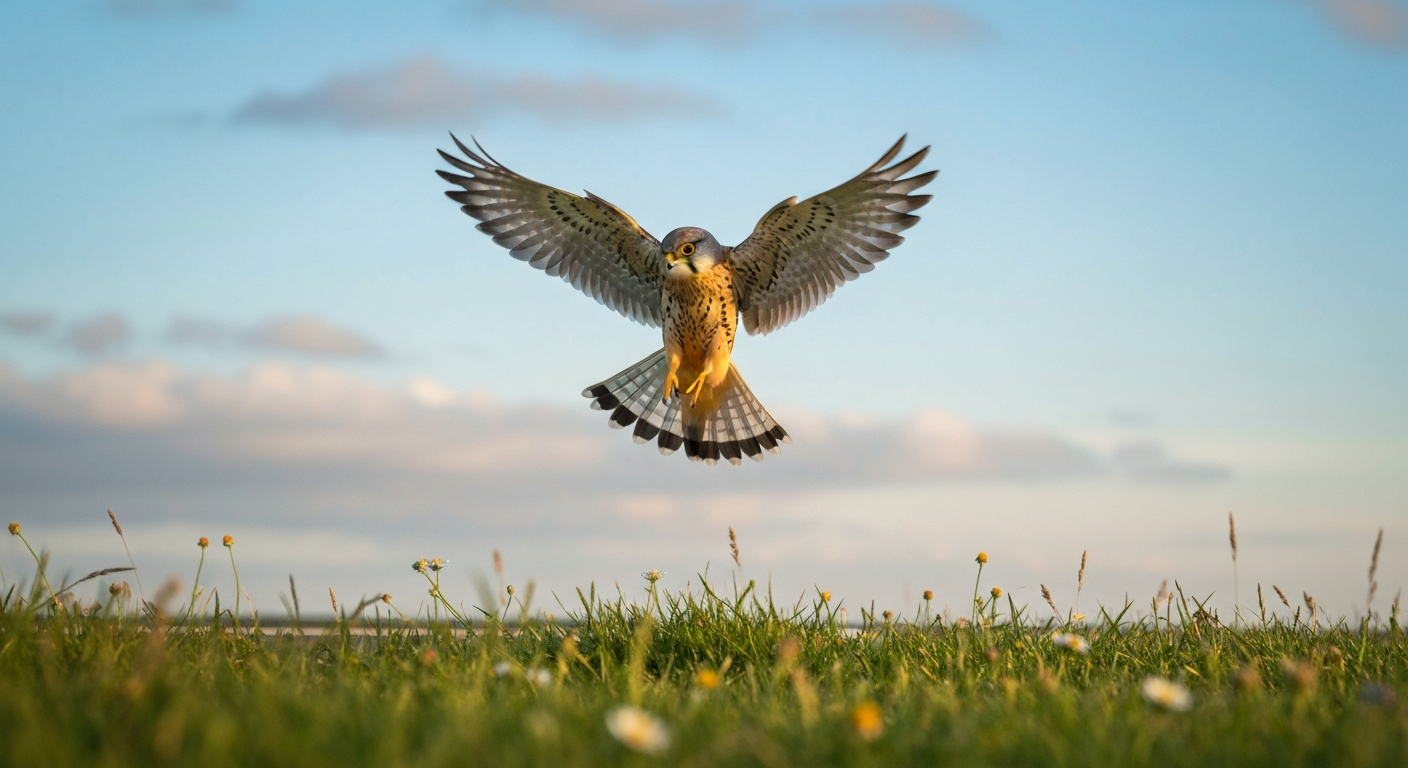
A hovering bird most commonly means one thing in nature: there is prey below and the bird is locked in a visual search before striking. Culturally and symbolically, hovering has long been read as watchfulness, divine protection, or a message held in suspension, something important paused at the threshold between arrival and action. Whether you have just watched a kestrel hang motionless over a roadside verge or dreamed of a bird floating above you, the interpretation depends on the species, the setting, and the tradition you bring to it. This guide covers all three angles: the natural history, the symbolism, and the practical tools to tell them apart.
Hovering Bird Meaning: Literal, Symbolic and Practical Tips.

Marcus Blackwell
13 Aug 2026
What a hovering bird usually means
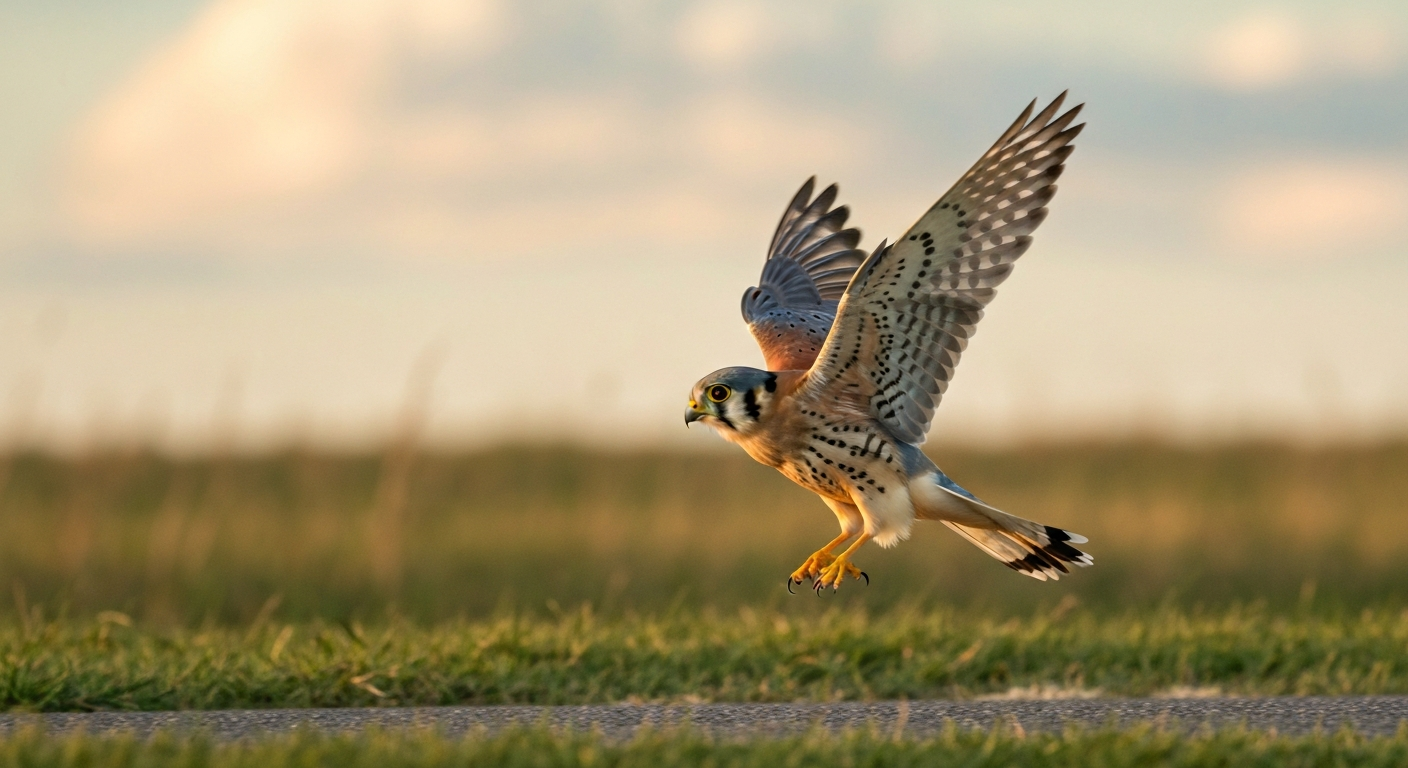
In the most grounded sense, a bird hovering over a specific spot is hunting. It has detected movement or a promising patch of ground and is using station-keeping flight to hold its position for a cleaner look before committing to a strike. That is the default explanation for the vast majority of real-world hovering sightings, and it is worth anchoring everything else to that fact.
Symbolically, hovering occupies a distinctive space that soaring and swooping do not. Soaring reads as freedom, transcendence, or long-range vision. Swooping reads as decisive action, sudden intervention, or threat. Hovering sits between them: it is the moment of attentive waiting, of focused intention that has not yet committed to a direction. Across many traditions, that quality, suspended watchfulness, maps onto ideas of guardianship, divine surveillance, spiritual presence, or the moment just before a revelation arrives. The Spirit descending at Jesus' baptism is described in the Gospels as coming down 'like a dove,' an image of purposeful, deliberate descent from a point of stillness. Isaiah 40:31 uses the eagle's soar as a metaphor for renewed strength after patient endurance. Both images borrow their emotional weight from real bird behavior that human observers have watched for thousands of years.
In dreams, Jungian analytical tradition reads a hovering bird as an archetypal symbol of the psyche in a liminal state, present, observing, not yet acting. It can represent a message you have not yet received, or an aspect of yourself holding back before a significant choice. That interpretation is a framework, not a fact, but it is a useful one if you are looking for psychological resonance rather than ornithological identification.
Key terms: hovering, kiting, soaring, and stooping
These four words get mixed up constantly in casual descriptions of bird flight, which matters because each describes something genuinely different, and those differences carry different symbolic weight too.
| Term | Technical definition | Who does it | Symbolic register |
|---|---|---|---|
| Hovering (powered) | Station-keeping flight using rapid wingbeats at effectively zero forward airspeed relative to the surrounding air | Hummingbirds; some terns and kingfishers | Precision, patience, focused intention |
| Kiting / wind-hovering | Facing into a headwind so that airspeed and ground speed cancel out; bird appears stationary but is flying forward into the wind | Kestrels, some Buteo hawks, harriers, kites | Watchfulness, vigilance, held purpose |
| Soaring | Exploiting thermals or orographic updrafts to gain or maintain altitude with minimal flapping | Eagles, vultures, large raptors, storks | Freedom, transcendence, long-range vision, divine elevation |
| Stooping / swooping | High-speed dive or aerial strike, often from height; 'stoop' is the technical raptor term, 'swoop' is broader | Falcons, hawks, eagles, diving terns | Decisive action, sudden intervention, power, or threat |
Merriam-Webster defines 'hover' simply as 'to remain suspended in the air over a place or object' or 'to remain in an uncertain state.' That second definition is, in a quiet way, exactly why the image works so well symbolically: uncertainty held steady is a genuinely unusual posture, and unusual postures attract meaning.
Why birds hover: the natural-history reasons
Ornithologists distinguish two mechanically different modes of station-keeping flight. True powered hovering, used by hummingbirds, is energetically expensive and physically demanding. Studies of hummingbird kinematics show the wings moving in a figure-of-eight stroke, generating lift on both the downstroke and the upstroke to maintain position in still air. This is rare in birds larger than a hummingbird because the metabolic cost scales poorly with body size.
Most birds that appear to hover are actually performing wind-hovering or kiting: facing directly into a headwind so that their forward airspeed through the air precisely cancels their backward drift over the ground. The bird is working hard aerodynamically, using wing and tail morphing to fine-tune its position, but it is borrowing energy from the wind rather than generating all of it from muscle. Kestrel studies using detailed kinematic analysis confirm exactly this, the bird adjusts wing and tail geometry continuously to 'lock' its head position over a patch of ground even as wind speed fluctuates.
Three main ecological reasons drive hovering behavior, and identifying which one is happening changes both the identification and the interpretation.
- Prey search: The bird has detected, or expects to detect, moving prey on the ground or in shallow water below. Its head stays locked on the target zone while the body adjusts to the wind. This is by far the most common context.
- Territory and courtship display: Some species hover briefly during boundary patrols or as part of a display flight to a mate or rival. This is usually accompanied by calling, repeated circuits over the same area, or obvious pair interaction nearby.
- Nest defense or localized scanning: A bird defending a nest site may hover over an intruder (including a human observer) as an assessment or threat behavior rather than a hunting one. Context — proximity to a nest, alarm calls, repeated passes — distinguishes this.
Practical field cues help separate these motives. A prey-search hover typically involves a head that is unnaturally still while the body bobs, the bird positioned over open ground, grassland, or water, with periodic short dives or repositioning. A territorial or display hover usually involves more calling, a more exposed position, and the presence of a second bird or a repeated flight path. Wind-assisted kiting correlates strongly with wind direction and topography: watch for it on ridgelines, coastal cliffs, and open slopes where wind is channeled.
Why birds soar: mechanics, energy savings, and display
Soaring is almost the opposite of hovering in energetic terms. Where hovering costs the bird significant muscular effort to stay still, soaring is the art of spending as little energy as possible while covering large distances or gaining altitude. The bird is not fighting the air, it is reading it.
Thermals are columns of warm air rising from sun-heated ground. Raptors and vultures locate them visually (often by watching other soaring birds) and then circle within the thermal column, riding the updraft upward with wings spread and wingbeats minimal. Doppler lidar measurements of thermal structure have confirmed a direct match between thermal strength and the altitude gains achieved by soaring raptors. Orographic lift, upward deflection of wind against a ridge or cliff face, provides a different but equally exploitable energy source, which is why ridge soaring is so spectacular at places like Hawk Mountain in Pennsylvania.
Symbolically, soaring birds have accumulated the richest portfolio of meanings: transcendence, spiritual ascent, divine connection, and the ability to see what ordinary ground-level vision misses. The eagle soaring in Isaiah 40:31 carries all of these overtones. If you are interested in the full symbolic range of soaring behavior, the soaring bird meaning entry on this site explores that territory in depth. See the soaring bird meaning entry for a deeper exploration of those symbolic associations.
Why birds swoop: hunting strikes, defense, and aerial displays
A swoop or stoop is what follows a hover or a high perch in many hunting sequences: the committed, high-speed descent onto prey. In Peregrines, which are built around the stoop, this can exceed 150 mph (240 km/h). In Ospreys, the terminal strike is a feet-first plunge into water. In Red-tailed Hawks, it is typically a shorter, angled drop onto ground prey. The key quality of a swoop, in both ethological and cultural terms, is finality. The decision is made; the waiting is over.
Defensive swooping is a different behavior: a bird (particularly breeding terns, mockingbirds, or Red-winged Blackbirds) dive-bombing an intruder to drive it away from a nest. These are genuine physical strikes or close misses and are worth knowing about for safety reasons (more on that shortly). In cultural symbolism, the swooping bird has historically been read as either a decisive divine intervention or, depending on the tradition, an omen of conflict. A great bird swooping toward you carries a different register than one hovering overhead, and that distinction is worth exploring across cultures. See the entry on the meaning of a great bird swooping for a concise, cross-cultural overview.
Hovering birds of prey: a species guide
Most of the birds people describe hovering in midair are raptors using wind-hovering to hunt. Three species account for the majority of such sightings in North America and Europe, and each has its own characteristic style.
American Kestrel (Falco sparverius)
The kestrel is the canonical hovering raptor of open country. Small (roughly robin-sized compared to other falcons), colorful, rusty back and tail in both sexes, blue-grey wings on males, and conspicuous, it is the bird most people are watching when they describe a hovering falcon over a highway median or farm field. Its technique is textbook wind-hovering: face into the wind, flap just enough to compensate for any gusts, and keep the head absolutely still over the target. Kinematic studies have confirmed that kestrels modulate wing and tail shape in real time to achieve this head-lock, making them one of the most aerodynamically studied hoverers in the literature. They are primarily targeting small mammals and large insects. eBird range data shows them across most of North America through the year, with the highest detection rates in open grassland and agricultural habitats. American Kestrel, eBird Status & Trends range map (Cornell Lab / eBird Science) provides weekly and seasonal range maps showing detections of kestrels across most of North America and their habitat associations, with higher detection rates in open grassland and agricultural areas American Kestrel — eBird Status & Trends range map (Cornell Lab / eBird Science).
Common Kestrel (Falco tinnunculus)
The European equivalent, and the bird most British or Continental European readers will picture when they hear 'hovering bird of prey.' Behavior, technique, and symbolism are closely parallel. It is the default roadside raptor across much of Europe, Central Asia, and Africa, using the same wind-hover hunting method. In British folklore the kestrel is sometimes called the 'windhover,' a name Gerard Manley Hopkins immortalized in his 1877 poem of the same name, one of the most precise literary renditions of what wind-hovering actually looks like: 'the achieve of, the mastery of the thing.'
Osprey (Pandion haliaetus)
The Osprey is a specialist fish hawk, and its hovering is a brief but decisive part of a hunting sequence. It quarters over water, often flying back and forth at 30 to 100 feet, then pauses in a wind-assisted hover when a fish is spotted below, before folding and plunging feet-first into the water. The hover here is shorter and more transitional than a kestrel's sustained station-keeping, but it is distinctive enough to be one of the key identification cues in aquatic habitats. Large, with a white belly, long bowed wings with a dark wrist patch, and a distinctive M-shape silhouette from below, the Osprey is usually unmistakable. Its symbolism overlaps with wider hovering bird of prey meanings: focused intention, precise targeting, and the crossing of a boundary (in this case between air and water).
Buteo hawks and kites
Several of the large Buteo hawks, Red-tailed Hawk, Rough-legged Hawk, and Ferruginous Hawk among them, will kite in moderate to strong winds, appearing to hover without the rapid wingbeat of a kestrel. The Rough-legged Hawk is probably the most consistent hoverer among North American Buteos, doing so regularly over tundra and open fields. American and Mississippi Kites, and the White-tailed Kite of the West, also use wind-hovering as a primary hunting strategy. The hovering bird of prey passing by you piece on this site covers the encounter-specific symbolism, what it may mean when one of these birds pauses over you specifically rather than over a generic patch of ground.
Other hovering birds worth knowing
Raptors are not the only hoverers. Several other groups use station-keeping flight, and knowing them prevents misidentification, and adds some interesting symbolic nuance.
Hummingbirds
The only birds capable of sustained powered hovering in still air, hummingbirds beat their wings 50 to 80 times per second in a figure-of-eight stroke that generates lift on both the forward and backward stroke. A New Approach to Animal Flight Mechanics, Journal of Experimental Biology notes that sustained flapping hover is energetically costly and largely restricted to small taxa such as hummingbirds A New Approach to Animal Flight Mechanics — Journal of Experimental Biology. This is genuinely unique among birds. Culturally, hummingbirds carry meanings of joy, energy, resilience, and love across many Indigenous American traditions, and their ability to hover, to hold still while everything else moves, is sometimes read as a special kind of presence or blessing. In Aztec cosmology, Huitzilopochtli, the deity of war and the sun, was associated with the hummingbird.
Kingfishers
Common Kingfishers in Europe and Belted Kingfishers in North America both hover briefly over water before plunging for fish, similar in purpose to the Osprey's pause, but at smaller scale. The Belted Kingfisher's rattling call and hovering silhouette over streams and coastal waters is a familiar field cue. Kingfishers carry ancient symbolic weight (the 'halcyon days' of calm winter weather come from a Greek myth about the kingfisher, or halcyon), and their hovering appearance, vivid, deliberate, suspended over reflective water, has made them potent images of fleeting beauty and careful attention.
Terns and gulls
Many tern species, Common Tern, Arctic Tern, Forster's Tern, hover over water before plunge-diving for small fish. This is flapping hover rather than wind-hover, and it is energetically costly. Large gulls will occasionally wind-hover in coastal settings, though this is less committed than a tern's hunting hover. Terns in folklore are associated with sea journeys and navigation; their hovering over water before diving is sometimes read as a metaphor for deliberation before commitment.
How to identify the species and behavior in the field
If you have just seen a hovering bird and want to know what it was, and what it was doing, there is a short checklist that resolves most cases quickly. You do not need binoculars for all of it, though they help enormously.
| Field cue | What to look for | Why it matters |
|---|---|---|
| Size | Is it sparrow-sized, pigeon-sized, crow-sized, or larger? Hummingbirds are tiny; kestrels are small-falcon sized; Ospreys are large. | Eliminates most misidentifications immediately |
| Wingbeat | Rapid flutter (hummingbird/tern), moderate kestrel-style flapping, or nearly still wings (kiting Buteo in wind) | Identifies the hovering mechanism — powered vs. wind-assisted |
| Silhouette | Long narrow wings = falcon or tern; bowed wings with dark wrist patch = Osprey; broad rounded wings = Buteo hawk | Narrows to species group even at distance |
| Habitat | Over open grassland/farmland = kestrel or Buteo; over water = Osprey, kingfisher, tern; garden/flowers = hummingbird | Context is often decisive |
| Head behavior | Is the head locked still while the body moves? That is the prey-search hover; head moving and bird calling = display or defense | Separates hunting from territorial/defensive behavior |
| Sound | Kestrels give a high kee-kee-kee; Ospreys give a series of clear whistles; kingfishers rattle; hummingbirds hum; terns have sharp harsh calls | Confirms species when visual is ambiguous |
| Wind conditions | Is the bird facing directly into the wind? Strong or moderate wind present? | Confirms kiting/wind-hovering vs. powered hover |
| Season and range | Check eBird range maps for your date and location — seasonal presence is highly diagnostic | Eliminates species not present in your area at that time of year |
A phone with a good camera, pointed upward and zoomed, will often capture enough detail for a later identification if you cannot identify the bird in the moment. Record a short video clip if possible: flight style, wingbeat rhythm, and silhouette in motion are far more useful than a single still frame. When photographing raptors near potential nest sites, keep your distance and use a telephoto lens rather than moving closer. The Audubon ethical photography guidelines recommend against baiting birds or disturbing nesting activity, and the American Birding Association's code of ethics makes the same point: the bird's welfare comes before the photograph. For sensitive or rare species, consider scrubbing precise GPS coordinates from image metadata before sharing publicly.
What a bird hovering over you might mean
This is the question that brings a lot of people to this kind of reference in the first place: not just 'what is that bird doing?' but 'why is it hovering over me specifically?' The honest ornithological answer is that the bird almost certainly is not hovering over you as a person, it is hovering over the patch of ground you happen to be standing on, or using you as a perch reference point. For a deeper discussion of interpretations when a hovering bird of prey passes near you, see the entry on what a hovering bird of prey passing by you might mean. Kestrels in particular will hold position over a roadside verge regardless of whether a human is walking along the road below.
That said, the experience of a bird hovering directly overhead is genuinely unusual, and unusual encounters with wildlife have attracted symbolic readings across virtually every human culture on record. Scholarly surveys of bird symbolism in the ancient world document that flight overhead, birds circling above a person, and birds lingering near an individual were all read as potential omens or messages in Greek, Roman, Egyptian, Hebrew, and many Indigenous traditions, though what the sign meant varied enormously by species, direction, and cultural context. A hawk hovering overhead in some Indigenous North American traditions is a sign of a message incoming or of a guardian spirit's presence. In European folk traditions, birds circling above were sometimes read as a sign of protection, and sometimes as a less comfortable omen depending on the species.
The most honest guidance is this: meaning depends on the framework you bring. If you are interpreting the experience through a spiritual or folkloric lens, the species matters enormously (a hovering kestrel carries different freight than a hovering vulture), as does the direction of flight, whether the bird seemed to notice you, and whether it lingered or moved on quickly. If you are working through a dream in which a bird hovered above you, Jungian analysis would read that as a psyche symbol, something significant held in suspension, a message not yet delivered, or an aspect of yourself waiting for the right moment. If you are simply curious about a real bird you saw, the field cues above will get you to a species and a behavioral explanation faster than anything else.
How context changes the meaning: a practical checklist
Whether you are reading a hovering bird symbolically, writing about one, or trying to interpret a dream or personal encounter, five variables consistently change what the image means. Run through these before committing to any single interpretation.
- Species: A hummingbird hovering at a flower means something entirely different — culturally and ecologically — from an Osprey hovering over a lake or a kestrel over a motorway verge. Species is always the first filter.
- Location and habitat: The same bird hovering over open farmland, over water, over a city park, or in a dream carries different probable meanings. Habitat defines both the ecological reason and the symbolic resonance.
- Behavior before and after: Did it dive and catch prey? Did it call and move off? Did it hover, then look directly at you, then depart? The full behavioral sequence matters more than the static hover alone.
- Timing and season: A Rough-legged Hawk hovering in winter carries different ecological context than one in summer; a bird hovering at dawn vs. dusk has different readings in many folkloric traditions.
- Your own cultural and personal background: Bird symbolism is not universal. What a hawk overhead means in a Lakota spiritual framework is not what it means in ancient Roman augury or in a contemporary secular context. Knowing which tradition you are drawing on — or whether you are drawing on any — shapes every interpretation.
Practical next steps after a hovering bird sighting
If you want to go further after a sighting, whether to identify the bird, understand the behavior more deeply, or explore the symbolic angle, here is a short practical path.
- Record what you saw as soon as possible: size, shape, wingbeat rate, color, habitat, wind conditions, and behavior before and after the hover. Notes taken within minutes are far more reliable than memory an hour later.
- Use eBird's species range maps filtered to your location and date to identify which hovering species are plausibly present. This immediately narrows the field.
- Cross-reference with the Macaulay Library's photo and video archive (hosted by Cornell Lab of Ornithology) for visual confirmation. Kestrel hovering videos, for example, are time-stamped and location-tagged, making comparison straightforward.
- If the bird was close to a nest site and appeared agitated or was striking at you or other animals, give it more space. Defensive swooping from breeding terns, mockingbirds, and some raptors is a genuine physical behavior, not symbolic — and the appropriate response is a calm, deliberate retreat.
- For symbolic or spiritual interpretation, identify your source tradition first, then look up the specific species within that tradition rather than applying generic 'bird symbolism' to any species indiscriminately.
- Explore the related entries on this site for the hovering bird of prey encounter, the swooping bird meaning, and the soaring bird meaning — each covers the behavioral and symbolic angles specific to that flight mode in more depth.
FAQ
Quick answer: What does a hovering bird mean, literally and symbolically?
Literally: a hovering bird is usually using one of two physical strategies—powered/flapping hovering (common in very small species like hummingbirds) or wind‑assisted hovering/kiting (common in kestrels, some hawks and kites, and ospreys when hunting). The behaviour usually relates to foraging (searching for prey), territorial/displaying, or holding position in wind or updrafts (sources: Journal of Experimental Biology; Cornell Lab). Symbolically: cultural and literary meanings vary widely by tradition—common themes include alertness, message or omen, freedom, vigilance, or spiritual presence. Symbolic readings depend on species, context, and the cultural or personal framework used to interpret the sighting (sources: cultural bird‑symbolism literature; Jungian and literary traditions).
How can I tell whether a bird is hovering for natural reasons (hunting or wind) rather than ‘meaning’ something symbolic?
Check observable cues: (1) Species: small falcons (kestrels), ospreys and some harriers often hover while hunting; hummingbirds hover to feed. (2) Location and substrate: hovering over fields/water suggests prey search; over a nest/territorial boundary suggests display. (3) Behavior pattern: repeated dives or plunge after hovering = hunting; vocalizing or repeated short routes = display. (4) Wind and topography: hovering into a steady headwind or over ridgelines/sea cliffs suggests kiting/wind‑hovering. Use local field guides, eBird range data and photo/video records (e.g., Cornell Macaulay Library) to confirm species‑typical behaviour (sources: field studies; eBird; Cornell Lab).
Why do birds hover, soar, or swoop? (natural‑history reasons)
Primary proximate reasons: (1) Prey detection and capture—hovering lets birds visually scan for ground or water prey before diving (kestrels, ospreys). (2) Energy‑efficient movement—soaring on thermals or ridge updrafts lets raptors cover ground with minimal flapping. (3) Display or territory signaling—hovering/display flights can communicate with mates or rivals. (4) Wind station‑keeping—kiting into the wind lets birds remain roughly stationary relative to ground without continuous high‑energy flapping (sources: biomechanics and field ornithology studies; Journal of Experimental Biology; Hawk Mountain Sanctuary).
Which species commonly hover and how to identify them (short guide)?
Key hovering species to watch for: - American Kestrel (Falco sparverius): small falcon, faces into wind with steady wingbeats and tail spread; common hover‑hunting in open fields. - Osprey (Pandion haliaetus): larger raptor seen hovering briefly over water before plunging feet‑first to catch fish. - Harriers and kites (Circus spp., Elanus spp.): low, buoyant kiting often over marshes/fields. - Hummingbirds: true powered hover while feeding at flowers—rapid wingbeats, tiny size. - Red‑tailed and other Buteo hawks: may appear to hover when wind‑kiting or when riding thermals but often are soaring/holding with little wingbeat. Use field marks (size, silhouette, tail pattern), habitat, and behaviour. Refer to species pages and eBird range maps for local seasonality (sources: Cornell Lab All About Birds; eBird; Hawk Mountain).
How have cultures traditionally interpreted a hovering bird or a bird flying overhead?
Interpretations vary by culture and historical context. Common motifs: - Omen or message: many cultures read overhead birds as signifiers—context and species matter (e.g., doves as peaceful/holy in Christian symbolism; eagles as strength/renewal in scriptures). - Psychopomp/spirit: some traditions view certain birds as soul‑carriers or messengers from the other world. - Vigilance/foresight: hovering birds, especially raptors, are often metaphorically linked to watchfulness and keen perception. Scholarly overviews stress variability—meanings require provenance and local sources; avoid universalizing symbolic claims (sources: Birds in the Ancient World; religious and literary texts).
What does it mean if a bird hovers over or passes directly above me? (omens, dreams, intuition)
There is no single factual meaning—interpretation depends on cultural background, personal associations, and immediate context. Practical interpretive prompts: - Note species and behaviour: a hunting kestrel passing by is likely food‑related behaviour, not a supernatural message. - Consider personal symbolism: if birds have prior personal or cultural significance (e.g., a family emblem), that shapes meaning. - Dream contexts vs waking sightings differ: dreams are symbolic material processed by the psyche (Jungian frameworks treat birds as archetypal), while waking sightings have observable ecological explanations. If someone seeks an omen reading, ground the interpretation in documented symbolic traditions for that culture and be explicit about interpretive uncertainty (sources: Jungian literature; cultural surveys).
Next Article
Hovering Bird of Prey Pass By You Meaning: Symbol, Safety & ID
Discover literal and symbolic meanings when a hovering bird of prey passes by you, behaviors, species, safety, and how to