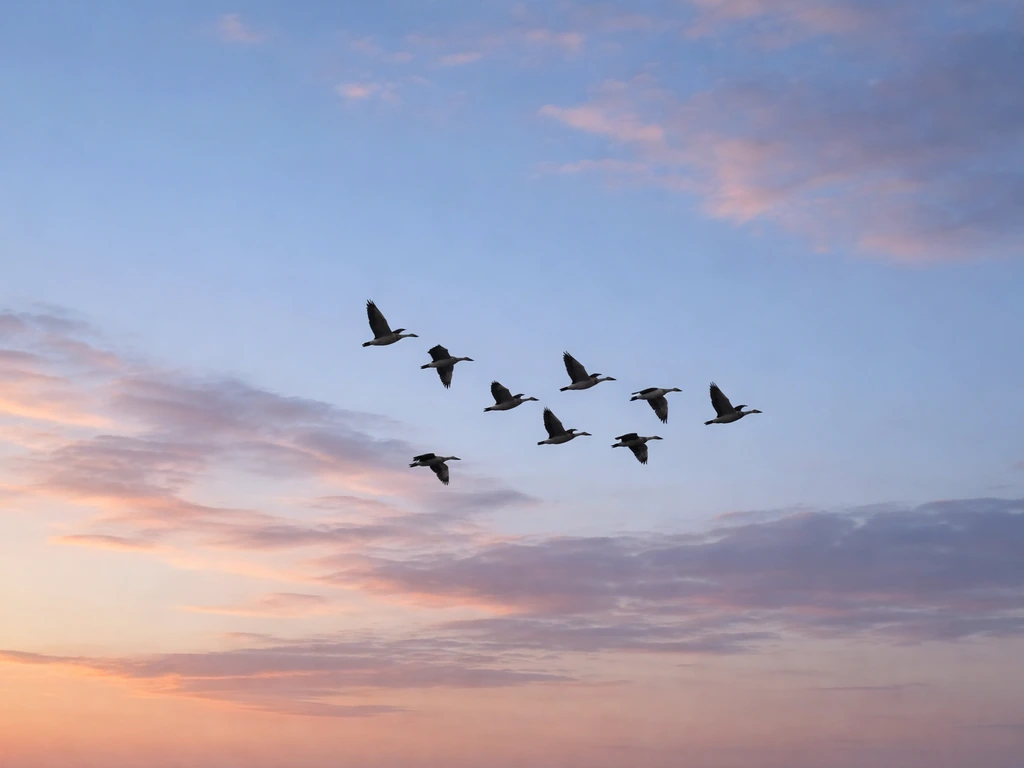
As a grammar note worth keeping handy: it is a countable noun phrase. You use "a bird of passage" for one person and "birds of passage" for a group. That plural form is the one you will see most often in formal writing, as in the Cambridge example: "At present the organization has to rely on young, inexperienced graduates who are usually birds of passage." Both singular and plural are standard and correct.
Where the phrase actually comes from

The phrase traces back to a French original. Wiktionary's etymology proposes it is a calque of the Middle French oiseau de passage, where "passage" carries the sense of part of a journey or route. That French term dates to at least 1549. The idiom crossed into English sometime in the 1600s: Merriam-Webster records a first known use in 1633 for the literal migratory-bird sense.
Dictionary. com, drawing on a different corpus, gives first recorded use as 1785 to 1795, which may reflect when the figurative, human-transience sense became more widely documented. A 1717 entry in the Philosophical Transactions of the Royal Society of London uses "bird of passage" explicitly for a migratory bird, confirming the phrase was well established in English scientific writing by the early 18th century.
The 1911 Encyclopædia Britannica offers a useful anchor for the literal meaning that feeds the metaphor. It describes "birds-of-passage proper" as blank" rel="noopener noreferrer">birds that "show themselves but twice a year," passing through a country in spring and autumn without settling. Those transient visits, appearing and then vanishing with the season, are exactly the image the idiom carries into its figurative use. The word "passage" is doing the heavy lifting: it signals movement through, not arrival at.
Understanding that literal seasonal root also helps you appreciate why the phrase lands with a slightly wistful or elegiac weight in literature. It is not just "temporary." It carries the suggestion of migration as a natural condition, someone who is built to keep moving rather than someone who chose to leave. That nuance matters when you encounter it in fiction or journalism. For a deeper look at the broader concept behind the literal side of the term, the article on migratory bird meaning is worth reading alongside this one.
How the figurative meaning works in everyday English
In practice, calling someone a bird of passage signals that their presence is temporary by nature, not just by circumstance. It implies a pattern rather than a single short visit. A tourist who stops in a city for two days is not quite a bird of passage in the idiomatic sense. But a consultant who cycles through companies every few months, a diplomat posted to a new country every two years, or a young graduate who treats a job as a stepping stone rather than a destination, those are the people the phrase is built for.
The phrase also carries a mild implication of unavailability or unreliability, not as a personal flaw but as a structural reality. Cambridge's example about graduates depending on organizations is exactly this: the problem is not that those individuals are bad workers, it is that their nature as birds of passage makes institutional continuity difficult. When you use the phrase, you are usually naming a pattern that the person themselves may be unaware of or indifferent to.
It sits comfortably in both formal and literary registers. In journalism and business writing, "birds of passage" works well for groups: contract workers, short-term staff, temporary residents. In narrative prose and literary fiction, the singular "a bird of passage" tends to appear with a more reflective or evaluative tone, as in the Cambridge example: "Would he be a mere bird of passage, like so many others, or a permanent member of their usual circle?" The word "mere" before it is a common pairing when the speaker wants to express disappointment or resigned acceptance.
The symbolic weight of 'passage' in bird culture
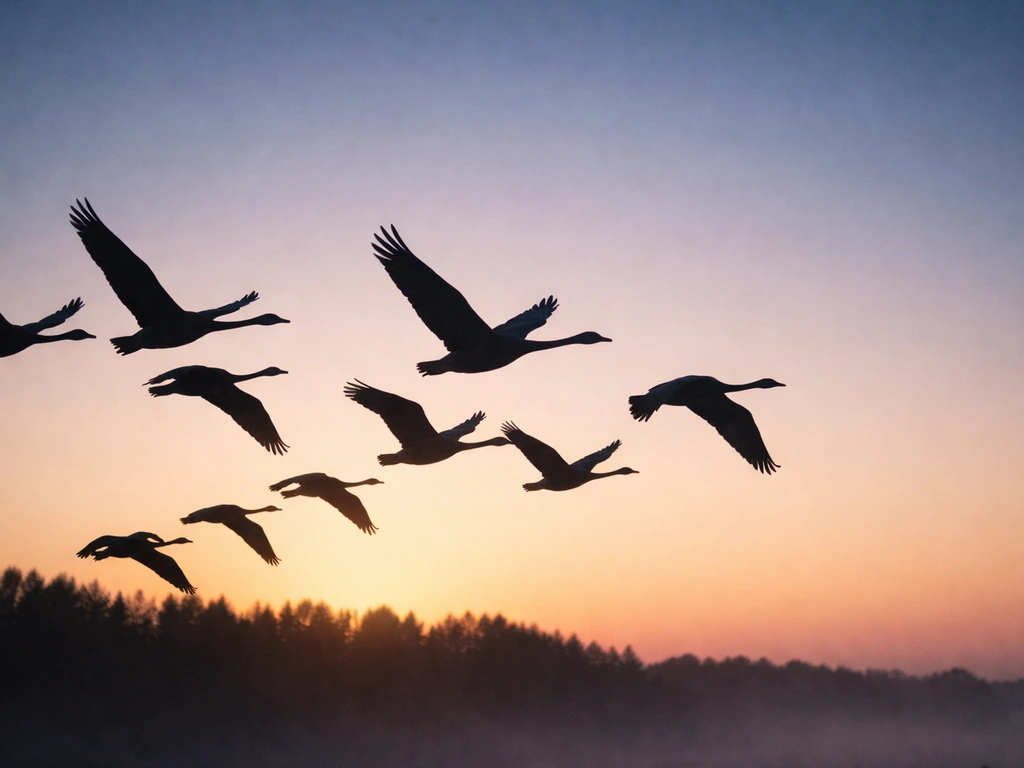
Birds that migrate have carried symbolic meaning in human culture for as long as people have watched the sky. Their appearance and disappearance mark seasons, signal change, and represent the impermanence of all living things. The swallow returning in spring, the goose flying south in autumn, these arrivals and departures have always been read as messages about time and transition. The idiom "bird of passage" inherits all of that.
"Passage" as a concept in bird symbolism is specifically about movement between states, between seasons, between places, without fully belonging to any of them. A bird of passage is defined by its in-between status. In that sense, the phrase connects to a broader symbolic tradition around birds as messengers or liminal figures, creatures that cross boundaries humans cannot. That liminal quality is part of why the phrase reads as slightly poetic even in a business memo.
It is also worth noting what the phrase is not pointing at. It is not about birds defined by their song, their color, or their species behavior in the way that, say, a passerine bird meaning is rooted in a specific taxonomic and behavioral category. The bird of passage is defined purely by its relationship to place and time: it shows up, it passes through, it leaves.
Several bird idioms float around in the same general neighborhood as "bird of passage," and it is easy to conflate them if you are not careful. Here is a quick comparison of the ones most likely to cause confusion.
| Phrase | Core meaning | What it is NOT about |
|---|
| Bird of passage | A temporary presence; someone who moves on without settling | Arrival timing, certainty, or dismissal |
| Early bird | Someone who arrives or acts before others; gets an advantage by being first | Migration, transience, or impermanence |
| A bird in the hand | What you already have is more reliable than what you might get | Movement, staying, or leaving |
| Go-away bird | A humorous or dismissive label for someone who needs or is told to leave | Seasonal migration or a pattern of wandering |
The a bird of passage idiom meaning article on this site goes deeper into the idiomatic usage specifically, but the short version is this: if the sentence is about someone being temporary or always moving on, "bird of passage" is correct. If it is about timing an action early, use "early bird." If it is about valuing what you already have, use "bird in the hand." And the go-away bird is its own creature entirely. Speaking of which, if you have seen the phrase and wondered why it is called go away bird, the answer is more literal than you might expect.
One more phrase worth separating out: "bird of passage" is sometimes loosely used as a near-synonym for "nomad" or "drifter," but those words carry more deliberate agency. A nomad chooses movement as a lifestyle. A bird of passage, in the idiomatic sense, is simply not built to stay. The shade of meaning is subtle but real, and getting it right makes the phrase land with more precision. If you have encountered the phrase in the context of a bird that literally signals you to leave, the go-away bird meaning is a different concept worth keeping separate in your mind.
How to use it correctly: example sentences and quick tips

The best way to lock in a phrase is to see it used several different ways. Here are examples that cover the range of registers where you will encounter "bird of passage," along with a note on what each one is doing.
- "She had always been a bird of passage, staying in each city just long enough to learn its coffee shops before moving on." (Narrative prose, singular, reflective tone. The phrase functions as a subject complement.)
- "He was a mere bird of passage in our department, gone before the project even launched." (Evaluative use with 'mere' to signal disappointment or mild frustration.)
- "The conference attracts birds of passage from across the industry, people who cycle through every year without ever joining the community." (Plural, journalistic register, describing a pattern of behavior in a group.)
- "I live out of a suitcase; a bird of passage never has a comfortable nest." (Self-descriptive, slightly wry. This exact construction appears in Cambridge's corpus examples.)
- "Like a bird of passage, he appeared in her life for one winter and was gone by spring." (Simile form, literary, leans into the seasonal/migration imagery deliberately.)
A few practical tips for using it well. First, decide early whether you want the literal or figurative sense, because in most modern contexts the figurative sense is the default assumption. If you are writing about actual migratory birds, you may want to specify that. Second, the plural "birds of passage" works better in formal or analytical writing when describing categories of people. The singular "a bird of passage" is more personal and evaluative, fitting better in narrative or conversational contexts. Third, pairing it with "mere" or "like a" are both established patterns you can borrow without sounding clichéd, as long as the rest of the sentence earns them.
When you encounter the phrase in someone else's writing, whether in a novel, a news article, or a quote, the interpretive move is straightforward: ask whether the subject is being characterized as temporary by nature (not just by accident), and whether that temporary quality is the main point being made. If both are true, you are reading "bird of passage" used correctly. If the writer seems to mean something closer to "passing visitor" or "newcomer," they may be using the phrase loosely, which happens, but the precision of the idiom is its value.