When people search for "crane bird meaning," they almost always want two things: a quick confirmation that yes, a crane is an actual bird, and then the deeper symbolic meaning that makes the crane one of the most recognized animals in world mythology. The short answer is that the crane is a large, graceful wading bird, and across dozens of cultures it most commonly symbolizes longevity, good fortune, vigilance, and transformation. That combination of the literal and the figurative is what makes the crane so interesting to look up.
Meaning of Crane Bird: Symbolism and What to Do When You See One

Marcus Blackwell
6 Apr 2026

The literal crane: what kind of bird it actually is
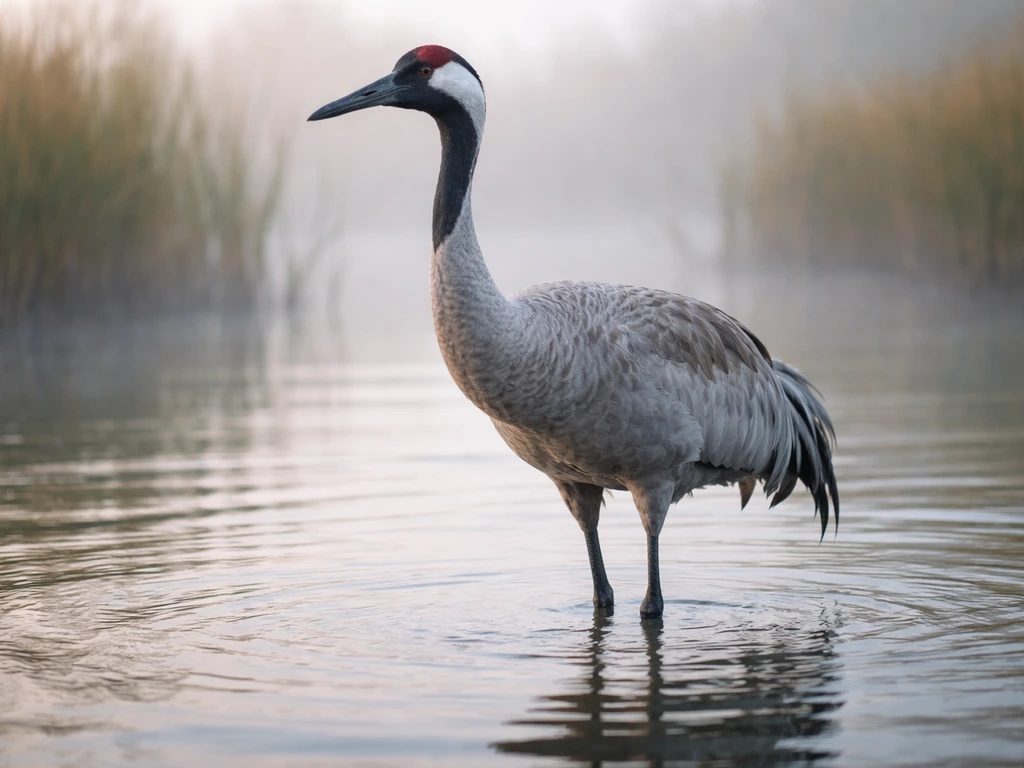
A crane is any of 15 species of tall wading birds in the family Gruidae, order Gruiformes. Every major dictionary agrees on the basics: cranes have long necks, long legs, and streamlined bodies built for life near water and open grasslands. The San Diego Zoo describes them as having long rounded wings and moving with a deliberate elegance that most people instantly recognize. In North America, the Sandhill Crane is the species most people are likely to encounter, often spotted in shallow wetlands, harvested agricultural fields, and along river sandbars during migration.
One thing that sets cranes apart from similar-looking birds is their behavior. Sandhill Cranes produce loud, trumpeting calls that carry for miles, and their courtship involves elaborate sequences of wing-spreading, head-pumping, bowing, and leaping. The International Crane Foundation distinguishes between the "Unison Call," a duet that bonded pairs perform to strengthen their relationship and defend territory, and a soft purring "Contact Call" that flock members use to reassure each other of their location. If you hear or see this behavior and wonder what it means, it helps to know that you are watching one of the most choreographed rituals in the bird world.
What the crane symbolizes across mythology and folklore
Longevity is the dominant theme in crane symbolism, and it shows up independently in multiple cultural traditions. The Cleveland Museum of Art notes that in East Asia, cranes are said to live a thousand years, making them a direct visual shorthand for long life whenever they appear in art or literature. That is not a coincidence or a borrowed idea. Cultures across China, Japan, and Korea developed crane mythology in parallel because they were observing the same thing: a large, slow-moving bird that seemed immune to the usual speed of nature.
In Chinese mythology, cranes are connected to divine bird worship and the idea of travel between heaven and the human world, serving as carriers of immortals or messengers between realms. That gives the crane a spiritual dimension beyond simple longevity: it becomes a symbol of transformation and transition. In Japanese tradition, the crane is considered mystical and holy, historically offered to shrines and temples as a request for blessings. Good fortune, peace, and longevity are all bundled into the same symbol.
Grace and vigilance round out the symbolic picture. A crane standing still at the edge of a wetland, neck extended, watching the water, became a natural image for patient awareness. Ancient writers used cranes as symbols of watchfulness, and that meaning has stuck across folk traditions in both Eastern and Western contexts.
Where crane symbolism shows up in culture and language

The crane's most famous cultural moment is almost certainly the origami crane tradition in Japan. The story of Sadako Sasaki, who folded paper cranes in the hospital after the Hiroshima bombing, and the broader tradition of folding one thousand origami cranes as a wish for health or peace, is one of the most widely known examples of animal symbolism entering everyday practice.
Today, the “Children’s Peace Monument / Paper Cranes” tradition is tied to Japanese origami and functions as a symbol of peace [Children’s Peace Monument / Paper Cranes tradition](https://www. city. hiroshima. lg.
jp/site/english/158105. html). The Hiroshima Peace Memorial Museum uses the crane as its central symbol, linking the bird directly to the concept of world peace. If you want to understand what the Japanese crane bird means in deeper cultural context, that tradition is the best place to start.
In Japanese art history, crane imagery appears across painting, lacquerware, textiles, and ceramics. A Japanese government cultural overview describes cranes as traditionally associated with good fortune and notes that crane imagery functions almost like a recurring motif in the country's visual language. Paired cranes are especially common at weddings and celebrations, where the longevity symbolism doubles as a wish for a long and happy life together.
In Chinese art and literature, the crane appears alongside the pine tree and the tortoise as one of the classic groupings of longevity symbols. The comparison "cranes live 1,000 years, tortoises 10,000" appears in traditional Japanese references as well, borrowed from earlier Chinese usage, showing how the symbol traveled. Cranes also appear in Chinese poetry and classical painting as companions to hermits and sages, reinforcing the association with wisdom, elevated character, and spiritual refinement.
Crane idioms and figurative expressions
Cranes do not dominate English-language idioms the way some birds do. You will not find a roster of crane-specific proverbs in the English tradition the way you might find them for ravens or swallows. But the bird has left clear marks in Asian language traditions. The Chinese chengyu 鹤立鸡群, literally "a crane standing in a flock of chickens," describes someone who stands out elegantly among ordinary company. It is used as a compliment for a person who has exceptional bearing, talent, or presence. The image is self-evident: a tall, white crane in a crowd of chickens is impossible to miss.
In English, the phrase "crane your neck" is the most common figurative use, describing the act of stretching the neck upward or forward to get a better look at something. It comes directly from the bird: you are mimicking the crane's characteristic pose of extending the neck for a clearer view. It is one of those idioms so embedded in everyday speech that most people never connect it to the animal.
There is something fitting about the fact that a bird associated with watchfulness and vigilance ended up as the source metaphor for straining to see something better. This kind of figurative borrowing is similar to what happens in expressions like "sing like a bird," where a bird's natural behavior becomes a shorthand for a human one.
Outside of these, cranes in English tend to carry their symbolic weight through literature and visual art rather than fixed idiomatic phrases. When a writer places a crane in a scene, they are usually invoking the longevity and grace associations rather than quoting a proverb.
What it means when you see a crane bird

This is the question behind a huge number of crane searches, and it is worth treating seriously rather than brushing aside. Seeing a crane in real life prompts people to reach for meaning, and that instinct is culturally and historically grounded. Different traditions offer different frameworks. In Japanese and Chinese traditions, a crane sighting has historically been treated as a positive omen, especially one associated with longevity, good fortune, or a message from a spirit or ancestor. In some Native American traditions, cranes are associated with good luck, endurance, and the ability to navigate difficult terrain.
If you want to interpret a crane sighting in a grounded way rather than just reaching for the most generic spiritual answer, here are the factors worth paying attention to:
- What was the crane doing? A crane standing still and watchful reads differently than one in mid-dance or calling loudly. The Nature Conservancy notes that the dancing behavior is the bird's most famous ritualistic act, so catching that is observationally significant.
- Were there one or two cranes? Paired cranes carry stronger associations with partnership, fidelity, and long-lasting relationships in East Asian symbolism. A solitary crane is more often linked to solitary contemplation or a message meant for you specifically.
- What is the context of your life right now? Symbolic interpretation is more meaningful when it intersects with something you are actively thinking about. A crane appearing during a time of transition, health concern, or big decision tends to carry more interpretive weight for people.
- How did you feel in the moment? That emotional response is data. Surprise, calm, awe, or unease all suggest different interpretive angles.
- Where did you see it? A crane near water (its natural habitat) is part of an ordinary sighting. A crane somewhere unusual or unexpected adds a layer of interpretive interest.
A practical next step is simple: write down what you saw, where, and how you felt. Journaling the sighting grounds it in your actual experience and lets you revisit it with more perspective. If you are drawn to a specific cultural tradition, it is worth going deeper into that tradition's specific meanings rather than staying at the generic level. The symbolism of cranes in Chinese mythology, for example, has more texture than the summary version you will find on most websites.
It is also worth noting that crane behavior itself can be the meaning. Watching a crane hunt patiently at the water's edge is a lesson in stillness and attention. Watching the unison call of a mated pair is a lesson in coordination and partnership. You do not need a spiritual framework to take something real away from watching these birds. Sometimes the observation is the interpretation.
Crane the bird vs. crane the machine: avoiding the obvious mix-up
"Crane" is one of those words with completely separate meanings that share the same spelling. The construction crane, that tall mechanical lifting device you see on building sites, gets its name from the bird. The similarity is in the long projecting arm or jib, which resembles the outstretched neck of a crane bird. Historical dictionaries trace the naming directly to the perceived visual similarity between the machine's arm and the bird's characteristic silhouette. OSHA regulations and engineering standards use "crane" exclusively in the mechanical sense, referring to boom angles, jibs, and load capacities.
For search purposes, this matters because someone searching "crane meaning" with no context might be looking for mechanical specifications rather than mythology. This article is about the bird. When people add "bird" to the phrase, as in "crane bird meaning," they are usually signaling that they want the symbolic and natural history reading, not the construction equipment one. The disambiguation is worth being clear about, because the two meanings genuinely cross wires in search results and sometimes in conversation.
| Meaning of 'crane' | What it refers to | Common context |
|---|---|---|
| Crane (bird) | A tall wading bird in the family Gruidae; 15 species worldwide | Wildlife, symbolism, mythology, idioms, literature |
| Crane (machine) | A mechanical lifting device with a projecting arm or jib | Construction, engineering, OSHA regulations |
| Crane your neck (idiom) | To stretch the neck upward or forward to see better | Everyday English conversation |
| Crane (Chinese idiom 鹤立鸡群) | A crane standing among chickens; a person who stands out elegantly | Chinese language, compliment, figurative speech |
Putting it all together: what to take away
The crane bird carries a remarkably consistent symbolic message across cultures: long life, good fortune, grace, and the ability to move between worlds, whether those worlds are literal wetlands and fields or the metaphorical gap between earth and sky. If you see one in real life and feel pulled to find meaning in it, you are participating in a tradition that goes back thousands of years and touches almost every major culture that shares habitat with cranes. That is not nothing.
If you are exploring the broader world of bird symbolism, it is worth knowing that birds as a category carry an enormous range of figurative meanings across cultures. Some focus on behavior, the way eating like a bird became an idiom about eating very little, drawing on a (somewhat inaccurate) observation about bird appetite. Others focus on physical features or sound. Cranes are unusual in that they are primarily symbols of moral and temporal qualities: longevity, patience, elegance, and fidelity, rather than purely behavioral ones.
Less obvious birds carry surprising symbolic weight too. If you are curious how symbolic meaning attaches to birds that are not obviously majestic, the crawdad bird meaning is an interesting comparison point, showing how regional and colloquial bird names develop their own layers of meaning over time. Similarly, expressions like "crawls like a worm from a bird" show how bird-related imagery shows up in idiomatic speech in ways that are easy to overlook.
And for a completely different kind of figurative crane, the crunch bird is a good example of how bird names attach to cultural moments that have nothing to do with the literal animal. If you are looking for the crunch bird meaning, that term usually points to a specific modern cultural reference rather than the crane itself. Bird symbolism runs wider and deeper than most people expect until they start pulling on the thread.
One last note: if you are drawn to the idea of a bird as a symbol of something you aspire to, the crane is one of the strongest candidates in the animal kingdom. A bird associated with a thousand years of life, with dancing as a form of devotion, with watchfulness and grace, and with carrying souls between worlds is a pretty good one to have show up in your day. Whether you take that literally or as a useful frame for reflection, the crane earns the symbolism assigned to it. Similarly, the phrase "she eats like a bird" demonstrates how effortlessly bird behavior slips into the way we describe people, which says something about how deeply embedded birds are in the way we think and talk about the world around us.
FAQ
How can I tell if a crane sighting is “symbolic” versus just a coincidence?
A crane sighting is easier to interpret when you separate the bird’s literal context from symbolic tradition. If you saw feeding or hunting near water, a practical reading is patience and attention. If you saw courtship displays or heard duets, a practical reading is partnership and timing. If you saw a crane alone in an unusual place (like a quiet yard far from wetlands), some traditions treat it as a stronger “message” because the appearance felt out of the ordinary, but your journal notes will matter most.
Does the crane’s behavior change the meaning?
Yes, behavior matters, and it can refine the meaning you assign. Loud, trumpeting calls often coincide with pair bonding and defending territory, so many people connect them with fidelity and boundaries. Still standing with the neck extended is commonly linked to vigilance and patient awareness. If you observed wing-spreading, leaping, or bowing, courtship rituals are usually the best explanation first, and symbolism second (devotion, coordination, transformation).
Does the season or time of day affect what a crane sighting means?
It can. In Japanese and Chinese traditions, a crane is more consistently “positive omen” when it appears in calmer, natural settings associated with water and open landscapes (like wetlands or rice fields), because that matches the bird’s typical presence. A crane showing up during migration may feel especially “timely,” since migration historically gave observers a strong sense of seasonal transition. Still, avoid treating the date or weather as a hard rule, write down what you actually witnessed.
What should I do if the crane looks injured or out of place?
If you’re near a crane’s typical habitat, first assume it is behaving normally rather than interpreting it as personally directed. Look for signs it is moving through, foraging, or calling with a mate or flock. If the crane seems injured, trapped, or acting strangely (for example, unable to stand, entangled, or colliding repeatedly), treat it as a wildlife safety issue, contact a local wildlife hotline or park staff, and postpone symbolism until after the immediate need is addressed.
Do different crane species have different symbolic meanings?
Cranes have a range of species, and “meaning” traditions often speak generally about cranes rather than a single species. For your own interpretation, focus on observable cues you can confirm: location (wetlands versus fields), likely species if you can identify it (such as Sandhill Crane in North America), and behavior (calls, courtship, feeding). If you want deeper cultural context, anchor your reading in the tradition that fits your background or the one you’re researching, rather than assuming every crane species carries separate symbolic rules.
What’s a good way to interpret a crane sighting without overreaching?
One mistake is taking “one-size-fits-all” meanings from quick summaries and forcing them onto the moment. A better approach is to list three details you remember (where you were, what the crane was doing, what emotion you felt), then match only one or two symbolic themes that fit those details. If you felt calm and slow, “patience and longevity” may fit better than “warning.” If you felt energized or focused, “vigilance” or “transformation” may fit better than generic luck.
How can I use crane symbolism for practical decisions?
If you’re trying to connect crane symbolism to your life, keep the link concrete. For example, “vigilance” can become a decision to check in on a commitment you’ve neglected, “transformation” can become a plan to change one routine for a month, and “good fortune” can become noticing opportunities you might have missed. The key is translating symbolism into an action you can actually take, rather than waiting for a sign to do the work for you.
When I look up “crane meaning,” how do I avoid mixing up the bird and the construction machine?
Yes. Your article covers the “bird” versus “construction equipment” disambiguation, and it’s worth applying that when you research more. When you search or read about “cranes” for symbolism, add terms like “bird,” “Gruidae,” “Sandhill crane,” “origami crane,” or “Japanese crane” to avoid mechanical content. In conversation, ask a quick clarifying question if someone says “crane meaning,” because the construction sense can easily be what they mean.
Next Article
Munster Bird Meaning: Folklore, Symbolism, and How to Verify
Meaning of Munster bird searches: folklore, symbolism, idioms, spelling variants, and quick ways to verify the reference